




 View Count:41
 Date:2026-09-04
“How do I choose an anti-mold agent manufacturer?” is the most frequently asked — and most frequently mis-answered — question for sourcing managers at shoe, bag and furniture factories. Suppliers range from small trading desks to full manufacturers with in-house labs, and prices range from USD 1.2/kg to USD 12/kg. A 2025 follow-up survey of 32 buying companies in the Pearl River Delta showed 62% had suffered cargo loss or rework from choosing the wrong supplier, and over half of those problems came down to “comparing only price, never auditing the manufacturer.” This article gives you a five-question framework and an audit checklist that will filter out roughly 80% of unqualified suppliers.
Question 1: Can the test report be verified by a third party?
Every supplier will show you test reports — but reports are not created equal. Check three things:
- Issuing body: Prefer CMA/CNAS-accredited third-party labs (SGS, CTI, regional customs technology centers) over the supplier’s own “in-house self-test.” Third-party reports carry a unique number you can verify on the lab’s website.
- Test standard: Match the standard to your material — textiles: GB/T 24346 or AATCC 30; leather: GB/T 24346-2009; plastics and rubber: GB/T 31402 or ISO 22196; wood: GB/T 18261. If the standard number does not fit your product, the report is useless.
- Species tested and date: Are all 8-10 fungi (Aspergillus niger, Penicillium, Aureobasidium pullulans, etc.) covered? Is the report within 12 months? Reformulated products void old reports.
A shoe materials trader in Dongguan once bought a very cheap anti-mold agent; the “SGS report” turned out to have a fake number — the supplier had just changed the header of another company’s report. On arrival, tests showed almost no inhibition zone against Aspergillus niger. Veto rule: if the report cannot be third-party verified, walk away.
Question 2: Is the lab in-house or borrowed?
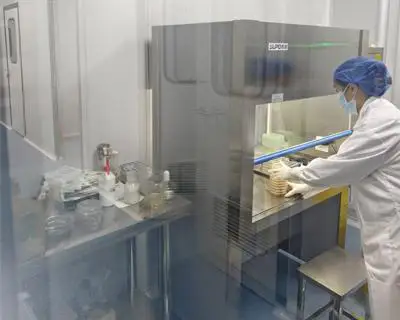
A manufacturer with its own lab can do three things: incoming material inspection (raw-material batch variation), outgoing QC (batch-by-batch inhibition-rate sampling), and custom development (formulation trials on your substrate). Without these, you may get batches that vary in quality.
How to verify a real lab? Two on-site checks: does it have mold incubators, laminar flow workstations and autoclaves (28°C ± 1°C, RH above 85%, 7-28 day incubation)? And will it let you bring your own material for a live test? A supplier confident enough to test your material on site usually has substance; one that only shows slides — be cautious.
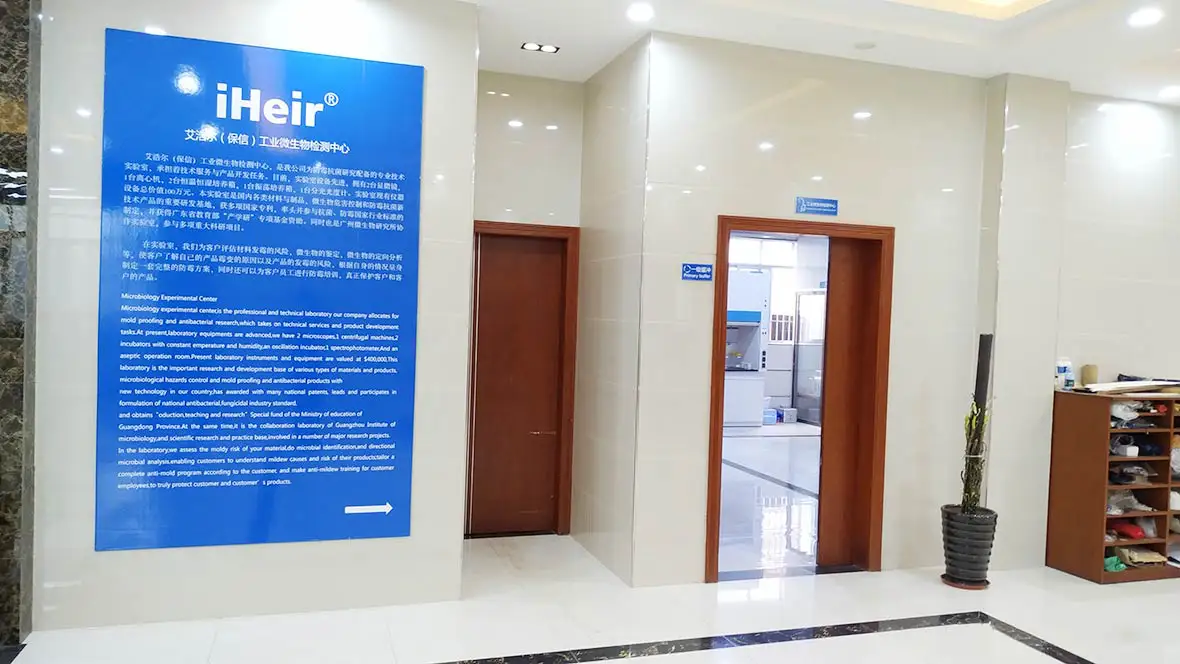
For reference, iHeir runs an industrial microbiology testing center and supports customer sample testing to GB/T 1741, AATCC 30 and ISO 22196, with initial results in 7 days — open testing itself is a screening signal. For how mold testing works, see How to Test for Mold? Testing Methods Guide.
Question 3: Can the formula be customized?
Different substrates demand very different agents: leather is sensitive to pH and discoloration, fabrics must keep hand-feel and color fastness, plastics and rubber must match processing temperature, and exports to the EU/US involve REACH and FDA compliance. A supplier selling one “universal agent” can rarely cover your case.
Ask three questions: Can they adjust concentration and solvent system for my substrate (PU leather, genuine leather, cotton)? Can they provide 2-3 gradient samples for my own line test? Do they support tuning odor, color and eco metrics? Three “yes” answers mean real R&D; three “the standard product is fine” answers mean you are buying repackaged trading goods.
Question 4: Does the “concentration” on the quote survive the math?
The root of the price trap is opaque active-content concentration. Two products both called “leather anti-mold agent”: Supplier A at 45% solids for USD 5.5/kg, Supplier B at 15% solids (diluted) for USD 2.2/kg — per unit of active ingredient, A is actually 34% cheaper.
Formula: real cost = unit price ÷ solids (or active content). Ask for the MSDS content declaration plus a third-party solids test, and write “arrival solids not below X%” into the contract. A furniture factory in Dongguan once bought “cheap” agent; 300 export sofas arrived moldy, and claims plus rework exceeded USD 110,000. Lab testing showed solids at only 60% of the declared value.
For substrate-by-substrate selection, cross-check How to Choose Industrial Anti-Mold Agents? Buyer’s Guide.
Question 5: After-sales — sell-and-run or side-by-side?
Mold prevention is a system; the chemical is only one link. Moisture content, warehouse RH, packaging and sea-freight conditions can all cause mold. A reliable manufacturer offers: loading quantity tables, warehouse humidity SOPs, and emergency rework protocols — sometimes on-site support.
A shoe factory in Wenzhou had a 2024 export batch stranded at port for 20 days in typhoon weather; 15% molded on opening. The supplier arrived the same day with iHeir-CM mold remover, reworked the molded pairs, re-sprayed protection and switched to moisture-proof packaging — cutting the loss from “full rejection” to “small-area downgrade.” That is a long-term partner. To tell product categories apart, see Mold Inhibitor vs Antimicrobial Agent; for rework products check iHeir-CM Mold Remover, and for routine protection iHeir-Spray Water-Based Anti-Mold Agent.
FAQ — Common Sourcing Questions
Q1: How long does sample testing take?
A: Basic antifungal testing takes 7-14 days (incubation); run substrate compatibility (discoloration/hand-feel) in parallel. Reputable suppliers offer free samples — confirm freight and MOQ first.
Q2: Do I need eco certifications?
A: Exports to the EU/US require attention to REACH and RoHS; food-contact items involve FDA or LFGB migration testing; Japan applies the Food Sanitation Law. Tell the supplier your target markets so reports match.
Q3: Can I buy the cheapest option?
A: Yes, but compare per-kg-of-active-ingredient, not per-kg of liquid; require arrival solids testing and write claim clauses into the contract.
Q4: How do I verify a report is real?
A: Look up the report number on the issuing lab’s website; call to confirm the applicant and sample description; be wary of reports without the lab’s contact details.
Q5: Manufacturer or distributor?
A: Go direct to manufacturers where possible — formulation, batch consistency and after-sales are stronger. If using a distributor, confirm written authorization and factory batch reports.
Ready to select an anti-mold agent supplier for your factory? Bring your substrate and testing requirements and contact us — we support test-first, order-later with data to back it up.