




 View Count:18
 Date:2026-09-14
The filter bags tested at 99% antibacterial rate in a third-party lab, yet two months in your own warehouse the surface shows black spots. This is one of the most frustrating complaint patterns for filter media converters and baghouse filter manufacturers: the QC manager holds a passing test report, purchasing holds the supplier’s promise, and the owner faces a rejection notice for a full container. Everyone feels wronged, and the dispute usually stalls because nobody separates two different questions. A lab test measures momentary performance under controlled conditions; warehouse survival over six months depends on fungus loading, process residue, and the microclimate in storage. This article walks through the mechanism first, then the process fixes, so nonwoven mills, filter media converters, and baghouse assemblers can each find their own entry point.
Why Hydrophobic Nonwoven Still Grows Mold
Polypropylene fiber contains nothing mold can digest, and the fabric is hydrophobic — on paper it should be a low-risk material. Three factors explain most field failures. First, the spore load is set before the roll leaves the line: drafting air on a spunbond line, recirculated water on a spunlace line, and dead corners of ovens on thermal-bond lines all press ambient mold spores into the fiber web. Spores are not mold spots yet, but they are waiting for the right conditions. Second, process additives feed the fungus: finish oils applied for hand and antistatic properties often contain long-chain fatty acid esters, and the laminating adhesives and coating thickeners added downstream are carbon sources as well. Third, the storage microclimate does the rest: day-night temperature swings condense moisture on the roll surface, and because PP is hydrophobic, that water migrates into the layer gaps and stays. Interlayer relative humidity above 80% for two days is enough for spores to germinate.
Here is a practical check for QC: when auditing outbound rolls, peel off the outer two wraps and inspect the inner layers — spots almost always start between layers. By the time mold is visible on the surface, the whole roll is usually compromised. The arithmetic is painful: a 500-meter roll of 300 gsm fabric at 1.6 meters wide carries a material cost above RMB 10,000, and a moldy roll is downgraded or scrapped in full.
Spunbond, Spunlace, Thermal Bond: Where to Add the Agent
Each web-forming process has a different dosing window, and adding at the wrong stage wastes money. Spunbond lines run at 300-500 meters per minute, too fast for uniform online spraying, so the mainstream options are blending an antibacterial masterbatch at the pellet stage or finishing the wound fabric afterward. Spunlace lines have a natural window: dose the circulating water with a measured feed of antibacterial agent and the water jets carry it into the web evenly — just re-test the working liquor every four hours, because the water treatment system consumes agent. Thermal bond (ES fiber), mostly used in hygiene products, goes the masterbatch route at 0.5-1.2%.
Post-finishing covers all three processes and needs no line modification, which makes it the default route for existing plants. iHeir-PG composite nonwoven antimicrobial agent was designed for exactly this: a water-based formulation compatible with padding, spraying, and foam application, and it also protects the adhesive layer in laminated nonwovens. Working liquor concentration starts at 1-2%. For hygiene-grade fabrics and wash-durable requirements, add iHeir-333 textile antimicrobial agent, whose quaternary actives bond to the fiber and keep above 90% antibacterial rate after 50 wash cycles.
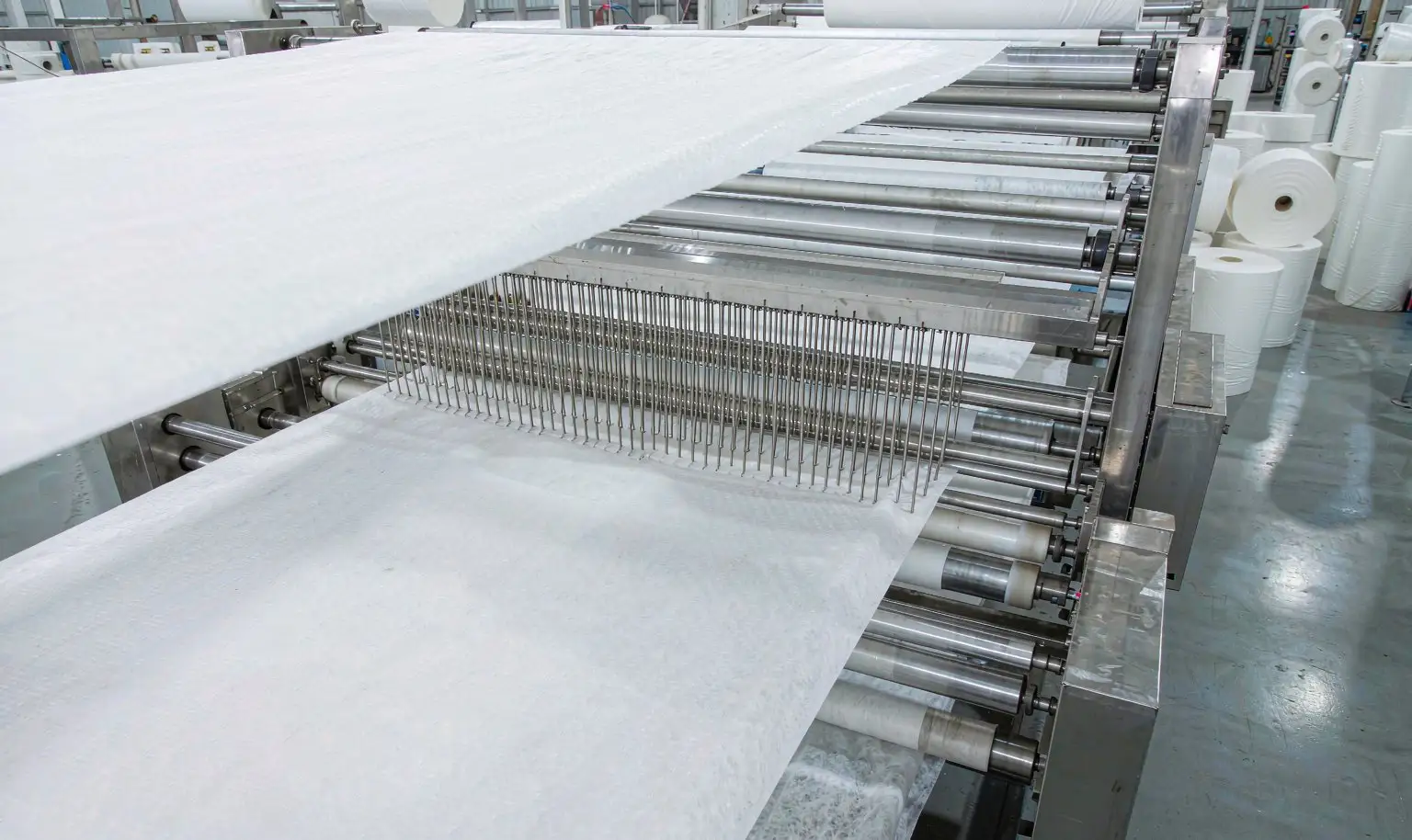
Baghouse Filters and Meltblown Media: Harsher Duty
Dust-collector filter bags live in a loaded gas stream, and their duty cycle makes hygiene-grade nonwoven look easy. Pulse-jet cleaning hits every bag with a reverse air pulse every few minutes; a finishing agent that is not well anchored loses its effect within three months. High-humidity service — waste incineration, biomass boilers, cement mill exhaust — puts the bag surface near the dew point, which is exactly where mold thrives; that is why bag blinding and mold spots tend to arrive together. Bag converters work on two levels: treat the fiber at the yarn-dipping or needle-punch stage for the base fabric, then dip-finish the sewn bags as a second pass. Temperature compatibility matters — standard polyester bags run at about 130°C continuous, so the agent’s heat window must cover the service temperature. We covered the yarn-stage mold prevention logic in an earlier article: the earlier the intervention, the stronger the foundation.
Meltblown media (filter cartridges, respirator layers, oil-absorbent pads) has the opposite constraint: an extremely fine web with huge specific surface, where any excess agent plugs pores and raises pressure drop. Practical settings: pad concentration 0.5-1%, drying below 110°C to avoid shrinking the web and dropping filtration efficiency, and a pressure-drop check on every batch — if differential pressure rises more than 5%, back the concentration down.
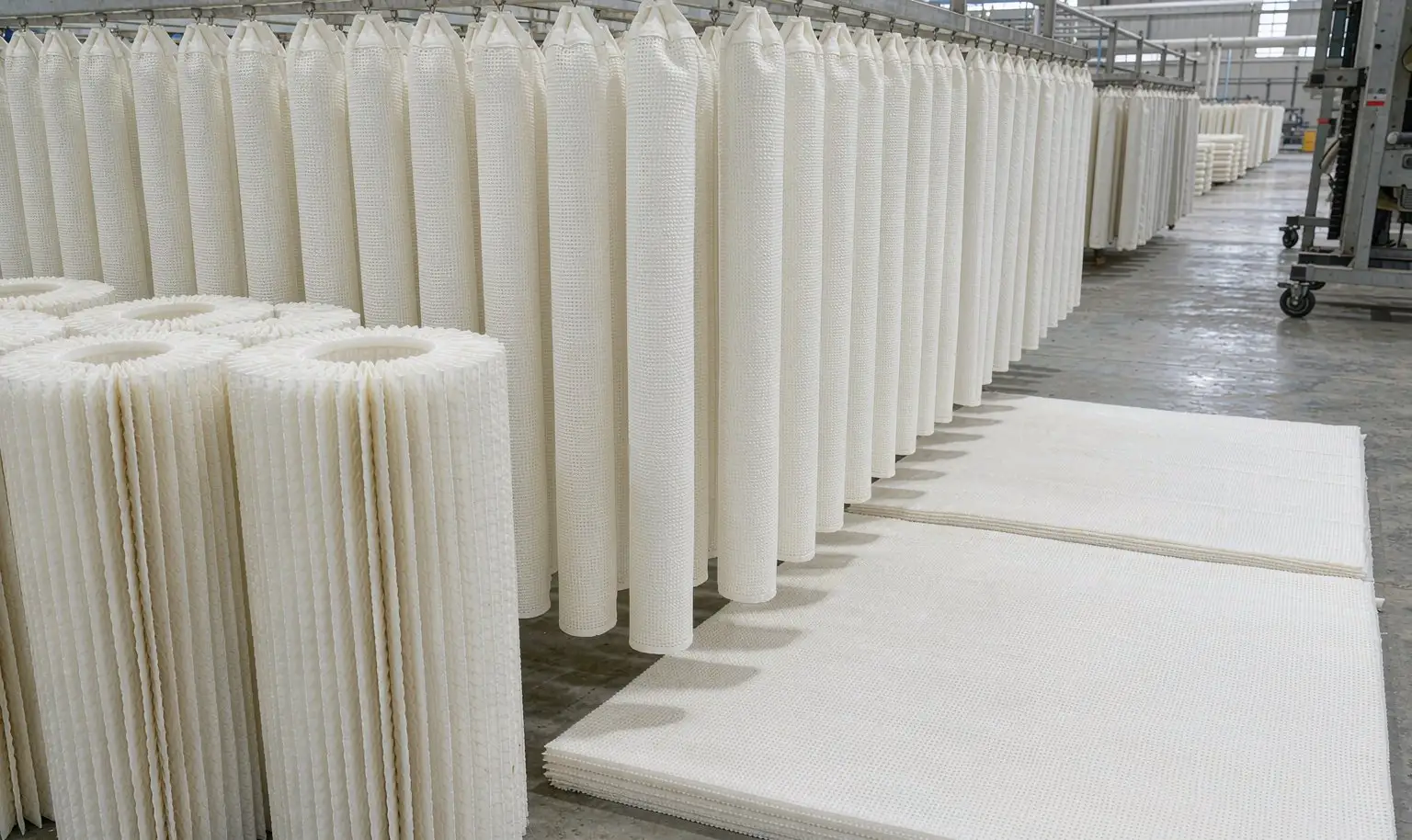
Packaging and Agricultural Cloth: The Low-Margin Arithmetic
Woven-bag liner fabric, furniture covers, and agricultural ground covers are high-volume, thin-margin products, and the purchasing question is blunt: what does the agent add per square meter? At 1-2% working liquor and 70% wet pickup, the added cost runs about RMB 0.15-0.30 per square meter, or 2-4% of factory price. Against that, one rejected export container for mold typically costs 30-100% of shipment value plus the customer relationship. Purchasing managers should frame the spend as insurance, not cost.
Agricultural cloth needs one extra layer of thinking: outdoor exposure means rain and soil contact, so pair the antibacterial agent with a triple-proof finish (water, oil, soil repellency). The combination logic in our outdoor textile water-repellent and anti-mold finishing article transfers directly. In storage, keep rolls on pallets at least 15 cm off the floor and 30 cm off walls with ventilation lanes between stacks; through the rainy season, pair dehumidifiers with T-1000 container desiccant sticks to hold warehouse humidity under 65%, which pushes mold probability down to a marginal level.
Padding, Spraying, or Foam Application
For process engineers, here is the comparison table. Padding (dip-nip): the most uniform route, for fabrics that tolerate water — liquor ratio 1:8-1:15, double dip double nip, wet pickup 60-80%, pre-dry at 100-110°C and cure at 120-130°C for 60-90 seconds. The downside is energy cost and unsuitability for water-sensitive laminates. Spraying: lowest capital and fast changeover, for single-side treatment and toll finishing — 2-3% working liquor at 30-50 g/m², and watch the selvage overlap, because mold loves the strip the gun missed. Foam application: the route for water-sensitive laminated nonwovens — foam blow ratio 1:8-1:12, add-on 20-40 g/m², almost no free water, so the lamination adhesive stays intact. The shared acceptance metric is anchorage: after 10 standard wash cycles, the antibacterial rate should drop no more than 10 percentage points.
The finishing schemes for made-up home textiles, including anti-mite combinations, follow the same parameters — see our antibacterial and anti-mite finishing guide and the textile anti-mold agent buying guide.
Testing, Storage Control, and FAQ
Two sentences for QC managers. First, test nonwoven antibacterial performance with GB/T 20944.3 (shake flask method), which reflects the porous structure of filter media far better than agar streaking; report anti-mold rating on the GB/T 24291 or AATCC 30 0-4 scale, where grade 0 (no growth) is the common export requirement. Second, pair the report with storage control: keep two retention samples per batch, one at ambient and one accelerated at 60°C/90% RH for 7 days. If the accelerated sample stays clean, six months of normal storage is a safe bet.
FAQ.
Does the agent hurt filtration efficiency?
Below 1% concentration with correct drying, meltblown pressure drop typically changes less than 3% and the efficiency grade holds.
Can a moldy roll be saved?
Surface spots respond to the clean-then-refinish workflow in our textile treatment guide, but rolls blackened between layers should be downgraded — the complaint cost of forcing them out exceeds the downgrade loss every time.
What humidity target for the rainy season?
One hygrometer per stack, target under 65%; if it drifts up, run dehumidifiers and add CH-10 anti-mildew drying and deodorizing packs inside the stacks. Get the three basics right — keep spores out, leave no nutrient source, keep humidity down — and a passing test report finally equals a mold-free warehouse.