




 View Count:29
 Date:2026-09-10
Suzhou Wedding Dress Mold Prevention: Silk & Lace from Cutting to Sea Freight
Huqiu bridal gown market in Suzhou and the Shengze silk base in Wujiang hold more than 70% of China’s mid- and high-end wedding dress and silk gown capacity—exporting to France, Italy, the US, and Southeast Asia. But the combination of “silk protein fiber + lace and bead trims + high moisture regain” is a perfect mold incubator—and the client’s first complaint on opening the container is always about “mildew spots,” “moldy smell,” or “stains.” This guide walks through five stages—silk pre-shrinking anti-mold, lace/bead accessory moisture control, finished-goods hanging warehouse, vacuum packaging, and export moisture barrier bag—for a zero-mold workflow.
1. Why Wedding Dresses Are Delicate — Silk Protein Fiber Properties
Silk (mulberry silk) is a natural protein fiber made of 18 amino acids and chemically close to human skin. This creates two consequences for the factory:
- Extremely high moisture regain: silk reaches 11% moisture regain (cotton 8%, synthetics 0.4%-4%); in 90%RH ambient it absorbs to saturation within 24h;
- Easily attacked by mold: protein is the nitrogen source mold spores need; once humidity goes above the threshold, mold penetrates the fiber surface in 7-14 days and creates color spots and odor;
- pH sensitive: silk loses 10%-30% tensile strength below pH 4 or above pH 9. Strong acid or strong alkali anti-mold agents will “burn” the fibroin and cause brittleness and yellowing.
Lace (nylon/polyester/cotton blend) and bead accessories are another mold source: lace mesh structure has 8%-12% moisture regain; the bead backing adhesive (PVA/PVC plasticizer) is mold’s favorite carbon source. Stack these three factors and add Suzhou’s plum-rain season (above 90%RH regularly), and wedding dress mold is virtually guaranteed.
Note: never apply acid, alkali, or chlorine-containing anti-mold agents to silk. You must use a neutral pH (6.5-7.5) textile anti-mold antimicrobial to avoid damaging the fibroin.
2. Fabric Incoming Inspection and Pre-Shrinking Anti-Mold
The Suzhou bridal factory incoming-fabric inspection has three steps:
- Moisture regain test: random sample 5 rolls per batch, use a halogen moisture meter to measure. Silk ≤11% is passing, >12% must be dried before storage;
- Pre-shrinking finishing: silk shrinks 3%-5% after water contact; run a low-temperature steam pre-shrink (80-90℃ ×10 min) before the cutting bed to eliminate later shrinkage that would deform seams;
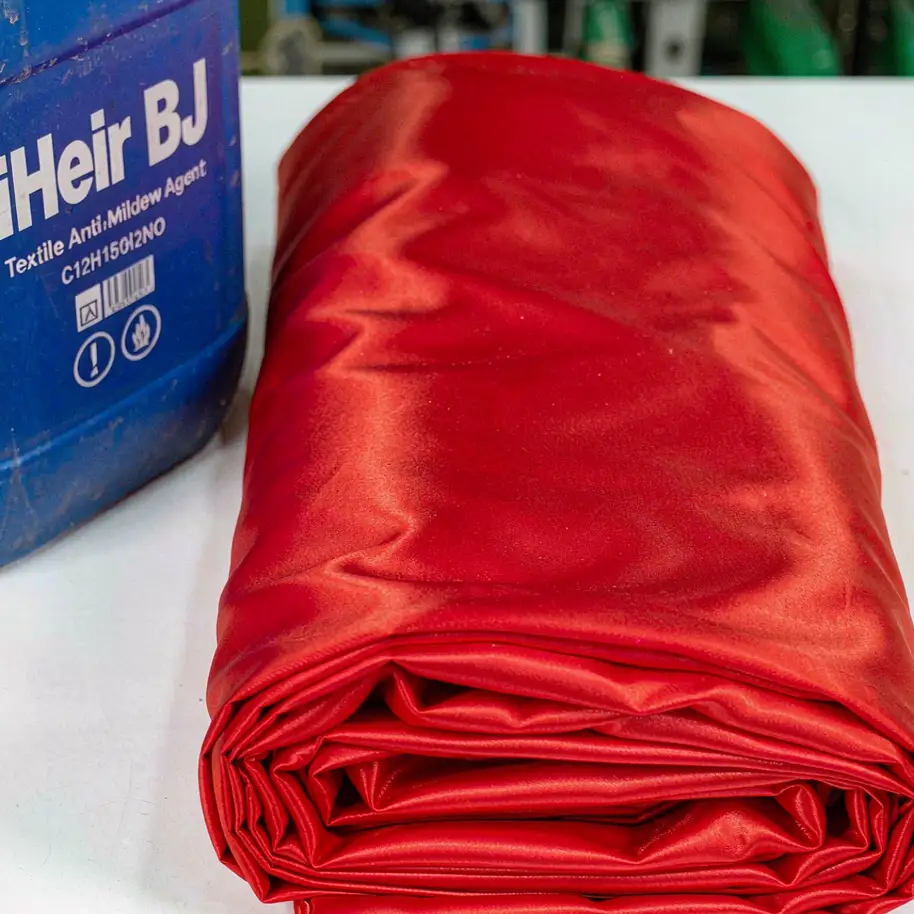
- Anti-mold pre-treatment: before storage, spray one pass of iHeir-BJ textile mildew inhibitor (neutral pH 6.5-7.5, 2%-3% owf) on the fabric and air-dry 30 min before stacking.
Field test: iHeir-BJ-treated silk tested per AATCC 30 (textile antifungal activity test, 28 days under humid incubation) delivered mildew grade 0-1 (no visible mold) versus grade 4-5 (severe mold) on the untreated control. No visible effect on colorfastness, hand, or fibroin tensile strength. Compliance with GB/T 24253-2009 antibacterial textile evaluation.
3. Lace / Bead Accessory Moisture Control
Lace and beads are the “trim trio” of a wedding dress and the most failure-prone accessory. Three control points:
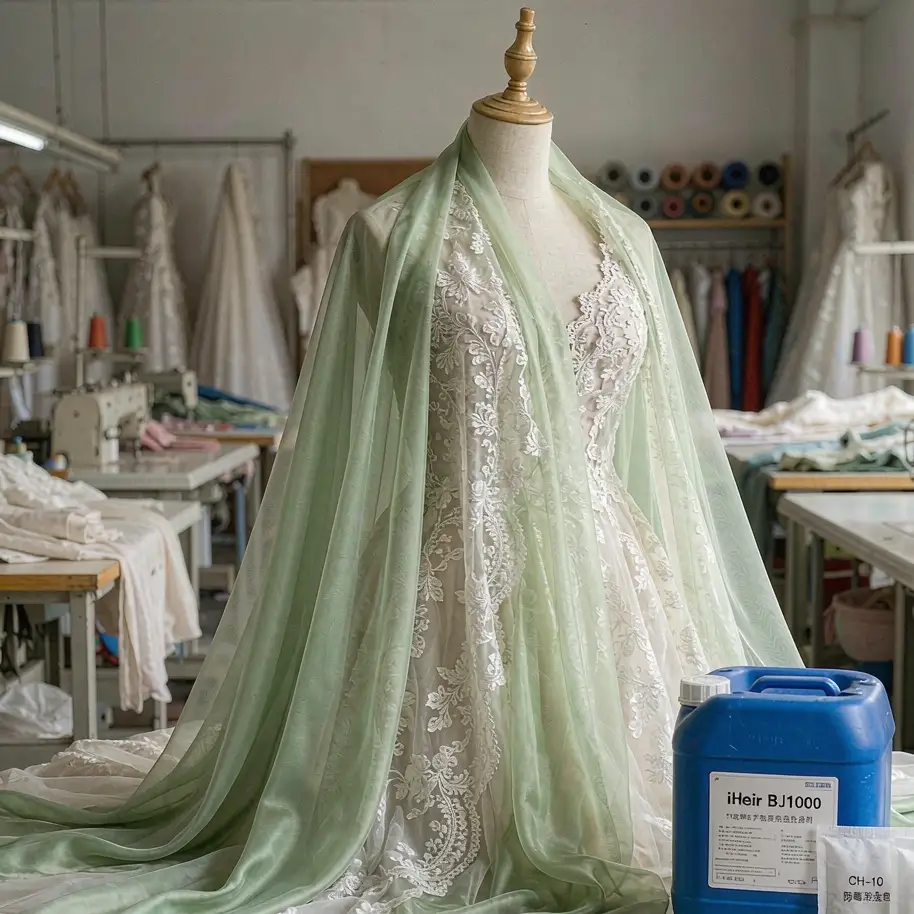
- Lace before storage: pad application with iHeir-BJ1000 silver-ion antimicrobial agent (neutral pH 6.5-7.5) 1%-2% owf, dry at low temperature 100-110℃ for 2-3 min (avoid high temperature damaging lace elastic);
- Bead backing adhesive: contains PVA/PVC plasticizer, which is mold carbon source. Choose “anti-microbial backing adhesive” at procurement (factory pre-loaded with iHeir antimicrobial) or spray iHeir-Spray (M3D) 1% concentration on the whole bead panel;
- Accessory warehouse humidity: store lace and beads separately; humidity threshold below 65%RH; start dehumidification at ≥75%RH.
4. Finished-Goods Hanging Warehouse and Vacuum Packaging
How the finished wedding dress (after sewing) is stored directly impacts mold probability. Recommended:
- Hanging warehouse: hang finished gowns on three-dimensional hangers; warehouse humidity threshold below 60%RH; temperature 18-22℃;
- Hanging-bag protection: cover each gown with a non-woven dust bag (breathable); do not use PVC bags (PVC contains plasticizer which is mold carbon source, and is non-breathable);
- Vacuum packaging: before long-distance transport, vacuum-seal each gown + place 1 Power Pak anti-mildew & deodorizing tablet inside the bag to suppress mold during transit;
- Batch records: each gown gets a batch ID tag with storage date + anti-mold treatment date for traceability.
5. Export Sea Freight: Moisture Barrier Bag + Desiccant Configuration
Wedding dresses export mostly by air freight (small batches, urgent orders) or sea freight (large batches, trade fair orders). The sea segment is where mold breaks out most often—container rain plus cross-ocean condensation plus a 25-45 day sealed transit. The standard mitigation:
- Vacuum bag + foil moisture barrier double-layer: vacuum-seal each gown then put it in a foil moisture barrier bag (blocks water vapor);
- Power Pak inside the bag: place 1-2 Power Pak anti-mildew & deodorizing tablets per gown bag—slow-release gas-phase anti-mold;
- Outer carton desiccant: stick one CH-10 anti-mildew drying & deodorizing pack (20 g each) on each inner wall of the corrugated outer carton—moisture absorption + anti-mold + deodorization triple function;
- Container desiccant sticks: 4-6 sticks per 20-foot container and 8-10 sticks per 40-foot container of T-1000 container desiccant stick—each stick can absorb more than 200% of its own weight;
- Pre-load drying: after gown-bag + vacuum-bag + outer-carton packing, hold 24h in warehouse for temperature equalization before container loading.
6. Inspection Emergency Response & Client Claim Handling + FAQ
Emergency response plan for wedding dress mold:
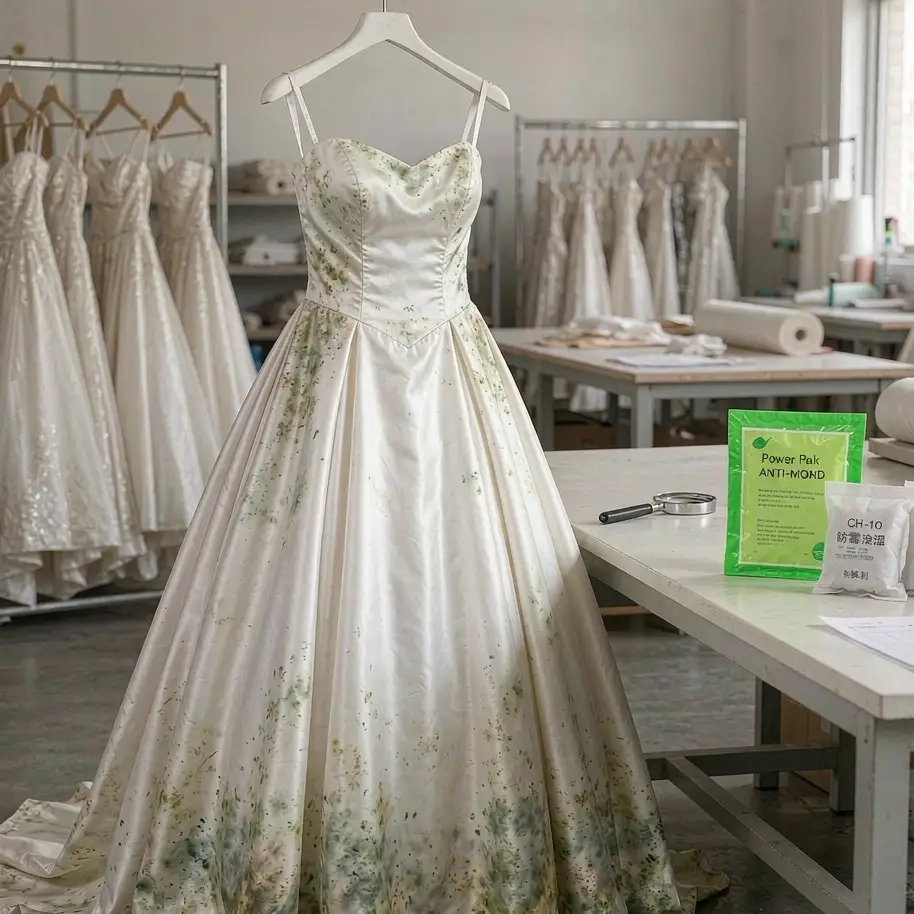
- Light mold spots (white powder mildew on the silk surface): hang in a ventilated area for 24h, then spot-clean with iHeir-Clean mold-spot cleaner (dilute to 1% for silk), air-dry and re-pack;
- Moderate mold (fabric discoloration): spray iHeir-CM mold remover diluted 5%-10% then air-dry 24h, finish with iHeir-Spray (M3D);
- Severe mold (fabric decay, strong odor): full return and report to insurance company.
Case: A Suzhou bridal factory received a mold claim of 180,000 EUR (about 1.4 million RMB) from a Paris buyer in 2024—on arrival 30% of the silk gowns showed mold spots on localized areas. Root cause: silk pre-shrink had no anti-mold finishing, lace had no antimicrobial treatment, finished warehouse humidity was at 78%RH, export vacuum bags did not contain Power Pak, and no T-1000 sticks were hung in the container. Corrective: all silk fabrics now get iHeir-BJ anti-mold after pre-shrinking, lace gets BJ1000, finished warehouse humidity threshold is 60%, every gown’s vacuum bag gets 1 Power Pak tablet, and every container gets 6 T-1000 sticks. Zero mold complaints since.
FAQ:
Q1: Can normal textile mildew inhibitors be used on silk?
A: No. Normal textile mildew inhibitors are often weakly acidic or alkaline and damage silk fibroin (pH sensitive), causing brittleness and yellowing. You must use a neutral pH (6.5-7.5) iHeir-BJ textile mildew inhibitor, and the supplier should provide a third-party “silk-compatible” test report.
Q2: Lace elastic yarn loses elasticity after treatment—what do we do?
A: Elastic yarn (spandex/Lycra) tolerates ≤110℃; keep finishing/drying temperature within 100-110℃ and time ≤3 min. iHeir-BJ1000 silver-ion antimicrobial can be dried at lower temperature (80-90℃) while maintaining antimicrobial activity.
Q3: How do we treat bead backing adhesive mold?
A: Light mold (white powder on backing surface): wipe with iHeir-Clean mold-spot cleaner and air-dry 24h. Moderate mold (backing discoloration): disassemble the bead panel and re-sew; discard the whole bead panel and update. Severe mold (backing decay): full return. Best procurement practice is to specify anti-microbial backing adhesive directly to eliminate the issue at source.
Q4: How many Power Pak tablets inside the wedding dress export vacuum bag?
A: 1-2 tablets per gown (vacuum bag size about 60×100 cm). For every 50% increase in bag volume, add 50% more Power Pak. Power Pak uses a mustard-extract formula; concentration inside the sealed vacuum bag is extremely low and volatilizes immediately after opening—safe for skin contact.
Q5: A client complains about wedding dress mold—how do we do emergency treatment?
A: First use iHeir-Clean mold-spot cleaner diluted to 1% (must dilute for silk) to wipe the spots, then spray iHeir-CM mold remover for 24h, and finish with iHeir-Spray (M3D). This emergency response package can cut return losses by 70%. For moderate mold (fabric discoloration), offer free refurbishment or refund.
Suzhou wedding dress and gown factories that want to build a systematic “zero-mold export pipeline” can contact us for sample testing and a customized plan. Standard products like iHeir-BJ textile mildew inhibitor (neutral pH silk grade), iHeir-BJ1000 silver-ion textile antimicrobial, CH-10 anti-mildew drying & deodorizing pack, and Power Pak anti-mildew & deodorizing tablet are in stock and ship same-day for small orders.