




 View Count:34
 Date:2026-09-10
Cixi Small Appliance Export Anti-Mold: Plastic Parts & Packaging Full Guide
Zhouxiang and Guanhaiwei in Cixi, Zhejiang concentrate over 60% of China’s humidifier, water purifier, electric kettle, and heater small-appliance capacity—annual exports exceed 20 billion RMB. The plastic shell + water-contact chamber + wire harness trio, however, is a perfect hidden home for mold during a 25-45 day sea-freight transit: filter cores grow mold, wire insulation gets moldy, plastic shells show mildew spots—and the client’s first complaint on opening the container is always about mold. This guide walks through five stages—shell plastic antimicrobial masterbatch, food-contact part antimicrobial, factory drying, warehouse humidity threshold, and sea-freight moisture—for a zero-mold Cixi small-appliance workflow.
1. Where Small Appliances Hide Mold — Water Tank / Filter Core / Wire Harness
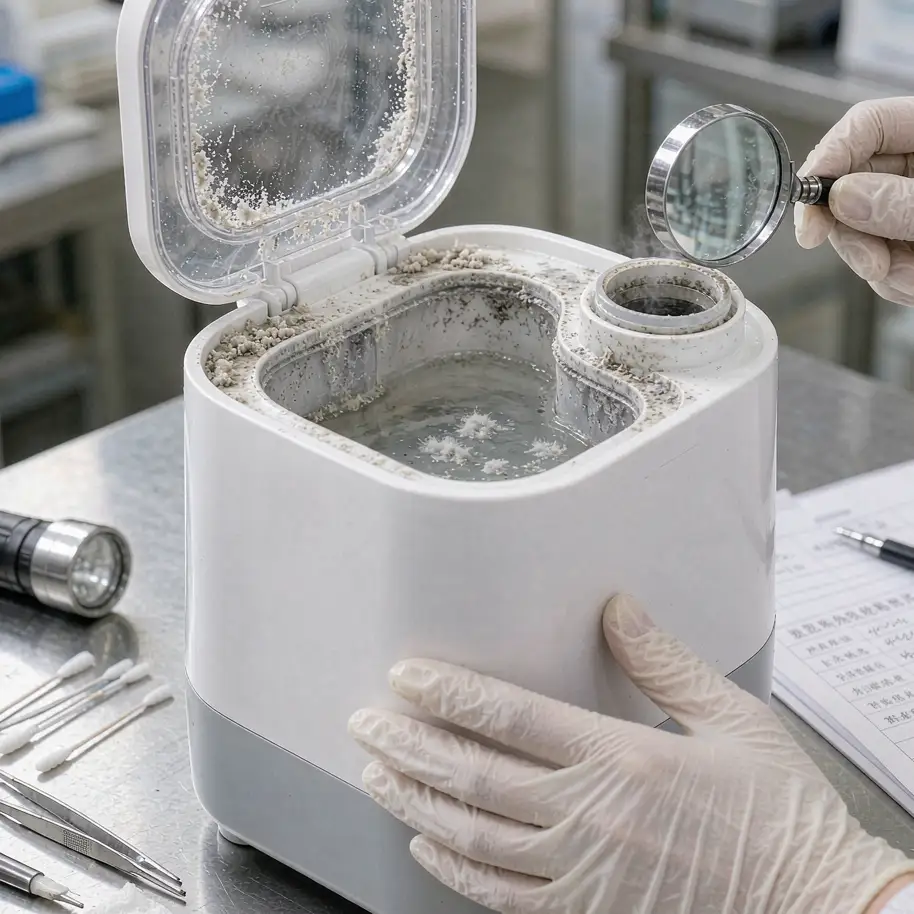
Most Cixi factory owners first receive a mold complaint puzzled because the packaged unit looked clean at shipment. The contamination hides in three invisible zones: the water tank/chamber, the filter core/mesh, and the wire harness. Humidifier and water purifier tanks retain 5%-10% residual moisture (less than 100 ml standing water) even after draining; during sealed transit this turns the inside of the chamber into a 95-100%RH microclimate where mold spores can establish colonies on PP/ABS plastic in as little as 14 days. Activated-carbon and PP-cotton filter cores contain both carbon source and residual nutrient salts in the activated carbon pores—perfect mold media. PVC wire insulation uses plasticizers (DOP/DEHP) plus a cotton braid layer as nitrogen source; once moldy it can cause shorts and even fire risk. Stack these three hiding spots and add Cixi’s humid spring (relative humidity above 85%RH regularly), and mold becomes inevitable. The variable is timing—30 days of use or 90 days. The fastest check is finished-goods moisture regain: above 0.5% on the plastic shell or 10% on the packaging carton demands immediate action; ambient humidity above 75%RH sustained requires a dehumidifier.
2. Shell Plastic Antimicrobial Masterbatch vs. Spray Coating
Many small Cixi factories still rely on a post-production spray for plastic shell antimicrobial protection—durability is poor and the effect drops to near zero within 3 months. The correct approach is to load antimicrobial masterbatch into the plastic formulation at the source.
| Process | Antimicrobial masterbatch | Loading/spray concentration | Process point | Result |
|---|---|---|---|---|
| Injection (PP/PE shell) | iHeir-ECO plastic antimicrobial | 1%-2% | Premix with raw material at 180-220℃ | ISO 22196 activity ≥3.0, 5+ years effective |
| Injection (ABS/PMMA shell) | iHeir-IPI silver-ion inorganic antimicrobial | 0.5%-1.5% | Premix at 200-230℃ | ISO 22196 activity ≥3.0, food-contact grade |
| Spray (finished shell) | iHeir-Spray (M3D) water-based antimicrobial | 1%-2% | Spray on finished shell, dry 60-80℃ ×10 min | 3-6 months short-term, not recommended for export |
Field test: iHeir-ECO antimicrobial ABS shells tested per ISO 22196 (antibacterial activity on plastics, 24h bacterial contact) on Staphylococcus aureus ATCC 6538 and Escherichia coli ATCC 8739 both delivered activity values ≥3.0 (kill rate ≥99.9%). The control shell without masterbatch saw bacterial counts multiply over 1000-fold within the same window.
Key: PP/PE use ECO (rated 220℃); ABS/PMMA use IPI (rated 230℃). Spray coating is only a remedial measure, not recommended for long-term export orders.
3. Food-Contact Parts (Humidifier / Water Purifier) Compliance
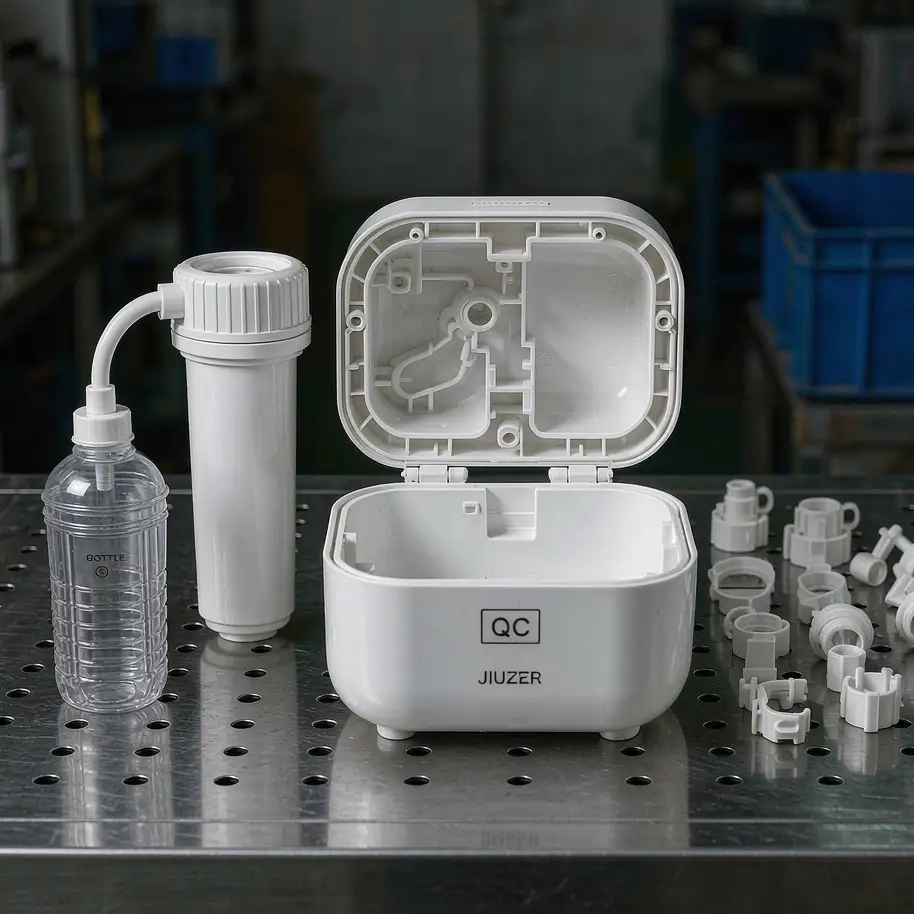
Food-contact parts (parts that directly contact drinking water or domestic water) carry extra regulatory requirements: FDA 21 CFR (US), LFGB (Germany), and GB 4806.7 (China). The selection logic Cixi factories use:
- Water tank / chamber: must use iHeir-IPI silver-ion inorganic antimicrobial 0.5%-1.5% injection molding; passes FDA 21 CFR 175.300 and LFGB Section 30/31;
- Filter housing / water-path connectors: same iHeir-IPI; avoid organic antimicrobials (PSE, QAS);
- Sealing / silicone rings: use iHeir-GG907 silicone-rubber antimicrobial paste (indirect water contact); avoid iHeir-QF anti-mold paste (contains acidic components);
- Water-path cleaning: before shipping, flush 3 times with water and dry at 60℃ for 30 min to ensure chambers are dry before packaging.
Note: every food-contact part antimicrobial must carry an FDA 21 CFR / LFGB food-contact compliance report; do not purchase from factories missing it. Cixi each year sees small factories losing whole containers to German customs due to missing LFGB reports, plus the claim cost.
4. Packaging: Color Carton Moisture Control & Container Desiccant
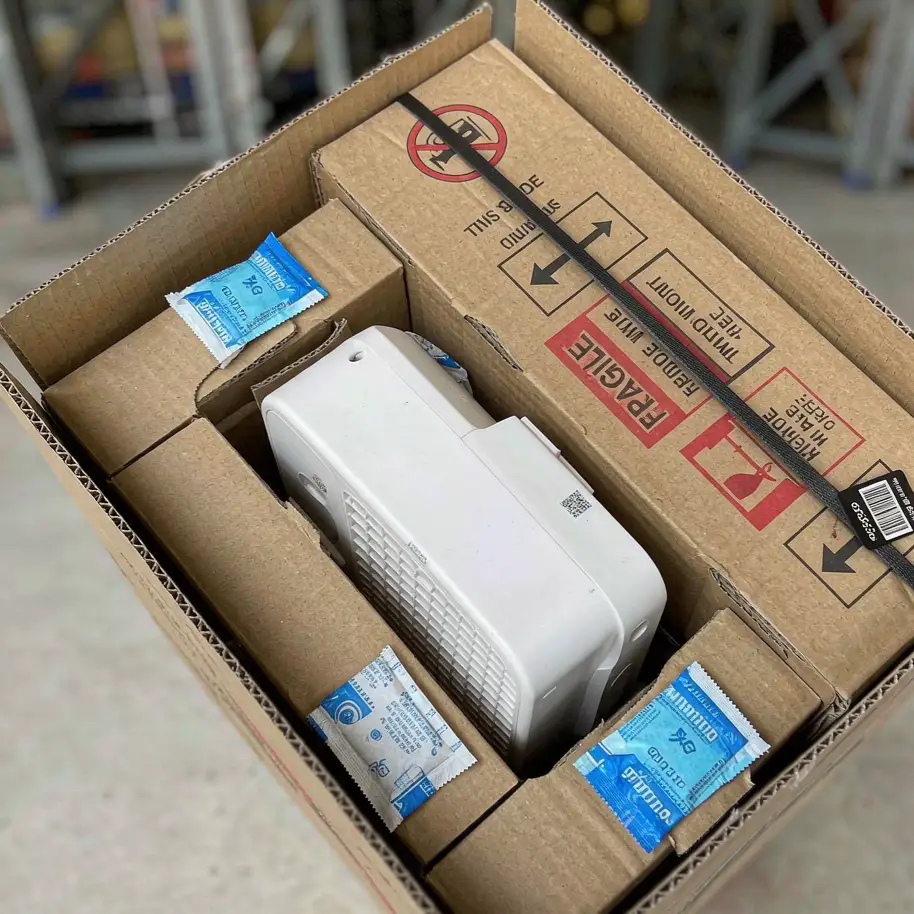
Cixi small appliances typically use a double-layer packaging: color-printed inner carton + corrugated outer carton. The color carton itself is a nutrient source for mold (paper fiber + ink-starch adhesive); 25-45 days of sea transit almost guarantees mildew. The standard mitigation:
- Place one CH-10 anti-mildew drying & deodorizing pack (5-10 g) inside each color carton—combines moisture absorption + anti-mold + deodorization;
- Wrap each color carton with one layer of iHeir anti-mold packaging paper for a physical moisture barrier;
- Stick 4-6 silica gel desiccant sachets (10 g each) on the four inner walls of the corrugated outer carton;
- Hang 4-6 T-1000 shipping container desiccant sticks per 20-foot container before loading—each stick absorbs 2-3 kg of moisture;
- Seal container door seams with waterproof tape to block sea-spray intrusion.
Field case: A Cixi humidifier factory exported a 40-foot container to the US in 2024 without T-1000 sticks; on arrival 30% of color cartons showed mildew and 5% of humidifier tanks grew mold inside. The corrective batch added 8 T-1000 sticks per container plus 1 CH-10 pack per carton—zero mold complaints on arrival.
5. Cixi Appliance Factory Warehouse Humidity Management
The humidity threshold for a Cixi small-appliance finished-goods warehouse is below 60%RH. Many small factories do not even have a humidity meter, let alone a dehumidifier—this is the common cause of “shipped clean, arrived moldy” complaints. A directly reproducible SOP:
- Install an electronic temperature-humidity meter in the finished-goods warehouse; log daily;
- Start dehumidification at ≥65%RH; investigate any water leak source at ≥75%RH;
- Stack finished goods with at least 30 cm spacing between units and at least 50 cm from walls, for airflow;
- Run a blank PDA plate exposure test monthly: place 3 open PDA plates in the warehouse for 1 hour then incubate for 3 days; ≤5 CFU/plate is passing.
6. Certification (FDA / LFGB Food-Contact / ISO 22196) + FAQ
Two certification categories matter most for small-appliance export:
- Food-contact compliance: US FDA 21 CFR 175.300, German LFGB Section 30/31, China GB 4806.7—mandatory for food-contact parts;
- Antimicrobial performance: ISO 22196 (antibacterial activity on plastics), JIS Z 2801 (Japan, equivalent), GB/T 31402 (antibacterial activity on plastic/textile)—required when making antimicrobial claims.
Case: A Ningbo small-appliance contract factory received an FDA inspection failure notice from a US client in 2024—the humidifier tank’s antimicrobial masterbatch supplier could not provide an LFGB report, and 8,000 machines were returned. Loss: about 650,000 RMB. The corrective switch to iHeir-IPI silver-ion inorganic antimicrobial (with full FDA 21 CFR + LFGB documentation) passed FDA inspection on the first 5,000-unit batch and has stayed complaint-free for six months.
FAQ:
Q1: Does adding antimicrobial masterbatch to small-appliance plastic shells affect appearance color?
A: At proper loading (≤2%) there is no meaningful effect. iHeir-ECO is a white powder; the post-loading color shift ΔE is ≤0.5, almost invisible to the eye. iHeir-IPI silver-ion antimicrobial is a faint yellow but at ≤1.5% loading keeps ΔE ≤1.0; dark plastics (black/gray) show no visible change.
Q2: How do we get FDA 21 CFR compliance for food-contact part antimicrobials?
A: The antimicrobial itself must hold a third-party FDA 21 CFR 175.300 test report (extractives ≤limits), and the plastic substrate must be on the FDA Food Contact Substance (FCS) notification list. iHeir-IPI series come with full FDA 21 CFR + LFGB + GB 4806.7 compliance documentation and can be exported to the US, Germany, and China directly.
Q3: How much CH-10 anti-mildew drying & deodorizing pack goes inside a color carton?
A: 5-10 g per carton (small-appliance color carton about 30×20×15 cm). For every 50% increase in carton volume, increase CH-10 by 50%. We recommend placing one Power Pak anti-mildew & deodorizing tablet at the carton opening as a second line of defense (kept inside the color carton only, not touching the appliance).
Q4: Warehouse humidity is above 80%RH but the client wants to pick up the goods urgently—how do we manage?
A: Temporary measures—drop warehouse air-conditioning to 20℃ (which will lower humidity to 50%RH) plus force-run a dehumidifier for 12h; add 1 CH-10 pack per outer carton and 8 T-1000 sticks inside the container. Communicate with the client about a 24-48h delay to avoid mold claims.
Q5: Small appliances are mold on arrival—how do we do emergency treatment?
A: Light mold (white powder on color carton surface): remove and clean with iHeir-Clean mold-spot cleaner, air-dry 24h. Moderate mold (spots on plastic shell): spray iHeir-CM mold remover then apply iHeir-Spray (M3D) for ongoing protection. Severe mold (interior chamber mold): full return. Emergency response can cut return losses by 70%.
Cixi small-appliance factories that want to build a systematic “zero-mold export pipeline” can contact us for sample testing and a customized plan. Standard products like iHeir-ECO plastic antimicrobial, iHeir-IPI silver-ion inorganic plastic antimicrobial, T-1000 shipping container desiccant stick, and CH-10 anti-mildew drying & deodorizing pack are in stock and ship same-day for small orders.