




 View Count:28
 Date:2026-09-11
Haining Leather Factory Anti-Mold: Garment & Upholstery Leather Process Control
Haining, known as China’s leather capital, is home to more than ten thousand leather garment, upholstery leather and automotive leather manufacturers. Genuine leather jackets, sofa leather and car-seat leather shipped from here reach Russia, Europe and North America every week. Yet leather is one of the most mold-prone materials in existence: the hide itself is animal protein, while fatliquoring agents and finishing pastes are a ready food supply for fungi. Every rainy season, factories open their warehouses to find white and green mold colonies spreading across hide rolls. One buyer complaint of “musty odor and mold spots on arrival” can mean rework, rejection, or a full-container claim. This article lays out a workable zero-mold process across five stages: tanning/fatliquoring, crust storage, finishing, cutting & sewing, and export containers.
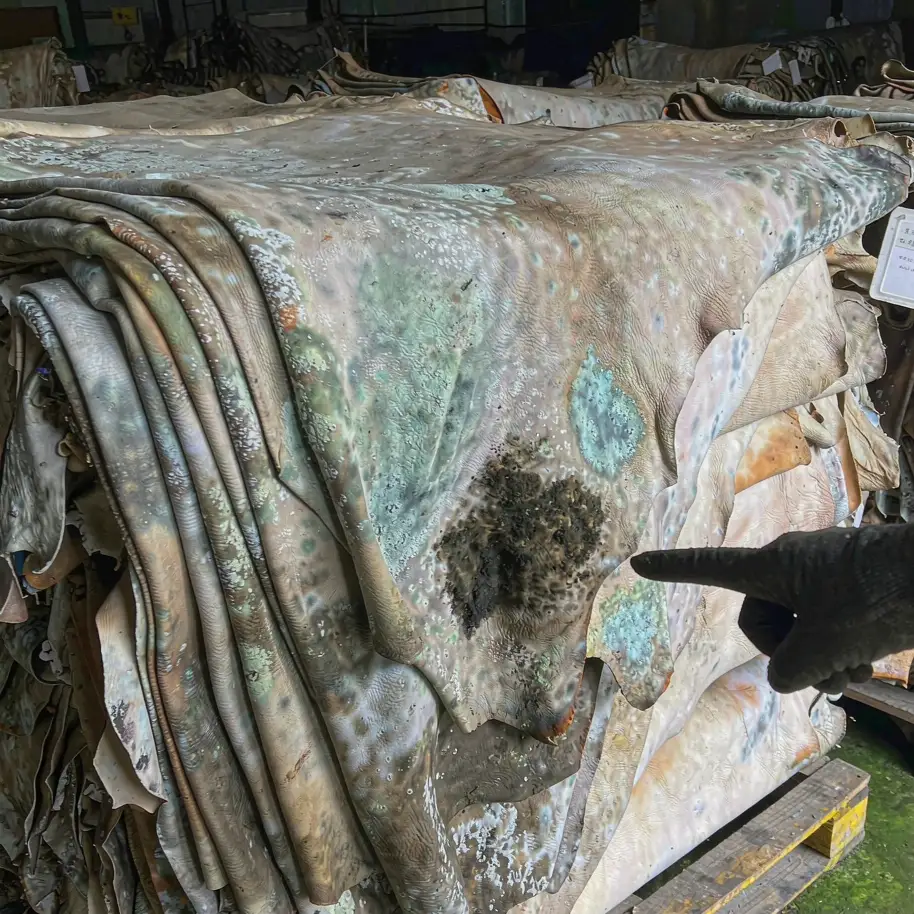
1. Why Leather Molds: Collagen Plus Fatliquor Equals a Fungus Buffet
Genuine leather is a mat of collagen fibers, and collagen is rich in nitrogen — an ideal nutrient for mold. On top of that, tanneries add fatliquors (sulfated oils, synthetic esters) to soften the leather and casein and wax emulsions in finishing pastes, both packed with carbon. With nitrogen and carbon together, fungi have a complete diet, and mold growth becomes only a matter of time:
- Humidity threshold: at 75% RH or above sustained for 3–5 days, the water activity on the leather surface rises above 0.7 and spores of Penicillium and Aspergillus begin to germinate;
- Temperature window: fungi are most active between 20–35°C — exactly the overnight temperature range in Haining during the June–July plum-rain season;
- What mold looks like: early stage, white powdery spots (easy to mistake for salt bloom); mid stage, green and black patches with a sour, musty smell. Once mold penetrates the grain layer, even successful cleaning leaves permanent discoloration.
A common mistake is confusing mold with “fatty spue”. Spue is white wax-like bloom from saturated fats migrating to the surface; it wipes off and does not return. Mold is a living colony — wipe it and it grows back in the same spot within 48 hours. A quick test: place a drop of water on the white patch. Spue makes the bead roll off; mold absorbs and spreads. If in doubt, treat it as mold.
2. Tanning and Fatliquoring: The Best Point to Add Anti-Mold Agent
The cheapest and longest-lasting protection is built into the leather during wet-end processing, not bolted on after mold appears. Three dosing points:
- After liming and unhairing: the pelt is most receptive. Add iHeir-PF leather antimicrobial agent at 0.3%–0.5% (based on shaved weight) into the pickling bath so it penetrates uniformly with tanning;
- During fatliquoring: dose iHeir-PF together with the fatliquor at 0.2%–0.4%. The active ingredient deposits on the fiber surfaces along with the oil, forming a protective film — this is the most durable point, giving finished leather 12+ months of protection;
- Final fixation bath: for export orders, add a 0.2% iHeir-PF topping bath to reinforce surface protection.
Test data: one batch of crust was split into two groups — the treated group received 0.3% iHeir-PF at fatliquoring, the control received none. Evaluated under AATCC 30 (28-day fungal resistance protocol): the treated group scored grade 0 (no visible mold); the control scored grade 3–4 (30%–60% of the surface colonized). Bursting strength, tear strength and elongation showed no statistically significant difference — hand feel and coating adhesion are unaffected.
Remember that this in-leather protection is the foundation for downstream defense: the finished-sofa measures described in our genuine leather sofa anti-mold guide assume the crust itself was treated. Both ends together push risk to zero.
3. Crust Storage: Stacking Discipline Beats Dehumidifiers
Crust leather after shaving still holds 55%–65% moisture — it is effectively a large water reservoir, and careless storage guarantees mold. Four rules:
- Off floor, off walls: pallets raised at least 15 cm off the floor and 30 cm from walls to block rising damp;
- Aisle spacing: keep 20 cm ventilation gaps between stacks. The still, humid air trapped when two stacks sit face-to-face is the single most common mold hot spot;
- Monitoring: at least two thermo-hygrometers per warehouse at 1.5 m height. Red line is 65% RH; at 70% RH, start dehumidifiers or ventilation immediately;
- FIFO: keep crust inventory under 30 days; any batch over 60 days must be re-inspected for mold before shipment.
4. Finishing and Surface Protection of Finished Leather
Finishing is the last line of defense. Do two things: build fungus resistance into the topcoat itself, and spray a water-based protective layer on finished leather destined for export.
- In-topcoat dosing: add 1%–2% antimicrobial additive into the topcoat/hand-feel paste so the coating itself inhibits growth;
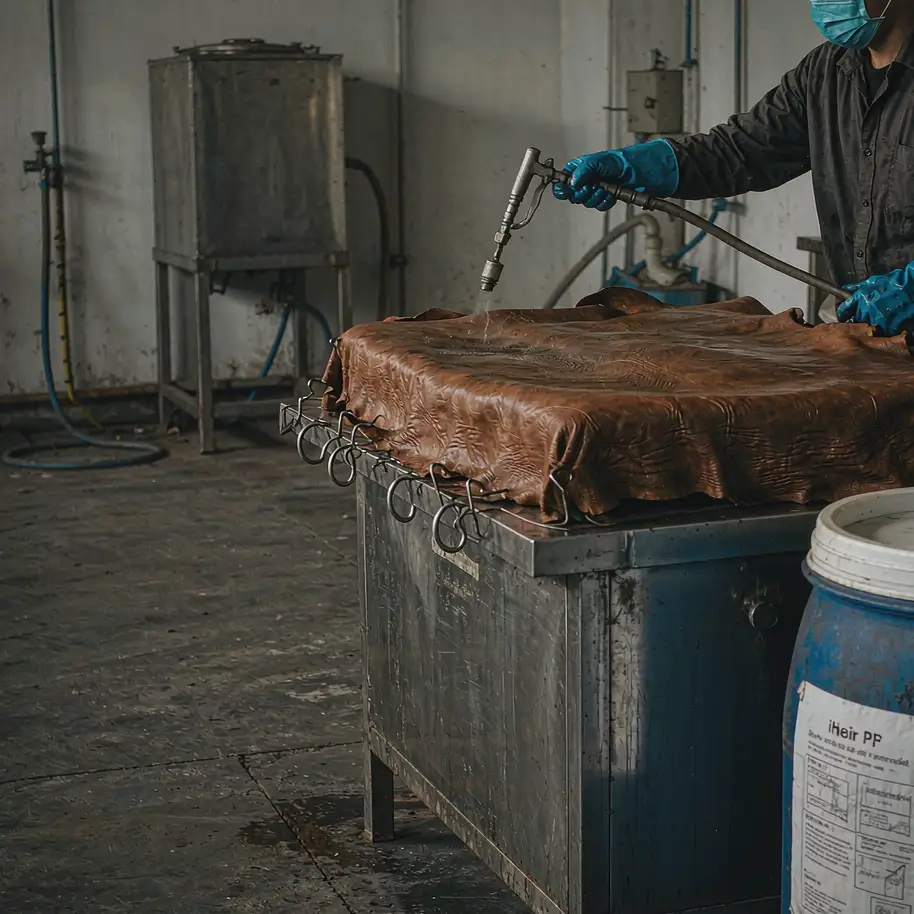
- Surface spray: before cutting and sewing, spray finished leather with iHeir-Spray (M3D) water-based anti-mildew agent diluted 1:10, from 30 cm distance at roughly 20–30 ml per square meter, then dry 30 minutes. M3D is water-based — it does not change gloss or feel and does not interfere with stitching or cementing;
- The blind side: many factories spray only the grain side and skip the flesh side, which is rougher, more absorbent, and usually molds first. Spray both sides.
Shoe and leather-goods factories can apply the same approach — see the Wenzhou leather shoe factory anti-mold guide for the lasting-to-carton process. For PU and synthetic leather, the logic is slightly different; read the PU & synthetic leather anti-mold guide.
5. Cutting and Sewing: The Human Factor Everyone Ignores
Turning hides into finished garments or sofa panels involves cutting, splitting, sewing and lining — hours of human handling in workshops whose conditions decide the microbial load shipped out:
- Clean tables: wipe cutting tables daily with diluted neutral detergent; mop floors and tables weekly with iHeir-Clean mold spot cleaner at 1:20 to kill residual spores;
- No work-in-progress overnight: cut pieces go to sewing the same day; sewn panels go into garment bags the same day. Panels left out overnight absorb moisture;
- Workshop humidity: hold sewing areas at 55%–65% RH; run dehumidifiers 24/7 through the rainy season;
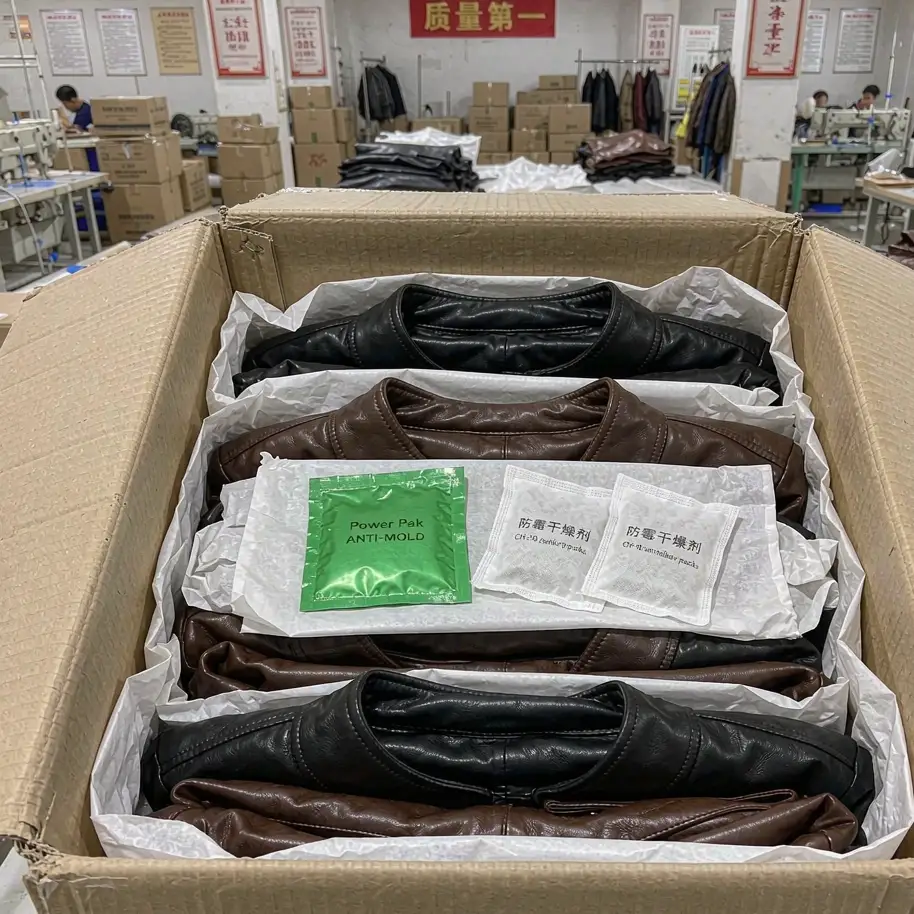
- In-bag protection: place one Power Pak anti-mold & deodorizing tablet in each garment bag (mustard-extract slow-release formula; renders the bag fungus-free within 72 hours; safe for leather, hardware and lining alike).
For fur-integrated and down products, storage windows are even tighter — see the fur & down warehouse anti-mold guide; tighten the humidity red line by another 5 points.
6. Export Containers and Mold Recovery + FAQ
Sea freight is where everything you prevented so far can unravel: 25–45 days sealed, day-night condensation cycles, trapped humidity. Container protocol:
- Carton plus moisture bag: line each export carton with a PE moisture-barrier bag; drop 1–2 Power Pak tablets before sealing;
- Container desiccant: hang 6 T-1000 container desiccant sticks per 20-ft container (10–12 per 40-ft; each absorbs over 200% of its own weight), distributed evenly on the wall hooks;
- Timing: load on dry mornings, never in rain or at night when ambient humidity peaks; close doors promptly after loading.
Case study: A Haining leather garment factory shipped 4,200 genuine leather jackets to Moscow in 2024. On arrival the buyer found green mold on about 15% of the jackets, mostly at cuffs and hem lining, and filed a claim of roughly RMB 860,000 including penalties. The post-mortem found three failures: crust warehouse humidity had been running at 78% RH with no intervention; no M3D surface spray before packing; only 2 desiccant sticks per container. After rectification — 0.3% iHeir-PF at fatliquoring, 1:10 M3D on both sides, a 65% RH red line in storage, and 6 T-1000 sticks per container — the factory has shipped five consecutive orders with zero mold complaints.
FAQ:
Q1: The leather already has mold spots. Can it be saved?
A: Light mold (white powder): wipe with iHeir-Clean mold spot cleaner diluted 1:5 using a soft cloth in one direction, air-dry 24 hours, then re-spray M3D 1:10 to prevent recurrence. Moderate to severe mold (green-black, grain penetrated): downgrade, or cut away the affected area — discoloration will remain. Any cleaned leather must be quarantined for a week and confirmed mold-free before returning to stock.
Q2: Will iHeir-PF in the fatliquoring bath affect oil uptake or hand feel?
A: No. iHeir-PF is compatible with anionic and nonionic fatliquors; at 0.2%–0.4% it does not measurably change uptake, bursting strength or elongation. Always run a small trial first, since fatliquor formulations vary between suppliers.
Q3: How do I quickly tell white spue from mold?
A: Three methods. Water-drop test (bead rolls off = spue; absorbs and spreads = mold). Magnifier test (visible filaments = mold). Re-growth test (returns in 48 hours at the same spot = mold). During rainy season, default to treating white deposits as mold.
Q4: Any ingredient restrictions for leather exported to Europe?
A: Watch DMF (dimethylfumarate) — banned under EU REACH for consumer anti-mold use. Power Pak and iHeir-PF are DMF-free and REACH-compliant; request the test reports from your supplier to hand over at buyer inspection.
Q5: A sofa-leather customer just filed a mold complaint. What now?
A: Get photos and grade the damage: surface white mold is handled with iHeir-Clean 1:5 wiping and drying; dark mold in the grain calls for local refinishing or panel replacement. Then immediately audit same-batch stock and any containers in transit — goods from the same environment are likely affected, and proactive replacement costs far less than complaint-by-complaint firefighting.
Want a systematic zero-mold pipeline from tanning to container? Contact us for sample testing and a tailored plan. iHeir-PF leather antimicrobial agent, iHeir-Spray (M3D) and Power Pak anti-mold tablets are in stock and ship same-day for small orders.