




 View Count:15
 Date:2026-10-21
How is mould prevented on a stainless steel sink? Not on the steel. Every spot lands on the ring of sealant around the drain and on the damping pad bonded to the base, and two months in a warehouse is enough for the joint to go black and the batch to fail a visual inspection. The sealant carries iHeir-JS glue mildew inhibitor at 1.0%-2.0% of the glue weight, and the pad carries iHeir-FP foam antimicrobial agent at 0.5%-1.5% before foaming. This article gives both addition points, the curing conditions and the inspection line for export.
1. Sink mould only appears in three places, and the steel is never one
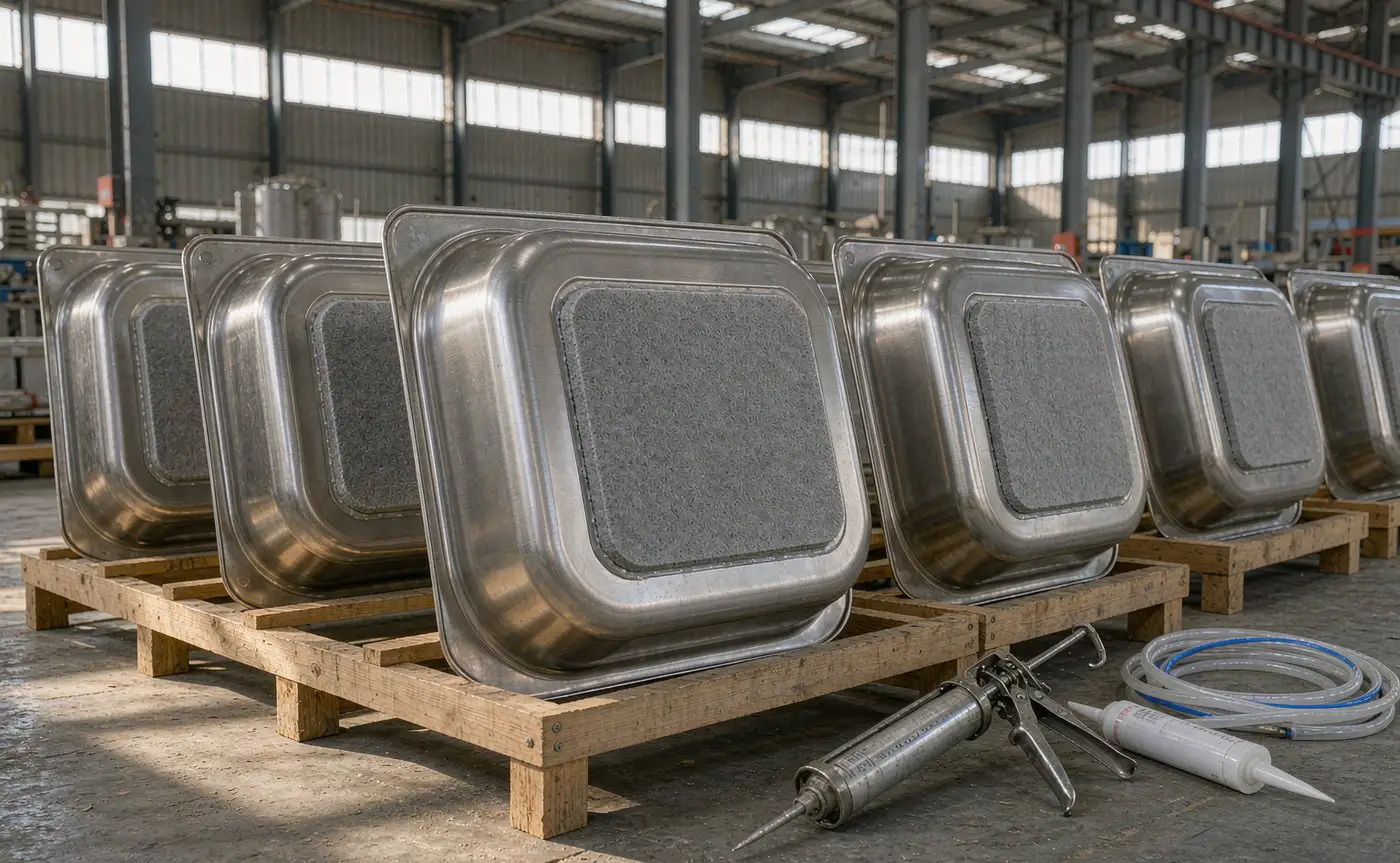
The stainless bowl is metal and mould cannot hold on it. The real footholds are three: the bead of sealant around the drain flange, an organic compound sitting in residual water and detergent under a thin oil film; the damping pad on the base, never in light or air, where water collects at its edge; and the drain connection with the overflow, where water stands in the thread and the washer gap.
All three have the same character: none of them is steel, all of them are polymer or a crevice, and all of them sit where the sink cannot dry after washing. So the logic is not to spray something onto the steel. It is to build the active into the sealant and into the foam, so the material itself holds out for its whole service life.
2. Sealant and damping pad: stages, products and addition levels
The table lines up both locations with their addition point, dose and criterion, ready to be used as a process card.
| Location | Material | Addition point and level | Criterion | Points to watch |
|---|---|---|---|---|
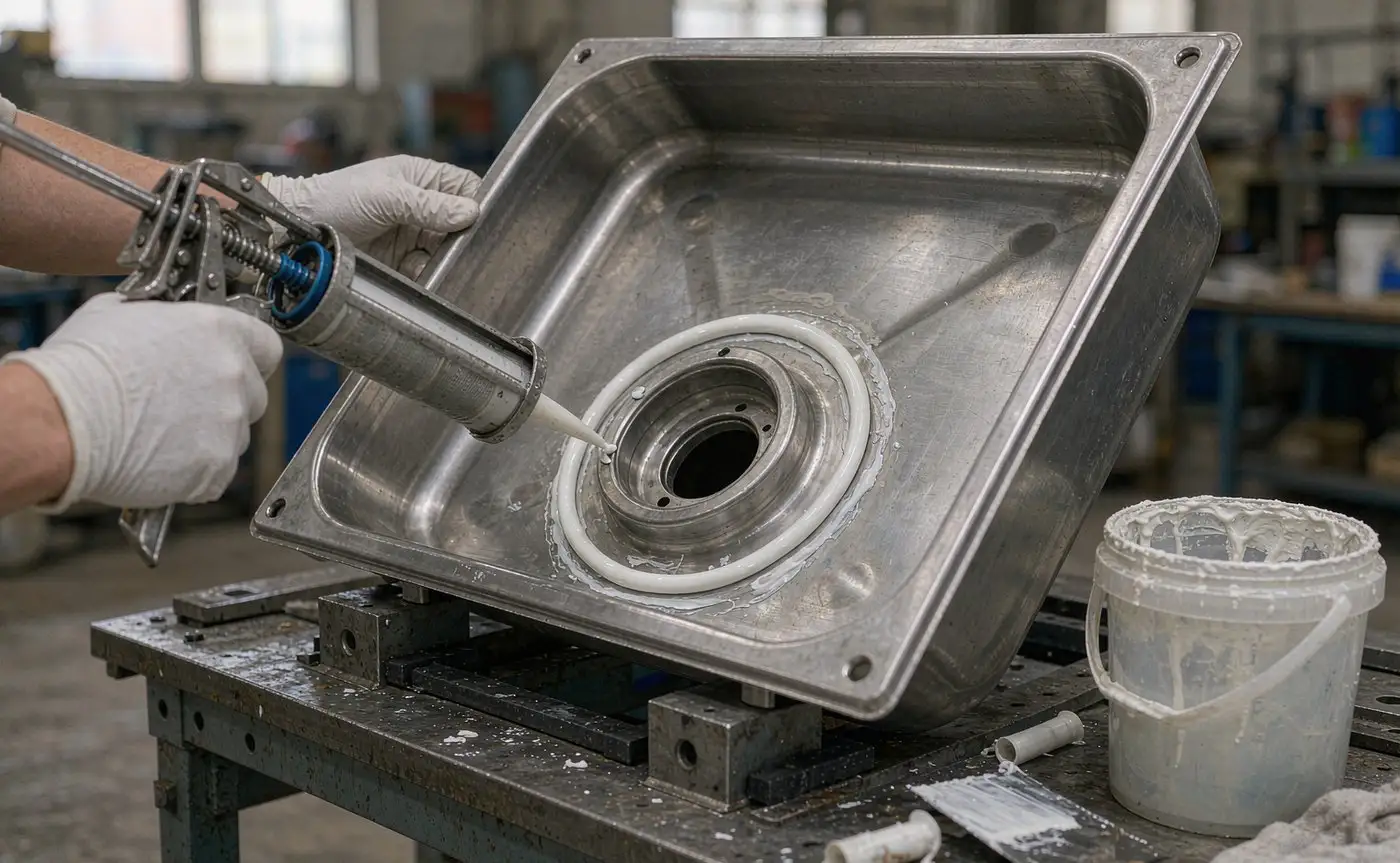
| Drain sealant | Silicone or polyurethane sealant | Before caulking, add iHeir-JS at 1.0%-2.0% of the glue weight and stir thoroughly | Even compound, no floating layer, no grit | Most stable at pH 6-7; no unlined metal containers |
| Damping pad | Foamed material | Before foaming, add iHeir-FP at 0.5%-1.5% of the foam weight | Even cells, no shrinkage cavities | Stable across pH 1-11, add in the batching stage |
| Drain connection | Washer and thread | No separate additive, covered by compound and washer | Fully seated, no water trap | The overflow is where a washer most often goes missing |
| Assembly and store | Finished sinks | – | Dried after the water test, dry inside the bag | Blow the test water off before bagging |
The first two rows are two different ways of adding an active: one is a liquid stirred into a compound, the other is an antimicrobial dispersed into foam. Use one formula for both and one of them must fail, because an antimicrobial for foam will not disperse in sealant and a glue additive disturbs the foam cells.
3. JS in the sealant: 1.0%-2.0% of the glue weight, stirred before caulking
iHeir-JS glue mildew inhibitor is a clear colourless liquid with a mild aromatic odour, specific gravity 1.02, 45% active, pH 6-7, 3cps at 25C, miscible with water in any ratio and soluble in most organic solvents. Its addition point is not critical: the data sheet records that the preservative effect does not change with the point of addition, so it can go in during batching or during adhesive make-up. The level is 1.0%-2.0% of the glue weight, and the compound must then be stirred thoroughly for even dispersion.
Two-component and one-component sealants differ: in a two-component system the additive goes into part A before the curing agent, while a one-component system can only be dosed before filling and must be used promptly. Either way, disperse for 15-20 minutes and check a sample for a floating layer or grit.
Three operating points. First, keep the system at pH 6-7: an acid-curing silicone releases acid as it cures and breaks the active down faster, so check the chemistry when choosing the sealant. Second, do not store or batch in unlined metal containers; use plastic pails. Third, JS contains no formaldehyde or formaldehyde releasers, so the material declaration on an export order can state that directly, and the TDS and declaration are available on request. Packing is 25 and 160 litres, stable for at least a year at normal storage temperature; keep the drums out of a sunlit window.
4. FP in the damping pad: 0.5%-1.5% of the foam weight before foaming
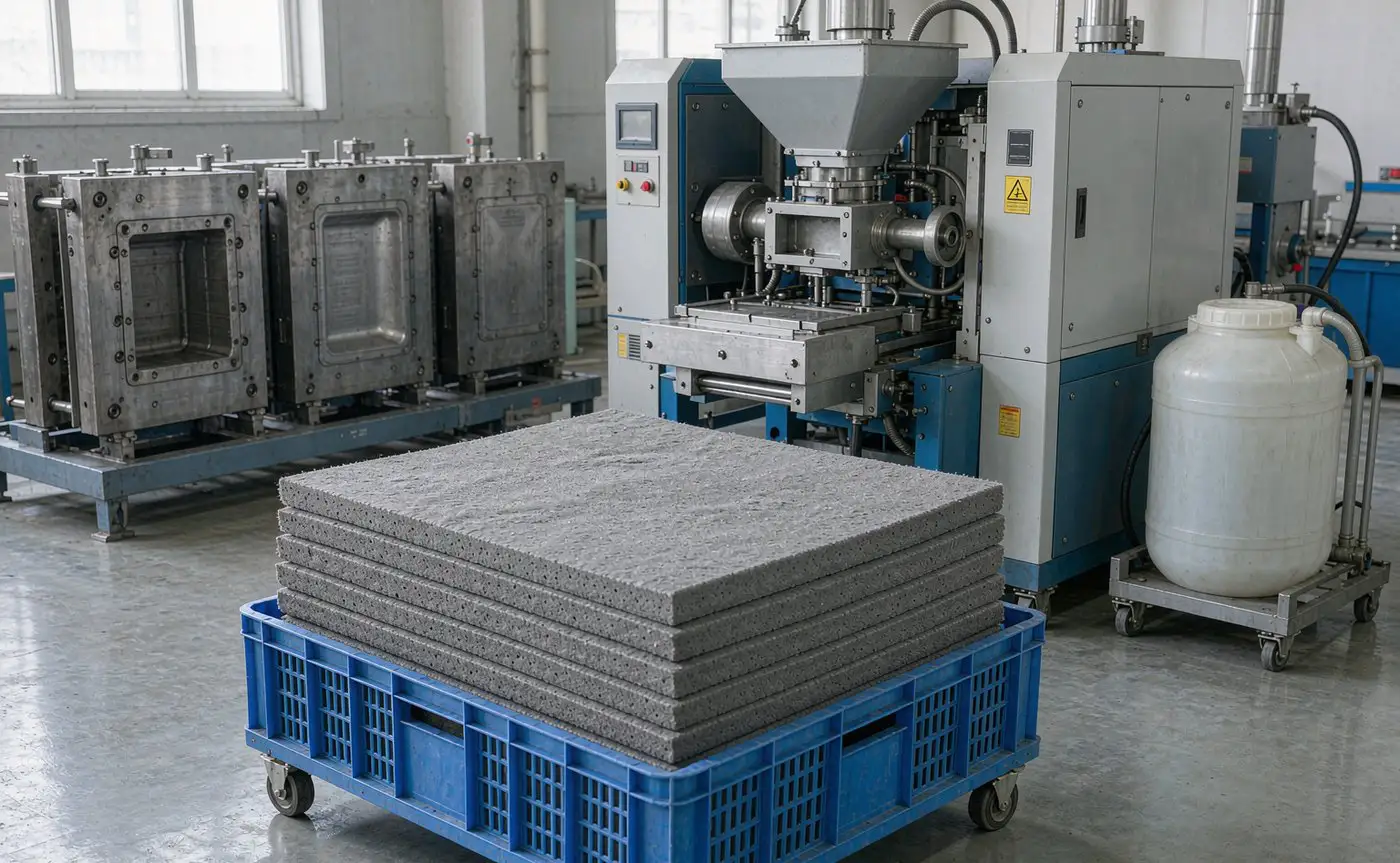
The pad exists to kill the noise of water hitting the bowl, it is usually a foam, and once bonded it is hidden by the cabinet and never sees daylight. This is the place for iHeir-FP foam antimicrobial agent: a clear, colourless to pale yellow liquid with no odour, stable from pH 1 to 11 and stable to light and heat, rated at up to 99.99% antimicrobial efficiency. The level is 0.5%-1.5% of the total foam weight, stirred into the polyol component at the foaming batch stage.
Three points: add to the polyol rather than the isocyanate, because it disperses there and does not disturb the reaction; run 0.5% on thin pads and 1.5% on thick or adhesive-coated ones, since above that there is nothing to gain; and keep the batching temperature on the foam process, because FP is already stable from pH 1 to 11.
FP comes in 25kg packing, stores cool and dry, and the drum must be sealed again promptly, or the surface skins over.
5. Assembly and finished store: test water is what brings the damp back
Once both materials are loaded, three actions decide the result: clean the flange before caulking, give the compound its curing time before the leak test, and dry the bowl and the pad edge after testing before bagging, because sealed-in test water beats any additive over months.
Manage the store as an export lot: pallets off the floor, a gap to the wall, humidity held, dry carton liners, and absorbent material in the container with an air path at the doors.
6. Questions: is a surface spray still needed, and can one-component glue take it
With JS already in the sealant, should the surface be sprayed as well? No. JS sits inside the compound, the joint face is covered by its own film, and a sprayed active cannot penetrate it; it only leaves a white bloom on the surface. What needs attention is the workmanship: a clean flange, enough compound, and an unbroken bead.
Can a one-component sealant be dosed? Yes, with a changed flow: it can only be added before filling, and the filled cartridges must be used promptly instead of being batched ahead. If the line buys ready-filled cartridges and cannot dose them, put the effort into selection instead – buy a sealant that already carries an anti-mould claim – and make the pad stage complete, so at least the base is covered.
How is the effect verified? Send the finished material to a third party: plastics and compounds go through ISO 846 or ASTM G21 for mould growth rating, antimicrobial performance through ISO 22196 for inhibition rate. The samples must be cured compound sheet and foam pad that actually contain the additive, not the raw material. We can arrange the testing and supply the TDS, and both products are available as samples for a trial against your sealant chemistry and foam system.
Closing figures: drain sealant dosed with iHeir-JS at 1.0%-2.0% of the glue weight at pH 6-7, dispersed at high speed before caulking; base pad dosed with iHeir-FP at 0.5%-1.5% of the foam weight at the foaming batch; bowl and pad edge dried after the water test before bagging; pallets off the floor, absorbent material in the container, and a carton checked for a black joint before loading.


