




 View Count:13
 Date:2026-10-21
How is the anti-mould agent added on a range hood? Not to the stainless housing but to two places: the black plastic impeller and the paint film. Kitchen oil mist leaves an oily film on both, which feeds mould, so a lot shipped to a humid market smells musty two months after opening. The impeller takes iHeir-JS117 plastic anti-mildew powder at 0.5%-1% at the compounding stage, and the housing paint carries iHeir-YQ paint anti-mould and antibacterial agent at 1%-1.5%. This article gives both addition points, dispersion requirements and the export inspection line.
1. Range hood mould starts on the impeller blades and the painted housing
The paths first. The impeller is a plastic part, usually PP or PA, with thin blades and narrow passages; oil mist condenses on the back of each blade as a tacky film that water does not dissolve, and that film becomes a medium for mould. The housing is sheet metal with an organic paint film, and once it has a pinhole or an oily deposit, moisture gets under it and spots lift from below.
There is one more place worth naming: the duct wall and the back-draught flap. Neither is painted and neither gets wiped, so oil and condensate collect together and mould grows worst there. They are not the subject of this article, but once the impeller and the housing are handled, most of the duct problem falls away and the rest is cleaning and extraction.
2. Impeller and housing: where each addition goes
The table lines the two locations up with material, addition point, level and criterion, as a draft process card.
| Location | Material | Addition point and level | Criterion | Points to watch |
|---|---|---|---|---|
| Impeller | PP/PA plastic part | At compounding, add iHeir-JS117 at 0.5%-1% of finished weight | Even in the resin, no white specks, no agglomerates | Dry powder tipped into the hopper clumps; pre-blend first |
| Housing | Sprayed paint film | At paint make-up, add iHeir-YQ at 1%-1.5% | Even paint, no floating layer | Add during milling or make-up and stir thoroughly |
| Duct and flap | Sheet metal | No separate additive, handled by design and cleaning | Free extraction, no oil pool | Do not build a water trap into the shape |
| Assembly and export | Finished unit | – | Wiped after the run test, dry inside the bag | Test oil and water come off before bagging |
The difference between the rows is not only the product but the stage: the impeller carries the active inside the plastic, the housing carries it inside the film. They cannot be swapped – powder settles out of paint, and a liquid cannot be dispersed into a resin at the hopper.
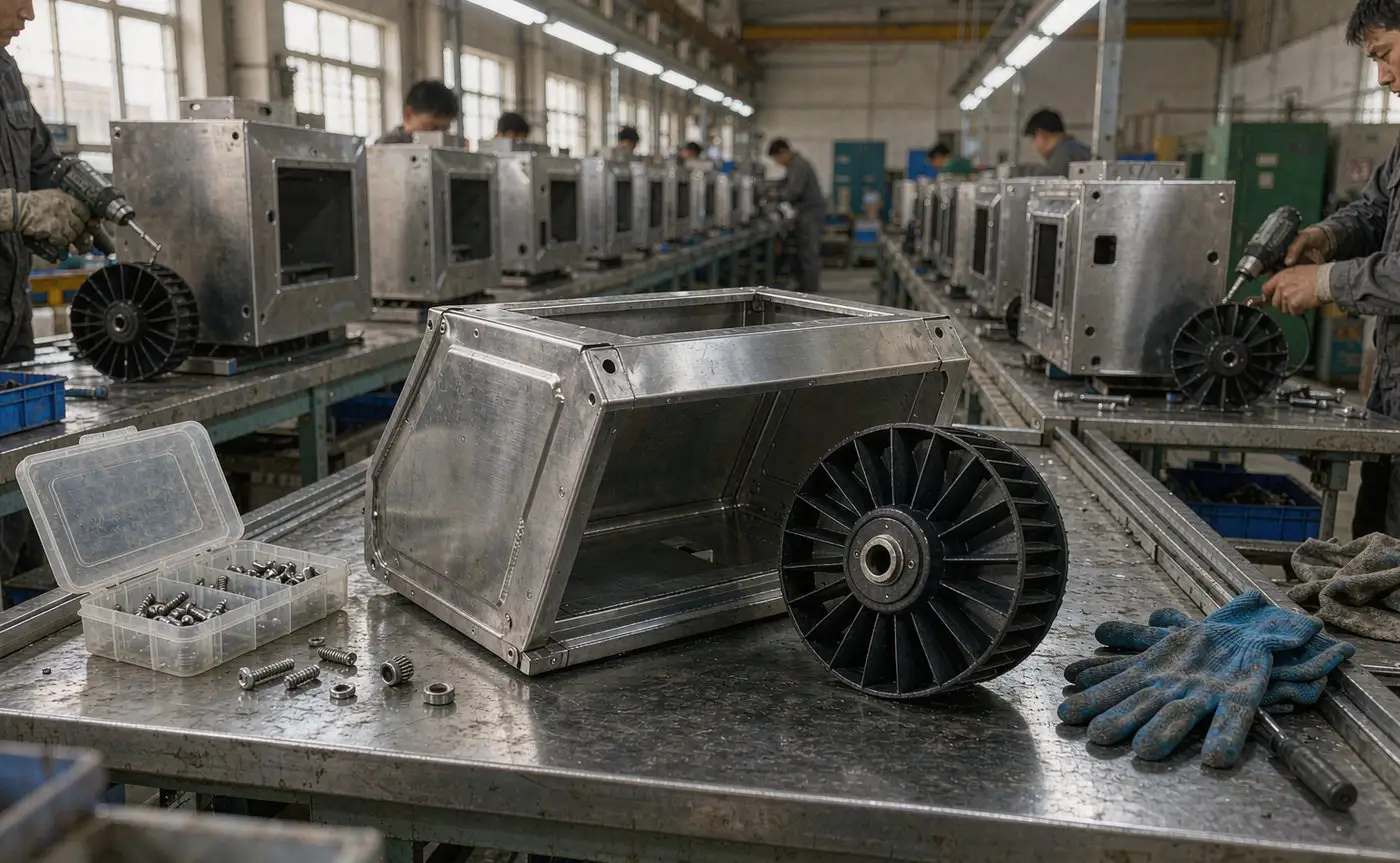
3. Impeller: JS117 at 0.5%-1% of finished weight, even at the compounding stage
iHeir-JS117 plastic anti-mildew powder is a white to pale yellow powder with a faint odour, specific gravity 1.21, more than 97% active, bulk density 380 kg/m3, mean particle size 110 microns (D50), soluble in aromatic compounds, ketones and alcohols but not in water or aliphatic compounds, with good resistance to leaching and no arsenic. Its active is a nitrogen heterocycle phenol-alcohol compound, effective in PVC, PU, silicone resin, polyolefins, polyester and TPE. The level is 0.5%-1% of the finished part weight, mixed into the resin before moulding.
Three points. First, pre-blend: powder tipped straight into the hopper is not dispersed by screw shear and shows up as white specks, so blend it with part of the resin for 3-5 minutes. Second, stay inside 0.5%-1%, because a thin-wall part gains nothing above it. Third, count the regrind, which already carries the additive.
One check after moulding: run the balance test on parts with and without the additive, a few pieces of each from the same tool, and confirm the balance figure has not moved. It is a simple step, and skipping it turns into a vibration and noise complaint at the customer.
4. Housing: YQ at 1%-1.5% in the paint, stirred at make-up
The film moulds on its own, especially matte finishes and low-bake systems, where the surface is rough and holds oil and water and the spots start at pinholes. iHeir-YQ paint anti-mould and antibacterial agent is a natural-coloured liquid, 79.5% active, pH 4-7, 3cps at 25C; it goes in during milling or paint make-up at 1%-1.5%, and the paint must then be stirred thoroughly for even dispersion.
Three notes: add at make-up, because milling runs hot and costs active; run 1.2%-1.5% on dark and matte finishes and 1% on gloss; and stay under 1.5%, since the maximum use level is capped at 15ppm active.
Packing is 25 and 160kg, stable for at least three years at normal storage temperature, and it should not sit in an unlined metal container. YQ contains no formaldehyde or formaldehyde releasers, a line export material declarations usually ask for, and the TDS and declaration are available on request.
5. Assembly, run test and export: oil and condensate are the two issues
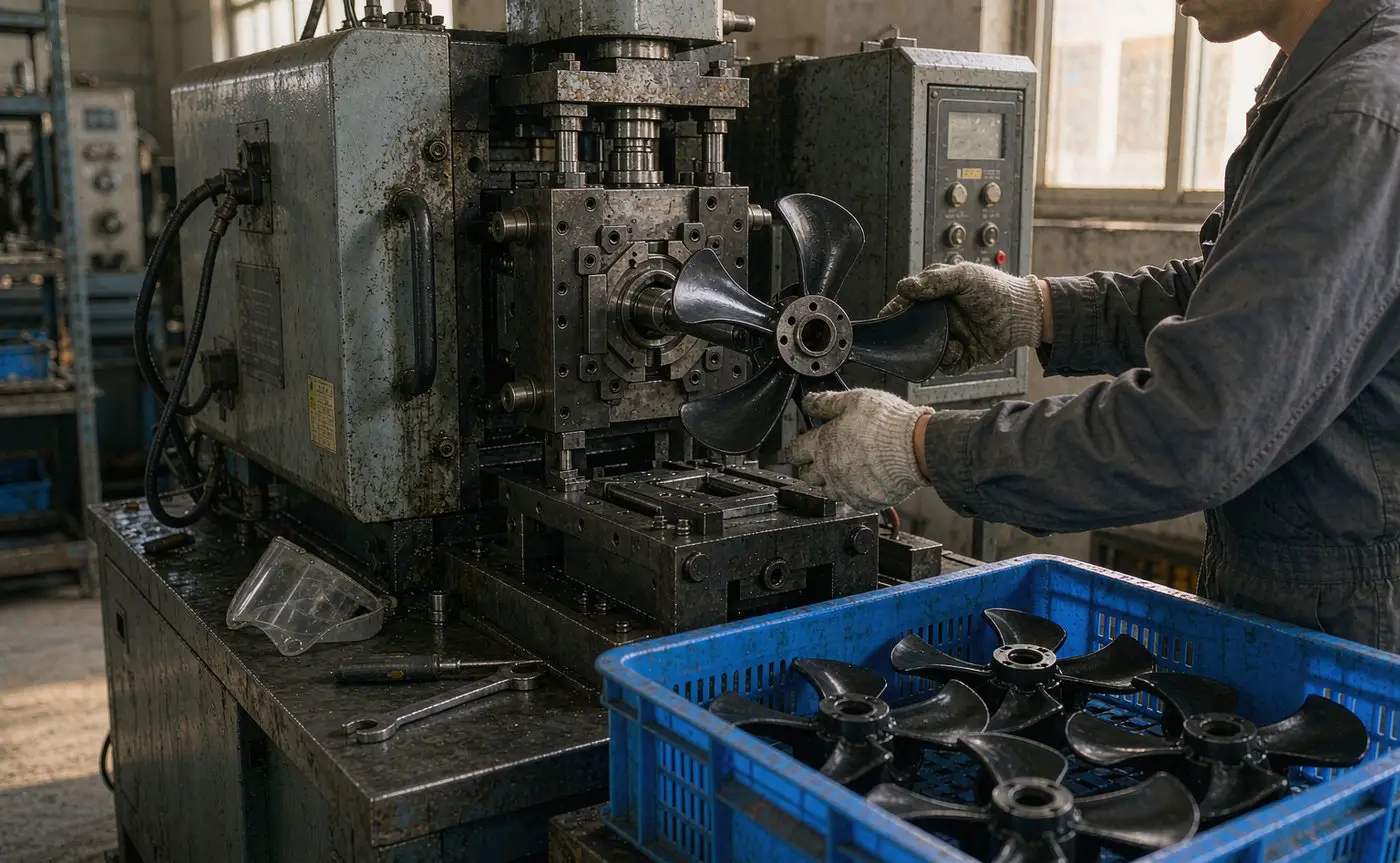
With both materials loaded, three actions decide the result: clean the housing and let the impeller spin dry after the run test before bagging; use dry foam inserts and no recycled board against the film; and keep the store off the floor with absorbent material in the container.
One field point: oil keeps arriving in a kitchen, and an additive holds mould back but not oil, so the material side is covered at the factory and the impeller still needs cleaning on a cycle.
6. Questions: is a spray still needed, and does the powder upset the balance
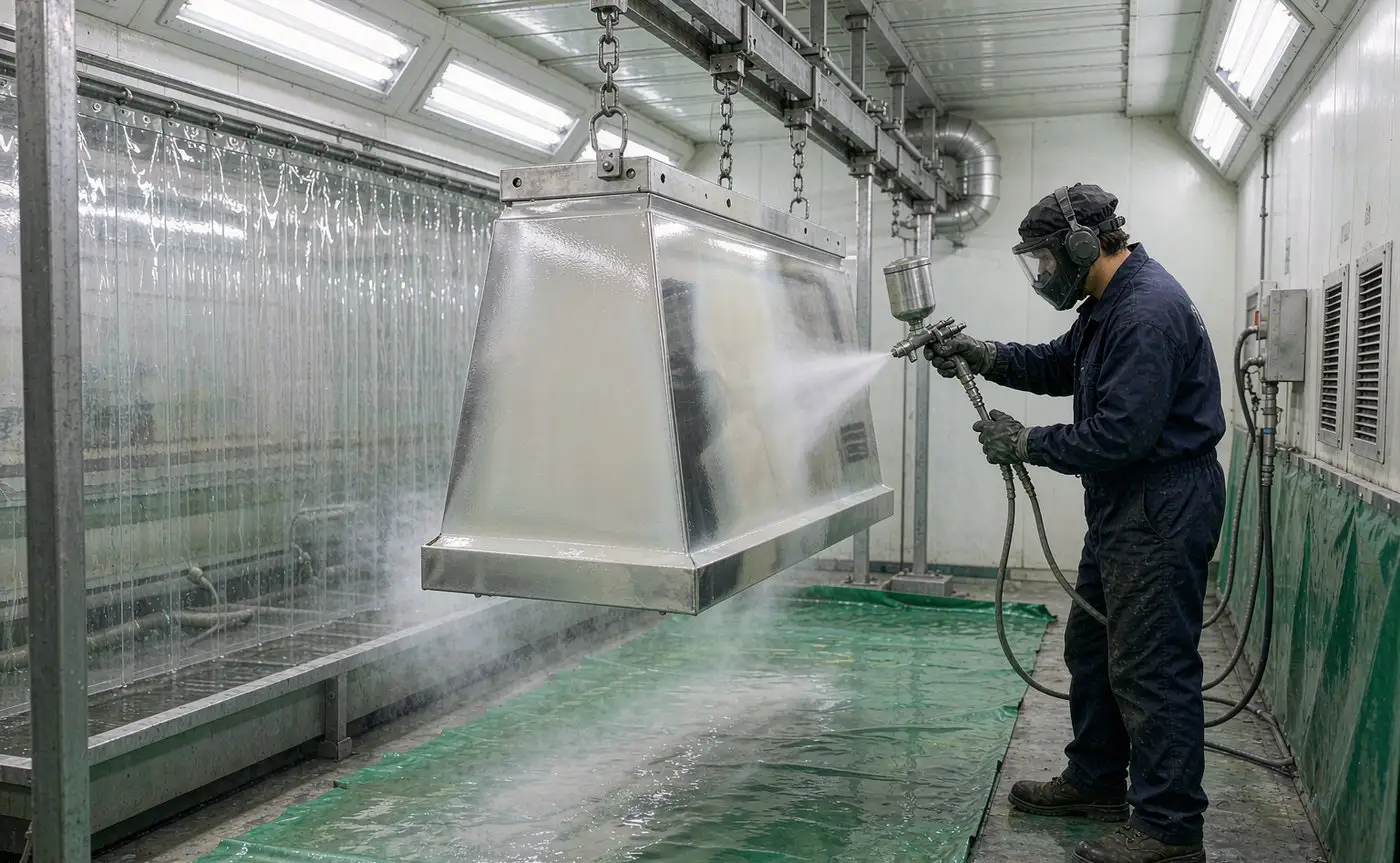
With JS117 already in the impeller, should it be sprayed before assembly? No. JS117 sits inside the plastic, a surface spray washes off after two cleaning cycles, and on a rotating part any residue affects balance. What needs attention is the tool and the material flow: mould temperature, regrind ratio and pre-blend time; when those three are steady, the lot is steady.
Does the powder change the balance of the impeller? At 0.5%-1% with even dispersion the change sits inside tolerance, but it has to be measured: same tool, same grade, five parts with and five without, balance figures compared and the data kept for the customer. It is over-dosing, say 2% to chase performance, that visibly affects mechanics and balance.
The housing is sprayed by a subcontractor – how is that controlled? Put the level and the addition point into the subcontract process sheet: 1%-1.5% at make-up, 10-15 minutes of stirring, lot records kept. On acceptance, take a film sample for a mould test under GB/T 1741 or ASTM G21 and read the growth rating, rather than judging by eye. Samples and TDS are available for both products to check against your resin grade and paint system.
Closing figures: impeller dosed with iHeir-JS117 at 0.5%-1% of finished weight at compounding, pre-blended with part of the resin and with regrind pro-rated; housing paint dosed with iHeir-YQ at 1%-1.5% at make-up and stirred for 10-15 minutes; housing wiped and impeller spun dry after the run test before bagging; pallets off the floor, absorbent material in the container, and a carton checked for smell and film condition before loading.


