




 View Count:32
 Date:2026-09-21
Choosing an anti-mould agent for inks and adhesives: where do you start when one wrong pick means a fouled tank and a scrapped batch worth thousands? Match the agent to the system’s water content and pH: alkaline water-based systems take iHeir-JS(OTB), acidic systems take iHeir-JS7, hot-melt and oil-based adhesives take iHeir-G, and printing inks run on iHeir-JS for in-can preservation. This article covers the dosing band, the addition point and the compatibility red lines for each system.
1. Read the system first: water content and pH pick the product
The first question is never price; it is two numbers from your own recipe. White glue, starch adhesive, PVA adhesive and water-based ink are all water-bearing systems: mould grows in the drum on that water, so in-can preservation is the main battle. Hot-melt and solvent-based adhesives carry no free water; the risk shifts to the bonded joint, where trapped moisture lets mould grow in from the edges, so the agent must protect the glue line itself. Within the water-bearing group, split by pH. Most styrene-acrylic and pure-acrylic emulsion systems sit at pH 7-9, mildly alkaline, which calls for the alkali-tolerant iHeir-JS(OTB). Acidic systems at pH 3-6, such as starch adhesives, modified animal glues and acidic pigment pastes, take iHeir-JS7. Hot-melt and oil-based adhesives take iHeir-G, which is built for that route. Send your system parameters to the supplier and get a selection answer back; we ask every enquirer for adhesive type, solids content and pH before quoting anything.
2. Water-based systems: JS(OTB), JS7 and JS each hold one band
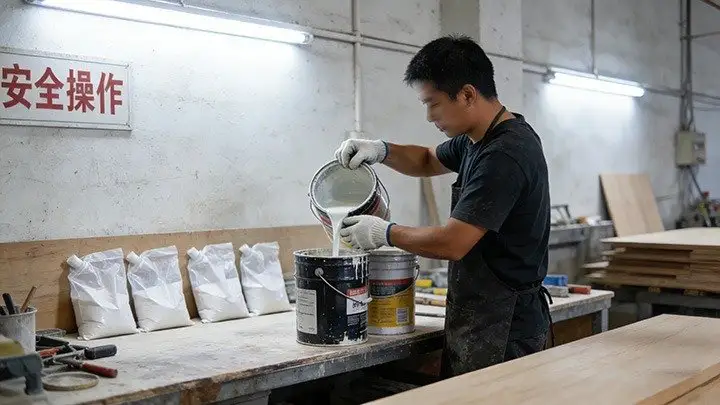
For alkaline water-based systems between pH 7 and 10, use iHeir-JS(OTB) alkaline adhesive fungicide at 0.25-1% of formula weight, added directly during production and mixed until uniform. It has good thermal stability for processes that run hot, disperses evenly in both oil-phase and water-phase slurries, and keeps for a year sealed below 25 degrees C. Acidic systems at pH 3-6 take iHeir-JS7 at 1-2% of formula weight, with 99.9% active content; its job is stopping the colour mottling and spotting that mould grows inside coatings and on surfaces, which makes it the right pick for pastels, pigment pastes, synthetic leather and other colour-critical systems.
Printing inks and high-water coating systems run on iHeir-JS at 1.0-2.0% of product weight, added at the grinding stage or the let-down stage and stirred thoroughly for even dispersion. It is registered with the US EPA for in-can preservation of water-based paints and coatings, contains no formaldehyde or formaldehyde releasers, and is non-irritating at use dilution. Three rules to write on the process card: the concentrate irritates skin and eyes, so dosing stations need gloves and goggles; never store it in unlined metal containers; shelf life is one year at normal storage temperatures, so do not blend leftover stock into a new batch.
3. Oil-based and hot-melt adhesives: G and its hard red line
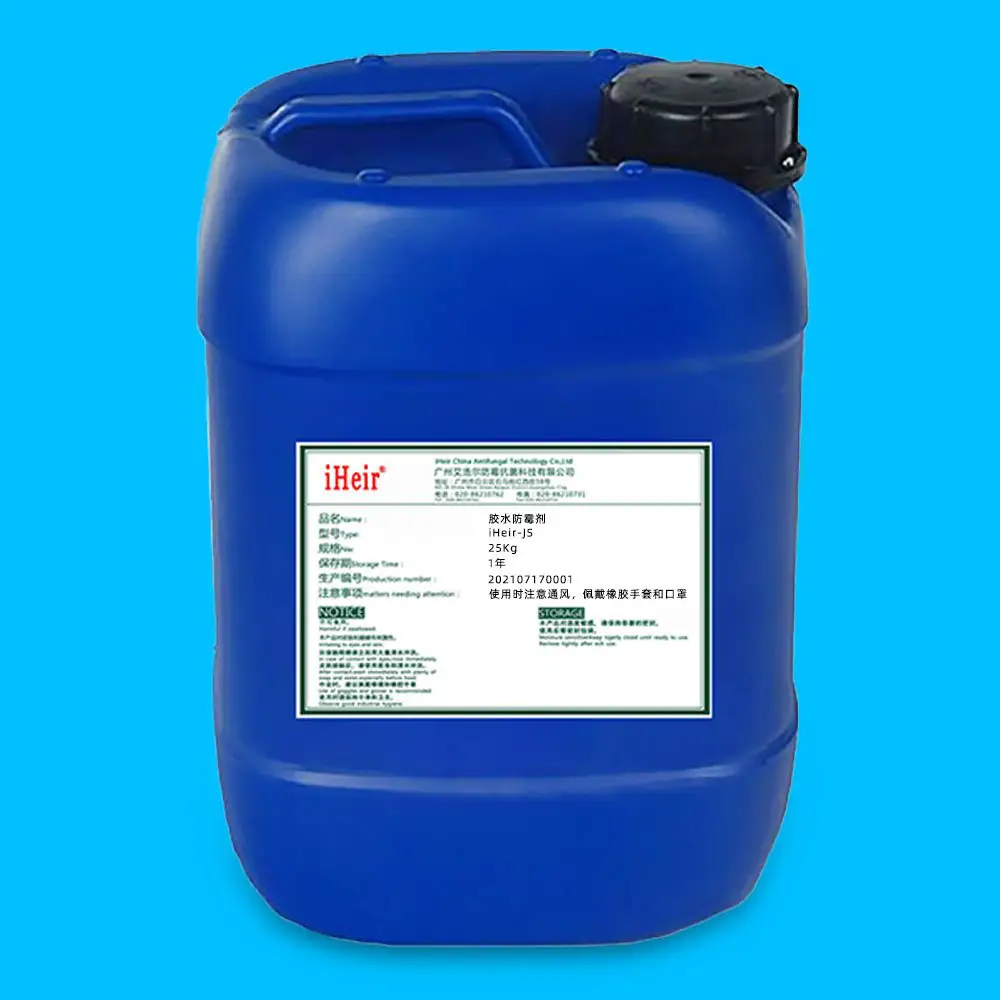
Hot-melt and oil-based adhesives take iHeir-G at 1-2% of adhesive weight, added during adhesive make-up and mixed until uniform. It is an emulsifiable liquid built on a benzothiazole-type active, targeted at fungal attack on bonded joints, keeping the glue line mould-free through humid service; it contains no phenols or environmentally hazardous solvents and meets export quarantine and inspection requirements in Europe and the US. One red line belongs on the process card in bold: never use it above pH 8 and keep it away from alkaline materials, because an alkaline background deactivates it. If an upstream pass in the laminating line uses alkaline treatment, bring the pH back down before the G step. For oil-based inks, PU and oil-based coating systems, iHeir-YQ is the alternative at 1-1.5% of formula weight, with 79.5% active content, covering in-can preservation and dry-film protection together, and a shelf life of at least three years.
All four systems fold into one table for the lab:
| Product | System | Dosing | Red lines and storage |
|---|---|---|---|
| iHeir-JS(OTB) | Alkaline water-based, pH 3-10 | 0.25-1% of formula weight | Add directly and mix; one year sealed below 25 C |
| iHeir-JS7 | Acidic systems, pH 3-6 | 1-2% of formula weight | Stops colour mottling; one year sealed below 25 C |
| iHeir-JS | Inks, emulsions, pigment pastes | 1.0-2.0% of product weight | EPA registered; no unlined metal containers; concentrate irritates |
| iHeir-G | Hot-melt, oil-based adhesives | 1-2% of adhesive weight | Never above pH 8; cool, dry, sealed storage |
| iHeir-YQ | Oil-based ink, PU, oil coatings | 1-1.5% of formula weight | 79.5% active; no unlined metal containers; shelf life 3 years+ |
The addition point is the same across systems: the grinding or let-down stage during manufacture, followed by thorough mixing. A clean-looking drum is not a sterile drum; microbial load on incoming raw materials climbs through the rainy season, so dose toward the top of the band instead of trimming to the bottom.
4. After dosing: compatibility trials and two verification tests
Any change of preservative means re-proving compatibility. Order of operations: beaker before plant. Dose a 500-gram sample at the recommended rate and read two checkpoints, 24 hours and 7 days, for viscosity drift, colour shift, flocculation or phase break. Only when both checkpoints pass does the plant trial start. JS, JS7 and JS(OTB) all demand thorough mixing after addition; insufficient shear leaves localised overdosing and produces compatibility readings that mean nothing.
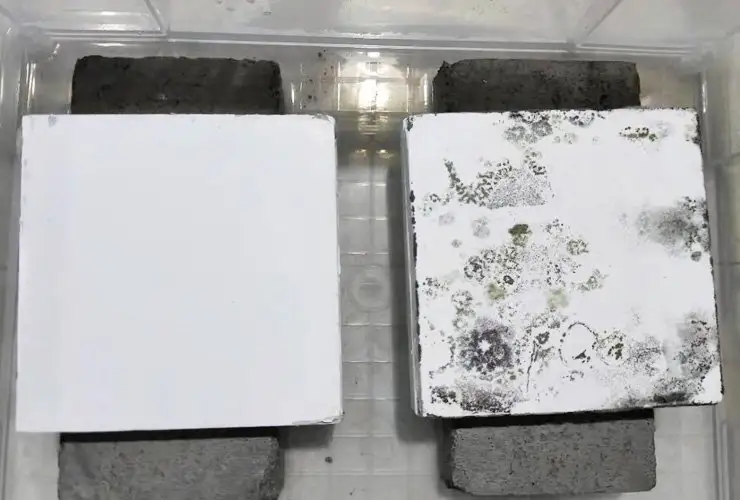
Prove the efficacy on two fronts. In-can preservation: run a microbial challenge test on water-bearing systems, inoculate and track colony counts over the test period; the result that matters is control inside the drum plus a buffer against recontamination after opening. Dry-film resistance: run coated panels side by side with untreated controls under GB/T 1741, inoculate in one chamber and read the mould growth grade at 28 days; a set of photographs showing the treated panel clean and the control panel black is the strongest document you can hand a buyer.
5. FAQ
Q: Can one agent cover both water-based ink and adhesive to cut stock?
Not recommended. pH ranges are hard constraints: JS7 loses effect in alkaline systems, G is deactivated above pH 8, and although JS(OTB) spans pH 3-10, hot-melt and oil-based systems still need G, which is built for the oil phase. Carry two agents for your main systems; that is cheaper than one general-purpose failure.
Q: Should we dose at the top or bottom of the band?
Follow the microbial load of the system: clean incoming materials and dry seasons run at the bottom of the band; rainy-season deliveries, open handling and poor customer storage push it to the top. For a first formulation, run the mid-point in the beaker, pass the challenge test, then fix the setpoint.
Q: A drum already smells sour. Does doubling the dose save it?
No. Preservatives prevent reproduction, they do not deodorise; a spoiled batch has long passed a safe colony count and will never regain stability, so write it off, clean the line thoroughly, and dose correctly on the next batch.
Q: How do samples and orders work?
JS(OTB), JS7, JS, G and YQ are all available as samples; send adhesive type, solids content, pH and target shelf life, and we return the dosing band and addition point, then quote per drum. Contact us.