




 View Count:40
 Date:2026-09-19
Anti-mould for floor coatings: why do textured stone paints and waterborne floor systems fail first in the rainy season? An alkaline waterborne line has two failure paths, in-can spoilage before shipment and mould spots on the film after application, and both land on the coating maker. Get the formula right in one pass: iHeir-TQ at 2-3% of system weight or iHeir-YQ at 1-1.5% for in-can and film protection, plus iHeir-BCA at 0.5-0.75% in the levelling putty. This article covers the split of duties, dosing, timing and verification.
1. Two gates in an alkaline system: in-can and on-film
Floor coatings and textured stone paints are mostly waterborne and alkaline, and mould protection crosses two gates with different failure modes. In-can spoilage strikes before shipment: the emulsion and cellulosic thickeners feed bacteria, and an under-dosed drum in a hot summer workshop turns sour and stratifies within weeks, which the customer smells the moment they open it. Film mould strikes after shipment: damp floors and rain-facing textured walls grow spots on the coating, and rework inside the warranty period is the coating maker’s bill. The mechanisms differ, in-can protection keeps the colony count down, on-film protection holds a lasting active layer on the surface, so check whether one agent genuinely covers both at its stated dose.
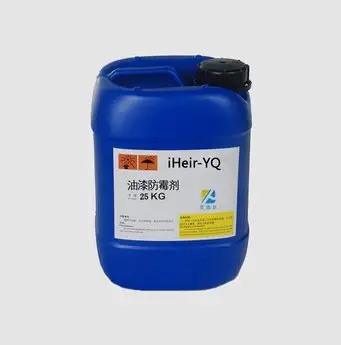
2. Choosing between TQ and YQ: match the system, then set the dose
Selection for waterborne and solvent lines, in one table:
| Product | Systems | Dosing | Coverage |
|---|---|---|---|
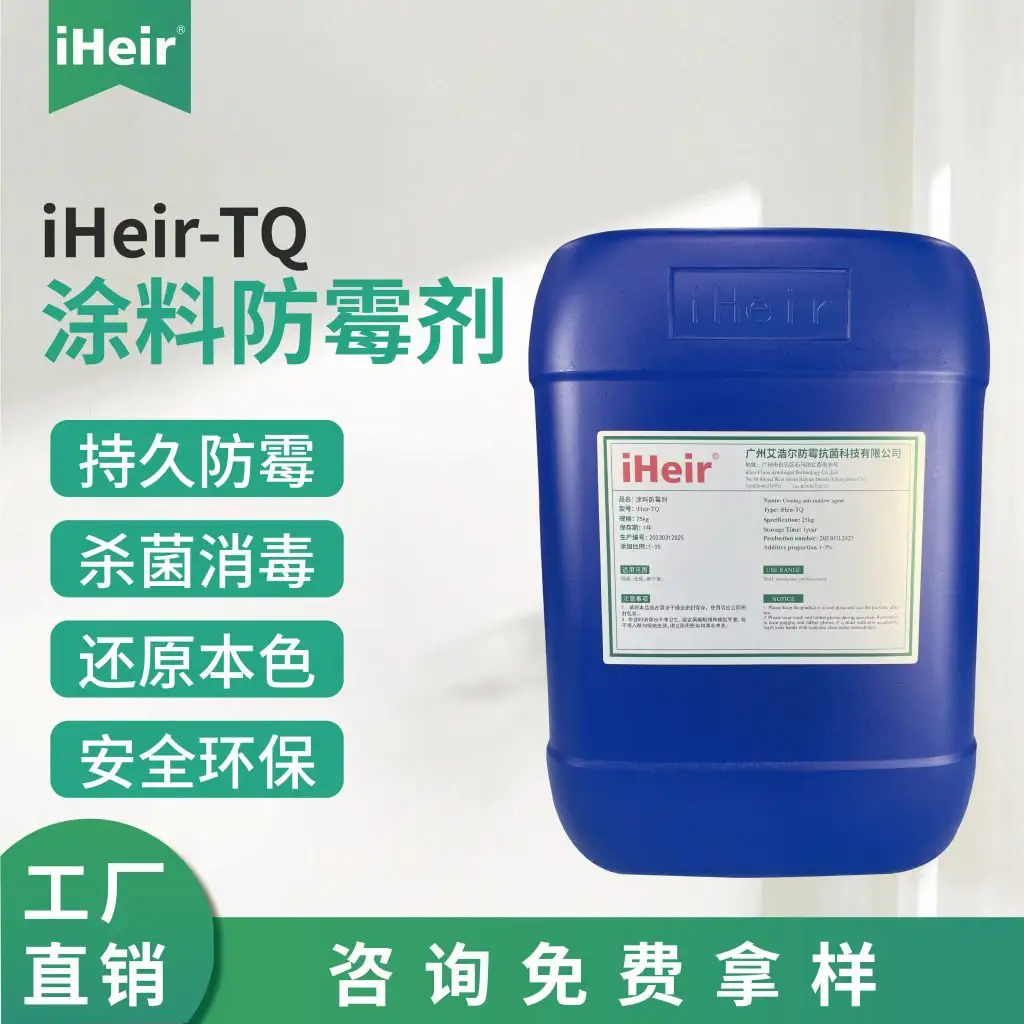
| iHeir-TQ coating mould inhibitor | Emulsion paints, waterborne coatings, dispersions, colour pastes | 2-3% of system weight | In-can preservation first; cationic wall bonding holds 5-10 years |
| iHeir-YQ paint mildew inhibitor | Paints, PU, emulsions, solvent coatings, inks | 1-1.5% of formula weight | In-can plus film, bacteria and fungi, waterborne and solvent |
| iHeir-BCA paint mould-proof powder | Putty and mortar companions (dry powders) | 0.5-0.75% of powder mass | Levelling layer under the film; alkali-tolerant at pH 5.0-10.0 |
iHeir-TQ is a 45% CMIT/MIT blend, EPA-approved for in-can preservation of waterborne paints, and mixes well with acrylic, vinyl acetate and styrene-butadiene systems at 2-3%. iHeir-YQ carries 79.5% active at a lower dose, covers bacteria and fungi across waterborne and solvent systems, and suits coating makers running both chemistries on one site. The two do not compete: TQ leads on waterborne lines, YQ on solvent and PU lines, with separate dosing windows where the lines share equipment.
3. Timing and process discipline
Both agents are added at the grinding or paint-mixing stage with thorough mixing afterwards; put that on the process card, because topping up at the viscosity-adjustment step risks poor dispersion. Four lines of discipline: never store or transfer TQ or YQ in unlined metal containers and check the suction-line material too; YQ concentrate is strongly skin-irritating before dilution (the use dilution is not), so charging stations wear gloves and goggles; TQ keeps at least a year and YQ at least three, so rotate stock first-in first-out; and pull a pre-dosing sample from every batch so any later dispute has a reference.
Dosing discipline matches it: count on formula weight, not drum estimates; 2-3% and 1-1.5% are the product-page ranges and a dedicated formula gets its exact rate from our technical centre by test, not by pushing past the range; re-run small trials when the emulsion or thickener supplier changes, because compatibility moves with the auxiliaries; and humid-region exterior orders dose at the top of the range.
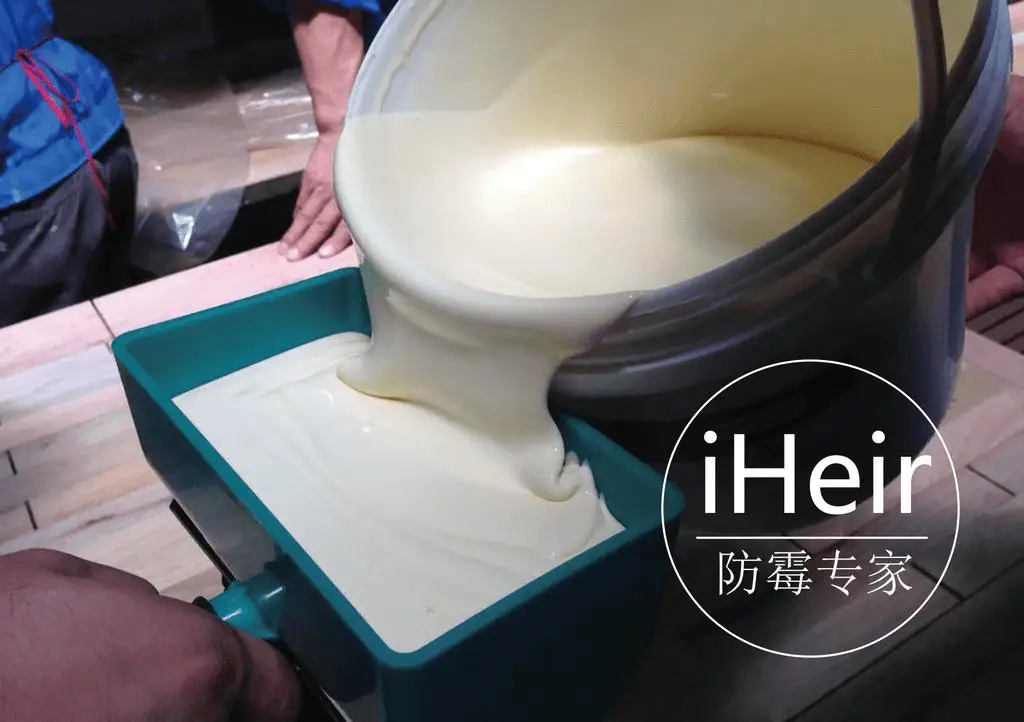
3bis. The levelling layer: BCA closes the system from below
Film mould is only half the story: a mouldy putty levelling layer under the coating blisters the topcoat, and the claim still lands on the coating maker. Coating plants that also supply putty or mortar dose iHeir-BCA at 0.5-0.75% of powder mass in the dry-blend stage; it is rated for alkaline systems at pH 5.0-10.0, its slow-release and light-stabilised technology holds long term, and the 4-30 micron particles disperse in a normal powder mix. With the film and the levelling layer both protected, humid-region tenders that demand reports for both layers stop being a problem.
4. Verification and batch records
Three checks carry the formula to the plant. In-can stability: seal dosed and control samples side by side through the humid season, 4-8 weeks on a workshop shelf; the control spoiling first means dosing or dispersion is off. Film retest: run dosed and blank panels through a damp-heat mould comparison; the grading system is covered in our paint anti-mold agents comparison. Batch files: dosing weights, drum numbers and retained samples matched per batch; when a customer opens a spoiled drum, that shelf is your first line of defence. For the application side, wall treatment and repair are covered in our wall mould treatment guide.
Humid-region exterior orders take one more step: cure the lab panels for a week in a hot-humid window before shipment so the film completes its early crosslinking in the plant, and it stands up to the rainy season on site. Across all three checks, keep the same batch numbering from the mixer to the panel shelf; the moment one number cannot be traced, the whole verification chain loses its value in a dispute. Retained samples of every dosed batch stay sealed until the project’s acceptance closes, which is what turns a spec sheet into evidence.
4bis. FAQ
Q: Can TQ and YQ be dosed together for a double shield?
Not blindly. The active systems differ, so run an in-can compatibility and stability trial before combining; one agent per line chemistry is normally enough, and special formulas can be reviewed with us.
Q: Will a strongly alkaline textured paint deactivate CMIT/MIT?
TQ is designed for alkaline waterborne systems including textured paints, and BCA is rated for pH 5.0-10.0; for an unusually high-pH formula, send it for an in-can stability trial before scaling up.
Q: In summer drums still occasionally spoil, is the dose too low?
Check three things first: whether the agent really goes in at the mixing stage and mixes well, whether weighing follows formula weight, and whether any drum or line touches unlined metal. Only then raise the dose, never by feel.
Q: How do samples and orders work?
TQ, YQ and BCA are all available as samples; send the formula system, emulsion grades and target shelf life, and we return dosing and a verification plan, then quote per drum. Contact us.