




 View Count:26
 Date:2026-10-19
Why is bamboo coaster mould better handled by spraying than by soaking? A coaster is thin and comes in large batches, so a whole stack goes into the tank face to face with the liquor unable to reach the middle, and the pieces come out warped at the edges. Spraying is easier: iHeir-M8 bamboo and wood fungicide at 1:20 in one even pass, air dried, and harder stock moves to iHeir-FT bamboo and wood anti-mildew powder at 1:100. This article gives the dosing rate for the spray, the racking method and the stacking rules.
1. Why coasters are awkward to soak: thin stock, large batches, warping
A coaster is a thin piece, usually a few millimetres thick and a dozen centimetres across, and that shape rules out soaking. Load a stack into the tank and the faces press together so the liquor only creeps in from the rim, leaving the middle dry; to penetrate properly the pieces have to be separated on a frame, and the labour costs more than the dip itself. Water uptake also goes up, and a thin piece that dries unevenly cups and bulges – the rejects cost more than the hours saved.
Volume adds to it. Coasters are a high-turnover item for kitchens and offices and a batch of several thousand is normal, so the dip, the draining and the racking each need floor space; spraying can run on a line, with a mesh belt carrying the pieces under a fixed gun at several times the throughput.
Appearance matters too. A coaster is looked at every day on a desk, so the grain and the shade are in front of the customer; a full dip wets the whole piece and the colour comes out a shade darker with flatter grain. A spray treats the surface, which changes the colour far less – the usual reason this kind of thin piece moves to spraying.
2. Dip against spray: the two routes compared
The table sets out where each route fits, the ratio and the points to watch, chosen by batch size and piece type.
| Route | Where it fits | Ratio | Criterion | Points to watch |
|---|---|---|---|---|
| Spray (preferred) | Thin stock, large batches, warping risk | iHeir-M8 at 1:20 | An even film with no runs | Thin and even; a heavy pass builds up at the edges and glues pieces together |
| Dip (thick or small lots) | Thicker stock, small quantities | iHeir-M8 at 1:20, 1-10 minutes | 10%-20% weight gain | Separate the pieces on a frame; never dip a tight stack |
| Hard stock alternative | Densified board, hard veneer | iHeir-FT at 1:100, above 45C | Section penetrated, no powder marks | Dissolve the powder first; lumps leave white spots |
| Racking and packing | – | – | Stack only when surface dry | Single layer; stacking early glues pieces and leaves marks |
The first two rows are one product used two ways, the third is the harder-stock bracket, the fourth is what happens after the spray. For most thin pieces the right combination is spray plus single-layer racking, not dip plus stacking.
3. M8 at 1:20: thin and even, never to the point of running
For spraying, iHeir-M8 bamboo and wood fungicide is diluted 1:20 (1kg of product to 20kg of water), stirred, sprayed evenly over the surface to full coverage and left to air dry. It is a clear amber liquid with a sharp acidic odour that disperses in the aqueous phase; it ships 25kg to the drum, the concentrate keeps three years, and the maximum use level is capped at 15ppm active substance.
Thin and even has to reach the operator: hold the gun 25-30cm away, keep the pass speed constant, and prefer two crossing passes to one heavy one. A uniform wet gloss is enough; spray until it runs and the material collects at the edges, drying into a dark rim the customer spots immediately. The edge of a coaster is end-grain fibre and takes water fastest, so give it an extra sweep – but do not stop the gun there.
Stir the bath before use; standing liquor throws a surface film, which is normal, and a mixed bath should be used within a month rather than left for the next one. The spray booth needs extraction and the operator needs gloves and a mask, and sprayed pieces should not be stacked until the surface is dry.

4. FT at 1:100 for hard stock
iHeir-FT bamboo and wood anti-mildew powder is graded by material: 1:200 for open stock, 1:100 for hard stock, 1:500 for food-contact chopsticks, all most effective above 45C. Where a coaster is densified board or hard veneer, the additive does not penetrate easily, so 1:100 dissolved in hot water and then sprayed or brushed holds up better than 1:200.
Powder through a spray gun needs two steps: dissolve it in water above 45C, pass it through a filter, then fill the bottle – undissolved grains block the nozzle and leave white spots on the face. A finished piece should show no powder mark; a mark means the bath was too strong or not fully dissolved, and the customer feels it with one finger. The bath is reusable, packing is 30kg to the drum with a three-year shelf life, and the powder must be kept dry so it does not cake.
How to split the two: ordinary bamboo coasters go through M8 spray, simple to run and quick to dry; hard stock, densified pieces, or a customer asking for a higher anti-mould rating go through FT at 1:100. Do not run both in one batch – the surface colour will not match and rework costs more.
5. Racking and stacking: avoiding glued pieces and built-up edges
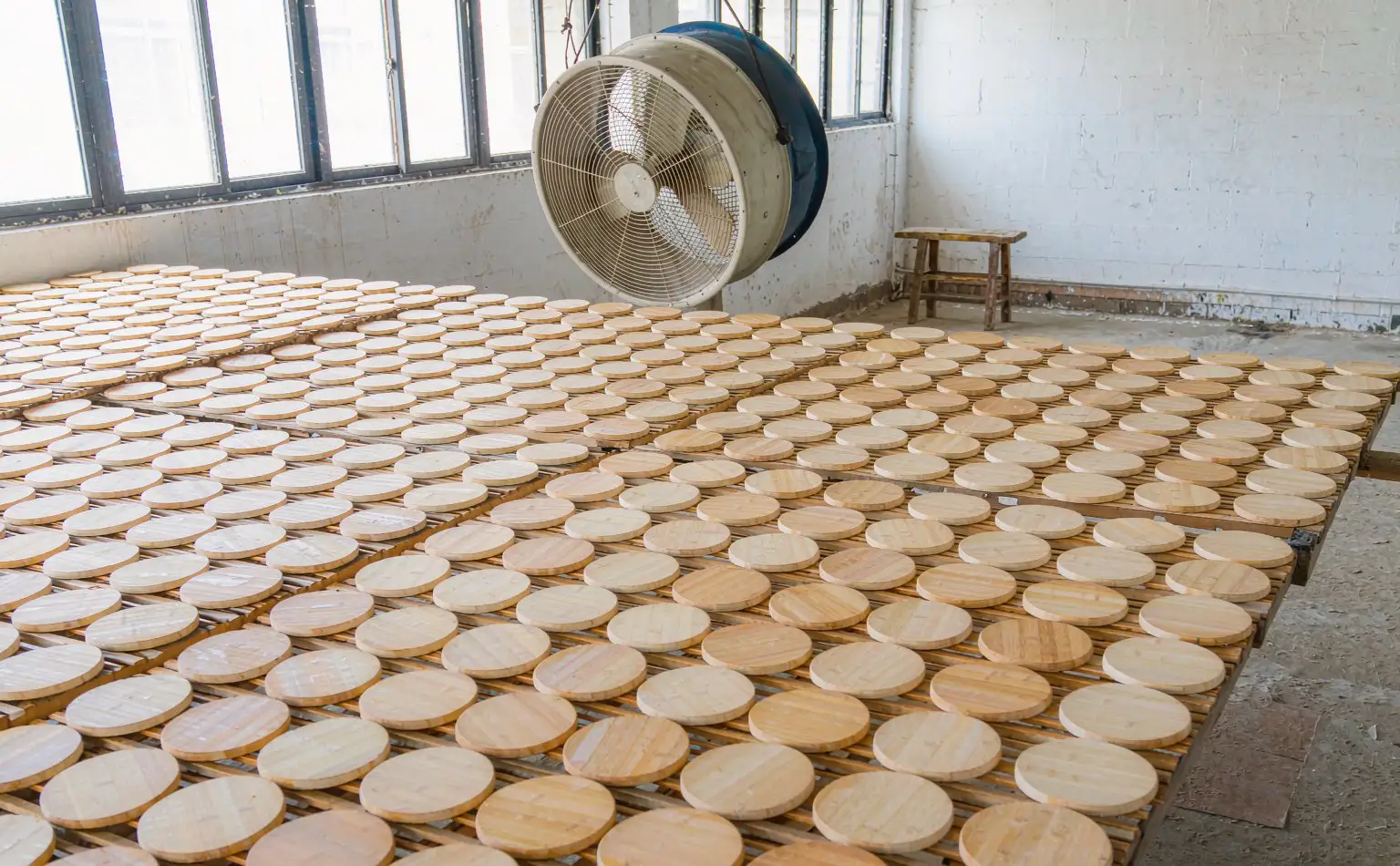
Sprayed coasters go on the rack in a single layer with a finger-width gap so the edges dry too, on a mesh or slatted surface that lets air underneath. In summer a few hours in still air is enough; in the rainy season or on a grey day they go into the drying room, but keep the temperature moderate – thin stock heats fast and cups when it is pushed.
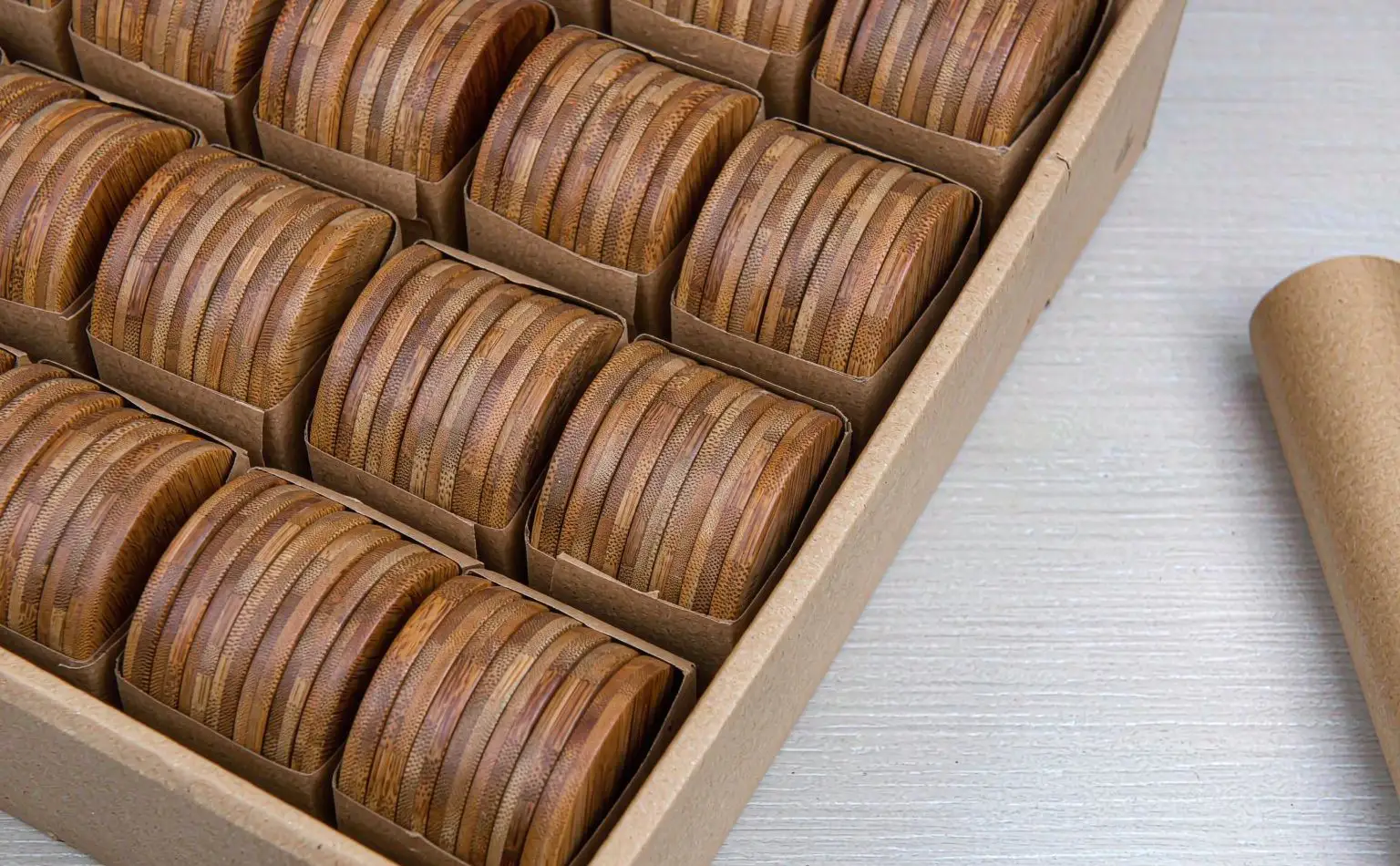
Stacking waits for the surface to dry. The test is the back of a finger: no tack, no shine at the edge. Stack early and the pieces stick, the separation leaves marks, and in bad cases takes the sprayed layer with it. Pack ten to a pile with a paper band, add an anti-mould sheet to the carton, ship oldest first, and open the cartons against the wall before and after the rainy season to check for damp.
6. Questions: is one face enough, and how soon can they be packed
Is spraying the face only enough? No. A coaster is used on both sides, the back sits on a desk where condensation forms just the same, and treating one face only leaves the two sides taking water at different rates, which makes the piece cup harder. Spray both, a lighter pass on the back, but full coverage.
How long before packing? Judge by the surface, not by the clock. Once the back of a finger comes away clean and the edge has lost its shine, the pieces can be stacked; in the rainy season use the drying room, and let them cool to room temperature before bagging, because bagging warm pieces condenses water inside. Do not try to rescue a mouldy coaster with another pass – the stain stays in the fibre and the colour comes out uneven, so sorting it out as a downgrade is cheaper. Samples and a TDS are available for both products.
Four closing figures: ordinary bamboo coasters at iHeir-M8 1:20, two crossing passes, thin and even, an extra sweep at the edge; hard or densified stock at iHeir-FT 1:100, above 45C, dissolved and filtered first; sprayed pieces racked in a single layer until surface dry, then stacked with an anti-mould sheet in the carton; and stock shipped oldest first, with the cartons against the wall checked before and after the rainy season.


