




 View Count:12
 Date:2026-09-14
Foam is the thirstiest family of materials a factory can work with: an EVA midsole absorbs more than ten times the water of solid stock, open-cell PU sponge grows visible mold within a week of getting wet, and EPS packaging that feels bone-dry still collects condensation between its beads. Shoe-material, packaging and padding plants all report the same pattern — the solid version never molds, the foamed version does. The cause is not the cell itself but what cells bring: enormous specific surface and a permanently damp microclimate. This article runs the solutions material by material — EVA, EPS, PU, and TPU/TPE elastomers — then closes with the warehouse half of the program that most plants skip.
Open Cells: Why Foam Invites Mold
Foaming multiplies specific surface area by one to two orders of magnitude — effectively building mold a hundred times more housing. Three mechanisms stack up. Moisture: open cells act like capillaries; above roughly 75% relative humidity, cell walls hold condensate and keep the microclimate in fungi’s comfort zone. Soil: dust, skin flakes and oils settle into pores where cleaning cannot reach, forming a slow-release nutrient bank. Protection limits: spray treatments only coat the outer wall — they never reach deep cells, so foam must be protected by compounding the active into the cell-wall material itself. One more window gets overlooked: the curing and resting stage after demolding (EVA typically rests 3-7 days) stays warm and humid, and plenty of batches walk into the warehouse already colonized — packing simply ships the problem to the customer.
EVA Foam: Dosing the Masterbatch
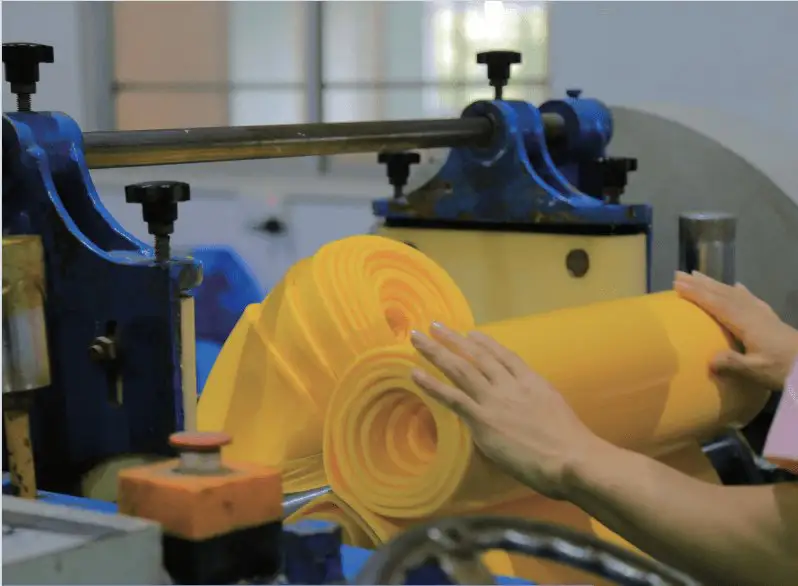
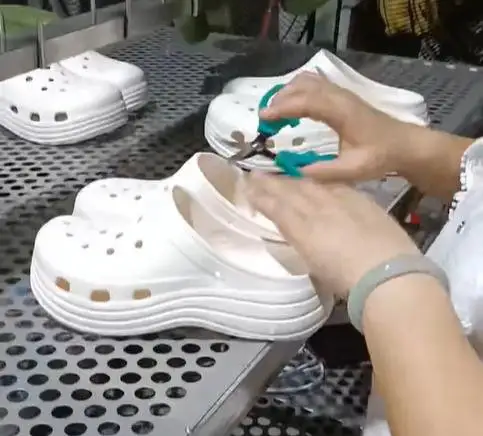
EVA is the volume leader — midsoles, case inserts, yoga mats, play mats. The route is a plastic antimicrobial masterbatch with an EVA-specific carrier, compounded together with the blowing package. Working numbers: 0.8-1.5% of the pre-foam compound with a dual antibacterial/anti-mold grade, topping the range for skin-contact goods like slippers and insoles. Keep mixing at 110-130°C; EVA starts to decompose and blow near 160°C, well within the stability of inorganic actives. Sequence: dry-blend EVA pellets and masterbatch for three minutes, plasticate in the banbury, add blowing agent (AC, 2-4 phr) and crosslinker (DCP, 0.5-0.8 phr), sheet off, then compression-mold at 160-170°C for 8-15 minutes. The masterbatch shifts melt viscosity, so trim DCP by about 0.05 phr per trial or the expansion ratio drifts. Our EVA slipper guide carries the full trial-and-testing workflow.
EPS Packaging: Humidity Control First
EPS (expanded polystyrene) wraps appliances and produce; bead-gap condensation drives the risk, and pairing it with a carton creates a moisture trap. Bead-stage formulation changes are expensive, so the pragmatic play has two layers: source beads with an antimicrobial masterbatch where available, or treat the molded part surface — and control the packaging microclimate with desiccants and anti-mold chips. For appliance exports the priority order is “humidity control first, kill second,” which is also what auditors expect.
PU Flexible and Rigid Foam: Dose the Liquid Stream
PU flexible foam (sponge, mattresses, seat cushions) runs above 90% open-cell content — the most demanding foam category. Sponge plants use the same combination as the coir mattress plan: an active dosed into the polyol stream, plus anti-mold finishing on the fabric layer. PU rigid foam (insulation board, wood-imitation) has high closed-cell content and lower risk — concentrate on cut faces and storage. The mechanics are close to the latex pillow plan for soft sponge products.
For chemistry, the iHeir-FP foam antimicrobial was built for exactly this line: a liquid that blends straight into polyol or foaming liquor across EVA, EPS, PU and silicone-foam systems, avoiding the dispersion problems masterbatch particles hit in low-solid systems.
TPU/TPE Elastomers: Transparent Parts and Overmolding
TPU and TPE are the fastest-growing elastomers: phone cases, watch straps, grips, wheels, seals. Processing notes: TPU runs 180-220°C and is hydrolysis-sensitive, so the carrier must avoid strong acid/base chemistry. Transparent TPU — phone cases are the classic — is extremely sensitive to optical side-effects: use a clear-grade inorganic chemistry and trial at 0.5-1%. On TPE overmolded parts (PP skeleton + TPE grip), remember the active travels with the TPE phase in two-shot molding; keep it from bleeding into the visible PP side. Straps and grips combine sweat corrosion with sebum supply, so dose 1-1.5%. Hydrolysis and mold often arrive together in TPU — hydrolysis scission leaves carboxyl end-groups that fungi eat, so a hydrolysis stabilizer and the antimicrobial are a standard pairing.
Testing and Warehouse Humidity + FAQ
Standards: mold testing on foam uses ISO 846 (behavior under microbial attack, rating 0-1 to pass) or ASTM G21; domestic filings accept GB/T 2423; surface antibacterial uses ISO 22196. Declare density with foam samples — the same recipe at different densities behaves differently, and reports should bind to the density. The warehouse is the other half of the program: keep the curing room below 65% RH, stack pallets off floor and walls, and drop container desiccant strips into every export load — footwear-industry data shows correct humidity control alone cuts mold incidence by more than eighty percent. Compounded protection is the insurance; humidity control is the main line of defense. The Jinjiang sports-shoes plan documents the full warehouse SOP. Where packaging touches the goods, a CH-10 anti-mold drying pack covers both moisture and odor in one step, and powder-form products pair with the iHeir-JS117 plastic anti-mold powder on PVC-heavy blends.
FAQ
Q1: Does the antimicrobial affect expansion ratio?
A: At recommended rates (0.8-1.5% of compound) the effect is small; pushing past 2% or dosing a poorly dispersed masterbatch coarsens cells and drifts density — confirm with density trials before scaling.
Q2: What if bead-stage dosing is impossible for EPS?
A: Go two-layer: surface-treat the molded part and control the pack microclimate. Verified cost across an appliance program usually lands lower than bead-line changes.
Q3: Will transparent TPU phone cases haze?
A: Ordinary silver chemistry carries a slight gray cast in high-clarity systems — use a clear-grade chemistry, trial at 0.5-1%, and measure transmittance and haze before release.
Q4: Should cut sponge faces be re-sprayed?
A: Fresh cut faces can take a water-based anti-mold spray as reinforcement, but the core protection must come from in-liquid dosing; spray-only does not survive ocean freight.
Three takeaways: foam protection must live in the cell walls, not on the surface; EVA, PU and TPU each have their own processing window and chemistry limits; compounded protection plus warehouse humidity control is a two-leg program — run only one leg and the other eventually fails. For trials matched to your foam line and density grades, contact us.