




 View Count:14
 Date:2026-11-09
Can cushion mould be prevented? Yes, but treating the shell alone will not do it. Cushion mould usually starts inside the fibre fill: the cover feels dry, the filling smells musty when you cut it open, and the customer finds out when the pack is opened. The routine is iHeir-333 textile antimicrobial at 2%-3% o.w.f. on the filling, and iHeir-BJ anti-mould agent at 2%-3% o.w.f. on the shell, run on a separate line. This article covers both doses, drying and compression packing.
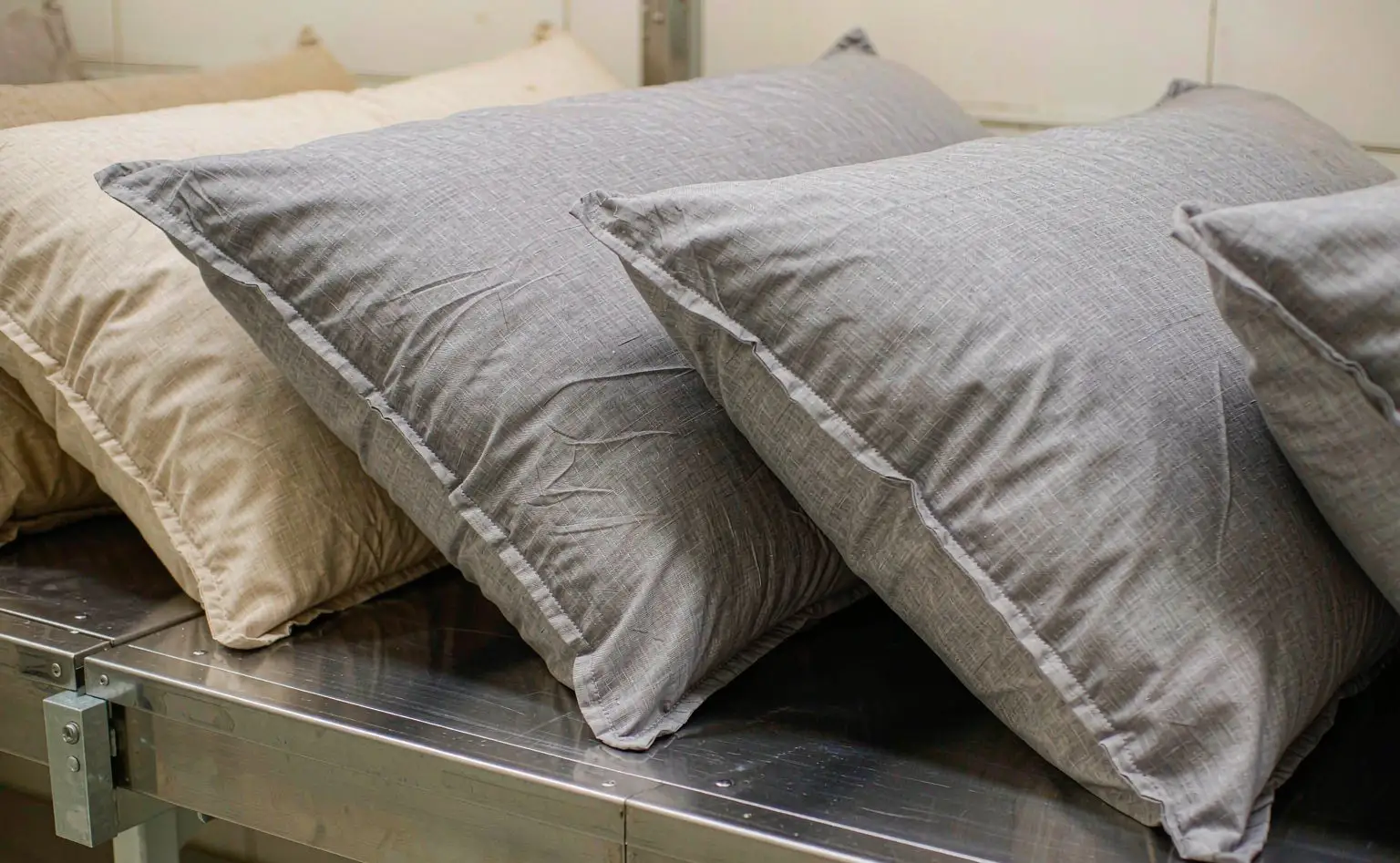
1. The filling takes up water and moulds from the inside out
Take a cushion apart: outer cover, lining, filling, zip or piping. The cover is polyester, cotton-linen or a blend, the filling polyester staple or feather-soft fibre. Of those four, the filling is the one that fails, and it fails where nobody sees it.
Staple fibre is an open structure. Polyester staple is crimped and tangled, so the fibres leave gaps everywhere. Gaps take water quickly and give it up slowly, and once the filling is packed tight into a cover there is almost no air movement inside, so whatever vapour goes in stays there.
Why the outside looks fine. The cover hides it and the hand cannot feel damp. By the time there is a smell, or the inside of the cover has yellowed, the filling is mouldy all the way through. That lot cannot be reworked, only scrapped.
Compression packing makes it worse. Export cushions are often compressed or vacuum packed down to a third of their volume. The pressure squeezes the gaps out of the fibre, so vapour has nowhere to go, and it sits in the bag for the whole sea voyage.
2. Shell and filling run on two counts
The table lines up the cover, the lining, the filling and the packing. Both the fabric and the filling are counted on o.w.f., weight of fibre, but they run on two lines and two baths, and they are not mixed.
| Part | Material | Product and level | Stage | Control point |
|---|---|---|---|---|
| Outer cover | Polyester, cotton-linen, blend | iHeir-BJ 2%-3% o.w.f. | Padding after dyeing, before setting | Bath 21-50℃, pH 4.5-8.5 |
| Lining and piping | Polyester lining cloth | iHeir-BJ in the same bath | Same padding pass | Pick-up held at 70% |
| Fibre filling | Polyester staple, feather-soft fibre | iHeir-333 2%-3% o.w.f. | Dip tank, then extract | Fully wetted, even extraction |
| Bag and carton | PE bag, corrugated | Humidity controlled, no extreme vacuum | Compression packing | Regain on spec before pressing |
One boundary. BJ handles the cover and the lining, 333 handles the filling. Treat the shell only and the filling still moulds; treat the filling only and the shell still spots. Run both lines and the pack opens clean.
3. Dosing 333 into the filling at 2%-3% o.w.f.
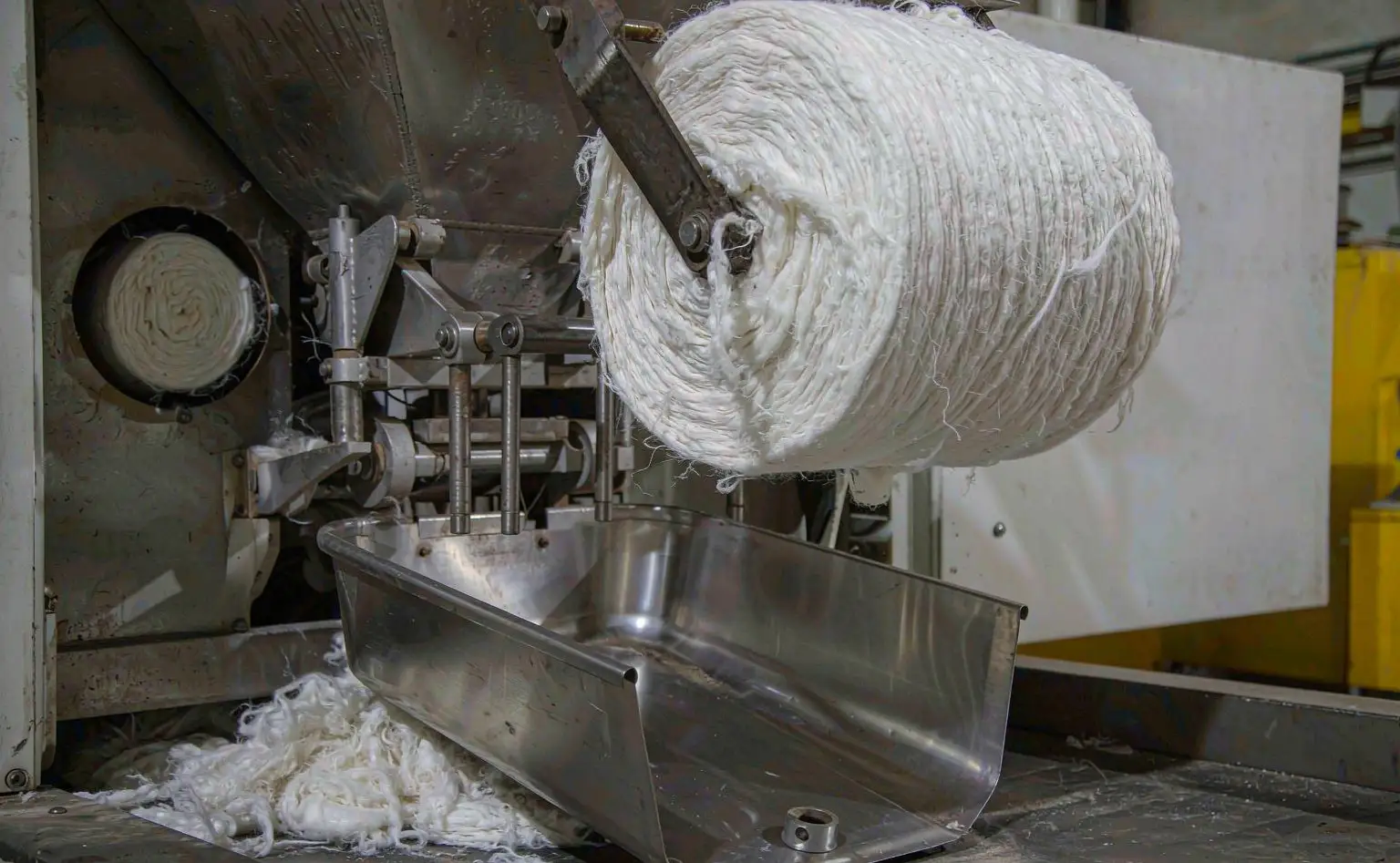
The level is 2%-3% o.w.f., on fibre weight. Fast-turnover domestic work takes 2%; export, compression packing and long sea routes take 3%. Loose filling is dipped in a tank and then extracted, not sprayed.
Mixing the bath. A working recipe is 67kg of pure water with 3kg of the agent, stirred before the fibre goes in. Hold the bath at 21-50℃ and pH at 4.5-8.5, and use soft water: calcium and magnesium in hard water bind the agent, so less of it lands on the fibre.
How to tell it landed. Use the bromophenol blue water test: put a drop on treated, dried fibre and a colour within 2 minutes means the antimicrobial layer is there. It is the fastest line-side check, far quicker than a lab test, and a few points per batch are enough.
Extract evenly. Centrifugal extraction after the dip: uneven extraction clumps the fibre, and a clump dries outside while the core stays wet. The wet core is where the spots appear. Go straight to the dryer rather than stacking wet fibre to wait.
4. The shell gets its own BJ finish on another line
The shell line runs 2%-3% o.w.f. of BJ: 2% gives roughly a year of protection and 3% gives two to three years. A cushion is used close to the body and washed repeatedly, so export orders take 3%.
Bath conditions. Hold 21-50℃ and pH 4.5-8.5, ideally 6, with soft water. Fix the pick-up at 70% and keep mangle pressure and line speed steady, because a 5% swing in wet pick-up is a 5% swing in the real dose.
How to add it. Dilute it with 9-13 times its volume of water first, then feed slowly into the padding bath. Cushion fabric is usually finished with softeners and antistatic agents, and anionic auxiliaries cannot share the bath with BJ because the two cancel out, so check the ionic type first and run anionics in a separate bath.
Run the lining through too. Send the lining, the piping tape and the zip tape through the same bath, which costs almost nothing and covers every textile part of the cushion. Treat the outer layer only and mould on the lining still reaches the shell.
Do not overcook the setting. Polyester is usually set at 170-190℃ and cotton lower. Too hot and the face yellows and stiffens while the agent does not stay on, so a process change gets a trial looking at whiteness, hand and mould resistance together.
5. Drying, regain and compression packing
Water left in the finished goods undoes both earlier steps.
Regain is the hard number. Polyester has a standard regain of only 0.4%, so anything above 1% in practice means it is not dry; cotton and blends are held to their own standard values and cotton above 9% does not go into packing. Test by bale, not just the surface.
Dry right through. Loose filling dries on the outside first and last in the core, so set oven temperature and time by bale weight, spread the fibre to cool after the oven and only then bag it. Bagging while still warm condenses water inside the bag.
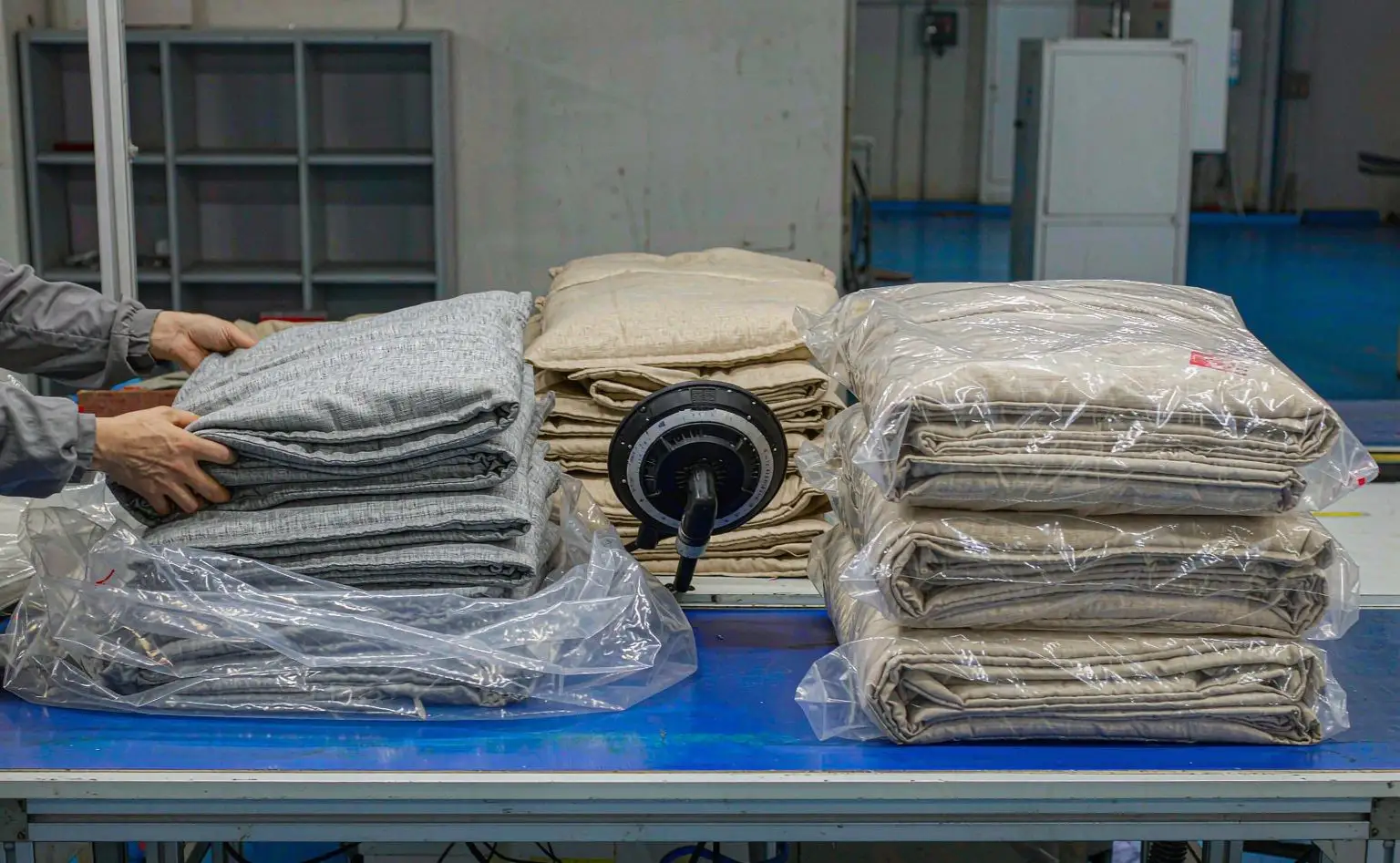
Do not pull a hard vacuum. The harder the vacuum, the denser the fibre and the worse the air movement. Leave a little margin so the bag has some give, and check a few bags hours later for suck-back, which means pinholes in the film.
Storage and loading. Hold the finished store below 60% RH, stand compressed bales on edge rather than flattening them, keep pallets 10cm off floor and wall, open a few bags for a smell check before loading, and line the container and hang desiccant sticks. Other home-textile work is covered in plush fabric, pile or filling and in fabric furniture prevention.
6. Questions on two lines, two baths and packing
Q: If the shell is treated, does the filling need its own treatment?
Yes. A cover does not stop vapour, and the filling takes up water and moulds on its own, in the place discovered last. The two steps cover different parts, and dropping one leaves a gap.
Q: Can 333 and BJ share one bath?
Not advisable. They are aimed at different substrates and stages, mixing makes the concentration impossible to control, and it affects the hand. The filling runs a dip tank, the shell a padding bath.
Q: Why do compressed cushions mould more easily?
Compression squeezes the gaps out of the fibre so vapour cannot escape, and a sea voyage is a month of that. Compressed lines take 3%, hold regain harder and avoid a hard vacuum.
Q: A bale already smells musty, can it be saved?
Open it, loosen the fibre and dry it again; if the smell persists, scrap the bale rather than mixing it into good stock. A musty smell means the filling is mouldy all through, and washing the surface achieves nothing.
Four points to take away: dose iHeir-333 at 2%-3% o.w.f. on the filling, mixing 3kg of agent into 67kg of pure water, holding 21-50℃ and pH 4.5-8.5, extracting evenly and confirming the layer with a two-minute bromophenol blue test; run the shell and lining on a separate line at 2%-3% o.w.f. of iHeir-BJ, diluted 9-13 times first, pick-up at 70%, anionics in another bath; test regain by bale after drying, below 1% for polyester and under 9% for cotton, and let goods cool before compression packing; grade mould resistance to GB/T 24346-2009 and send any antimicrobial claim to GB/T 20944.3 or AATCC 100. A kilogram of agent goes out for a trial, with MOQ on the iHeir-BJ product page.


