




 View Count:23
 Date:2026-10-27
Can canvas shoe mould be prevented when the upper and lining are both fabric and the shoe leaves a steam autoclave wet? A shipment sat for a month and grey spots came up across the upper while the lining inside was worse — the smell carried over the rubber. The upper canvas and the lining are finished in one bath with iHeir-BJ at 2%-3% o.w.f., bath 21-50℃ and pH 4.5-8.5, and moisture is re-checked after vulcanising. This article sets out where a shared bath works, the recipe, and the verification steps.
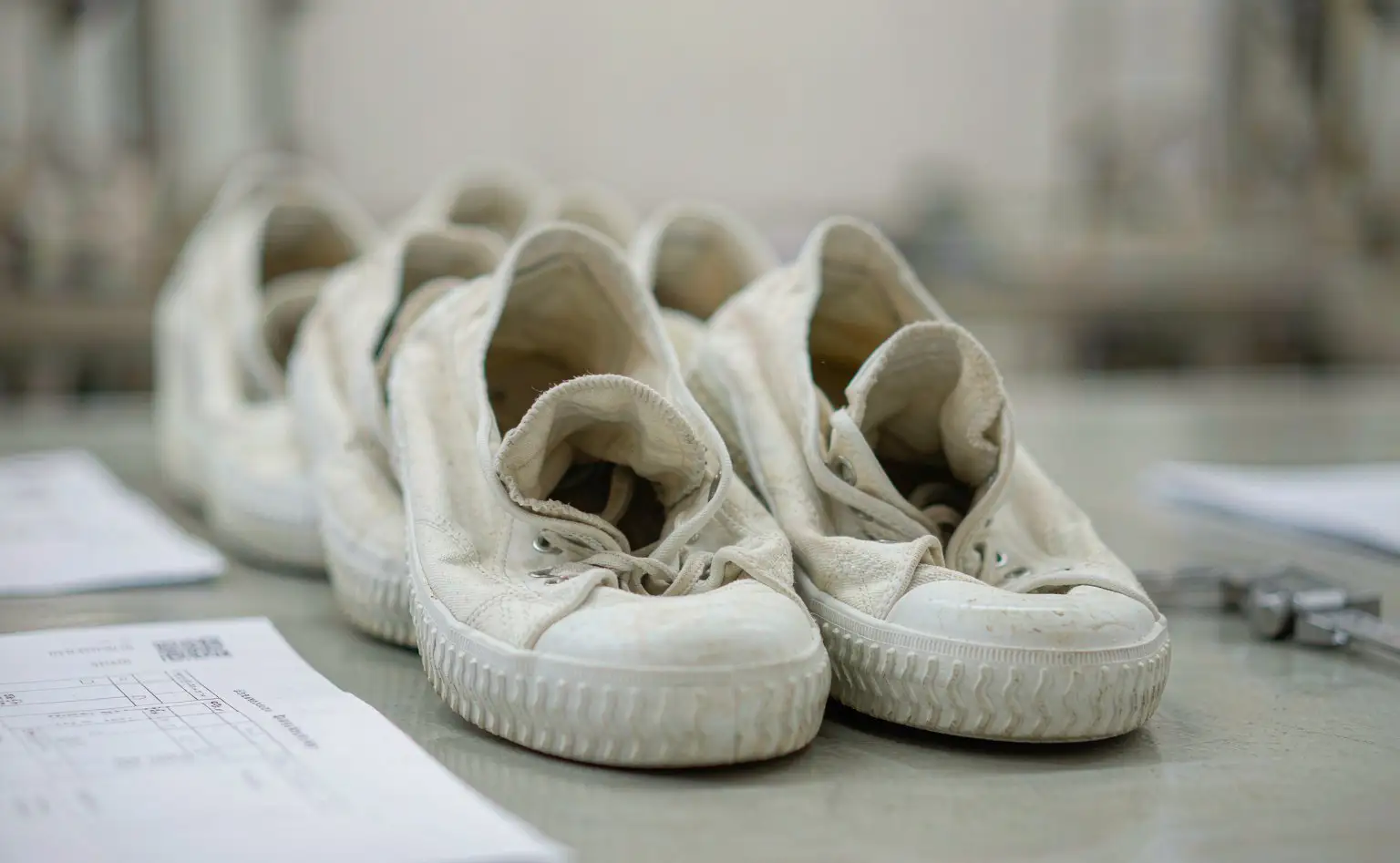
1. Mould grows on the upper and the lining at the same time
A canvas shoe is a textile-rubber assembly: thick canvas for the upper, a thin knit or twill for the lining, vulcanised rubber for the sole. Mould does not start in the rubber; it starts in the two fabrics — canvas is thick and takes up a lot of water, the lining is thin and sits against the foot, and both are fibrous materials holding water and residue in their pores.
Canvas has its own route. The yarns are coarse and tightly woven, so water diffuses in slowly and comes out more slowly still; the upper also passes through steam and adhesive during assembly, and the adhesive that soaks into the fabric wraps the fibres, so those areas neither take up the finish nor dry properly. The lining is more direct: against the foot, absorbing sweat, poorly ventilated, inside a semi-closed shoe.
So the answer is a textile finish on both fabrics, ideally in the same bath: the two are similar materials on similar processes, which saves a step and avoids a colour difference between them. What has to be worked out separately is the wet pick-up, not whether they can share the bath.
2. Where the shared bath stops
The table sets out upper, lining, rubber sole and packing. The first two share the finishing bath, the rubber does not enter it, and packing is about drying and humidity control.
| Location | Material and stage | Product and level | Method | Basis |
|---|---|---|---|---|
| Upper canvas | Heavy canvas, pad finishing | iHeir-BJ 2%-3% o.w.f. | Shared pad bath | Fabric weight, wet pick-up checked separately |
| Lining fabric | Light knit or twill | iHeir-BJ 2%-3% o.w.f. | Same bath as the upper | Fabric weight, wet pick-up checked separately |
| Rubber sole | Vulcanised | Not part of textile finishing | — | Not calculated on fabric weight |
| Packing and export | Tissue, carton, container | Desiccant plus store humidity control | Packing and loading | Carton volume and container type |
Two boundaries. First, one bath does not mean one figure: each fabric is dosed on its own weight, and heavy canvas has a much higher wet pick-up than a thin lining, so the same bath puts different amounts onto the two. Weigh both. Second, rubber stays out of the bath: vulcanised rubber takes up nothing in a textile bath and only contaminates it.
3. The shared bath: recipe, ratio and wet pick-up
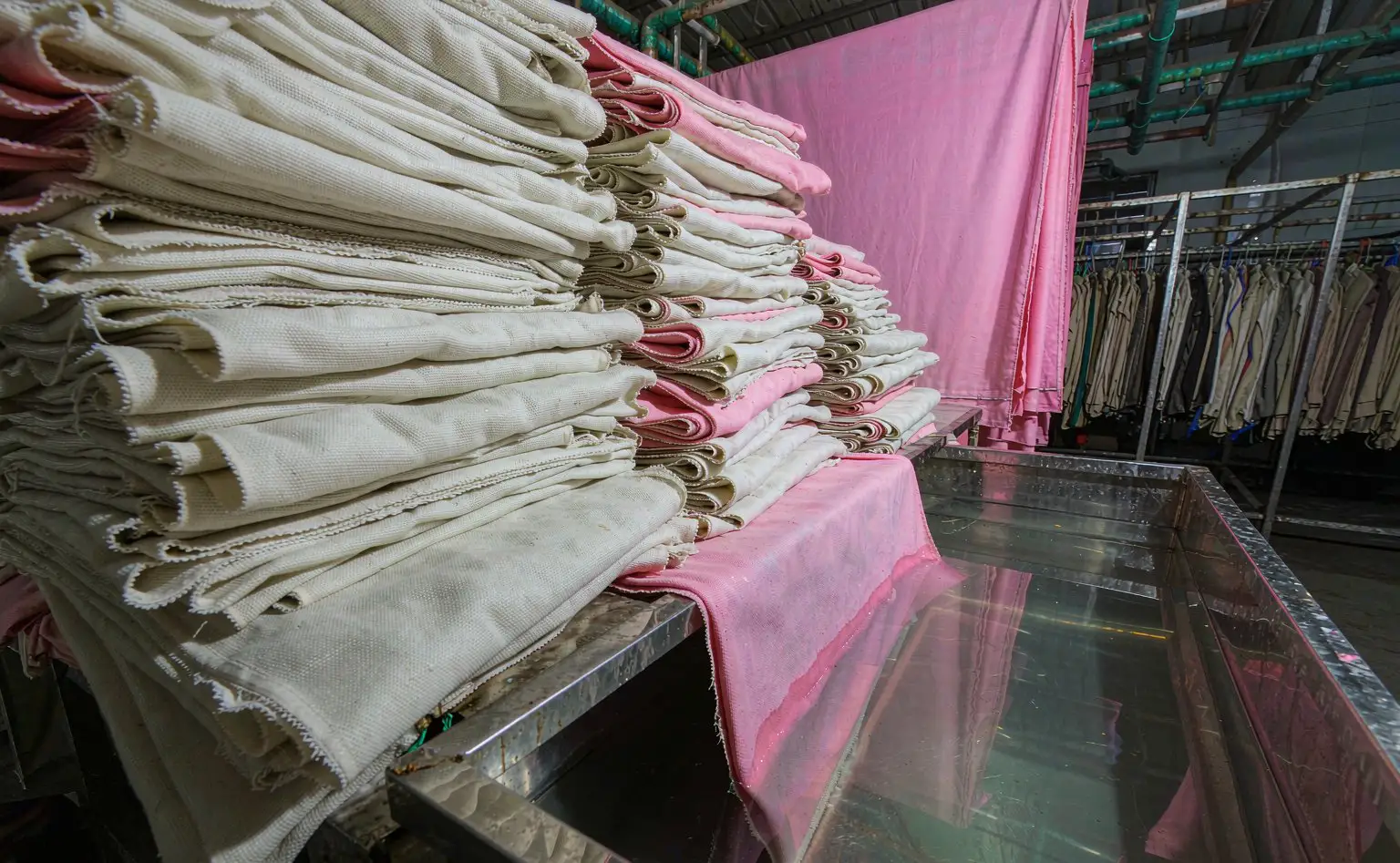
Use iHeir-BJ at 2%-3% o.w.f. on fabric weight, bath 21-50℃, pH 4.5-8.5. Dilute before making up: premix BJ with 9-13 times its volume of water, add 0.1% wetting agent, then bring the bath to volume. Concentrate poured straight in gives local over-concentration and marks on the cloth.
The number that decides a shared bath is not the concentration but the wet pick-up: the liquor a fabric carries away after the mangle, as a percentage of its dry weight. Weigh the dry fabric, saturate it, run it through the mangle and weigh again to get a pick-up for each fabric, then check that the actual add-on sits in the band corresponding to 2%-3% o.w.f. Heavy canvas typically picks up 1.5-2 times what a thin lining does, and the bath make-up has to allow for that.
One hard constraint: BJ is cationic and must not share a bath with an anionic auxiliary. Finishing shops also run softeners, penetrants and water repellents, and an anionic one meeting BJ flocculates — scum in the bath, no pickup on the cloth, protection effectively zero. Schedule cationic and anionic auxiliaries on separate runs, or confirm compatibility on a small sample before the full batch goes in.
4. Re-check moisture after vulcanising
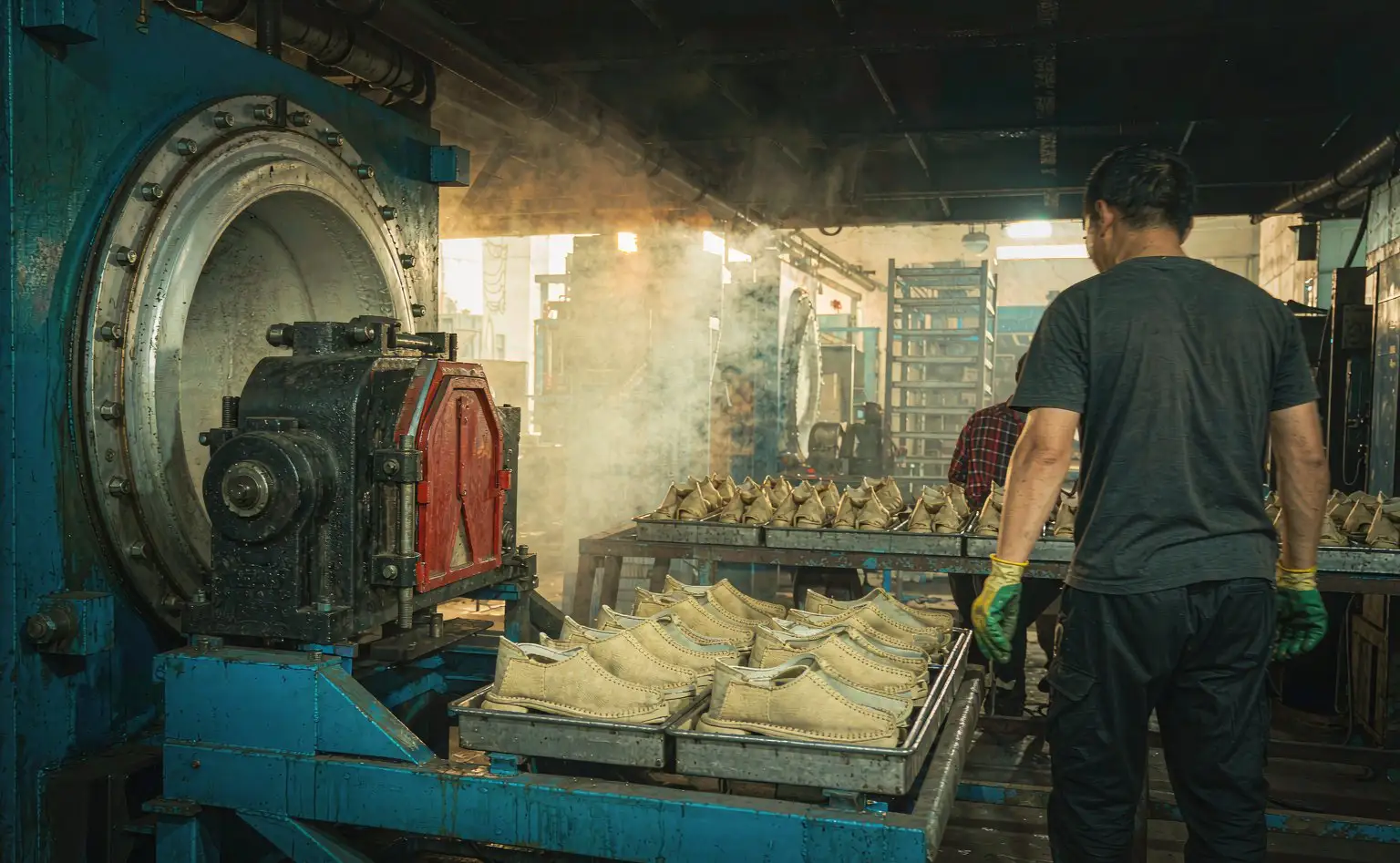
A canvas shoe takes its form in the autoclave: the blank goes on the last and steam and pressure cross-link the rubber. The autoclave is hot and wet, and the shoe comes out wet all through — water in the rubber, in the fabric layers and in the adhesive is all on its way out at once. Packed straight from the autoclave, that water is sealed into the carton and the mould starts in the lining.
So moisture is measured again. Let the shoes stand and cool after the autoclave, then measure with the fabric at shop temperature: two readings on the upper and two on the lining, and the fabric has to be below 8% before packing. Keep the shop below 60% RH, add dehumidifiers in the wet season, hang the shoes rather than stacking them.
Two more details. First, the tissue former has to be dry: it is there to hold the shape, and damp tissue is a charge of water inside the shoe — open the pack as needed and store it sealed. Second, do not close the lid immediately: leave the lid open for a shift so residual water escapes; that shift is worth more than extra desiccant.
5. Packing and export
Two things at packing. First, desiccant in the shoe box, sized to the box, in a non-woven bag in one corner and off the upper; a bag opened is used within the shift and the rest is sealed. Second, bag each shoe in a breathable bag rather than a sealed film bag — a sealed bag looks clean but holds the moisture in, and the first thing noticed on opening is the smell.
Leave an air path in the container: no carton against the wall or ceiling. The day-night swing over a thirty-day sea leg condenses water on the ceiling, it runs down the wall, and the cartons at the wall come back damp first, with the lining going mouldy before the outside. The mechanism is the same as in our note on condensation in sea freight containers,.
Verify at three levels. Fabric: a drop of bromophenol blue solution shows within two minutes whether the finish is present, then a mould resistance grade to GB/T 24346. Finished shoe: fabric moisture at two points in the process, off the autoclave and before packing. Carton: 30 days at 30℃/85% RH in a damp heat chamber, then inspect the lining and the tongue.
6. Questions on hand feel, yellowing and shoes that already have mould
Q: The fabric feels stiffer after the shared bath. Overdosed? Check the drying curve and the wetting agent first. Within 2%-3% o.w.f. BJ has little effect on hand feel; stiffness usually means the drying temperature is too high or too little wetting agent was used, and correcting those two works better than cutting the dose.
Q: The white canvas came out yellow after finishing. Where does that come from? Check bath pH and water quality first: pH outside 4.5-8.5 and elevated iron in the water both yellow white fabric,. White batches are better on their own bath and their own run, not shared with dark shades.
Q: Can a pair that already has mould be saved? Where the mould is on the surface and has not reached the yarn core, brush, dry and give it a fresh finish. Where the filaments have entered the fibres and left permanent staining or a brittle hand, the pair is a downgrade. Any rescued batch needs a fresh finish, or the next damp spell brings the mould back.
Four points to take away: upper and lining at 2%-3% o.w.f. iHeir-BJ on their own fabric weights in one bath, 21-50℃, pH 4.5-8.5, premixed with 9-13 times water plus 0.1% wetting agent; weigh both fabrics and work out pick-up separately, with heavy canvas at 1.5-2 times the lining; keep the cationic agent on a separate run from anionic auxiliaries; below 8% fabric moisture after the autoclave, desiccant in the box, an air path in the container.


