




 View Count:10
 Date:2026-10-30
Can flower pot mould be prevented at all, when the pot is a PP or ABS moulding with nothing in it to feed fungi? The mould arrives in storage and transit: condensation on the inner wall, water in the saucer, a carton taking up moisture. A rejected lot is graded on a ring of dark specks. Add iHeir-IPI001 at 0.8%-1.0% of part weight, drain the pots mouth-down before packing, and put iHeir-D paper at 0.1-0.2 g a sheet in the carton. This article covers both doses, the draining sequence and the release test.
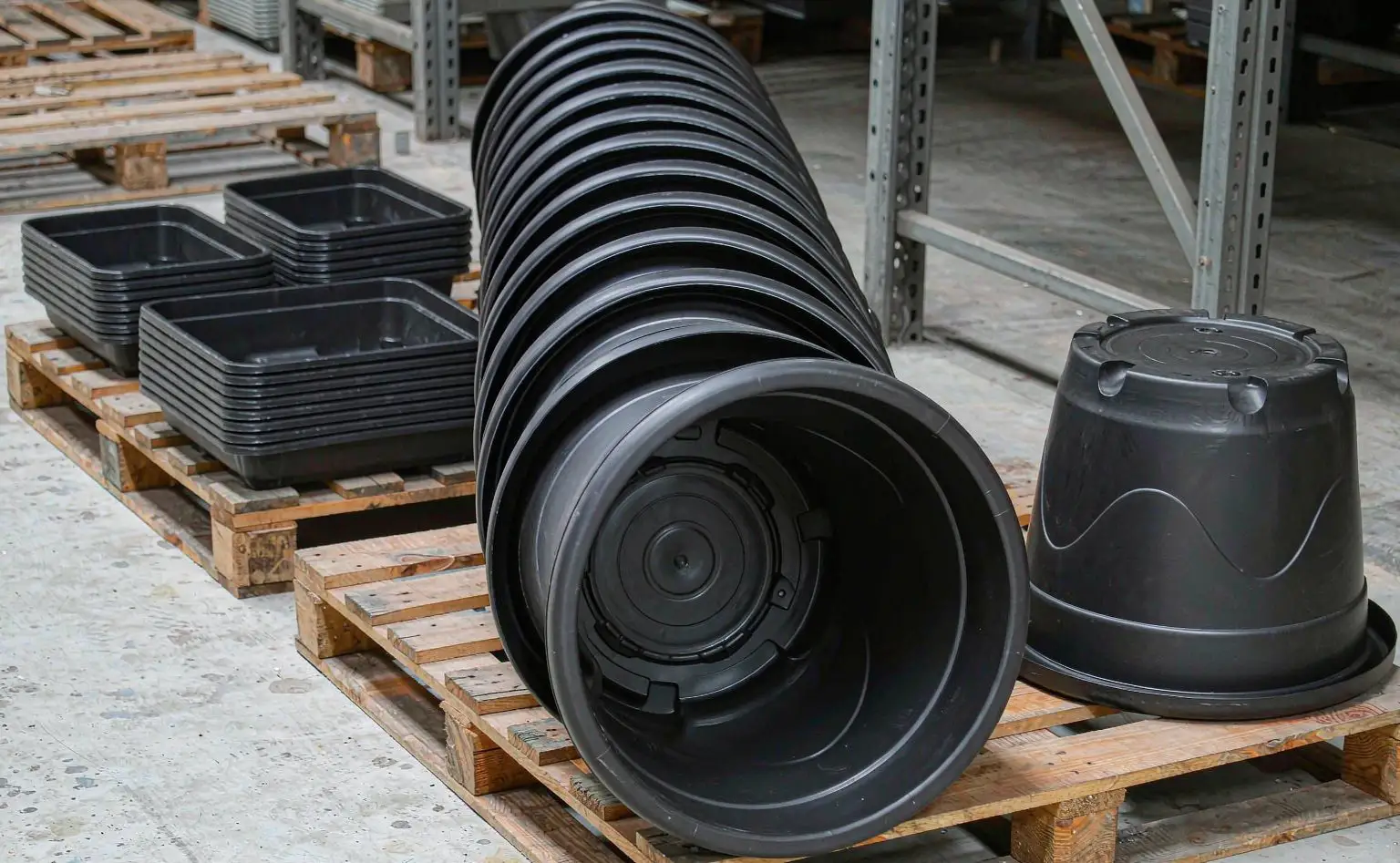
1. Mould appears on the inner wall and in the saucer
An injection-moulded pot is a thin-wall part in PP, ABS or regrind with colour masterbatch: dense, non-absorbent, and in theory not a mould substrate. In practice three locations fail every time — the inner wall, the saucer and the carton with its instruction card.
The inner wall is the face pointing up once the pots are stacked mouth-down. If the part is not blown dry after demoulding, or if it is handled with wet gloves, water collects at the corner between the base and the wall; the day-night swing on a sea leg condenses more on that face, and a spore landing there finds a water film waiting. The saucer is a thin disc, and water sits between discs while they are stacked; a month under load and there is a ring of specks. The carton takes up moisture in the store and the inside is stiller than the shop floor, so spores settle on clean walls as well.
One more point that gets missed: terracotta and cement pots do not grow mould, they effloresce. The white bloom on those pots is salt migration, not fungus, and buyers complain about both in the same email. Separating the two saves a wrong rework: efflorescence washes off, mould means changing the compound or the packing.
2. Pot compound and carton are handled separately
The table lines up pot, saucer, carton and storage. The pot is dosed on part weight, the paper on sheets and active content, and the two are not convertible.
| Part | Material | Product and level | Stage | Control point |
|---|---|---|---|---|
| Pot body | PP/ABS with masterbatch | iHeir-IPI001 0.8%-1.0% of part weight | Mixing or compounding | Even mixing, shade trial on pale parts |
| Saucer | Thin-wall PP | Same compound family, same dose | Same mixing stage | No water between discs |
| Carton liner | Board, instruction card | iHeir-D 0.1-0.2 g per sheet | At packing | Paper facing in, box sealed |
| Storage and export | Pallet, container | Sheets per carton, humidity control | Warehouse, loading | Store below 60% RH |
One boundary. The antimicrobial works on the water film on the pot surface; it does not remove spores already inside the carton, and it does not deal with free water trapped between saucers. Dosing and draining have to run together, or the problem is back at the next wet season.
3. Pot moulding: the antimicrobial goes in at mixing
The pot body takes iHeir-IPI001 inorganic zinc-ion antimicrobial at 0.8%-1.0% of part weight. The active content is a zinc-ion compound on a carrier at 99% or above: white powder, whiteness above 90, D90 under 3μm, bulk density 1.8-2.4 g/cm³, packed at 10kg. It resists discolouration by controlling the release rate of the metal ion, so it does not shift colour in the barrel.
Where it goes in: in-house compounders dose it in the high-speed mixer with resin and masterbatch for 8-10 minutes; if pellets are bought in, make an antimicrobial masterbatch on a twin-screw and convert the let-down ratio at the machine. Do not sprinkle powder into the hopper — a pot is a large thin-wall part with a long flow path, and uneven dispersion leaves patches with no protection.
Three points. Pale parts: white and bone pots show shade drift first, so trial them. Regrind: high regrind PP calls for 1.0%. Wall thickness: thin sections cool fast and the surface concentration matters most, so run the original mould temperature rather than adjusting it for the additive.
4. Draining before packing and the paper inside the carton
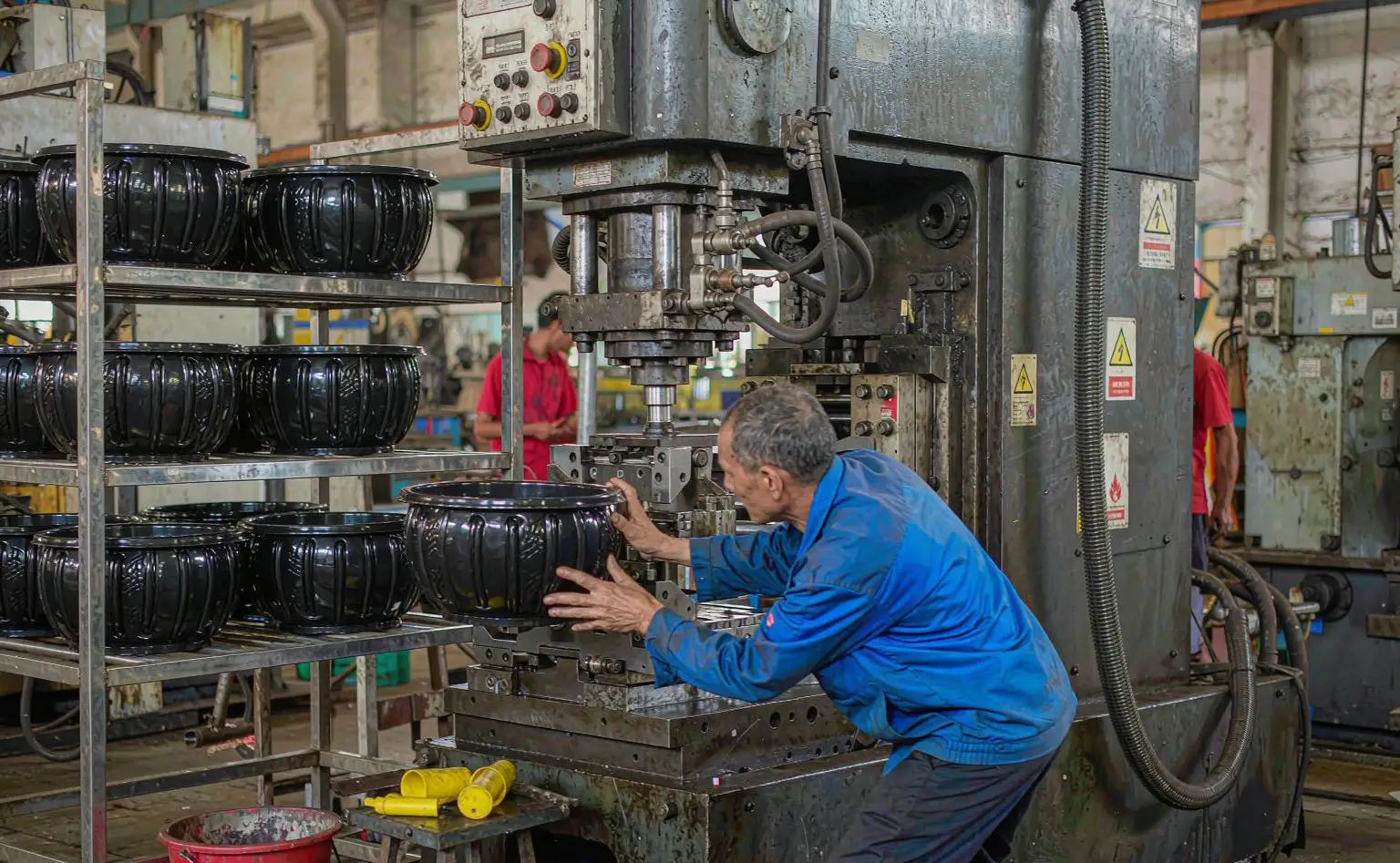
Draining is the stage that gets skipped. The order is blow dry off the mould, drain the water-cooled part, stand it mouth-down, then pack: after spray or water-bath cooling, stand pots mouth-down on a rack for at least 30 minutes, until no water hangs at the base corner, and only then pack. Packed mouth-down, any residue runs away from the inner wall instead of pooling on it.
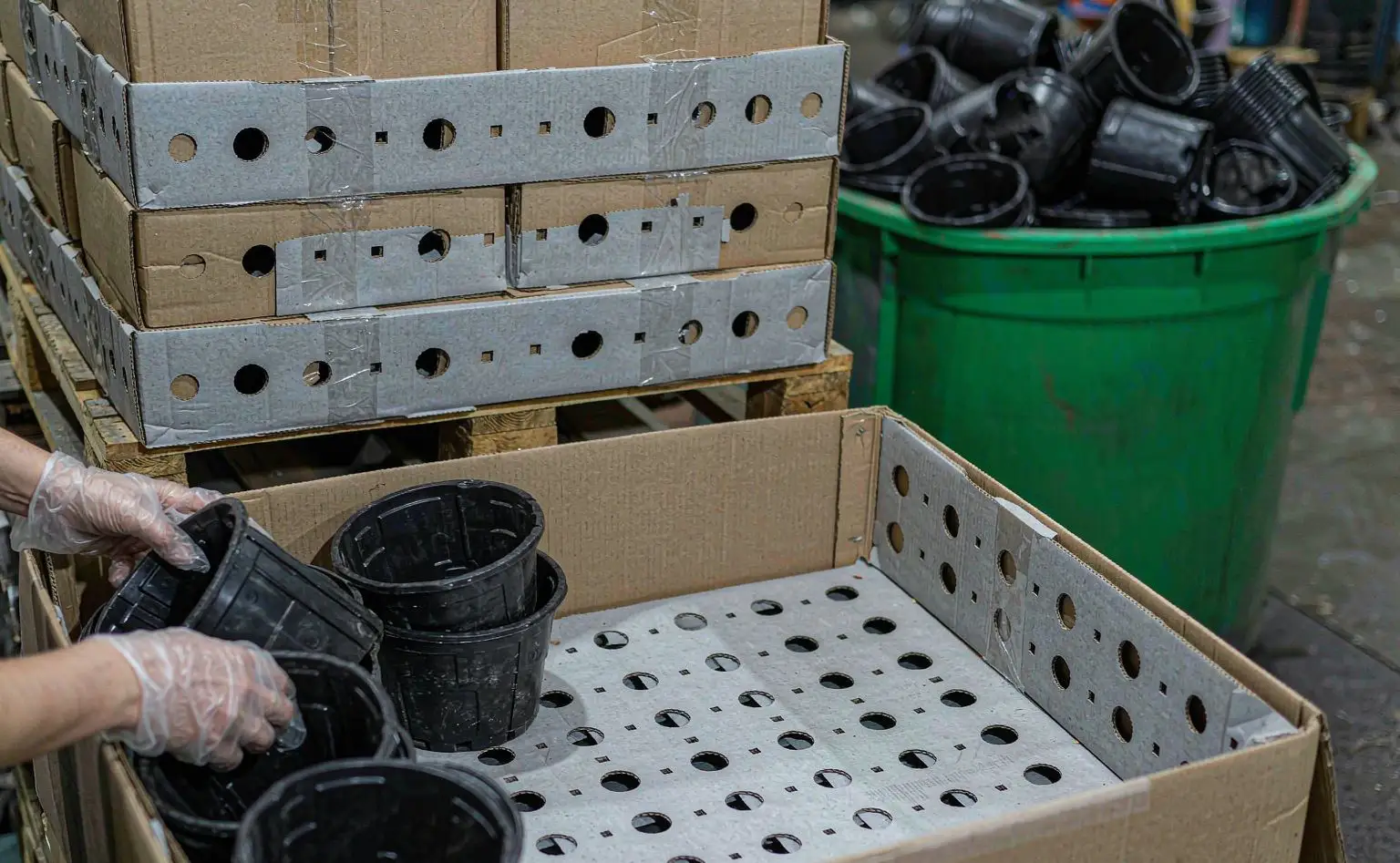
Inside the carton the product is iHeir-D gas-phase anti-mould paper, 0.1-0.2 g of active content per sheet, solids 70%±5, 25kg per drum, one year shelf life. It is a coated paper that releases into a closed space, so position and closure decide the result: against the carton wall, face towards the pots, box sealed. Sheet count follows carton volume and piece count; settle it with a packing trial — 30 days at 30℃/85% RH, then open and check inner walls and saucers.
Where saucers are packed on their own, put a thin sheet or a piece of anti-mould paper between discs instead of stacking plastic against plastic. Water trapped between two flat faces is where the specks concentrate.
5. Storage and export loading
In the store: pallets on racking, 10cm off the floor and 10cm off the wall, below 60% RH, first in first out. Pots are bulky and light, so deformation starts at the third layer unless a board goes between layers.
Leave an air path in the export container and keep cartons off the container wall; the logic is in condensation in sea freight containers. If stock is held outdoors at destination, the pallet has to be raised, because the bottom cartons in a wet season are the first to fail.
Release at three levels: pots to GB/T 1741 or ASTM G21 for mould grade; antibacterial rate to ISO 22196 or GB/T 20944.3 where a buyer wants a report; whole cartons for 30 days at 30℃/85% RH, checking inner walls, saucers and the card. All three together are what closes out the storage period.
6. Questions on shade, dark rings and clay pots
Q: Will the antimicrobial change the pot colour?
IPI001 resists discolouration, and at a normal dose white and bone parts look the same. Before a production run, mould a control set — half the batch dosed, half not, same mould and temperature — and compare shade under the same light.
Q: Is that dark ring inside the pot mould or scale?
Wipe it: what comes off cleanly with no mark is scale and dust; a pale brown stain that stays and smells earthy means the mould has gone into the surface layer. That part is replaced, because the additive prevents, it does not repair.
Q: Do terracotta and cement pots need the antimicrobial too?
No. The white bloom on those is efflorescence, a firing and curing issue, handled by washing and thorough drying; their mould problem sits in the carton and the packing, which the paper covers.
Four points to take away: dose the pot compound with iHeir-IPI001 0.8%-1.0% of part weight at mixing or compounding, trial the shade on pale parts and go to 1.0% with high regrind; blow dry, stand mouth-down and drain for at least 30 minutes before packing; put iHeir-D paper at 0.1-0.2 g per sheet into the carton by volume, face in and box sealed; store below 60% RH and release whole cartons on 30 days at 30℃/85% RH. A 1kg sample can go out for a moulding trial first; MOQ and lead time are on the iHeir-IPI001 product page.


