




 View Count:25
 Date:2026-09-11
Nanxun Wood Flooring Mold Prevention: Moisture Control & Export Packing
Nanxun in Huzhou is China’s largest wood flooring cluster — solid, engineered multilayer and laminate flooring produced here accounts for over a third of national output, flowing to domestic project channels and export markets in North America, Europe and Australia. Flooring is a classic “installed-then-discovered” product: problems surface only after the floor is laid in the customer’s home, and rework costs ten times the goods. Mold is the defect end users spot first — one mold streak along a joint and the buyer concludes the whole batch is bad. And 90% of flooring mold traces back to the blank stage: over-moist wood entering the kiln with fungus already inside. This article lays out a complete, plant-ready process across six stages: blank moisture content, kiln drying, anti-mold treatment, coating, warehousing, and container loading.
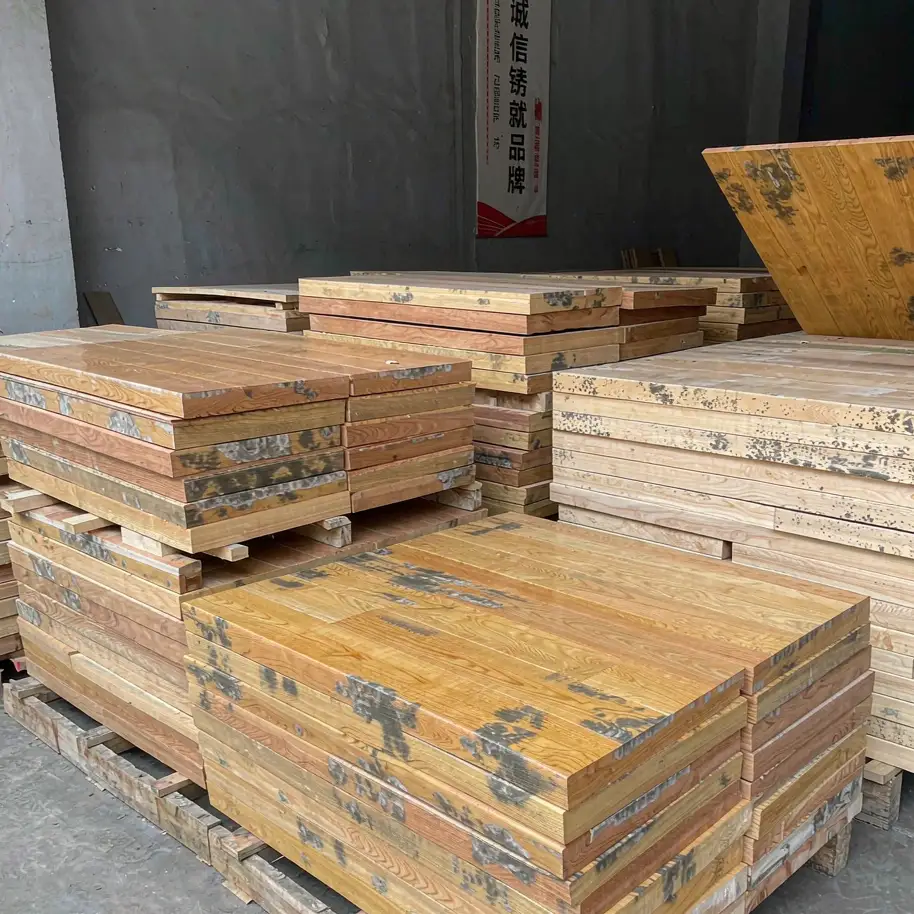
1. The Root Cause: Over-Moist Blanks Are 90% of the Problem
Fungus grows on wood when three conditions coincide: 5–40°C, sufficient oxygen, and wood moisture content (MC) at or above 20%. The first two are fixed by the workshop; MC is the one variable you control. Three numbers matter:
- 20% is the mold line: above 20% MC (below the fiber saturation point), spores germinate. Wet blanks stacked in the open during southern rainy season typically run 30%–60% MC — high-risk material;
- 12% is the finished-goods line: GB/T 15036 requires solid flooring MC to match the equilibrium MC of the destination region — most markets at ≤12%, humid southern regions up to 14%, dry northern regions below 10% to prevent later shrinkage cracks;
- 2% is the layer difference: for engineered multilayer flooring, if the wear layer and core MC differ by more than 2%, delamination follows — and the adhesive layer itself becomes a mold habitat once it absorbs moisture.
A common mistake is assuming “it’s going into the kiln anyway, a little mold before drying doesn’t matter.” Wrong. Hyphae that penetrate deep into the vessels survive kiln temperatures of 60–70°C and re-emerge the moment humidity rises. The first battlefield is therefore before the kiln — the same principle as in our Nankang solid-wood furniture anti-mold guide: wood products must be protected at the raw stage.
2. Kiln Drying: Get MC Right and Kill the Fungus
Drying must balance three goals: killing fungus, reaching target MC, and avoiding checking:
- Pre-kiln sorting: group blanks by initial MC (below 30%, above 30%). Mixed stacks leave thin boards over-dried while thick boards stay wet;
- High-temperature kill phase: raise kiln temperature to 70–80°C and hold 4–6 hours (core temperature ≥66°C for 30+ minutes deactivates nearly all mold and insect eggs — the same logic as ISPM15 heat treatment for export wood packaging);
- Drying schedule: then follow a species-specific MC reduction curve; hard hardwoods (oak, taun) at ≤5% MC reduction per day to prevent surface checking. Final MC per destination: North America 8%–10%, humid southern China 12%–14%;
- Conditioning: after kilning, rest stacks 5–7 days in a climate-controlled room so internal MC equalizes (layer difference ≤2%) before profiling and coating.
3. Blank Anti-Mold Treatment: Dip or Brush
For high-risk species (rubberwood, taun, poplar cores) and any rainy-season wet blanks, add a treatment step before profiling:
- Immersion (most thorough): prepare a 2%–5% solution of iHeir-MA soaking-type bamboo & wood preservative, immerse bundled blanks 15–30 minutes, air-dry 24 hours before kilning. The solution penetrates the vessels with the water and leaves active ingredient inside the wood — no effect on later profiling, sanding or coating;
- Brush/spray (supplementary): for profiled blanks or batches flagged by inspection, brush diluted iHeir-JP bamboo & wood anti-mildew agent onto the board backs and tongue-and-groove joints — the back of a floor is the unventilated face after installation and needs protection most;
- Long-life requirement: for exports to Australia and Southeast Asia, choose iHeir-M8 long-acting non-leaching wood antimicrobial, which bonds to wood fibers and protects for the life of the floor.
For a full comparison of soaking, spraying and powder processes, see how to use wood anti-mold agents; for general board remediation, read how to treat moldy boards.
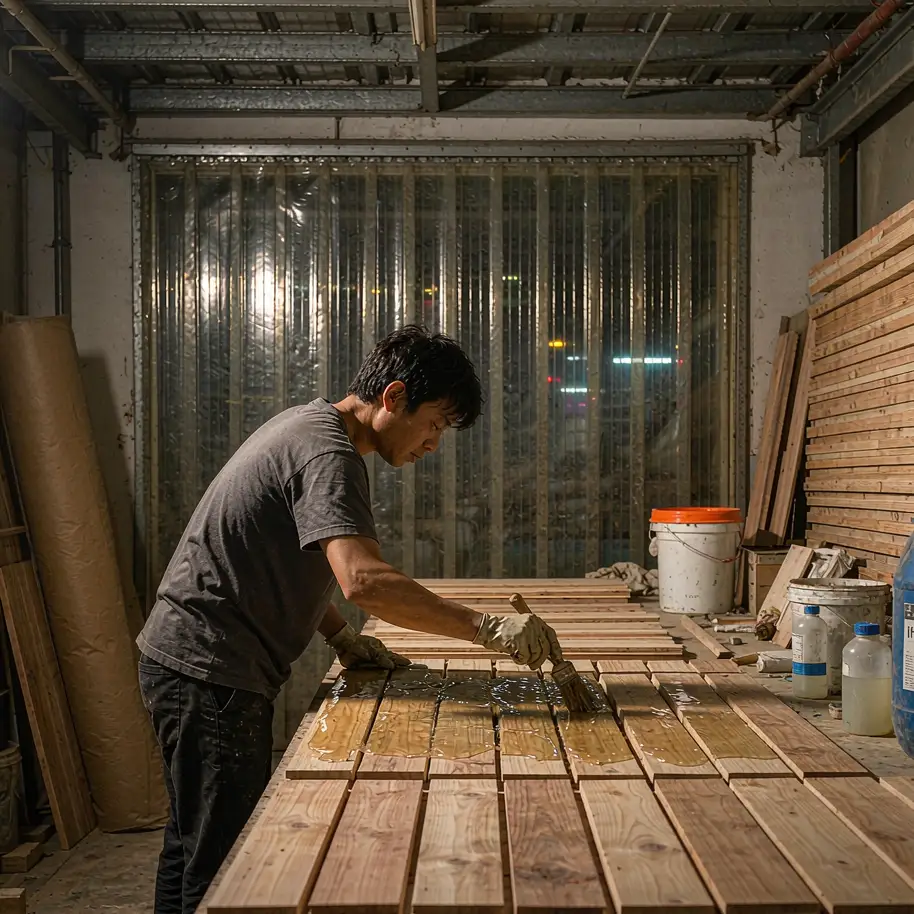
4. Coating Line: The UV Topcoat Is the Mold Face, the Back Coat Is the Mold Back
Coating is not just aesthetics — it seals surface pores so fungus loses its foothold. Two essentials:
- Full UV coverage on the face: 3–4 UV roller primer coats plus 2 topcoats, and make sure the board edges and groove walls carry film too — factories that coat only the face leave bare wood in the joints, which wicks moisture sideways and grows mold out of the seams;
- Back balancing coat: engineered flooring backs must carry a balancing layer (foil film or UV back coat). It blocks subfloor moisture and equalizes stress so boards stay flat. A floor with an uncoated back installed over underfloor heating or a damp slab has better-than-even odds of growing mold on the back within six months.
5. Finished-Goods Warehouse: Stacking, Dehumidifying, FIFO
Coated flooring has correct MC — the warehouse job is to keep it that way:
- Stacking: packed flooring on pallets, 15 cm off the floor, 30 cm off walls, 10 cm ventilation gaps between packs; never stack tight against walls where moisture lingers;
- Red line ≤60% RH: stricter than the raw warehouse because cartons absorb moisture fast; one industrial dehumidifier per 500 square meters and at least two thermo-hygrometers per bay;
- FIFO: any cartons stored over 90 days get opened and inspected (board surface and carton interior) before shipment; rainy-season intakes ship first.
6. Container Loading: Fumigation Compliance + FAQ
Loading must solve compliance and moisture at the same time:
- Wood packaging compliance: export pallets and crates need ISPM15 heat-treatment/fumigation stamps; plywood-free pallets or paper slips skip fumigation. Stamp and treatment records must match, or the container is held at customs. Pallet details in our wood pallet anti-mold & ISPM15 guide;
- In-container drying: hang 6 T-1000 container desiccant sticks per 20-ft container, 10–12 per 40-ft, evenly on the wall hooks. Flooring is dense cargo — little free air volume means condensation drips straight onto top-layer cartons, so never cut the desiccant count;
- Moisture barrier: line the container floor with barrier film before loading and drape one over the top layer, cutting off “container rain” from both directions;
- Loading window: dry mornings only; close doors immediately after loading.
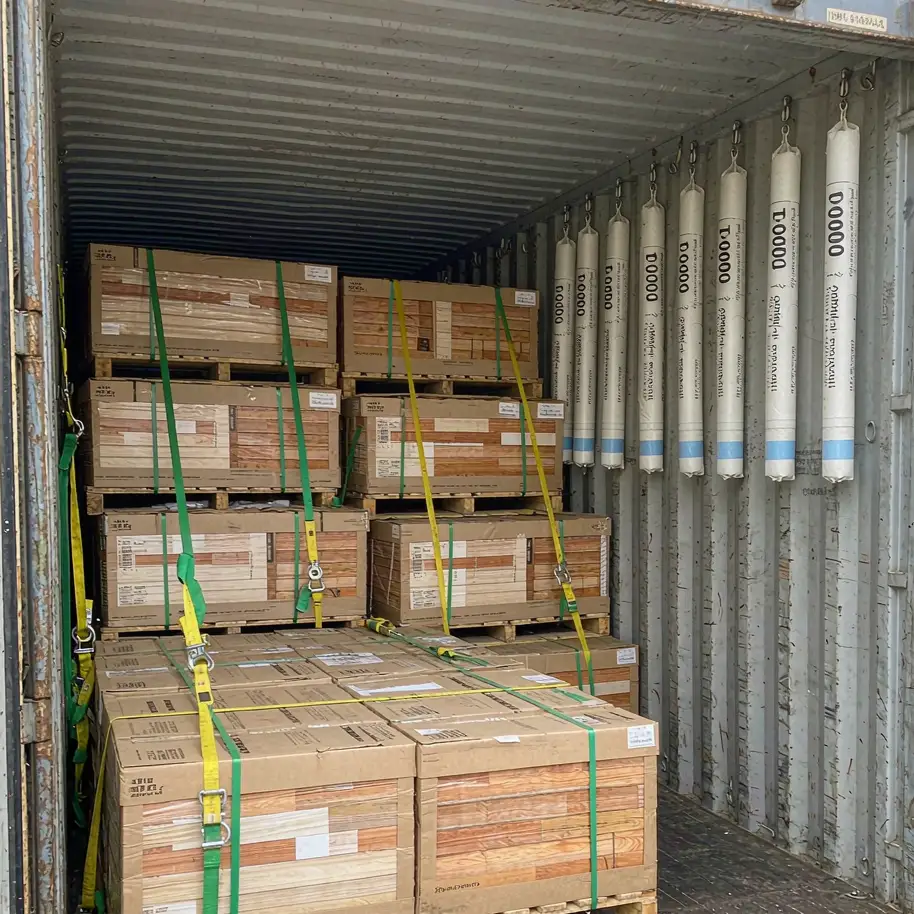
Case study: In 2024 a Nanxun flooring factory shipped a 40-ft container of 1,200 square meters of engineered flooring to Toronto. The importer’s inspection found mold on the backs and joints of 8% of boards, with top-layer cartons soaked by condensation; claims and replacement totaled about RMB 330,000. The audit found: poplar core entered at 28% MC during rainy season and was profiled directly; back balancing coats were skipped; the container had no desiccant. After rectification — reject cores above 25% MC at receiving, dip all blanks in iHeir-MA, 100% back-coat inspection, 10 T-1000 sticks plus floor film per container — the factory shipped seven consecutive containers with zero complaints and was upgraded to a primary North America supplier.
FAQ:
Q1: The board backs have mold spots. Can we clean and sell?
A: Light spots (white, on unfinished backs): wipe with iHeir-Clean solution, re-apply the balancing coat, re-test MC ≤12%, then sell into project channels as downgraded stock. Mold in the joints or on the face: rip down to shorter lengths or scrap — never into retail, because a recurrence after installation means tenfold liability.
Q2: Can the kiln replace anti-mold treatment?
A: No. Heat kills the fungus present at that moment, but flooring then passes conditioning, profiling, warehousing and months at sea — any re-wetting re-contaminates. Kiln (kill what’s there) plus anti-mold agent (protect the journey) are complementary, not either/or.
Q3: Engineered or solid — which molds more easily?
A: Engineered has an extra risk layer: urea-formaldehyde adhesive weakens when wet and feeds fungus. Once water enters the layers, mold grows hidden inside where no one can see. Engineered core MC and layer-difference control must therefore be stricter than solid.
Q4: Same desiccant count for North America and Southeast Asia lanes?
A: Not quite. Pacific-eastbound North America lanes (25–35 days) run fine at 10 sticks per 40-ft. Southeast Asia and Middle East lanes are shorter but the origin and destination ports are humid with frequent transshipment — keep 10 sticks and never skip the barrier film.
Q5: The distributor’s warehouse grew mold. Whose responsibility?
A: Look at delivery condition: if outgoing MC passed inspection, packaging was intact and moisture-protection records exist, the mold most likely developed in transit storage (leaky distributor warehouse, rising damp). Keep a 5-board sample per batch with MC records — that data settles responsibility disputes.
Want a one-shot build of the blank-to-container moisture and anti-mold system? Contact us for samples and a tailored plan. iHeir-JP, iHeir-MA and T-1000 container desiccant sticks are in stock and ship same-day for small orders. For long-term care logic in humid regions, also read why bamboo & wood mold in humid environments.