




 View Count:26
 Date:2026-11-18
Where does mould on stored tooling start? At the moment the mould comes off the press: a water film left in the cavity, an hour of the door being shut, and a fortnight later there are spots in the corners followed by rust. Hang one T-1000 rod per 1-2 m³ of cabinet volume, worked out from the container dosage, and put one or two iHeir-D sheets in the same cabinet at 0.1-0.2 g each. This article covers the shutdown routine, the dead corners, the rod position and the check before restart.
1. Mould and rust are the same problem
Steel does not grow mould by itself; the residue does: release agent, cutting fluid, sweat and oil mixed with water, sitting in a closed cabinet for a fortnight. Spots start in the corners, rust follows underneath.
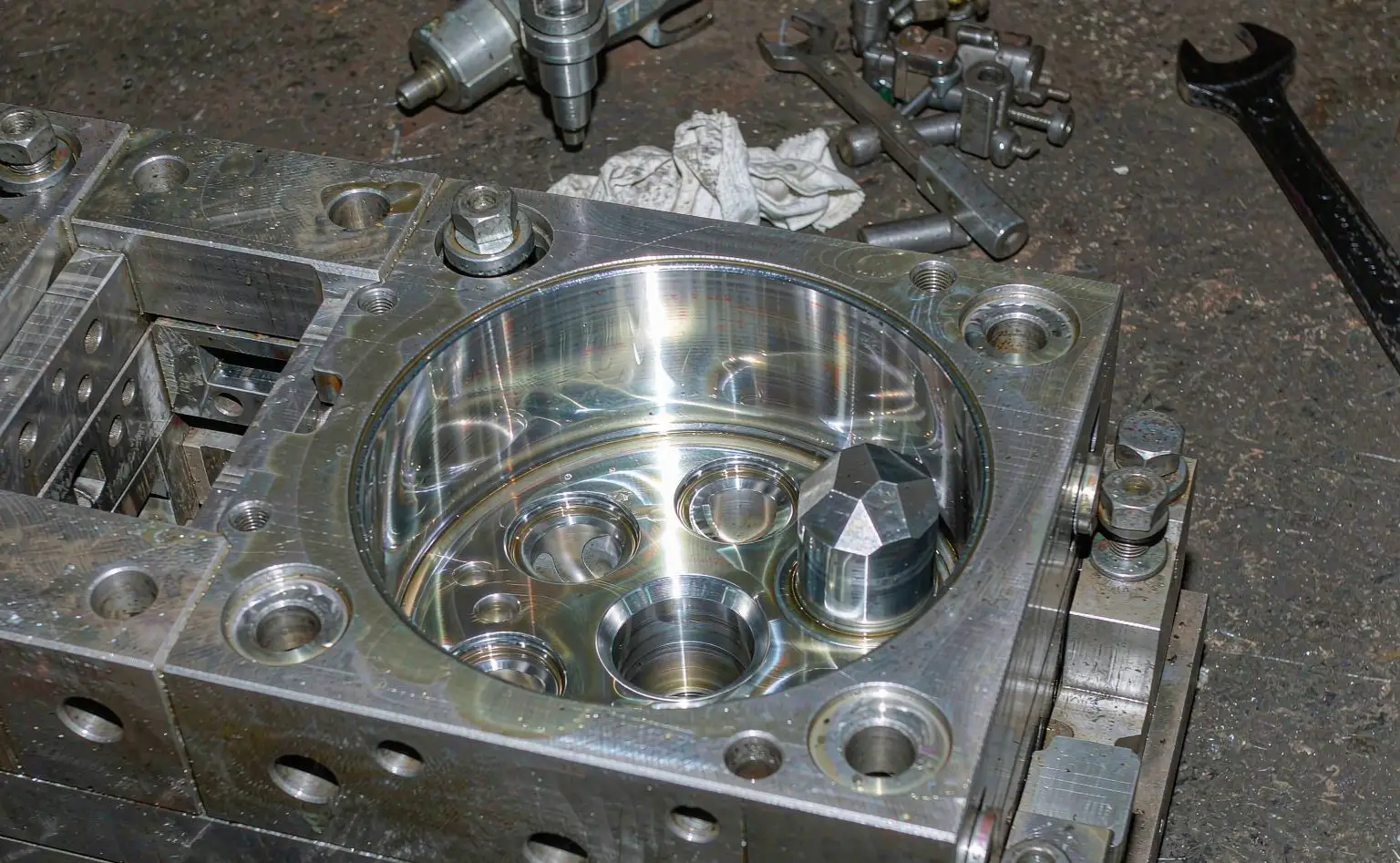
The film on the cavity face. After a trial run, a sample shot or a wash, there is always a film of water on the cavity. A wipe makes it look dry while the parting line and the radii are still wet, and that film is the starting point of the whole storage period.
Ejector holes and water lines. Water in ejector bores, insert seams and water-line fittings cannot be wiped out, only blown out. A line that is not drained seeps from inside, and the back of the cavity rusts first.
The air in the cabinet. Most mould cabinets are steel with a seal, so once shut no air is exchanged. In a southern workshop the humidity inside passes 80%RH in the wet season and condensate drips off the wall onto the frame.
Three places, three answers: the cavity by drying and an oil film, the dead corners by air, the cabinet by absorption and vapour. Skip one and the other two cannot hold.
2. Before shutdown: blow, wipe, oil
Blow first, wipe second. Open the mould, blow from the parting line outwards, then wipe with a lint-free cloth; wiping first pushes water into the radii. The air supply must pass a water trap, because a gun spitting water is worse than none.
Wipe until the cloth comes away clean. Release agent, oil and hand sweat all have to go; the test is a white cloth with no yellow mark. Keep bare hands off the cavity, because the salts in sweat are ready food.
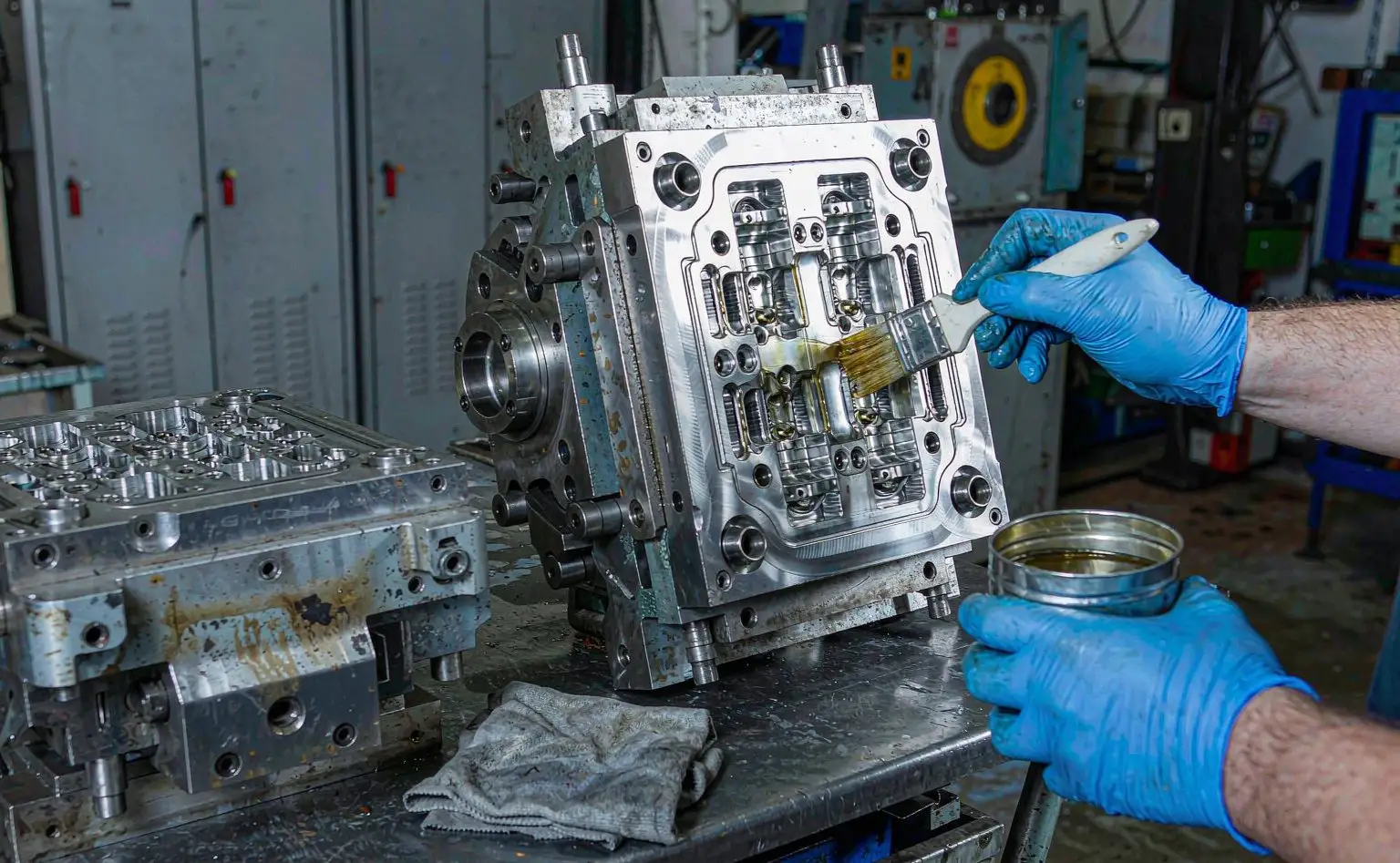
Oil thin and even. Brush or spray one thin coat. Thick oil runs into the ejector bores at the next start-up. Cover the parting line, slide guides and core sides, and do not wipe it out with a finger afterwards.
Do not clamp shut. Leave a 1-2 mm gap for air, or fit a stop block. Clamped hard, the oil is squeezed to the edges and the middle of the cavity ends up bare.
3. Ejector holes, water lines and slides: where the water hides
Blow each ejector bore. Run the ejector back, blow from the bore until no mist comes out, then put two drops of oil on the ejector pin and work it back and forth.
Blow the water lines through. Take the fittings off, put the gun on one end and leave the other open, and blow until no droplets appear; water lines will not drain by gravity, especially vertical runs.
Slides and lifters. Slide faces and lifter guides are flat contacts that take water in and hold it; strip, dry, oil and reassemble dry.
Seal insert seams with thin oil. Run a low-viscosity oil along the seam between insert and frame so it creeps in; a thick oil only sits on the surface.
| Part | Treatment | Product and level | Control point |
|---|---|---|---|
| Cavity face | Blow, wipe, oil | Rust-preventive oil, one thin coat | White cloth comes away clean |
| Ejector bores, insert seams | Blow one by one | Two drops of oil after blowing | No mist in the exhaust |
| Water lines | Blow through both ends | No addition | No droplets at the outlet |
| Storage cabinet | Absorption plus vapour | T-1000 one rod per 1-2 m³; iHeir-D one or two sheets at 0.1-0.2 g | Rods high up, sheets off the cavity |
| Export container | Rods inside the box | T-1000, 8-10 rods in a 20ft, 10-12 in a 40ft | Inside the doors, not on the load |
One boundary. The oil film covers the cavity surface, the air covers the bores and lines, the rods and sheets cover the air in the cabinet. In series, and the last can only partly make up for a missed first.
4. Dosing the cabinet: by volume, hung high, off the cavity
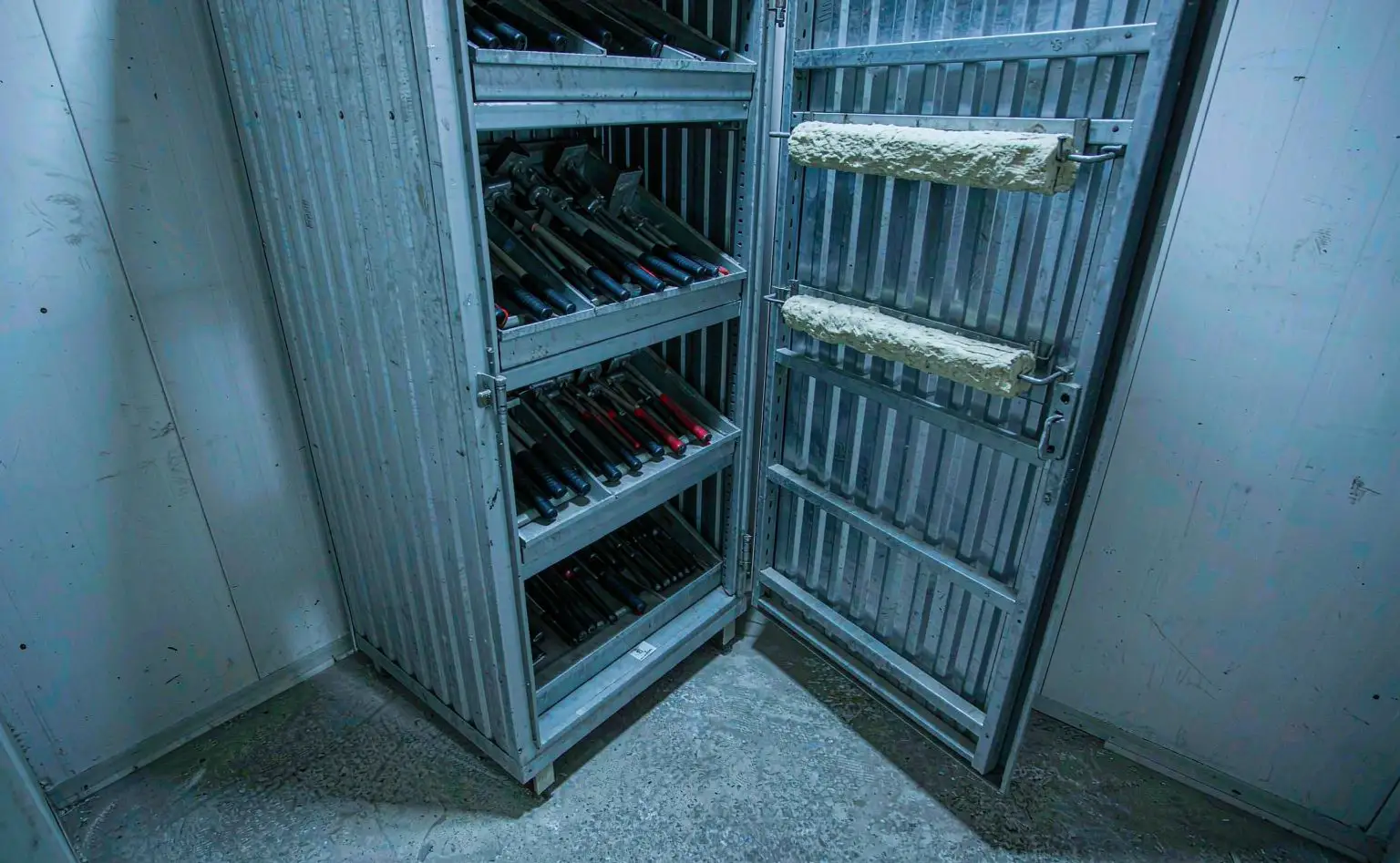
Work the count out from volume. T-1000 dosage is quoted for containers: 8-10 rods in a 20ft and 10-12 in a 40ft. Scaled down, one rod covers 1-2 m³ of cabinet, and a cabinet that is opened several times a day takes two.
Hang high, near the door. Absorption depends on air movement, so hang the rod from the top rail or high inside the door, where the moist air passes it before reaching the mould. Lying on the floor, it dries a patch of air at the bottom and nothing else.
Keep it off the cavity. The rod does not attack steel, but against a cavity it fouls the oil film and gets in the way. Leave 10 cm and a gap between moulds.
Sheets between the moulds. The iHeir-D sheet carries 0.1-0.2 g and goes between two moulds or on a shelf, never against a cavity face: under damp conditions it can corrode poor-quality metal, and mirror-finish cavities need the separation most.
Change on condition, not only on the calendar. A saturated rod goes soft and gains weight, so in the wet season change every two to three months. Log the cabinet humidity: a reading that stays above 60%RH means too few rods or a hardened door seal.
5. Before restart, and the export container
Three checks before running. Look for spots in the radii and corners, rust on the ejector pins, seepage marks at the water fittings. Spots come off with anhydrous ethanol and a polish; do not shoot a sample over them.
Wash the oil off. Rust-preventive oil has to be cleaned before production, or the first shots are off size and off surface. Blow the parting line dry afterwards.
Moulds shipped inside a container. Crate the mould with vapour sheets inside, and hang T-1000 in the container at 8-10 rods for a 20ft and 10-12 for a 40ft. Over thirty to forty days at sea the wall condensate settles on the crates, so add a barrier over the lid.
Open the crate on arrival. The customer should look at the cavity and the ejector pins before the press, and those three items belong on the receiving sheet.
6. Questions from the tool room
Q: The mould stays on the press, does it need all this?
A: Anything idle for more than a week does. The cabinet door is open but the shop humidity is the same, so the cavity still condenses; at minimum blow it dry, oil it and hang a rod beside the press.
Q: Will a hanging rod dry out the oil film?
A: No. The rod takes water vapour out of the air, not oil; a lower humidity actually keeps the film from emulsifying.
Q: We run a dehumidifier in the room, do we still need rods?
A: Yes. The dehumidifier serves the shop, while the cabinet is a semi-closed box that exchanges air every time the door opens; the rod works on that small volume.
Q: Do the sheets affect a mirror-finish cavity?
A: Not at 0.1-0.2 g per sheet and not against the cavity face. For mirror work, put the sheet on the shelf and bag the mould in a rust-preventive bag with one sheet inside it.
Blow the cavity out before wiping, oil it thin and even, and leave a 1-2 mm gap when closing; blow ejector bores and water lines until no mist comes out; hang one T-1000 rod per 1-2 m³ of cabinet with one or two iHeir-D sheets at 0.1-0.2 g off the cavity, changing rods every two to three months in the wet season; for export, 8-10 rods in a 20ft. Mould resistance can be verified to GB/T 24346 and ASTM G21, and pack sizes are on the T-1000 product page.


