




 View Count:8
 Date:2026-10-30
Can conveyor belt mould be prevented once the canvas core is already damp? The mould is not on the cover; it travels inside the polyester-cotton core and spreads from ply to ply, and a condemned roll is a full return with a black line between the plies. Soak the fabric with iHeir-BJ at 2%-3% o.w.f., then add iHeir-JS117 at 0.5%-1.0% of compound weight. This article covers both doses, the bath incompatibility and the moisture limit before building.
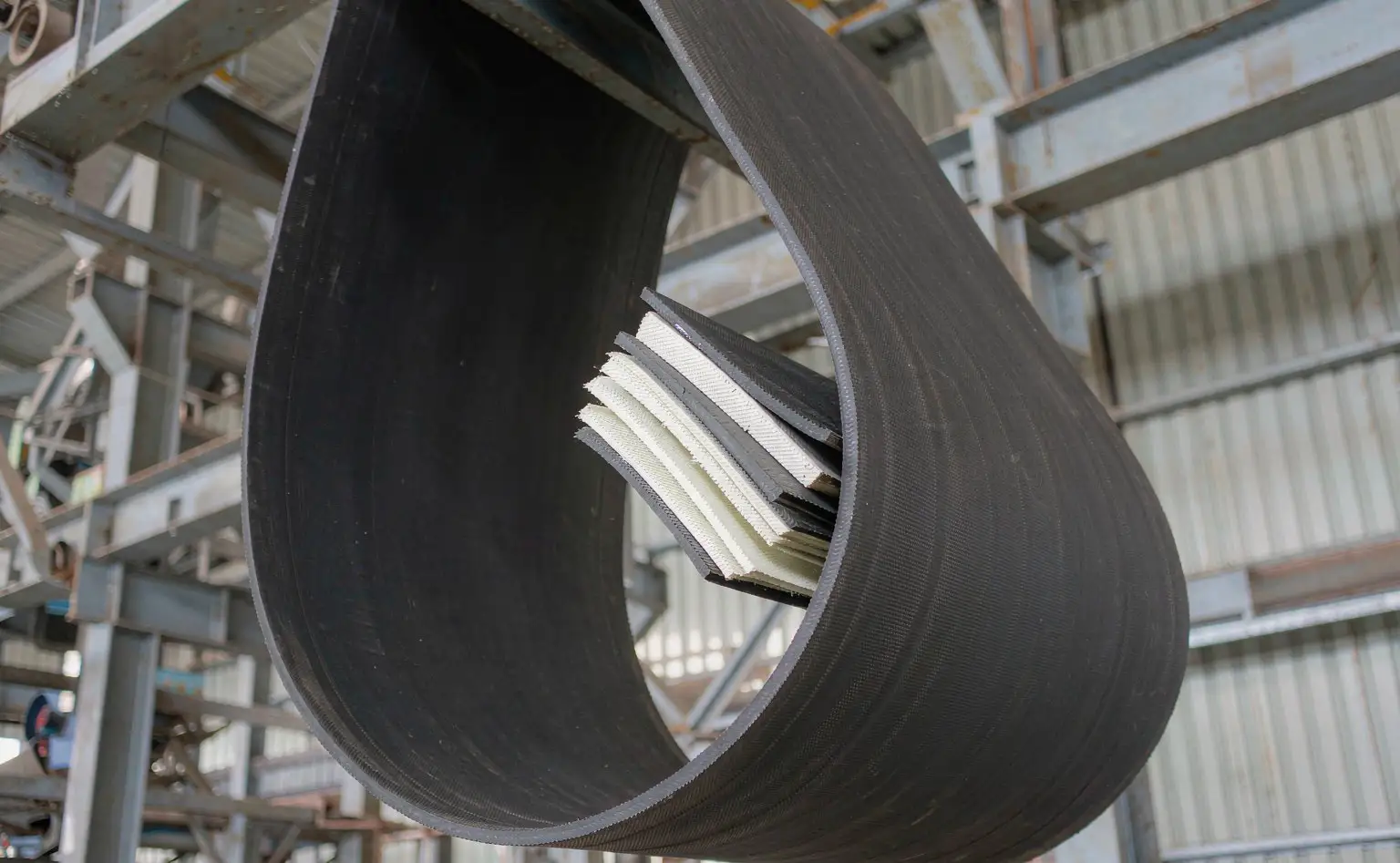
1. Mould travels in the canvas core, not on the cover
A fabric-core belt is a three-layer structure: NR/SBR cover compound with carbon black and a cure system top and bottom, and two to four plies of polyester-cotton canvas (EP or CC) as the carcass. The cover is dense and high in polymer, so mould struggles to establish on it; the canvas is a cotton-polyester blend, and the cotton half takes up moisture while the skim compound between plies supplies the carbon.
The root cause is water sealed between plies. If the fabric goes into building above its moisture limit, or is not dried through after dipping, the calender seals that water in. The cure then turns it to steam, which finds a way out at the edges as a blister and stays inside elsewhere; once the roll cools, that trapped water is where mould starts.
Why it is hard to save. Mould between plies is invisible from outside; you only see it by cutting or peeling the plies, and by then the adhesion has already dropped. A black ply line means the roll is scrap. The money in this line belongs before building, not after.
2. Canvas core and cover compound are handled separately
The table lines up the two stages. The fabric is dosed on dry fabric weight in o.w.f., the compound on compound weight in percent, and the two are not convertible; nor can the powder be tipped into the cure system to make up the difference.
| Part | Material | Product and level | Stage | Control point |
|---|---|---|---|---|
| Canvas core | Polyester-cotton EP/CC | iHeir-BJ 2%-3% o.w.f. | Its own dip, 70% pick-up | Never in the same bath as anionic aids |
| Cover compound | NR/SBR with carbon black | iHeir-JS117 0.5%-1.0% of compound weight | Internal mixer or mill stage | Even dispersion, no lumps |
| Building | Fabric plus skim | No additive, moisture control only | Dry before building | Fabric moisture below 1% |
| Finished roll | Roll and wrapping film | Humidity control, no sealed wrap | Winding and storage | Store below 60% RH |
One boundary. The powder in the cover does not replace the fabric treatment: the cover is a few millimetres thick, and mould arriving from the plies will not be stopped by it. The reverse also holds: with the fabric treated and no powder in the cover, a belt in dry storage passes, but in a humid region after a year the cover face will still speckle. Each stage does its own job.
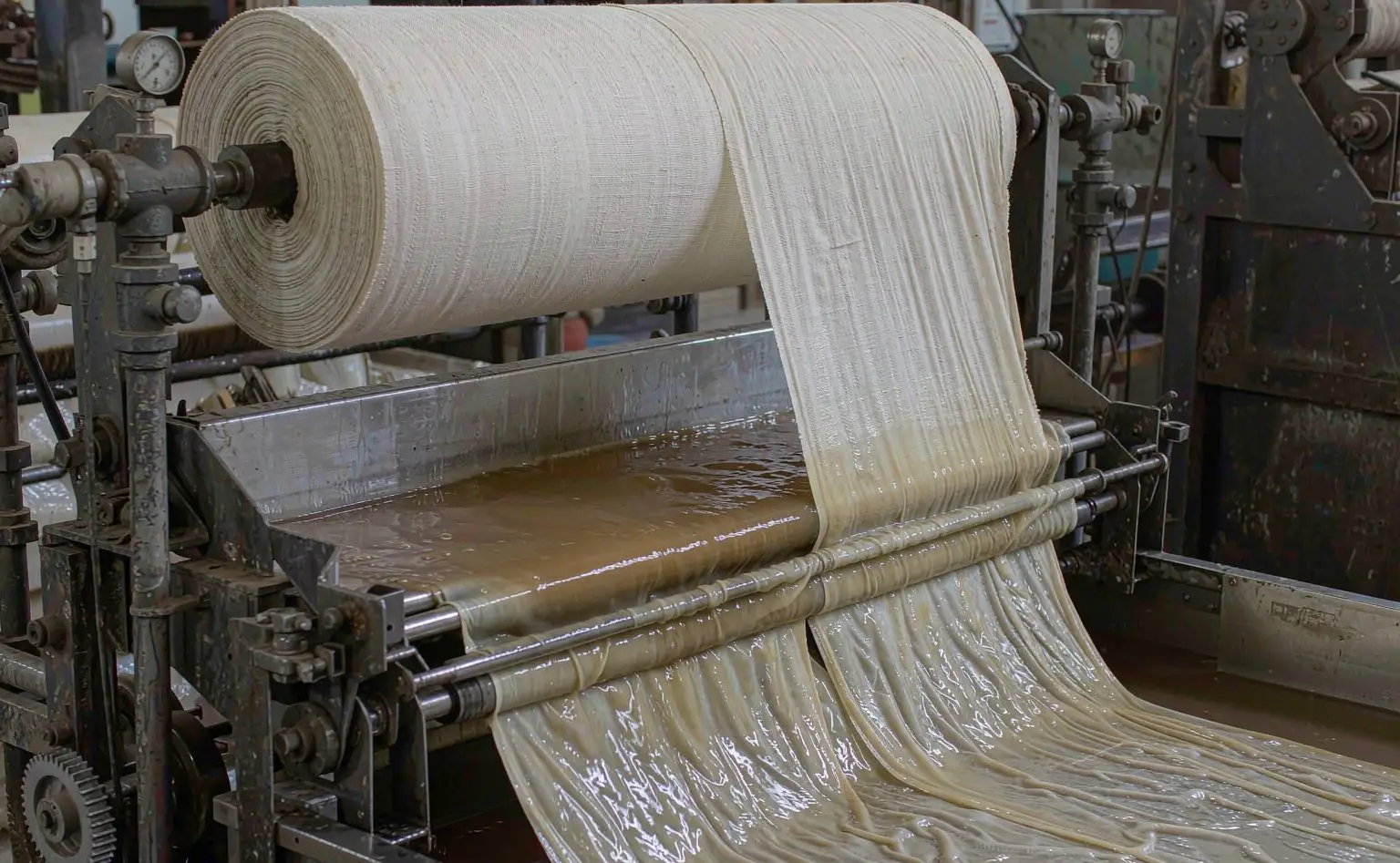
3. Canvas core: the anti-mould agent needs its own dip
The fabric takes iHeir-BJ textile mildew inhibitor at 2%-3% o.w.f. of dry fabric weight. Bath temperature 21-50℃, pH 4.5-8.5 with 6 as the target, soft water, pick-up taken at 70%: 100kg of fabric runs in 70kg of working liquor. Three kilos of the agent treats 100kg of fabric, 2% holds a year or more and 3% reaches two to three years.
The key is a separate tank. BJ is cationic and must not share a bath with anionic aids; the standard RFL dip (resorcinol-formaldehyde-latex) on belt fabric is an anionic system, and tipping BJ into the RFL tank breaks the emulsion, forms lumps and takes the adhesion down with it. Keep them apart: BJ in its own dip, squeeze, dry, then run the usual RFL dip and drying. Pre-mix with 9-13 times its weight of water and add in portions, which adsorbs more evenly.
Three points. Order: the BJ tank goes before the RFL dip, while the fabric is clean and takes liquor evenly; after the RFL film it is blocked. Moisture: dry to below 1% before building, which decides the outcome more than the dose does. Water quality: hard water weakens adsorption, so mix with soft or demineralised water.
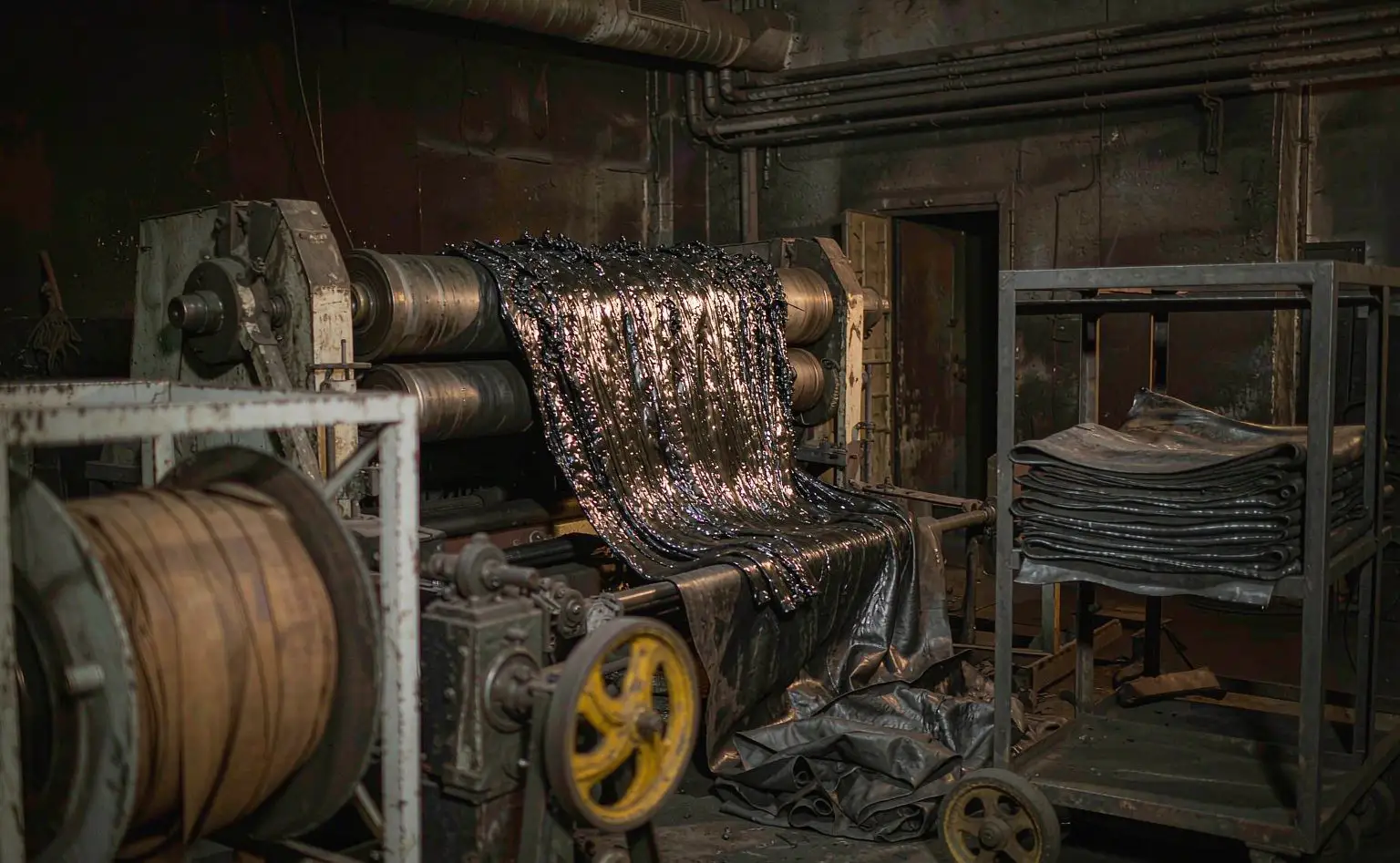
4. Cover compound: the powder goes in at mixing
The cover takes iHeir-JS117 plastic anti-mould powder at 0.5%-1.0% of total compound weight. Active content is above 97%, bulk density 380 kg/m³, D50 around 110μm, and it is insoluble in water, so a belt carrying damp material for years does not lose it to leaching.
Add it at the mixing stage, not before cure. In an internal mixer it goes in after the carbon black and oil are taken up and before the drop; on an open mill it is sprinkled in evenly during the cross-blending passes, then given two or three tight passes to confirm dispersion. Do not leave it to a hand stir before cure — compound viscosity is high, and a lump of powder becomes one concentrated defect. Cure runs as it always did; a 145-155℃ press cure puts no extra demand on this powder.
Test the effect on properties first. The powder is inert, and at 1.0% it shifts tensile strength and hardness slightly; a control set to GB/T 528 and GB/T 531.1 shows how much. Abrasion and adhesion are released to the existing recipe, and adding powder is not a reason to relax either.
5. Building, curing and storing the finished roll
Three things at building: dry the fabric below 1% moisture before it goes on the building machine; hold the building bay below 60% RH and keep fabric rolls off the floor; send the built belt to cure the same day instead of stacking it overnight.
After cure, cut a section per batch and look for a black ply line or a blister, with adhesion to GB/T 6759. Do not wrap the finished roll in a sealed PE film: leave vents or perforate the film, stand the roll core upwards, and keep condensation from running down the film into the belt edge.
Store below 60% RH, first in first out, and leave an air path in the export container; the condensation logic is in condensation in sea freight containers. Release on three levels: fabric to GB/T 24346-2009 for anti-mould performance; compound to GB/T 1741 or ASTM G21 for mould grade; whole rolls for 30 days at 30℃/85% RH, then cut and inspect the plies.
6. Questions on RFL baths, adhesion and downgrading
Q: Can the agent go straight into the RFL dip and save a stage?
No. BJ is cationic and RFL is an anionic system; in one bath the emulsion breaks, lumps form and adhesion drops. Give it its own tank ahead of the RFL dip.
Q: Does the fabric dip hurt adhesion?
At 2%-3% o.w.f., 70% pick-up and drying below 1%, adhesion is unaffected. When it falls, the usual cause is too much liquor on the fabric or incomplete drying, with water sealed in and blistered at cure. A peel control separates the two.
Q: Can a belt that already shows mould be downgraded?
Look at the plies. Surface specks can be wiped and the belt downgraded to short runs in dry conditions; where the ply line has gone black and a mould line shows on the cut, adhesion cannot be recovered and the roll is scrap. A reworked lot needs both the fabric dip and the building drying redone.
Four points to take away: give the canvas core its own dip at iHeir-BJ 2%-3% o.w.f., bath 21-50℃, pH 4.5-8.5, soft water, 70% pick-up, pre-mixed with 9-13 times water and added in portions, never in the same bath as RFL or any anionic aid; add iHeir-JS117 at 0.5%-1.0% of compound weight at the mixing stage and give it two or three tight passes; dry the fabric below 1% moisture before building and store finished rolls unsealed below 60% RH; cut a section per batch and release whole rolls on 30 days at 30℃/85% RH. A 1kg sample can go out for dip and mixing trials first; MOQ and lead time are on the iHeir-BJ product page.


