




 View Count:4
 Date:2026-10-31
How should business card holder mould be handled when the body is thin bamboo and the lining is glued in? A holder is built from two and three millimetre slices that take up water fast and change moisture content with the shop air, plus a flocked lining that holds water, and the two sit sealed in a gift box. The slices go through a dip mixed at 1:40 and taken to 15%-20% weight gain, about 5-10 minutes, while the lining takes iHeir-BJ at 2%-3% o.w.f. This article covers both doses, the drying rule and the lamination sequence.
1. Why thin slices mould faster than solid stock
The build is simple: a body of thin bamboo slices, a flocked or velvet lining, a magnetic catch and hinge, and a paper or fabric outer. Metal does not grow mould; the slices and the lining do.
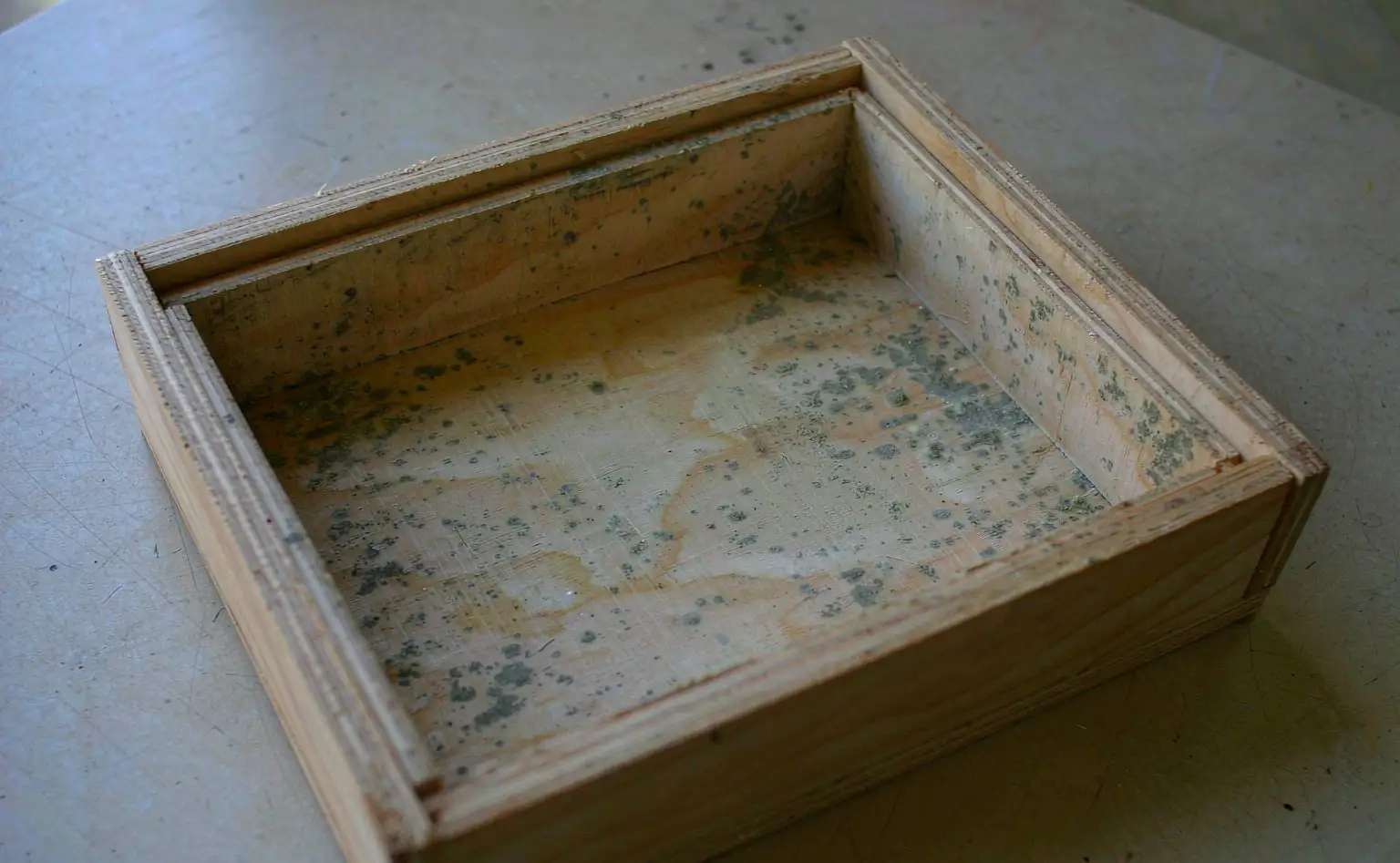
Thin slices have a large surface area. Planed to two or three millimetres, a slice exposes several times the area of a solid board, so it takes up and releases water quickly and its moisture content follows the shop. Assembly relies on adhesive, and adhesive carries water; box it before the glue dries and the water is sealed in the joint, where mould starts.
The other end is the dip itself. Thick stock is timed, thin slices cannot be: soak too long and they take up excess water, then shrink unevenly and warp in drying; soak too little and the core never wets out, so the cut edge is still raw. The control point for thin slices is therefore not how long, but how much weight they gain.
2. Slices and lining run separately
The table lines up slices, lining, adhesive and packing. Slices are controlled by weight gain and bath ratio, lining by fabric weight in o.w.f., and the two are not convertible.
| Part | Material | Product and level | Stage | Control point |
|---|---|---|---|---|
| Body slices | Bamboo, 2-3mm | iHeir-M5 bath at 1:40 | Dip to 15%-20% gain | About 5-10 minutes, fully submerged |
| Lining fabric | Flock, velvet | iHeir-BJ 2%-3% o.w.f. | Finishing bath before lamination | Dry before laminating |
| Assembly adhesive | White glue, water-based | Choose a grade away from strong alkali | Jointing, laminating | Glue fully dry before boxing |
| Packing and dispatch | Gift box, pouch | Paper per box, humidity control | Cartoning, storage | Store below 60% RH |
One boundary. A dipped slice does not excuse the lining: flock sits against the cards, holds moisture, and mould growing in the fabric still contaminates the inside. And no lining is good enough if the slice never wet out and the joint still carries water, because the box seals it in and mould returns from the seam. Both stages have to run to survive the sea leg.
3. Slices: controlling the 15%-20% weight gain
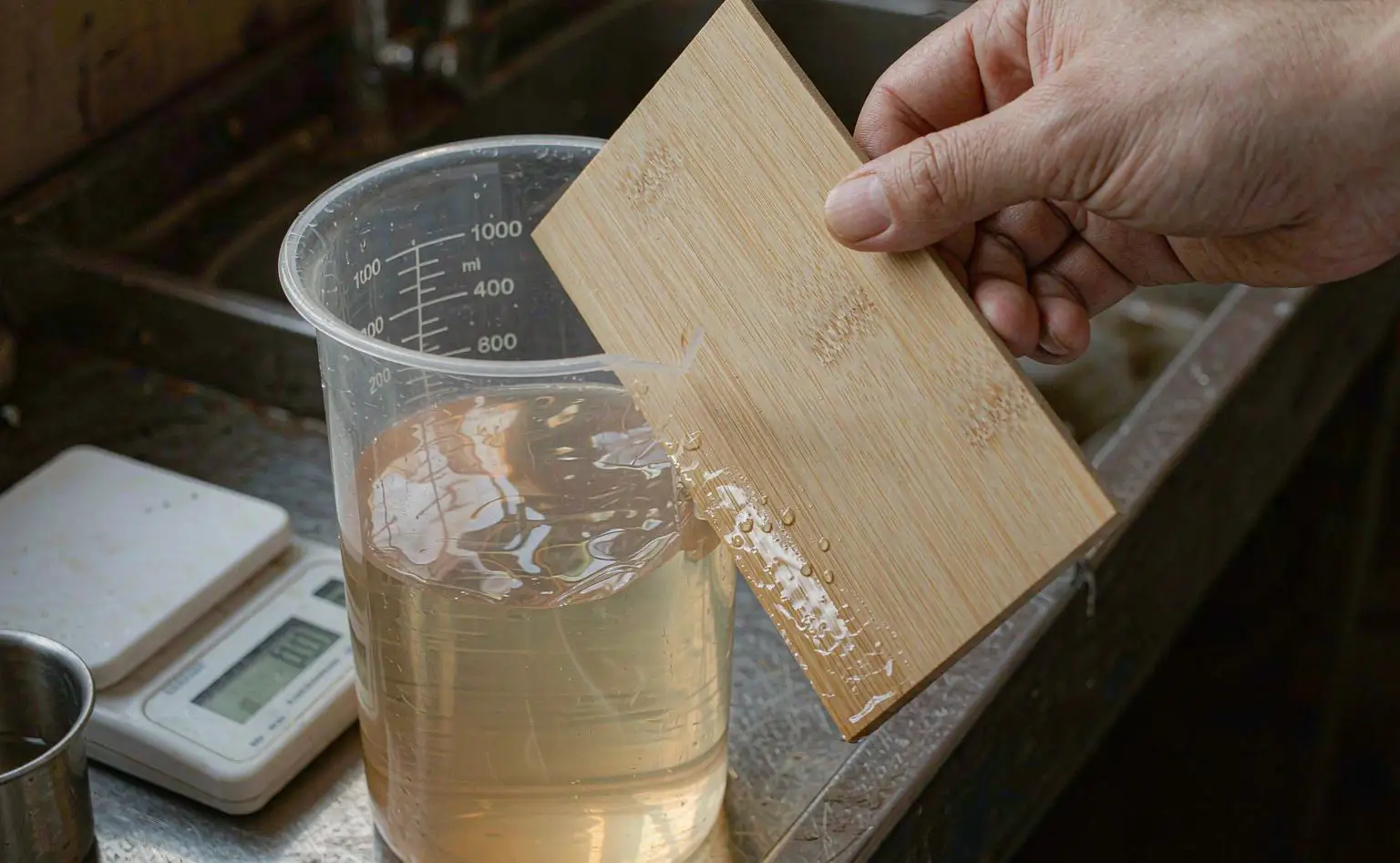
Soak in iHeir-M5 immersion-type bamboo and wood fungicide, mixed at 1:40 concentrate to water. The goods must be fully submerged, not breaking the surface, and pulled at 15%-20% weight gain; that usually lands at about 5-10 minutes depending on thickness and species. M5 is a red-brown liquid, acid and alkali resistant, resistant to leaching and strongly penetrating, packed 25kg to a drum, stored dry and dark with a one-year shelf life.
How to hold the gain. Production cannot run on guesswork: weigh a batch of dry slices for a baseline, dip, drain for one to two minutes and weigh again; the difference over baseline is the gain. Thin slices sit at the bottom of the range, around 15%; thick or dense stock goes to the top. Above 20% is not better, it is surplus water that shows up as warping in the dryer.
Three points. Mix the bath by weight at 1:40, not by eye on volume. Leave space between slices, because a stack loaded tight has dry cores. And finish properly: drain, air dry or sun dry, then pack, never stacking wet pieces. The three wood treatment routes are compared in how to use wood anti-mould agents.
4. Lining: a finishing bath before lamination
The lining takes iHeir-BJ textile anti-mould agent at 2%-3% o.w.f. on fabric weight. The bath runs at 21℃-50℃ and pH 4.5-8.5, ideally near 6, with a 70% wet pick-up; on that basis 3kg treats 100kg of flock. Pre-mix with 9-13 times its water and add in portions.
The sequence cannot be reversed. Bath the flock, dry it, then laminate to the body. If the laminating adhesive carries water, dry again after lamination: a lining that feels dry over wet glue turns a closed box into a sealed chamber, and mould comes back up through the fabric. That is the single most common rework on card holders.
Two conditions. Soft water. Cationic compatibility, because BJ cannot share a bath with anionic auxiliaries, so the softener normally used on flock has to be cationic or non-ionic, or the bath breaks and leaves oily patches that read as bright marks once laminated.
5. Lamination, packing and dispatch
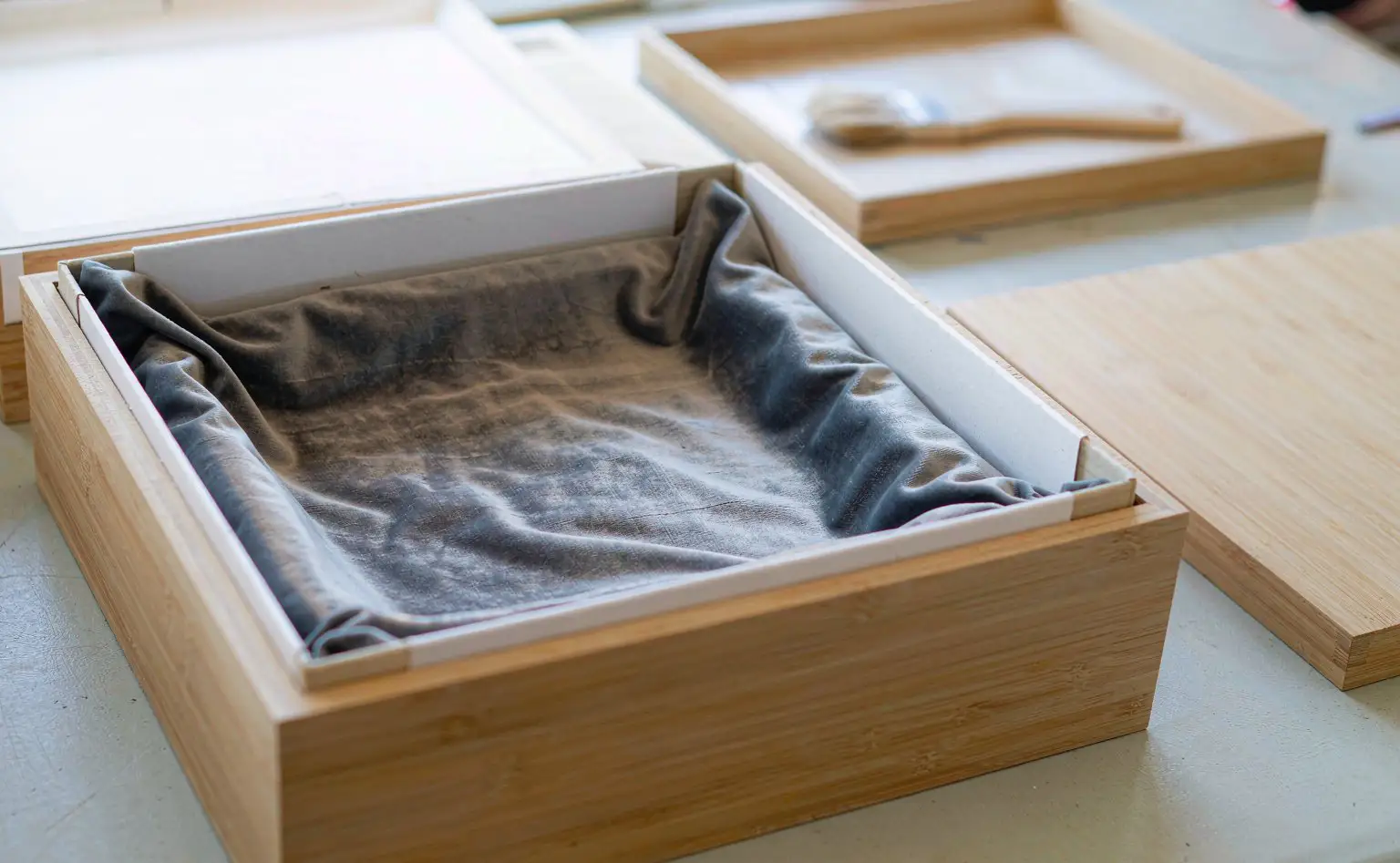
Two things to control at the lamination bench: glue quantity and shop humidity. Too much glue means more water and slower drying, and above 65% RH the slices start taking up moisture again while the glue sets. Measure glue by weight, run a dehumidifier at the bench, and lay laminated boxes out to dry rather than stacking them.
At packing, add a sheet of anti-mould paper inside the box, sleeve it, and keep cartons on pallets 10cm off the floor and wall below 60% RH, turning the bottom layer before the wet season. For sea freight, container condensation does more damage than shop humidity, so leave an air path and keep cartons off the wall; see preventing container rain.
Release at three levels: slices to GB/T 18261, sampling the cut face and the surface; lining to GB/T 24346-2009; complete boxes for 30 days at 30℃/85% RH, opening to check lining, joint and base.
6. Questions on warping, black seams and spraying
Q: Why do dipped slices warp?
Usually too much weight gain or too fast a drying cycle. Hold the gain at 15%-20%, drain, air dry before the drying room, and raise the temperature slowly with the slices laid flat under a weight; warping drops sharply.
Q: A seam has gone black. Is it the glue or the wood?
Both are possible, but check the glue first: boxed before the glue dries, water is trapped in the joint and mould starts there. Cut the glue quantity, extend drying after lamination, then check whether the slice was wet out through its thickness.
Q: Can spraying replace the dip on the lining?
For small rework lots, yes, but production should run a bath: spray gives an uneven pick-up, high in places and absent in others, and mould then appears in stripes. Sprayed lining still has to be dried before lamination.
Four points to take away: mix the M5 bath at 1:40, dip fully submerged to 15%-20% weight gain in about 5-10 minutes, drain and air dry before the drying room; run the flock lining through iHeir-BJ at 2%-3% o.w.f. with the bath at 21℃-50℃ and pH 4.5-8.5, a 70% pick-up, and let the glue dry through before boxing; control glue weight and bench humidity and lay laminated boxes out flat; release complete boxes on 30 days at 30℃/85% RH. A 1kg sample of each product can go out for a trial first; MOQ and lead time are on the iHeir-M5 product page.


