



 View Count:42
 Date:2026-09-08
Dongguan shoe materials & factory mold prevention: from shoe material market to container loading full-process guide
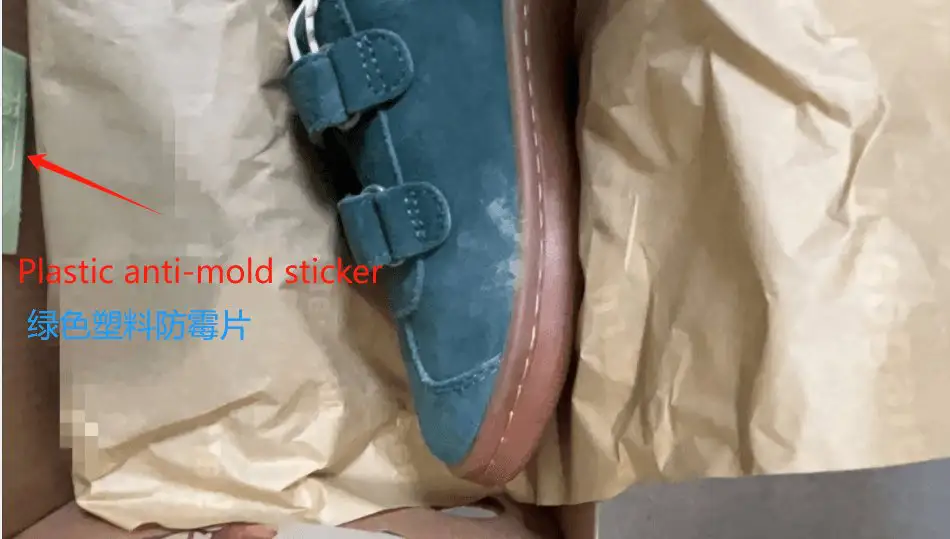
Dongguan is the heart of China’s footwear export industry — the four towns of Houjie, Nancheng, Chashan and Tangxia host over 6000 shoe material and finished shoe factories, producing more than 2 billion pairs a year for export to Europe, America, Southeast Asia and the Middle East. During the April-October plum rain and typhoon season, combined with hot and humid sea-freight cycles, mold claims spike. One recent incident: 30 000 pairs of export sports shoes arrived in Hamburg with the uppers covered in white mildew and a musty odor, and the German customer rejected the entire shipment and filed a USD 67 000 claim. Another brand customer refused delivery on a USD 35 000 moldy shoe box. The issue is rarely one single step — it is one or two weak links across six process ports: shoe material market procurement, raw material warehouse, production line, semi-finished warehouse, finished goods warehouse, and container sea-freight. This guide strings those six ports together into a ready-to-deploy mold prevention SOP for shoe factories, material suppliers and foreign-trade companies.
1. Mold risk chain from shoe material market to container
The shoe material supply chain is long, and mold typically appears at four high-risk ports:
1. Shoe material market (leather, PU, EVA, shoe upper fabric): Houjie shoe material market moves hundreds of tonnes of raw materials a day. Vendor warehouses and transit sheds rarely control humidity, so the moisture content of leather and EVA outsoles is often 12%-18% when purchased — far above the safe 8% line. During the half-day truck ride back to the factory in summer, the cabin sits at 35-40°C and 80%-90% RH, and surface mildew spots can already begin to grow.
2. Shoe factory raw material warehouse: Many small and mid-size factories use simple color-steel sheds; the floor is damp and there is no temperature or humidity control. Leather and PU rolls are stacked tightly with no airflow, so the center layer runs 3-5°C warmer than the outside, creating a localized “hot-humid microclimate”.
3. Production line (lasting, stitching, assembly): Water-based glue at the lasting station and the semi-finished storage area are the next high-risk ports. Semi-finished uppers and insoles stay on the line 2-3 days, and during plum rains the workshop humidity often stays above the safe threshold, producing local mold spots.
4. Finished shoe carton and container sea-freight: Finished shoes are placed into PE bags, color boxes and outer cartons, then pushed into the finished warehouse. If the finished warehouse is not humidity-controlled, the shoe boxes absorb moisture and the entire batch molds. Once inside a container the “container rain” effect kicks in: daytime sun bakes the box at 50-70°C, nighttime drops to 25°C with humidity above 95%, and condensation drips onto the boxes — doubling the mold risk.
This is why “throw in one anti-mold sticker” never works — control has to start at raw material moisture, raw material treatment, semi-finished buffering, finished carton protection, and container humidity, all five ports.
2. Dongguan shoe factory deployable SOP: six-port mold prevention plan
Below is a procedure directly insertable into the production flow of a Dongguan shoe factory:
1. Shoe material market to factory: For leather, PU and synthetic leather, spray iHeir-Spray (M3D) water-based anti-mildew agent evenly on the raw material surface (30-50 ml per square meter), air-dry 15-20 minutes before warehousing. For EVA and TPR outsoles, dip them in iHeir-PF leather antimicrobial agent diluted 1:10 with water for 5-10 minutes, drain and store. Moisture content can be brought below 8%.
2. Raw material warehouse: Install dehumidifiers and hold relative humidity below 60%RH. Separate leather and PU rolls with plastic spacers, place 1-2 Power Pak powerful anti-mildew tablets per cubic meter, lay moisture-proof mats on the floor. Re-check moisture content after 30 days of storage; if above 12%, re-spray with M3D.
3. Semi-finished warehouse and production line: Place small calcium chloride dehumidifier boxes in the semi-finished area (one per 5 m²). Run dehumidifiers in the stitching workshop to keep RH ≤65%. Add 0.3%-0.5% iHeir-PF to water-based glue to prevent mold growth in the glue layer.
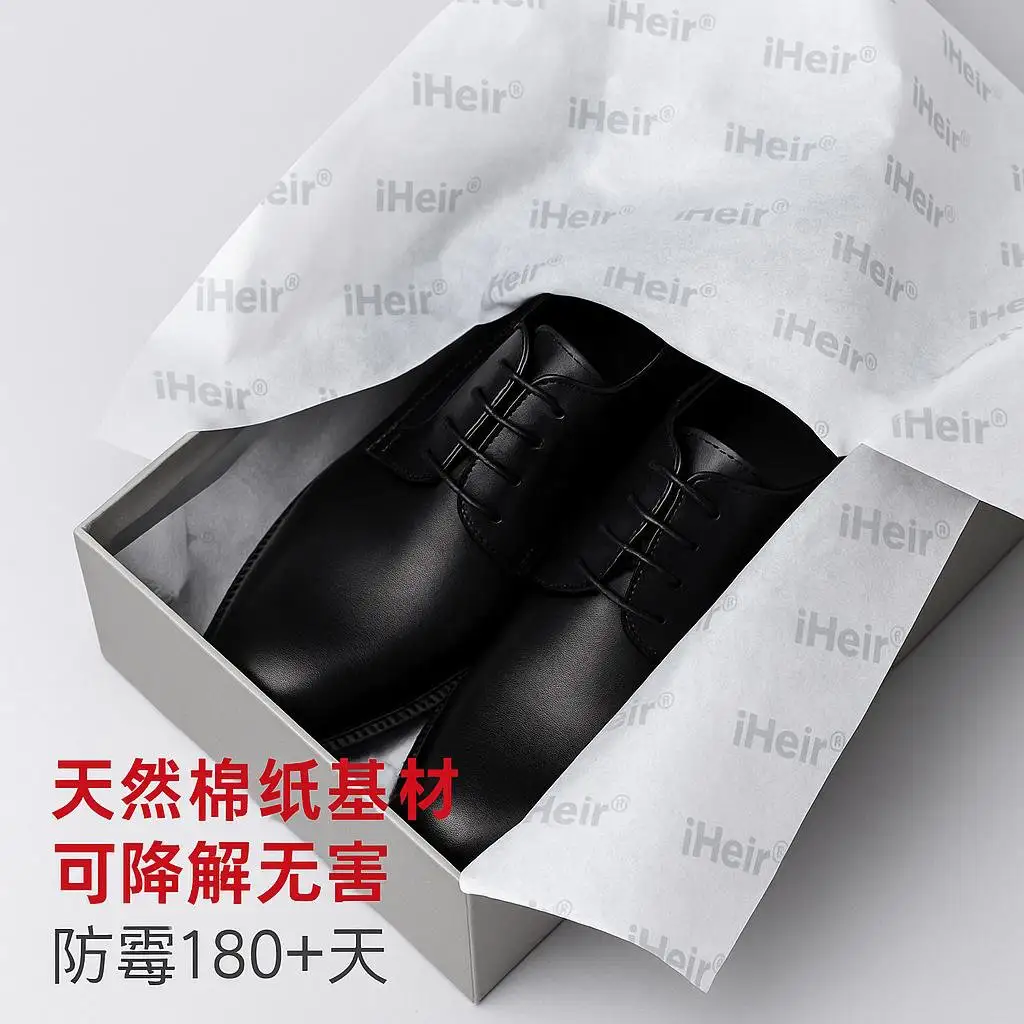
4. Finished shoe packing: Put each finished shoe into a PE bag with 1 Power Pak tablet (small size for single-shoe pack). For every 10-pair color box, line the bottom with a sheet of iHeir anti-mold packaging paper (natural cotton paper base, biodegradable, 180+ day mold protection). Drop one Power Pak tablet into each corner of the outer carton, and stick one gas-phase anti-mold patch (iHeir-D 5 series) to the inside wall.
5. Finished warehouse: Hold RH below 60%RH with industrial dehumidifiers, lay moisture-proof floor mats, and limit stacking height to 4 layers for ventilation.
6. Container sea-freight: Hang 6-8 T-1000 container desiccant sticks in a 20 ft container (350-400 g absorption each). Stick moisture-proof aluminum foil reflective film to the inner walls to deflect the “container rain” path. Inspect the door gasket for damage. T-1000 uses calcium chloride base material that absorbs moisture even at -20°C, covering the 18-22 day transit from China to the US West Coast.
This six-port plan is in active use at 30+ leading Dongguan shoe factories (also covered in the general shoe mold prevention guide). Total investment is 0.8%-1.5% of finished product cost — far below the 5%-15% mold claim exposure.
3. Real anonymized mold case at a Dongguan shoe factory
A branded sports shoe factory in Houjie (annual output 8 million pairs) shipped 30 000 pairs to Hamburg, Germany in May 2024 with FOB value RMB 2.2 million. After 28 days at sea, the consignee found 35% of shoe boxes covered in white mold spots and a musty odor. The German customer invoked contract annex 4 “on-arrival inspection” and filed a full-batch return and RMB 670 000 claim.
Root cause review: raw material warehouse had no humidity control (humidity 85%RH during plum rains); finished shoes had no Power Pak tablets inside; container had no T-1000 sticks; outer cartons used plain corrugated board with no anti-mold paper.
Remediation: dehumidifier added to raw material warehouse; 1 Power Pak tablet in every finished shoe PE bag; iHeir anti-mold packaging paper lined in every outer carton; 6 T-1000 sticks per 20 ft container; 0.3% iHeir-PF added to production-line water-based glue. In the second half of 2024 across 8 shipping containers, the mold rate dropped to under 0.3% and the maximum claim per container fell to zero.
A children’s shoe factory in Tangxia (annual output 4 million pairs) had a similar issue on EVA outsoles (see the EVA slippers antimicrobial guide). After switching to EVA outsole impregnation with iHeir-PF, mold rate fell from 12% to 0.4%.
4. Mold preventive product selection guide for Dongguan shoe factories
Dongguan shoe factories typically use four categories of mold preventive products, and the right model must be chosen per process port:
1. Surface anti-mold treatment (spray type): For leather, PU leather, synthetic leather, EVA outsoles, TPR outsoles and mesh uppers, use iHeir-Spray (M3D) water-based anti-mildew agent, non-toxic and odorless, safe on leather. For genuine leather and suede, use the dedicated iHeir-PF (with leather-specific penetrant). Mix ratio: M3D can be sprayed directly or diluted 1:5 with water; iHeir-PF is diluted 1:10 with water for 5-10 minute dipping.
2. In-pack anti-mold (tablet type): Inside the single-shoe PE bag, color box and outer carton, use Power Pak powerful anti-mildew tablets, selecting size by volume: 1-2 L space — Power Pak S, 2-5 L — Power Pak M, 5-15 L — Power Pak L, 15-50 L — Power Pak XL. Power Pak was the #1 anti-mold tablet sold in Houjie in 2024, with unit price around RMB 1.5-3 per tablet.
3. Container sea-freight moisture control (stick type): 6-8 T-1000 container desiccant sticks per 20 ft container, 10-12 per 40 ft high cube. For high-value precision shoes (performance shoes, mountaineering boots), add 1-2 packs of silica gel desiccant as backup.
4. Water-based glue and semi-finished buffering (inhibitor type): Add 0.3%-0.5% iHeir-PF to the glue. Use Power Pak tablets in the semi-finished warehouse in place of traditional camphor tablets (camphor odor triggers customer complaints).
5. Compliance essentials for Dongguan shoe exports: REACH, Prop 65, GB 25036 and inspection
Shoe materials exported to Europe and the US must pass the following compliance checks:
1. EU REACH Annex 17: Azo dyes in leather (22 aromatic amines), dimethyl fumarate (DMFu, limit 0.1 mg/kg), phthalates (DEHP/DBP/BBP, limit 0.1%). iHeir-PF / M3D have passed SGS REACH 171-item full testing; English reports can be provided.
2. US California Proposition 65: Lead content in leather limited to 300 mg/kg (effective 2018); heavy metals (cadmium, chromium, arsenic) in outsoles have limit requirements. All iHeir anti-mold products ship with California 65 test reports.
3. China GB 25036-2010 “Children’s footwear safety technical specification”: Extractable heavy metals, formaldehyde (≤75 mg/kg), moisture content (≤12%) for children’s shoes; Dongguan shoe factories exporting children’s shoes must complete these four tests.
4. Export commodity inspection and certificate of origin: Dongguan shoe factories exporting via Huangpu or Shekou Customs need CIQ commodity inspection certificates; FORM A, FORM E, FORM F certificates of origin are issued per customer requirement; shoe materials containing anti-mold agents must note “contains moisture absorber” on the customs declaration packaging description.
6. Printable six-port inspection checklist for Dongguan shoe factories
The following checklist can be printed and posted in the production office or QA room:
☐ Leather/EVA/PVC purchased from the shoe material market has been sprayed with M3D or dipped in iHeir-PF (record per batch: spray time, concentration, operator)
☐ Raw material warehouse RH ≤60%RH (dehumidifier running 24h), temperature ≤28°C, moisture-proof floor mats, Power Pak tablets between rolls
☐ Semi-finished warehouse: Power Pak tablets + dehumidifier (RH ≤65%RH), semi-finished goods dwell time ≤5 days
☐ Production line water-based glue: add 0.3%-0.5% iHeir-PF, stitching workshop RH ≤70%RH
☐ Finished shoes: 1 Power Pak tablet per PE bag, iHeir anti-mold packaging paper at the bottom of each color box, 1 Power Pak tablet at each corner of the outer carton
☐ Finished warehouse RH ≤60%RH, stacking height ≤4 layers, iHeir-D 5 gas-phase anti-mold patch on the outer carton
☐ 6-8 T-1000 sticks per 20 ft container, 10-12 per 40 ft high cube, container door gasket intact, moisture-proof aluminum foil reflective film on inner walls
☐ Customs declaration marked “contains moisture absorber”, with REACH 171-item + California 65 test reports + CIQ commodity inspection certificate
After running through this checklist, factories in Houjie, Nancheng, Chashan and Tangxia typically reduce their mold claim rate from 5%-15% to under 1%, and for shipments with per-container value above RMB 1 million, zero mold is achievable. For samples of shoe material anti-mold agents, bulk Power Pak quotes, or the full T-1000 container desiccant solution, please contact us for your tailor-made plan.