




 View Count:43
 Date:2026-09-07
Three questions come up every harvest and shipping season: “the tobacco leaf has molded, what do I do?”, “my cigars are growing white in the humidor, is that mold?”, and “an export container of tobacco arrived moldy, can we claim it?”. Tobacco leaf mold is one of the largest storage losses in the tobacco industry. Tobacco carries 15%-25% reducing sugar, making it a paradise for mold, and once aflatoxin B1 (AFB1) shows up the entire batch is scrapped—AFB1 is an IARC Group 1 carcinogen with no safe remediation. Tobacco, cigars, tea, and Chinese herbal medicine all share the same root cause: high-sugar + high-protein natural plant substrate + sustained high humidity + long storage. This article focuses on tobacco leaf (flue-cured, air-cured, and cigar leaf) and cigars (hand-rolled and machine-made), covering warehouse and export anti-mold. No chemicals are added to the tobacco or cigars themselves; all anti-mold action stays on the warehouse and packaging level, in line with the China Tobacco Monopoly Law, GB/T 18771, and ISO 14725.
1 Why tobacco molds faster than tea and herbal medicine
Tobacco, tea, and herbal medicine are all plant-origin agricultural products, but tobacco molds significantly more than the other two:
- Higher sugar content: a buffet for mold: tobacco leaf reducing sugar 15%-25%, 2-3x that of tea (5%-15%) and 1.5-2x that of herbal medicine (5%-20%). Reducing sugar is the fastest carbon source for mold; once spores land on tobacco, the sugar kicks off immediate growth.
- Higher nitrogen (protein, amino acid) content: tobacco total nitrogen 1.5%-3.5%; proteins and amino acids are the nitrogen source mold needs. Sugar + nitrogen together make tobacco mold reproduction 30%-50% faster than tea or herbal medicine.
- Higher moisture regain and larger moisture swings: at 20°C / 70%RH, tobacco equilibrium moisture can reach 15%-18%, higher than tea (12%-14%). Tobacco both absorbs and releases moisture quickly in storage, and the large swings further accelerate mold growth.
So tobacco’s mold threshold is lower than tea or herbal medicine: tea typically needs above 65%RH to start molding, tobacco starts showing mold risk at 60%RH and above. Tobacco warehouse humidity control is among the strictest in the agriculture industry.
2 How to identify tobacco mold: 4 symptoms plus aflatoxin risk
Four symptoms signal tobacco mold, and catching them early is the only way to limit losses:
- White, green, or gray-black mildew spots: white fluffy tufts, green or gray-black patches on the leaf surface. Smear into powder when rubbed—these are live mold colonies (mainly Penicillium and Aspergillus), not normal discoloration.
- Musty or sour smell: a sharp musty + sour odor on opening the bale. More sour and sharper than the musty smell of tea, because the breakdown of both sugar and protein produces more acidic by-products.
- Leaf clumping and sticking: loose leaves start to clump and stick together; mold has already eaten the leaf surface wax, the leaves lose their elasticity, and the bale becomes unsortable.
- Aflatoxin B1 (AFB1) over-limit: moldy tobacco is the perfect host for Aspergillus flavus, which produces AFB1, an IARC Group 1 carcinogen. The EU limit under EC 1881/2006 is ≤5μg/kg; the Chinese limit under GB 2761 is also ≤5μg/kg. AFB1 does not degrade after drying, so moldy tobacco must be scrapped entirely.
When handling a return, classify the mold by stage: ① factory raw-material warehouse; ② trader warehouse; ③ sea-freight container; ④ customer warehouse or humidor. Each stage carries a different responsibility and a different fix, so do not always blame the raw material. The physical moisture-control logic in our tea warehouse humidity guide applies to tobacco, but the humidity threshold is stricter.
3 Tobacco and cigar warehouse standards: ≤60%RH plus 12-18°C
Tobacco and cigar storage requirements are among the highest of any plant-origin product. The three key metrics are relative humidity, temperature, and moisture content:
- Relative humidity ≤60%RH: the warehouse red line is 60%RH, with a recommended 55%-60%RH. Cigar humidors run warmer and wetter: 65%-72%RH (hand-rolled) / 60%-65%RH (machine-made), but those are short-term humidor conditions, not a warehouse. For long-term cigar storage (>2 years), drop the warehouse to ≤60%RH and move the cigars to a humidor only at the retail or consumer stage.
- Temperature 12-18°C: tobacco mold is most active at 20-35°C. Holding the warehouse at 12-18°C cuts mold activity significantly, and the lower temperature also helps tobacco age (natural fermentation). Below 10°C the leaves dry out too fast and turn brittle, so do not go below 10°C.
- Tobacco moisture content 11%-13%: incoming tobacco should be at 11%-13% moisture; too high invites mold, too low makes the leaves brittle. Test moisture weekly (oven method or fast moisture meter) and adjust the storage environment as soon as it drifts.
- Light avoidance plus airflow: long exposure to light fades, oxidizes, and loses aroma in tobacco. Use blackout curtains or windowless warehouses. Leave 30-50cm airflow aisles between stacks to prevent local high humidity.
Sampling frequency: weekly during plum-rain season, opening 2-3 bales per batch to inspect for spots, smell for musty odor, and test moisture; every 2 weeks off-season. Sampling cannot rely on appearance only—smell the inside of the bale (open the pack and sniff). Early-stage mold may look fine on the outside but already smell inside. For cigars, inspect each stick for white or green spots. White bloom on a cigar is not always mold—it can be cigar plume (nicotine and oils crystallized at low temperature and high humidity, a sign of good aging). Distinguish by texture: plume is even and thin, with no musty smell; mold is uneven, fuzzy, and smells.
4 Tobacco export packaging 3-piece set: T-1000 + CH-10 + Power Pak
Tobacco sea-freight typically runs 20-50 days, with container humidity swinging from 35%RH to 95%RH and a 15-25°C day-night temperature gap that triggers container rain. Tobacco export packaging needs a 3-piece combination (same logic as tea, but no chemicals touch the tobacco itself):
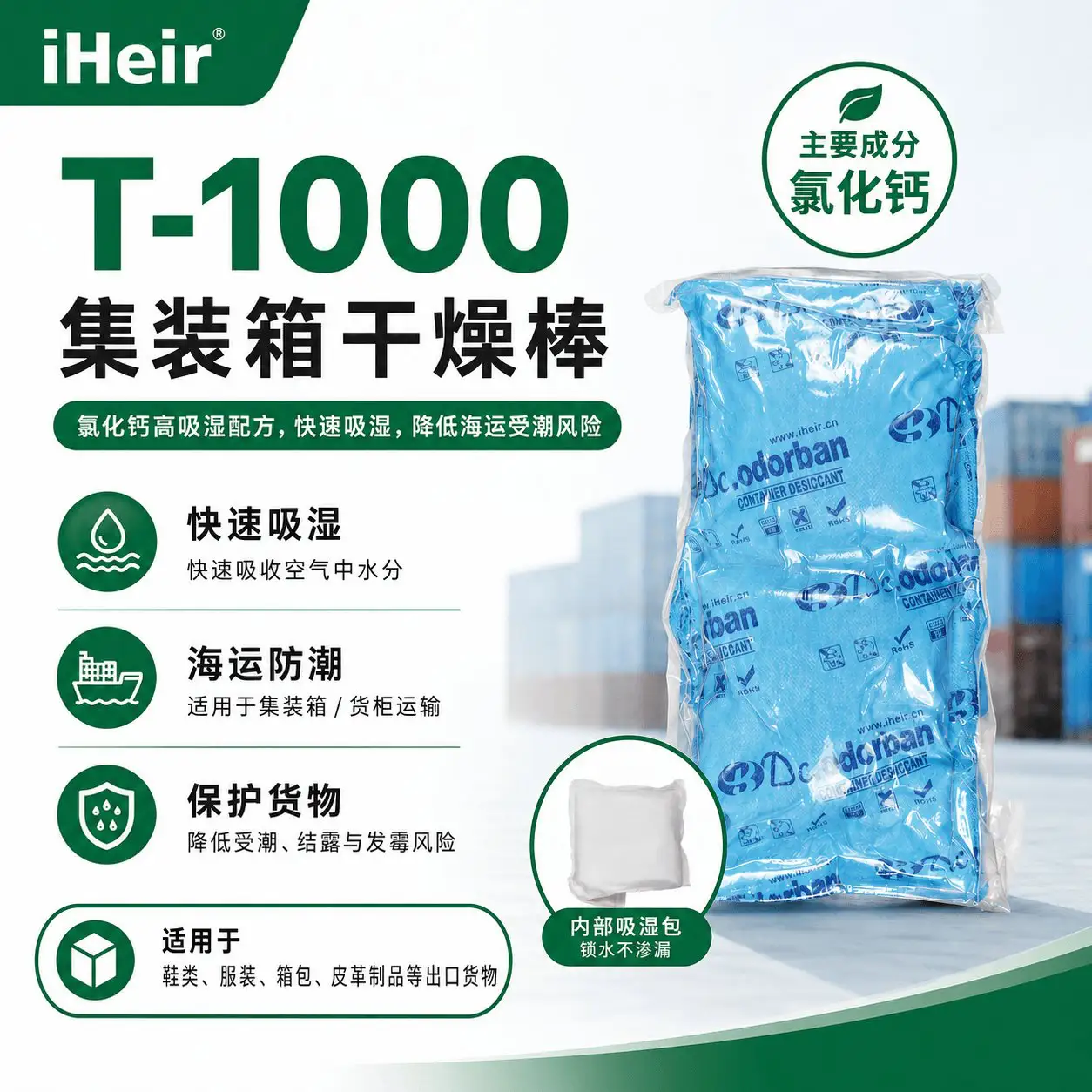
- Piece 1: T-1000 container drying sticks: place 6-8 T-1000 sticks per 20-25 ton container (see T-1000 container drying stick). The sticks absorb moisture across the whole container, pulling humidity from 80%-90%RH back down to under 55%RH. Adjust the count based on voyage length and season.
- Piece 2: CH-10 anti-mold drying and deodorizing pack: place CH-10 (see CH-10 anti-mildew drying and deodorizing pack) inside each tobacco carton (30-50kg), 2-3 packs per box. CH-10 absorbs moisture at the small-package level and suppresses both musty odor and tobacco odor cross-contamination, giving the customer a better unboxing experience.
- Piece 3: Power Pak anti-mildew and deodorizing tablets: drop 1-2 Power Pak tablets per tobacco carton (see Power Pak powerful anti-mildew and deodorizing tablets). The volatile anti-mold active reaches every corner of the box, and Power Pak also suppresses the tobacco beetle (Lasioderma serricorne) in cigar humidors, making it a must for cigar exports.
Outer packaging: tobacco uses double-layer PE bag + kraft paper bag + carton; cigars use cedarwood box + aluminum foil bag + paper box. The foil bag and cedarwood box both block external moisture; the double layer ensures that humidity swings during sea freight never reach the tobacco or cigar. Cost check: the 3-piece anti-mold set for one ton of tobacco runs about USD 11-28 (T-1000 USD 7-17 + CH-10 USD 3-7 + Power Pak USD 1-4), while a single mold-related claim is usually tens of thousands of dollars per ton. Excellent ROI.
5 GMP compliance and export inspection for tobacco and cigars
Tobacco and cigar storage and export are regulated by the Tobacco Monopoly Law and carry dedicated industry compliance requirements:
- Domestic compliance: the Tobacco Monopoly Law and its implementation regulations require tobacco purchasing, allocation, and storage to follow national standards. GB/T 18771.1-2015 (Tobacco Vocabulary) and GB/T 23220-2008 (Tobacco Storage Methods) set the rules for temperature, humidity, stacking, sampling, and pest control. Warehouses should keep a daily temperature and humidity log (traceable, retained for at least 3 years).
- Export compliance: ISO 14725 (Tobacco Storage and Transport Guide), EU EC 1881/2006 (AFB1 ≤5μg/kg), FDA Prior Notice of Imported Food and Feed, and the tobacco import inspection rules for Southeast Asia, Japan, and Korea. Exporting to the EU, Japan, or Southeast Asia requires an AFB1 test report; moldy tobacco almost never passes.
- AFB1 testing protocol: test AFB1 (HPLC method) at intake, at shipment, and at destination. Retain a 1kg sample per batch for at least 2 years. AFB1 does not degrade after drying, so high-risk tobacco should be sampled pre-shipment and any anomaly must trigger immediate isolation.
- Pest control: the main tobacco pests are the tobacco beetle (Lasioderma serricorne) and the tobacco moth (Ephestia elutella). Chemical fumigation (aluminum phosphide) works but leaves high residue and faces export restrictions. The physical + biological route is preferred: Power Pak tablets + low temperature (≤15°C) + sanitation, which keeps pest risk under control.
Cigar compliance is simpler: humidor humidity 65%-72%RH (hand-rolled), temperature 18-21°C, the ideal aging environment. But the humidor is short-term storage (a few months to 1-2 years). For long-term storage (>2 years), move to a ≤60%RH + 12-18°C warehouse, or the cigars will over-ferment and lose flavor.
6 FAQ plus one desensitized case
Q1: The tobacco has a few visible mold spots. Can we pick them out and use the rest?
A: Absolutely not. Visible mold means the hyphae have already penetrated deep into the leaf; the surrounding “clean” areas have already been contaminated with mold spores, just not yet showing visible growth. Those clean-looking leaves will mold again within 1-2 weeks, and the entire batch’s AFB1 may already exceed limits. Moldy tobacco must be scrapped in full; downgrading is not an option.
Q2: My cigars are growing white in the humidor. Is that mold?
A: Not necessarily. White on a cigar can be cigar plume—nicotine and oils crystallized at low temperature and high humidity, a normal sign of good aging. Plume is even, thin, and odorless. Mold is uneven, fuzzy, and smells musty. White with a musty smell is mold; isolate the affected cigars immediately.
Q3: What is the AFB1 limit for tobacco exports to the EU?
A: EU EC 1881/2006 sets AFB1 ≤5μg/kg for tobacco and tobacco products. China GB 2761 sets the same ≤5μg/kg. Southeast Asia and Japan are similar. AFB1 testing is mandatory before export; moldy tobacco almost never passes.
Desensitized case (Yunnan tobacco trader): A Yunnan tobacco trader exported 800 tons of flue-cured tobacco to Indonesia in 2024. After 28 days at sea, 15% of the cartons arrived with visible mold and a musty smell; the Indonesian customer’s local AFB1 test came back over-limit on part of the lot, triggering a full-container return and a RMB 2.36 million claim. Root cause: container humidity swung from 70%RH to 92%RH during the voyage, and only 4 container drying sticks were placed (should have been 8); no anti-mold tablets or deodorizing packs were placed inside the cartons; outer cartons were stacked naked. In 2025 the trader switched to the “8 T-1000 sticks per container + 3 CH-10 packs per carton + 2 Power Pak tablets per carton + double-layer PE bag + kraft paper bag + carton” 4-piece set. Across 18 export batches that year, mold rate held at ≤0.5% and 100% passed AFB1 testing.
Tobacco and cigar mold is the result of high-sugar high-protein plant substrate + sustained high humidity + long storage stacking together. The safest path is no chemicals on the tobacco or cigar itself; all anti-mold action stays on the warehouse and packaging level. Warehouse ≤60%RH + 12-18°C + export 3-piece set + strict AFB1 sampling brings mold rate below 0.5% and clears EU / Southeast Asia / Japan / Korea export inspection. For a tailored plan based on tobacco type (flue-cured / air-cured / cigar leaf), destination market, and AFB1 testing regime, contact iHeir Hangzhou for sample testing and a custom protocol.