




 View Count:25
 Date:2026-11-16
How should door frame mould be handled? The moulding has been through the tank and looks sound, then three months after fitting into a bathroom opening the ends go black, because a sawn end is cut fibre and the liquor never reached it. The route is to soak the profile in iHeir-M5 immersion type wood fungicide mixed 1:40 until it reaches 15%-20% pick-up, brush the cuts and the edge-band groove twice by hand, and put 0.1-0.2 g iHeir-D sheets in the bundle. This article gives the soak criterion, the brushing points and the dosage.

1. Where door frame mould comes from: cut ends, band joint, damp wall, bundle
A door frame is a set of jamb profiles with a casing board, mostly MDF, plywood or finger-jointed softwood, faced with a veneer or a coating and fitted with its back against the wall.
The sawn end comes first. Profiles go through the tank as full lengths, but after cross-cutting the fibre at the cut is open and takes up water several times faster than the face, while the liquor never followed it there. Growth almost always works in from the ends.
The band joint comes second. On a veneered profile there is a glue line between banding and substrate, and where that line is not continuous it is a vapour path. If the band groove gets glue but no treatment, moisture enters the core and swelling arrives together with growth.
The damp wall comes third and is the hardest to change. Frames are fitted into bathroom and kitchen openings where the wall is wet and ventilation poor. A coating cannot stop water coming from the back, so the protection has to be inside the board.
The bundle comes fourth. Once bundled, air cannot move inside, and on a long transit or storage period the cuts and the strap contact points are the first to show growth.
2. How far to soak: 1:40 liquor, 15%-20% pick-up
“Give it a while in the tank” does not transfer between species and thicknesses, so the criterion is pick-up.
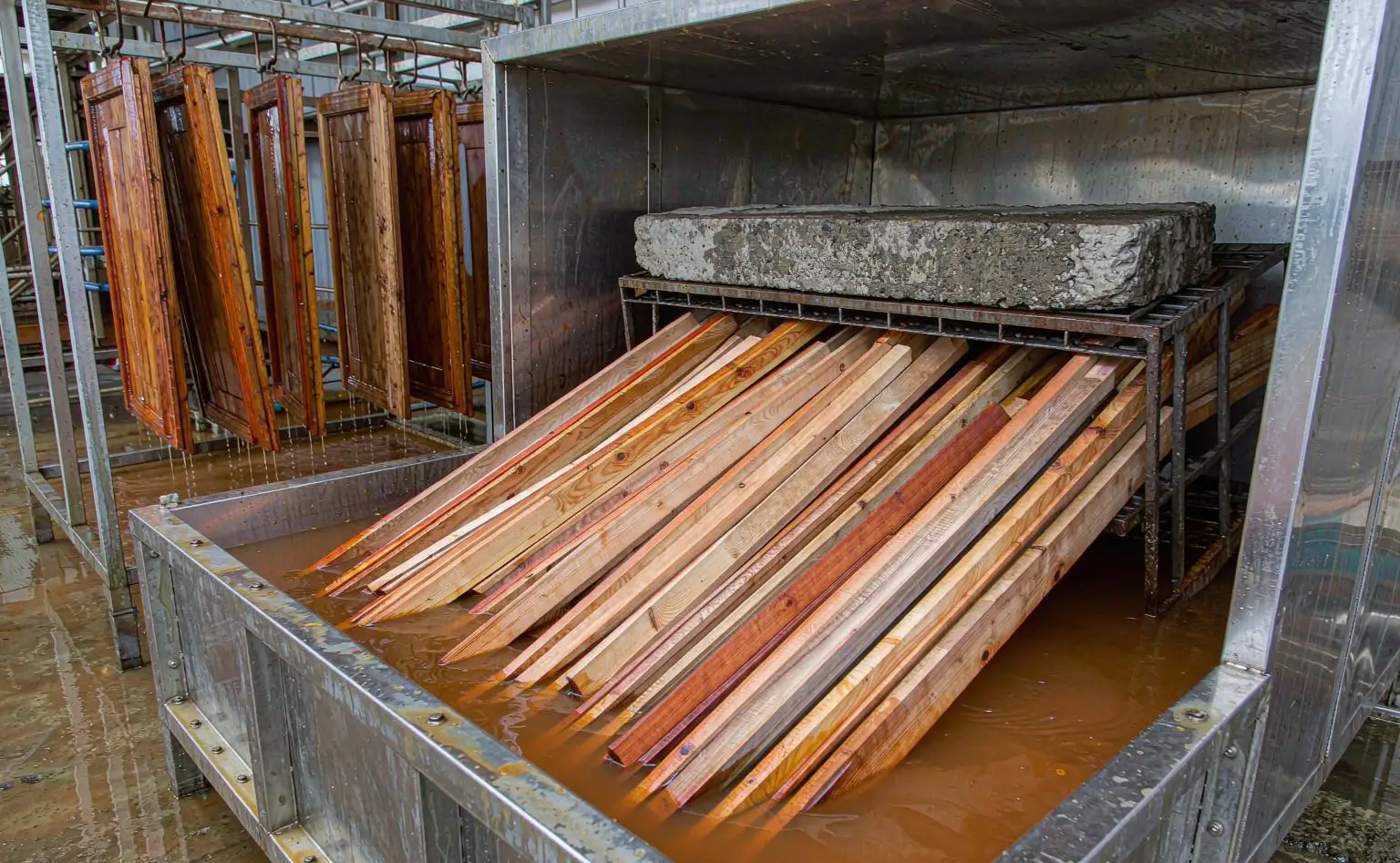
Making up the liquor. Mix iHeir-M5 with water at 1:40 and keep the level high enough to cover the profiles. They must be fully submerged: weight down anything that floats, or load it in a cage, because the part above the surface is untreated.
How long. Soak to 15%-20% pick-up, which is about 5-10 minutes for ordinary profiles, longer for dense hardwood and thick sections, shorter for pine and thin mouldings. Check it on the floor by weighing 3-5 pieces before and after and recording the pick-up on the process card.
Out of the tank. Let the profiles drain rather than stacking them wet; stack with the cuts facing out and gaps between layers so the excess runs off. Check tank level and appearance once a shift, top up on the pick-up figure, and change the liquor when it turns cloudy or throws sediment.
3. How to treat the cuts and the band: two coats, until the end face darkens
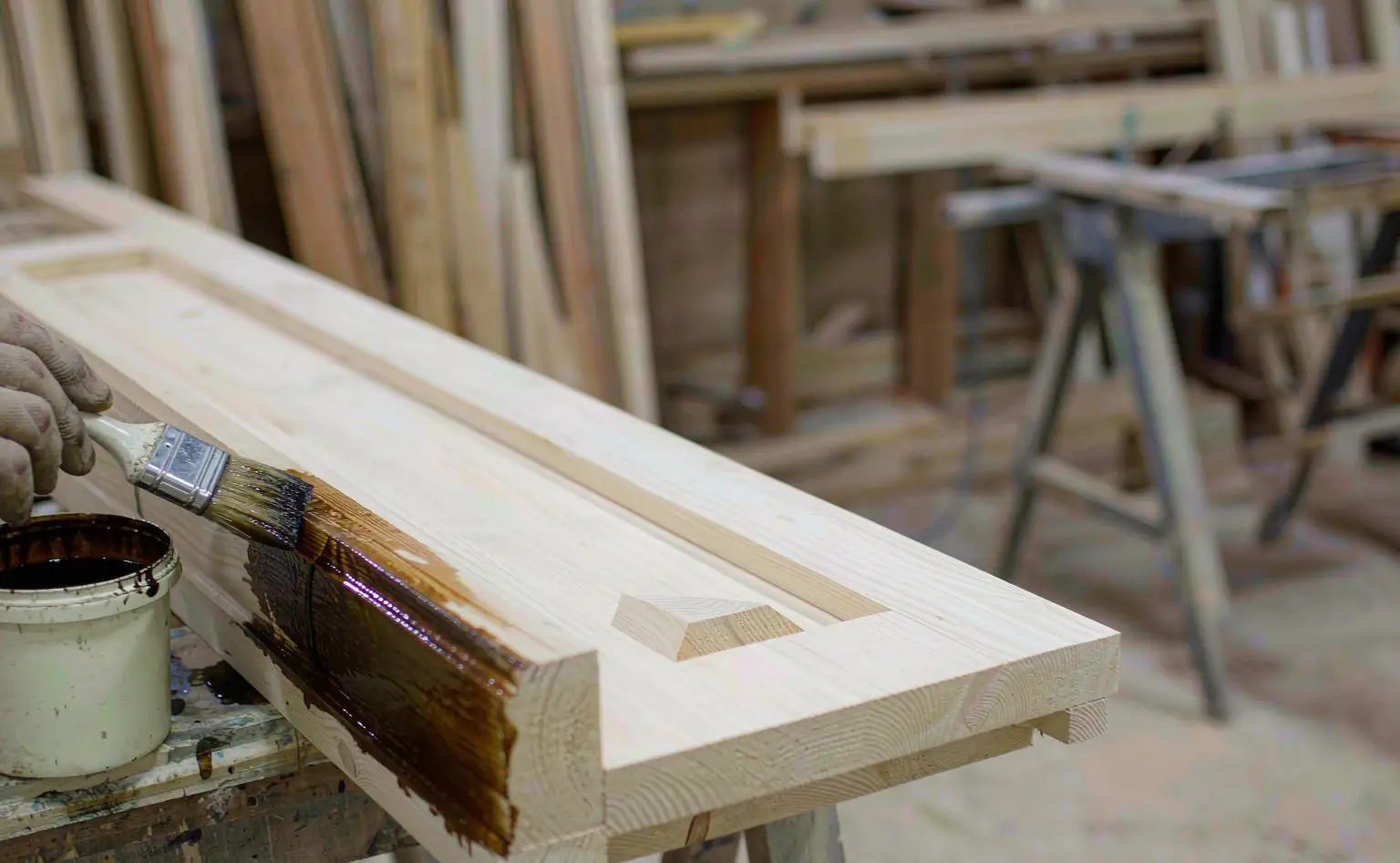
The tank covers the body of the profile; the cuts and the band groove have to be done separately, and this is the step that is most often dropped and most often fails.
Where. Both sawn ends after cross-cutting, the edge-band groove, handle and hinge cut-outs, and any rebate on the wall face. All five are open fibre and all five take water fastest.
How many coats. Brush on neat or 1:40 liquor twice, the second coat once the first is dry to the touch, until the end face darkens and looks wet through. Allow at least four hours after the second coat before the next operation; one rushed coat is the same as none.
Work with the banding. Use a water-resistant band, run the hot-melt at the temperature the adhesive calls for, and brush the joint between band and end again before filling. Use a water-resistant filler, because ordinary filler takes up water and becomes the seedbed.
| Part | Material | Product and level | Stage | Control point |
|---|---|---|---|---|
| Profile body | MDF, plywood, finger joint | iHeir-M5 at 1:40 | Full-length soak before cutting | 15%-20% pick-up, fully submerged |
| Sawn ends | Open fibre | iHeir-M5 liquor, two coats | After cross-cutting | End face darkened, four hours to dry |
| Band groove and cut-outs | Exposed core | iHeir-M5 liquor, two coats | Before banding, after machining | No glue pooling, no missed spot |
| Bundle | PE film, corner board | iHeir-D 1-2 sheets (0.1-0.2 g each) | Packing | Mid-bundle, off the coated face |
One boundary. The tank covers the water and spores inside the profile, the brushing covers the faces that were cut open, and the sheet covers transit and storage. Miss one and growth starts there.
4. Drying and moisture: below 12% before bundling
A soaked profile has to be dried back, otherwise the finish is wasted because the water is still inside.
How dry. Bring the moisture below 12% before bundling, and to 10% for northern Europe and North America. Read it with a pin meter at the ends and the middle, two points each, and take the average.
How to dry. Drain for two to four hours, then run a 50-60℃ room with the dwell set by thickness: 8-12 hours for thin mouldings, a full day for thick ones. The room must extract moisture; heating without extraction just moves water around the box. Brushed ends have to be dry before they go in, never with a wet film on.
No direct sun. Sun dries the face while the core stays wet, which locks in stress and warps the profile when it is machined later, and warp on an export order is harder to fix than growth.
5. Bundle and store: sheets inside, humidity outside
The bundle stage belongs to vapour-phase paper, counted on bundle volume and closed time.
How many. Each sheet carries 0.1-0.2 g of active. A bundle of 10-20 profiles takes one or two; a palletised export pack on a 30-day sea lane takes two, and humid-season stock one more. Put them mid-bundle between layers, never against a coated face.
How to close it. Wrap the PE film at least twice and seal both ends, with corner boards protecting the edges only. Wrap the pallet, keep it 10 cm off the floor and 30 cm off the wall, and patch any tear, because a tear wastes the sheet.
Storage. Hold the finished store below 60%RH and dehumidify in the humid season; stack long profiles no higher than 1.5 m so the lower layers are not distorted. Related practice on timber profiles is in wooden photo frame strips and backing paper.
6. Questions from the line
Q: The profile is already coated, does it still need the tank?
A: Yes. A coating stops surface water, while the sawn ends and the band groove are open fibre that paint never reaches; the soak puts the protection inside the board.
Q: Can the 1:40 liquor be reused?
A: Yes, with top-up on the pick-up figure and a shift check of level and appearance; change it when it turns cloudy, throws sediment or loses colour.
Q: Is one coat on the ends enough?
A: No. The end face takes liquid fast and one coat only skins it; the second coat is what carries it through, and four hours of drying comes before filler.
Q: With sheets in the bundle, is warehouse humidity still relevant?
A: Yes. Sheets cover the small volume inside the wrap while the warehouse sets the load on the film and the pallet, so hold the store below 60%RH and wrap the whole pallet.
Four closing points: soak full lengths in iHeir-M5 at 1:40, fully submerged, to 15%-20% pick-up, about 5-10 minutes, weighing 3-5 pieces for the record; brush both sawn ends, the band groove, handle and hinge cut-outs twice with the liquor, the second coat after the first is dry, and allow four hours; dry at 50-60℃ with extraction to below 12% moisture, 10% for dry northern markets, never in direct sun; put one or two iHeir-D sheets at 0.1-0.2 g in a 10-20 piece bundle, wrap twice and store below 60%RH. Mould resistance can be verified to GB/T 18261 and ASTM G21, and lead times are on the iHeir-M5 product page.


