




 View Count:31
 Date:2026-11-16
Can mosquito net mould be prevented before the carton is closed? Polyester mesh is light in weight but has several times the surface area of ordinary fabric, so a regain two points high is enough to grow a layer of spots inside a folded pack. The route is 2%-3% o.w.f. of iHeir-BJ textile mildew inhibitor in the setting bath, regain held below 8% before folding, and 0.1-0.2 g iHeir-D sheets in the carton. This article gives the bath parameters, the regain criterion and the sheet count.
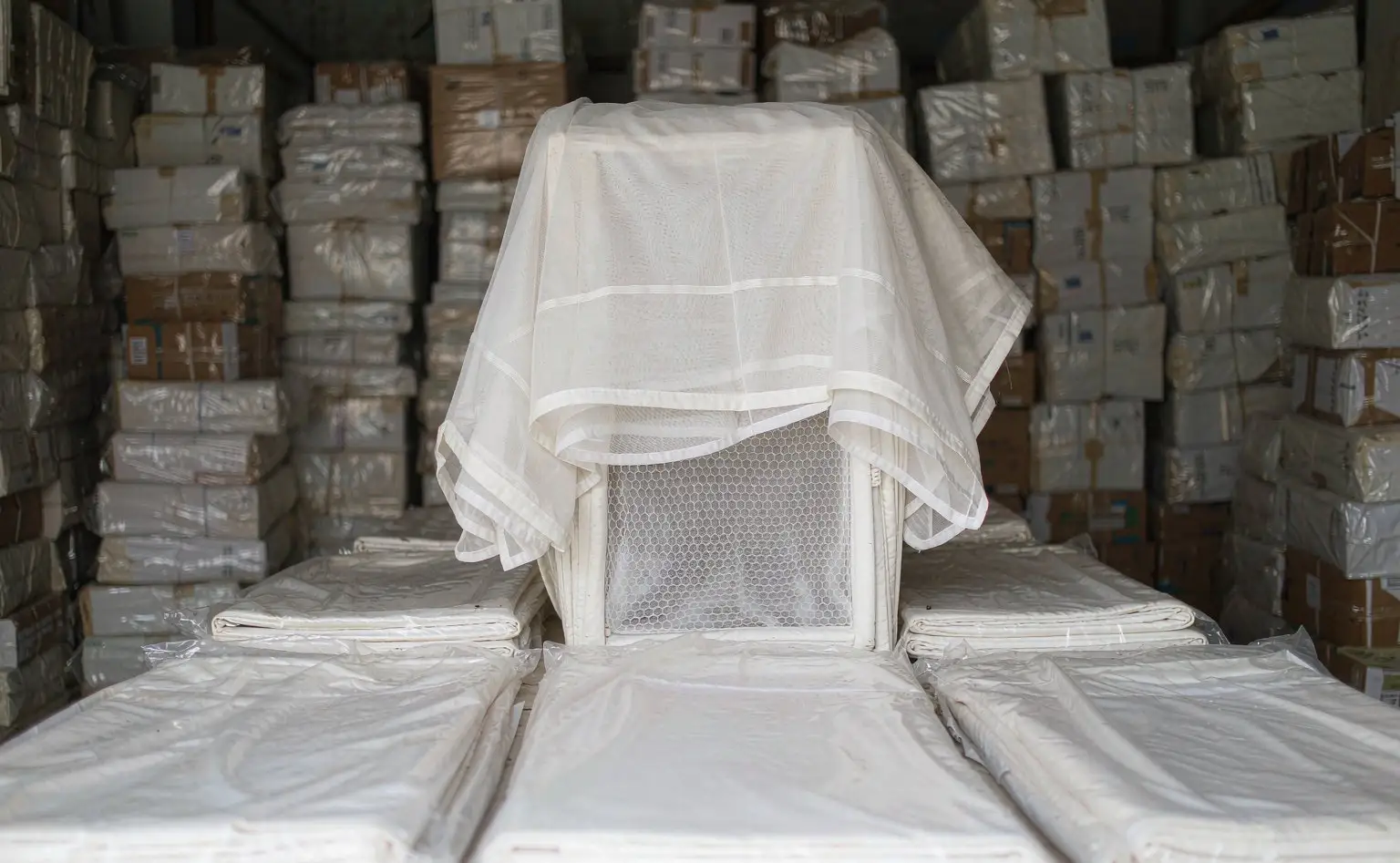
1. Where mosquito net mould comes from: light mesh, large surface, folded packing
The greige is usually polyester or nylon mesh, warp or weft knitted, wide in the batch and low in grams per square metre; one double net uses little yardage but opens to a large area.
Surface area is the root. Mesh absorbs and releases water faster than a plain weave. It is the first to take up moisture when the shop turns humid and the first to condense when it leaves the oven cold. Once folded, the layers press together, air cannot move between them and the water sits in the creases.
Folding and bagging is the second gate. The folding station often sits outside the air-conditioned area, and fabric folded while warmer than the room condenses between layers at once; once bagged, the vapour has nowhere to go and the creases show spots within two weeks.
Seasonal stocking is the third gate. Nets are built ahead of the season and can sit in the warehouse through a whole humid spell, where no process can reach them, so the finish and the sheet have to carry that stretch.
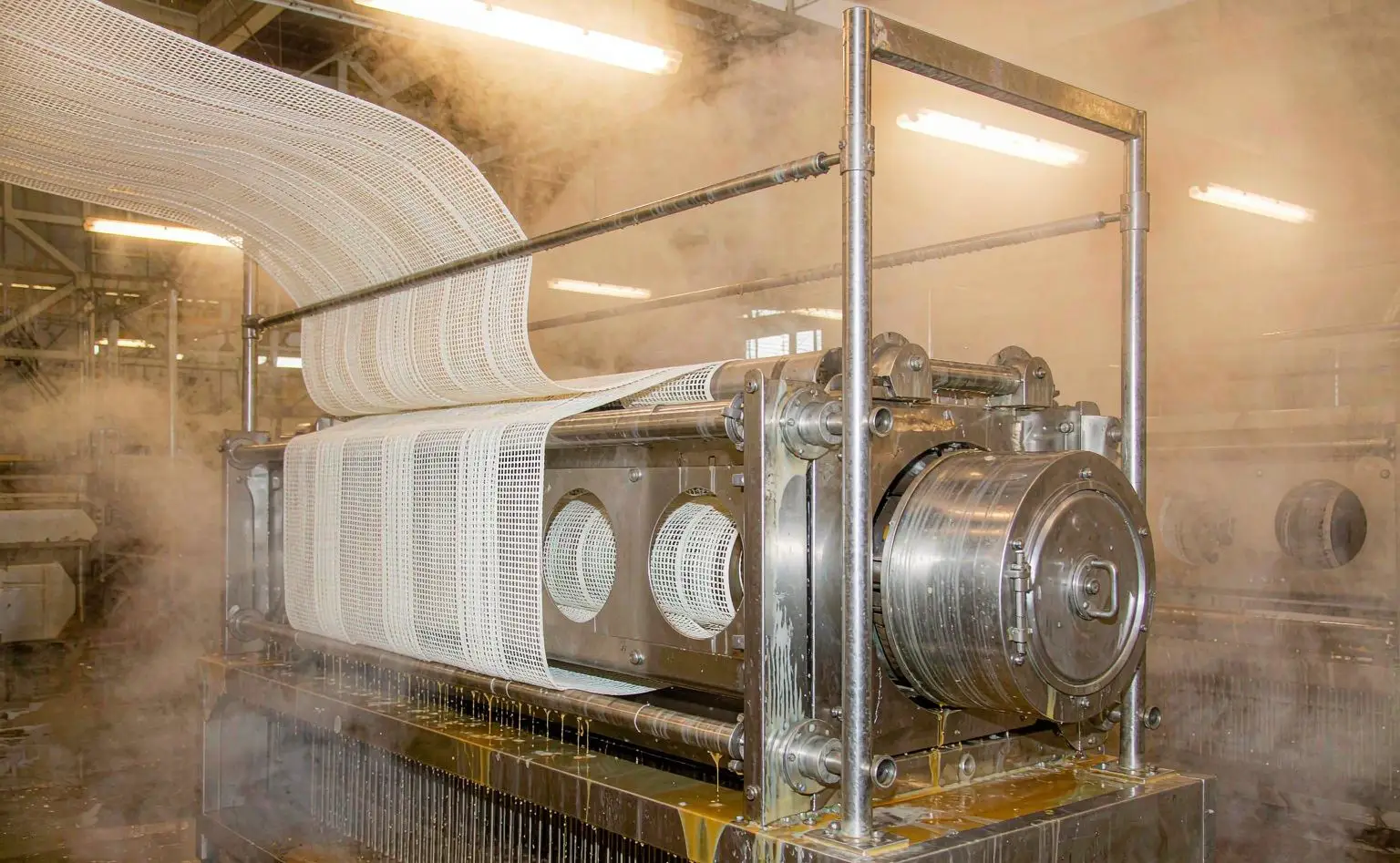
2. How to add it at the setting stage: 2%-3% o.w.f., 21-50℃, pH 4.5-8.5
The finish goes on in the setting bath, where padding carries it onto the fibre surface; it is not sprayed on the finished net.
How much. 2%-3% o.w.f. on dry fabric weight. 2% covers a normal export order at one year and beyond, 3% covers the two to three year requirement; light low-gsm mesh holds a season’s shipping at 2%, while long lanes to the Middle East and South East Asia or a two-year shelf life call for 3%.
Bath conditions. Bath temperature 21-50℃, pH held at 4.5-8.5 with 6 as the target, soft water for the make-up. Wet pick-up is taken at 70%, so the liquor carried out on one tonne of fabric is calculated on that figure when topping up.
How to charge it. Pre-mix with 9-13 times its volume of water and add in portions, otherwise one pour creates a local concentration spike and uneven uptake. iHeir-BJ is a cationic system and must not share a bath with anionic auxiliaries: check the ionic type of softeners and antistats before the recipe is set, because a shared bath neutralises both and leaves water-repellent patches.
3. What to check before folding: hold regain below 8%
“It feels dry” is the least reliable test on light mesh, which dries on the face while the layers still hold water. The criterion has to be a number.
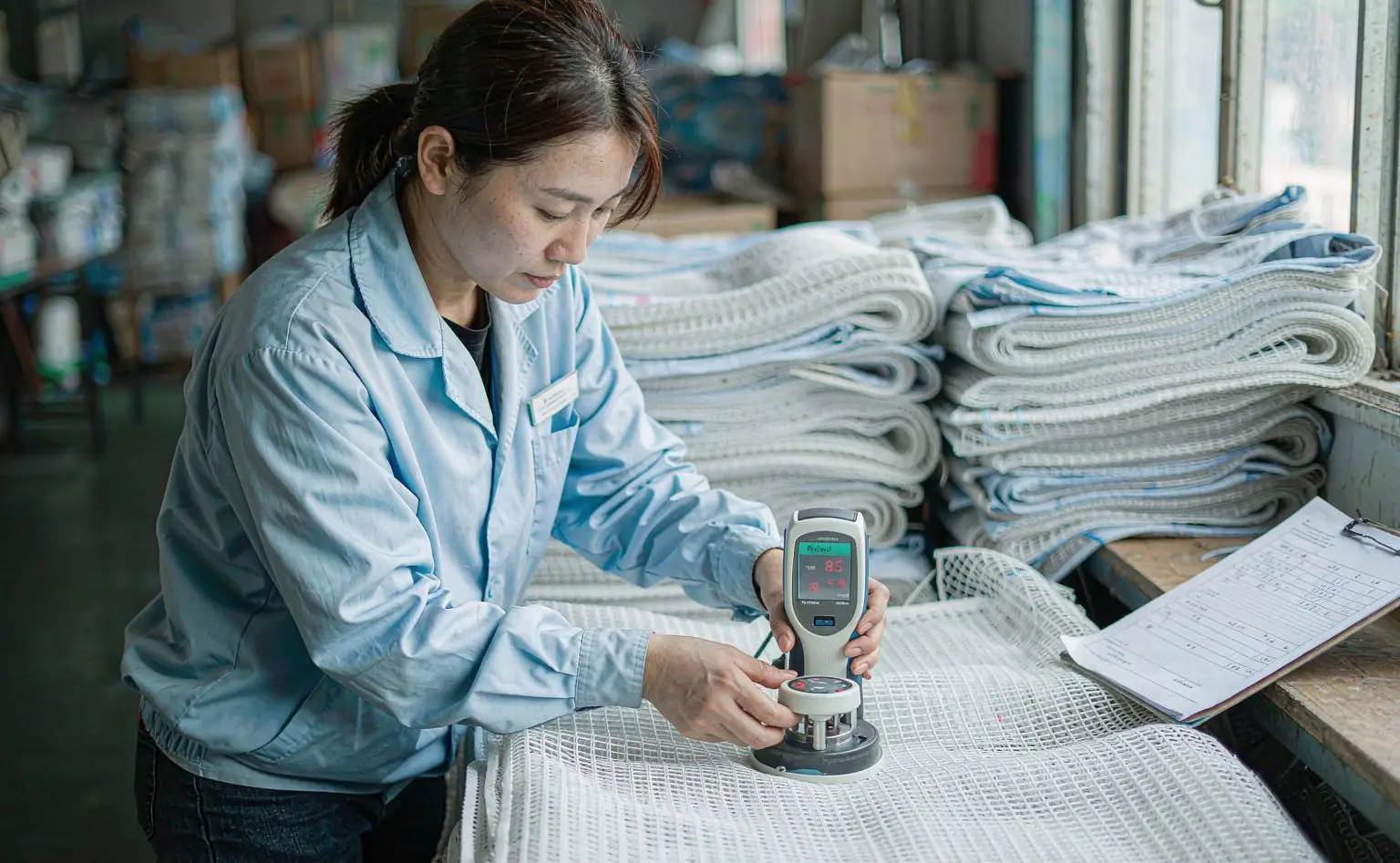
Where and how to measure. Take 5-8 readings across the width and along the length with a portable meter, both selvedges, the middle, head and tail; use the average and send any section above 10% back through the oven. Let the fabric cool to near room temperature first, because a hot web reads low.
What line to set. Fold at below 8%, at 7% through the humid season, and at 7% for long lanes to the Middle East and South East Asia. If it will not come down, add dwell or slow the line rather than pushing the setting temperature, which stiffens the mesh and pulls in the width.
The folding station. Do not leave an open buffer between the oven exit and folding; take the roll straight through with under two hours of dwell, hold the area below 60%RH, and have operators wear gloves so hand moisture does not mark the face.
| Stage | Material | Product and level | Parameters | Control point |
|---|---|---|---|---|
| Netting setting | Polyester mesh | iHeir-BJ 2%-3% o.w.f. | 21-50℃, pH 4.5-8.5 | 9-13 times water, no anionic share |
| Drying and folding | Open-width web | No additive, control water | Regain at or below 8% (7% in season) | Read cool, average several points |
| Bagging and carton | PE bag, carton | iHeir-D 2-4 sheets per carton (0.1-0.2 g each) | By season and lane | Bag sealed, sheet off the fabric |
| Finished store | Stacked cartons | No additive, control humidity | Below 60%RH | 10 cm off the floor, 30 cm off the wall |
One boundary. The bath finish covers growth on the fabric, the regain check covers the water carried into the carton, and the sheet covers storage and shipping. Each has a job and none replaces another.
4. How many sheets per carton: two normally, four in the humid season
Inside the carton the work is done by vapour-phase paper, counted on volume and closed time, not on the number of nets.
How many. Each sheet carries 0.1-0.2 g of active. A 60×40×40 cm carton holding 20-30 nets takes two; stock built for the humid season or held more than three months takes four; long lanes to the Middle East and South East Asia add one or two more.
Where to put them. On the upper inner walls at opposite corners, or between bags. Never flat against the netting, because the sheet marks the face when humidity is high, and the bag has to be sealed, since an open bag wastes the sheet.
The carton has to be dry too. Test incoming cartons and dry or replace anything above 12%. Skip newsprint and wood-pulp padding, which absorb water and carry spores, and are a source rather than a protection.
5. Verification: watch the batch-to-batch drift, not the first piece
On a seasonal build the usual failure is inconsistency between batches: the first run is treated, a later run is rushed without the addition, and the customer samples the later one and rejects the lot.
How to verify. Run GB/T 24346-2009 for mould resistance and read the growth grade, with AATCC 30 for export orders and GB/T 20944.3 where antibacterial claims are made. Cut test pieces from the treated roll of each batch rather than substituting a lab sample.
How to hold the batch. Keep three 20×20 cm swatches per batch, labelled with the bath number and mangle pressure, stored with the shipment, so a claim is answered with a comparison; check bath pH and level once a shift.
Incoming greige. Test regain on arrival and dry anything above 8% before setting, because damp greige dilutes the bath and reduces the add-on. Related textile practice is in tablecloth setting bath and regain.
6. Questions from the line
Q: Is 2% enough on light mesh?
A: 2% covers a normal export order at one year and beyond; go to 3% for long lanes or a two-year requirement. Dosage is calculated on dry fabric weight, not bath volume.
Q: Can it go in with the softener?
A: Check the ionic type first. iHeir-BJ is cationic and cannot share a bath with anionic auxiliaries, which neutralise it and leave water-repellent patches.
Q: Is the 8% figure a surface reading?
A: It is the overall figure. The meter reads the face, so average several points after cooling and re-dry any section above 10%; water between layers is not visible and is handled with dwell.
Q: With sheets in the carton, is warehouse humidity still relevant?
A: Yes. Sheets cover the small volume in the carton while the warehouse sets the load on the board and the outside of the box, so hold the store below 60%RH and wrap the pallet.
Four closing points: run iHeir-BJ at 2%-3% o.w.f. in the setting bath at 21-50℃ and pH 4.5-8.5 on soft water, pre-mixed at 9-13 times the water and added in portions, topped up on a 70% pick-up, never sharing with anionic auxiliaries; read regain at several points before folding and hold it below 8%, at 7% in the humid season and on long lanes, re-drying anything above 10%; pack iHeir-D at two sheets for a 60×40×40 cm carton and four in season at 0.1-0.2 g each, on the upper inner walls and off the fabric; keep three swatches per batch for GB/T 24346-2009 and AATCC 30 and hold the store below 60%RH. Lead times are on the iHeir-BJ product page.


