




 View Count:40
 Date:2026-09-07
Fur coats, suede jackets, and down jackets share one painful problem: they mold faster than cotton or synthetic fabrics. Why? Because all three are high-protein natural fibers—real leather, animal fur, and down clusters are direct food sources for mold. They also absorb 30%-50% more moisture than cotton at the same humidity. Combined with warehouse humidity above 60%RH or sea-freight humidity swings, a single batch can lose 30%+ of value to mold. This article explains how fur and down mold forms, how to spot it early, the right warehouse humidity (50-60%RH), the 4-step export packaging method (anti-mold paper + Power Pak + T-1000 + barrier bag), and where iHeir-PF leather agent and Spray(M3D) fit in the production line. All methods stay on the warehouse and packaging level—no chemical spraying or fumigation on the fur or down itself—to avoid oil residue, odor carry-over, and REACH/CA65 compliance risk.
1 Why fur and down mold faster than regular fabric
Three reasons explain why fur and down outpace cotton in mold speed:
- Natural protein fiber is direct food for mold: real leather is collagen, fur and down are keratin plus natural oils. Mold secretes enzymes that directly break down keratin and collagen, no preprocessing required. Cotton must first be decomposed by enzymes before mold can use it; fur and down are an instant meal.
- Moisture regain 30%-50% higher than cotton: at 20°C and 65%RH, fur absorbs 14%-16% by weight, down fill absorbs 10%-12%, while cotton sits at 8% and synthetics at 3%-5%. More internal moisture equals faster mold growth.
- Oil oxidation accelerates the cycle: leather oils and down oils slowly oxidize under high humidity. The oxidation by-products are themselves extra nutrients for mold. The older the stock, the higher the mold risk, which is why rework jobs most often hit long-held inventory.
Add in the bulk and loft of fur and down—air pockets between fibers trap moisture—and you get a micro-humid zone right inside the garment, far more inviting than tightly packed cotton.
2 How to identify fur and down mold (4 typical symptoms)
Four symptoms show up first on fur and down, and they differ from cotton mildew:
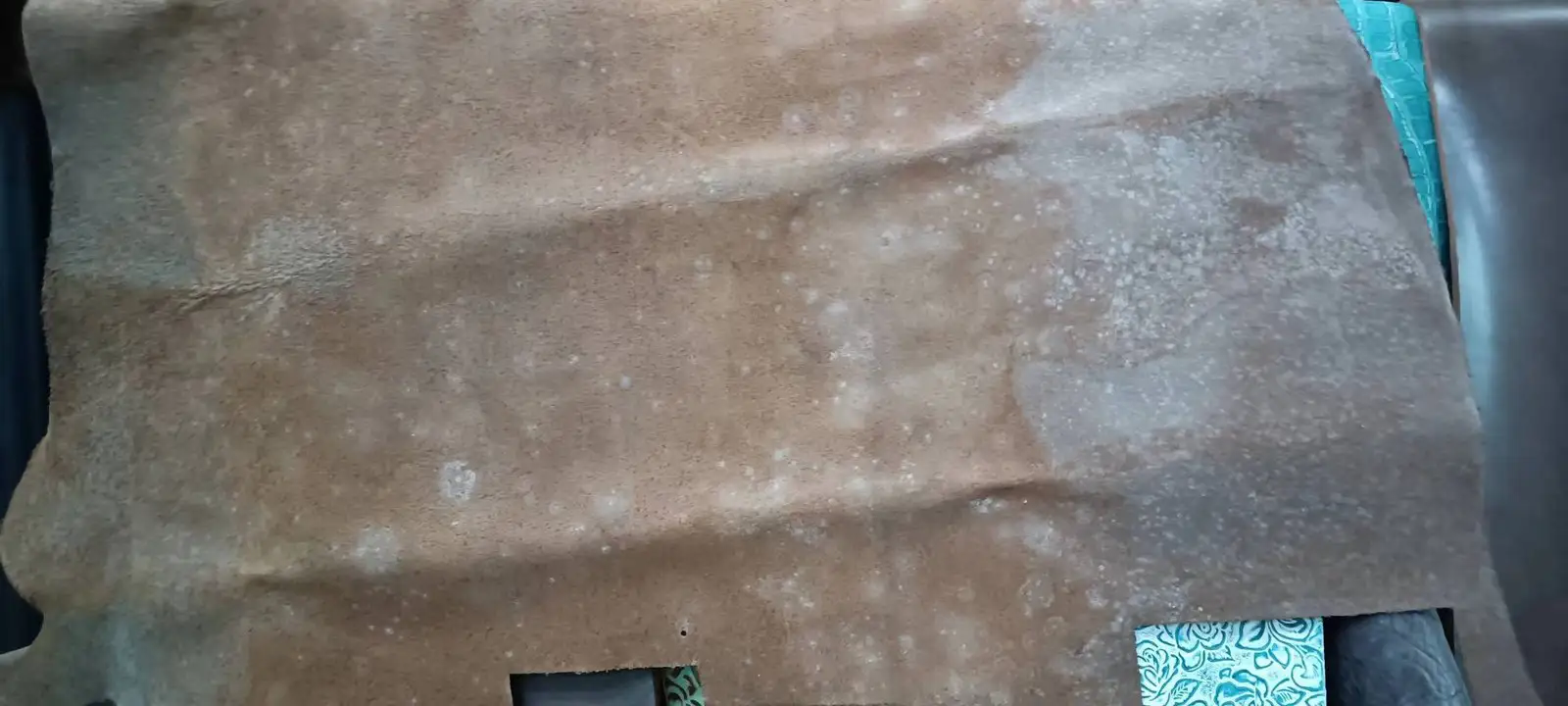
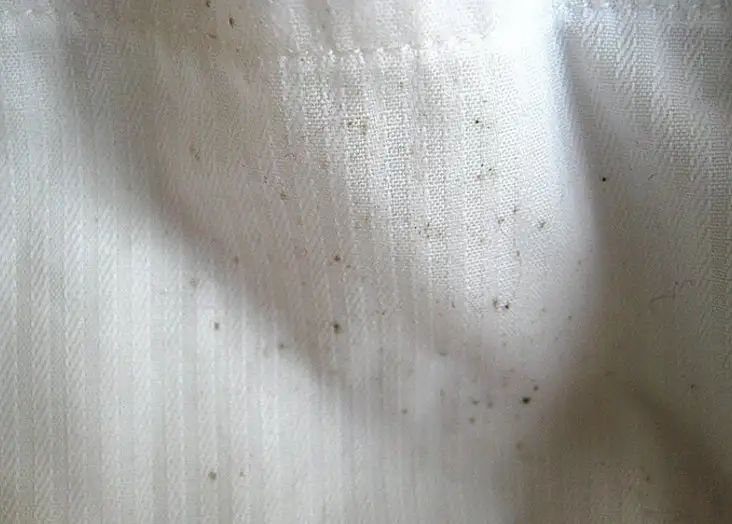
- White, green, or gray-black mildew spots: visible as fuzzy tufts or dark patches that smear into powder when rubbed. They do not wipe off like water stains.
- Increased shedding and fiber clumping: fur or down that was once fluffy starts to clump, mat, and shed more than usual. Mold has already attacked the protein structure at the root—this is irreversible, washing will not restore it.
- Musty or sour smell: opening the package releases a mix of musty, sour, and oil-rancid notes. Protein decomposition releases ammonia and sulfur compounds, so fur mildew smells more pungent than cotton mildew.
- Leather stiffens, cracks, or darkens: if the leather part of a fur coat picks up moisture and molds, the skin stiffens, becomes brittle, and darkens, losing the original hand and luster.
When processing a return, classify mold by stage: ① factory/trader warehouse; ② sea-freight container; ③ retail store or end-consumer closet; ④ raw material (raw hide, raw down). Each stage has a different responsibility and a different fix. The same physical moisture-control logic used in our tea warehouse humidity guide applies directly to fur and down.
3 Warehouse humidity standard: 50-60%RH plus pallet and wall spacing
Fur and down storage demands one tier above normal garments. The two key controls are relative humidity and stacking layout:
- Relative humidity 50%-60%RH: the real enemy is sustained high humidity, not heat. Hold the warehouse at 50%-60%RH year-round, drop to 55%RH or below in the plum-rain season. Northern dry regions can run 60%RH; southern and coastal warehouses must use a dehumidifier. Keep temperature at or below 25°C and block direct sunlight, which oxidizes oils and fades color.
- Pallet + wall spacing with airflow aisles: stack on pallets 20-30cm off the floor, 30cm off the wall, and leave 30-50cm airflow aisles between stacks. Fur loft traps moisture in the nap—airflow is the last line of defense.
- Sampling frequency: weekly sampling during plum-rain season, every two weeks otherwise. Open the package, sniff for musty odor, check the leather for color change. Smell is the earliest signal; visible spots appear after the protein is already damaged.
- Never store with harsh chemicals: keep fur and down away from bleach, disinfectants, and mothballs. These chemicals break down leather oils, fade color, and embrittle fur, while their odor transfers to the fur and cannot be removed by airing.
For storage format, hang fur coats in breathable non-woven garment bags—never sealed plastic bags (trapped moisture accelerates mold). Down jackets can be folded and stacked, but place an anti-mold packaging paper sheet between each garment. When sampling, check three places: the fur itself, the inside of the bag or box, and the warehouse wall behind the stack. Mold often starts on the wall before it shows on the garment.
4 Export packaging 4-step method: paper + Power Pak + T-1000 + barrier bag
Sea-freight containers swing between 30%RH and 95%RH over a 20-40 day voyage, with a 15-25°C day-night temperature gap that triggers container rain. A single desiccant or anti-mold chip is not enough; fur and down need a 4-step combination:
- Step 1: Wrap each piece in anti-mold paper: line the inner side of the garment bag or box with anti-mold packaging paper (pairs with Power Pak anti-mold tablets). The paper absorbs residual moisture and slowly releases anti-mold vapor—the first line of defense for long voyages.
- Step 2: Drop in Power Pak tablets: place 1-2 Power Pak tablets per garment depending on package size. The volatile anti-mold active reaches every corner of the garment, including the inner lining the paper cannot touch. The deodorizing active also suppresses the natural oil and sour notes in fur—better unboxing experience for the end customer.
- Step 3: Add T-1000 container drying sticks: in the outer carton or shipping container, add T-1000 container desiccant sticks (see T-1000 container drying stick). The sticks pull container humidity from 80%RH back down to under 50%RH. For a standard 40HQ container of fur or down, use 4-6 T-1000 sticks, adjusted by voyage length and season.
- Step 4: Barrier bag plus export carton: the outermost layer is an aluminum foil / PE composite barrier bag, sealed, then placed in the export carton. The barrier bag blocks external moisture, the carton takes the physical abuse, and the two layers handle the container-rain cycle together.
Cost check: anti-mold packaging for a single fur or down garment runs about USD 0.4-1.1 (paper $0.07-0.14 + Power Pak $0.14-0.28 + T-1000 $0.07-0.14 + barrier bag $0.14-0.55), while a single mold-related claim is usually thousands of dollars. One Northeast China fur trader lost RMB 670,000 to mold in 2024, then switched to the 4-step method in 2025 and held mold rate across 8 export batches to ≤0.3%.
5 iHeir-PF leather agent and Spray(M3D): production-line options
If a fur factory or down jacket maker needs raw-material or pre-shipment anti-mold treatment on the production line, iHeir-PF leather anti-mold agent (see iHeir-PF leather anti-mold agent) and Spray(M3D) water-based anti-mildew agent (see iHeir-Spray M3D) are the compliant picks:
- iHeir-PF leather anti-mold agent: apply after leather tanning and before dyeing. Dilute to 0.3%-0.5% of leather weight, immerse for 15-20 minutes, then dehydrate and dry. Treated leather stays mold-free for 30 days at 30°C / 85%RH, with no measurable effect on softness, color fastness, or tear strength. Passes REACH, California Proposition 65, and GB 18401 testing.
- Spray(M3D) water-based anti-mildew agent: for surface spraying on finished leather garments, bags, and suede items. Water-based, low VOC, no irritating odor. Spray 2-3 passes per garment (10ml each), air-dry naturally. The resulting breathable anti-mold film does not block leather pores or change the hand feel, so the original fur breathability stays intact.
Important: iHeir-PF and Spray(M3D) are factory production-line treatments, intended for fur factories, down jacket makers, and leather tanneries. Traders, export companies, and end consumers should not spray these on finished fur or down themselves—let a professional factory handle it. For home use, the dry brush + shaded ventilation + anti-mold chip combination is the safer route.
6 FAQ plus two desensitized cases
Q1: The fur coat already has mildew spots. Can it be saved?
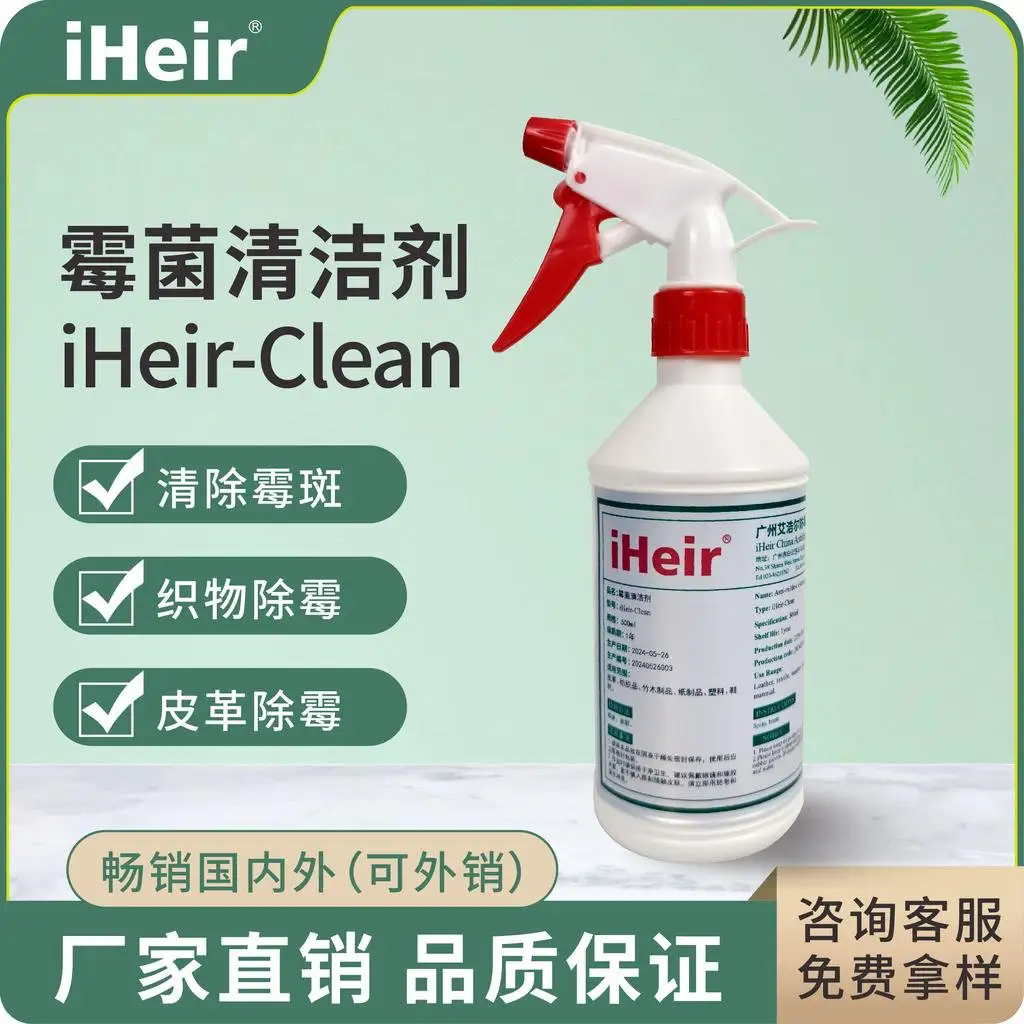
A: It depends on how deep the mold has gone. Surface white or green spots can usually be cleaned with iHeir-Clean leather & garment mildew remover (see the cleaning method in our garment mildew treatment guide), followed by soft brushing and shade drying. Once mold has reached the leather, fur root, or down cluster (visible shedding, stiffening, or color change), the damage is not reversible—downgrade or scrap the item.
Q2: Can fur coats be vacuum-sealed?
A: For short term (1-2 weeks) only. Vacuum sealing traps the moisture already in the fur inside the bag, creating a high-humidity micro-environment that accelerates mold. For long-term storage use a breathable non-woven garment bag + desiccant + anti-mold chip, kept in a dry, dark, cool closet.
Q3: The down jacket was washed once but the mildew is still there. What now?
A: Washing spreads the spores. Do not wash again. First, dry-brush the visible mold off with a soft brush. Then air-dry the jacket in a shaded, well-ventilated spot for 2-3 days. Finally, spot-treat the remaining stains with a mildew remover. If the down clusters are clumped and there is a sour smell, scrap the jacket.
Desensitized case 1 (fur trader): A Northeast China fur trader shipped 600 mink coats to Russia in 2024. After 2 months in the customer’s warehouse, 35% (210 coats) molded, triggering a RMB 670,000 claim. In 2025, the trader switched to the “anti-mold paper + Power Pak + T-1000 + barrier bag” 4-step method. Across 8 export batches that year, mold rate dropped to ≤0.3%, and end-customer unboxing feedback improved noticeably.
Desensitized case 2 (down jacket factory): An East China down jacket maker exported 30,000 units to Japan in late 2024. On arrival, the customer reported 12% of jackets had a musty smell and yellowed down clusters, with rework cost RMB 480,000. Root cause: container humidity swung from 78%RH to 95%RH during the voyage, and container desiccant was under-dosed. In 2025, the factory added 6 T-1000 sticks + anti-mold paper per container; arrival mold rate fell to under 0.5%.
The core of fur and down mold is three forces stacking up: high-protein natural fiber + high humidity + long storage. Holding warehouse humidity at 50-60%RH, using the 4-step export packaging, and adding production-line anti-mold treatment when needed, brings mold rate under 0.5%. For a tailored plan based on fur or down type, destination country, and voyage length, contact iHeir Hangzhou for sample testing and a custom protocol.