




 View Count:12
 Date:2026-10-21
What should be done with a mouldy cork? First decide whether the lot has taken up damp or actually moulded: a stopper that feels rough, has gone deeper in colour and smells closed is damp; grey-green spots mean mould has landed. Cork is porous, one wet season puts moisture back, and by the time spots show it is late. In storage, put iHeir-D paper in the pack at 0.1-0.2g per sheet; for shipment, hang 8-10 T-1000 sticks in a 20ft container. This article gives the criteria for both stages.
1. Decide first whether the cork has taken up damp or moulded
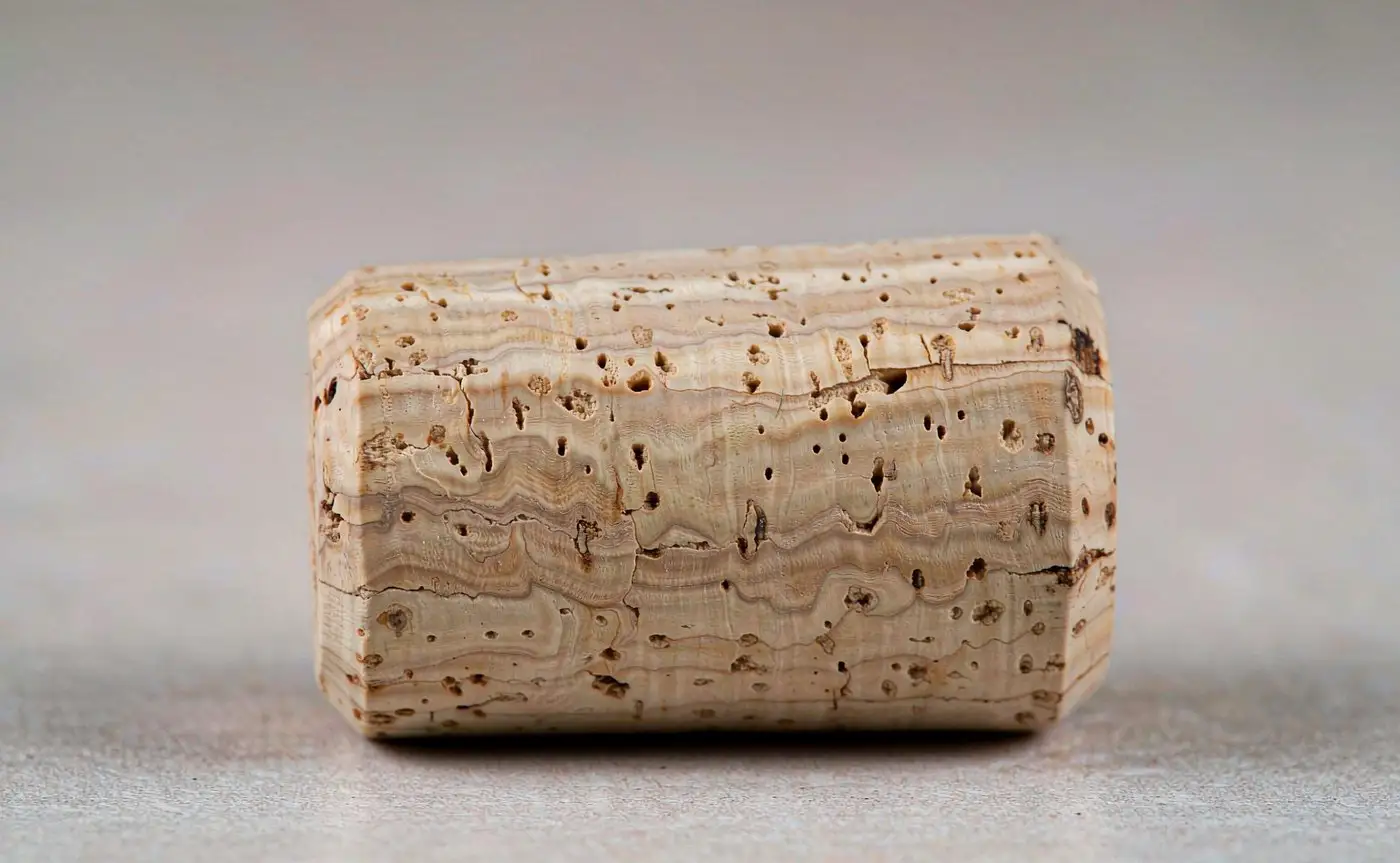
Cork is ground bark bonded with its own resin, a mix of closed and open cells: it takes up damp quickly, dries slowly, and once mould lands the hyphae travel along the pores.
Read it in three layers. First, feel and colour: a dry, rough stopper turning from pale yellow to a deeper tone has taken up damp, while a tacky surface means growth has started. Second, spot pattern: discrete dots with clean edges on the upward face are recent; patches running together in a grey-green sheet have been there for days. Third, the packaging: water marks on the liner paper or a softened carton wall tell you where the moisture came from.
2. Inbound, storage and shipment: three stages compared
The table sets out the action, the means, the level and the criterion for each stage, so purchasing and the warehouse can work from one sheet.
| Stage | Problem | Means and level | Criterion | Points to watch |
|---|---|---|---|---|
| Inbound check | Material arrives damp | Sample moisture and smell, reject if out | Dry, no musty note, no spots | Do not mix lots on one stack |
| Storage | Room humidity | Control humidity, pallets off the floor, gap to the wall | No damp marks on the liner | Check before and after the wet season |
| Inside the carton | Closed space in the box | iHeir-D paper at 0.1-0.2g per sheet | No musty note on opening, spots do not spread | Paper against the liner, never on the stoppers |
| Container | Condensate in transit | T-1000, 8-10 sticks in a 20ft | No water marks on the walls at destination | Hang high, clear of the cartons |
The first two rows are management, the last two are product. The order cannot be reversed: if warehouse humidity is not held, the paper’s capacity is used up in weeks; if there is no paper in the carton, the sticks cannot reach inside that cubic metre. All three stages together are what “damp control matters more than a later fix” actually means.
3. Storage: holding humidity down beats adding anything
Three failures explain most warehouse problems: cartons on the floor, where ground damp rises into the bottom layer; no gap to the wall, which condenses on the inside face; and no humidity record, so a lot sits for months before anyone sees a spot.
The fix: pallets up, an air path to the wall, a logger read daily, and a carton sampled before and after the wet season. Hold a steady band rather than drying hard once.

4. Inside the carton: paper at 0.1-0.2g per sheet, added at packing
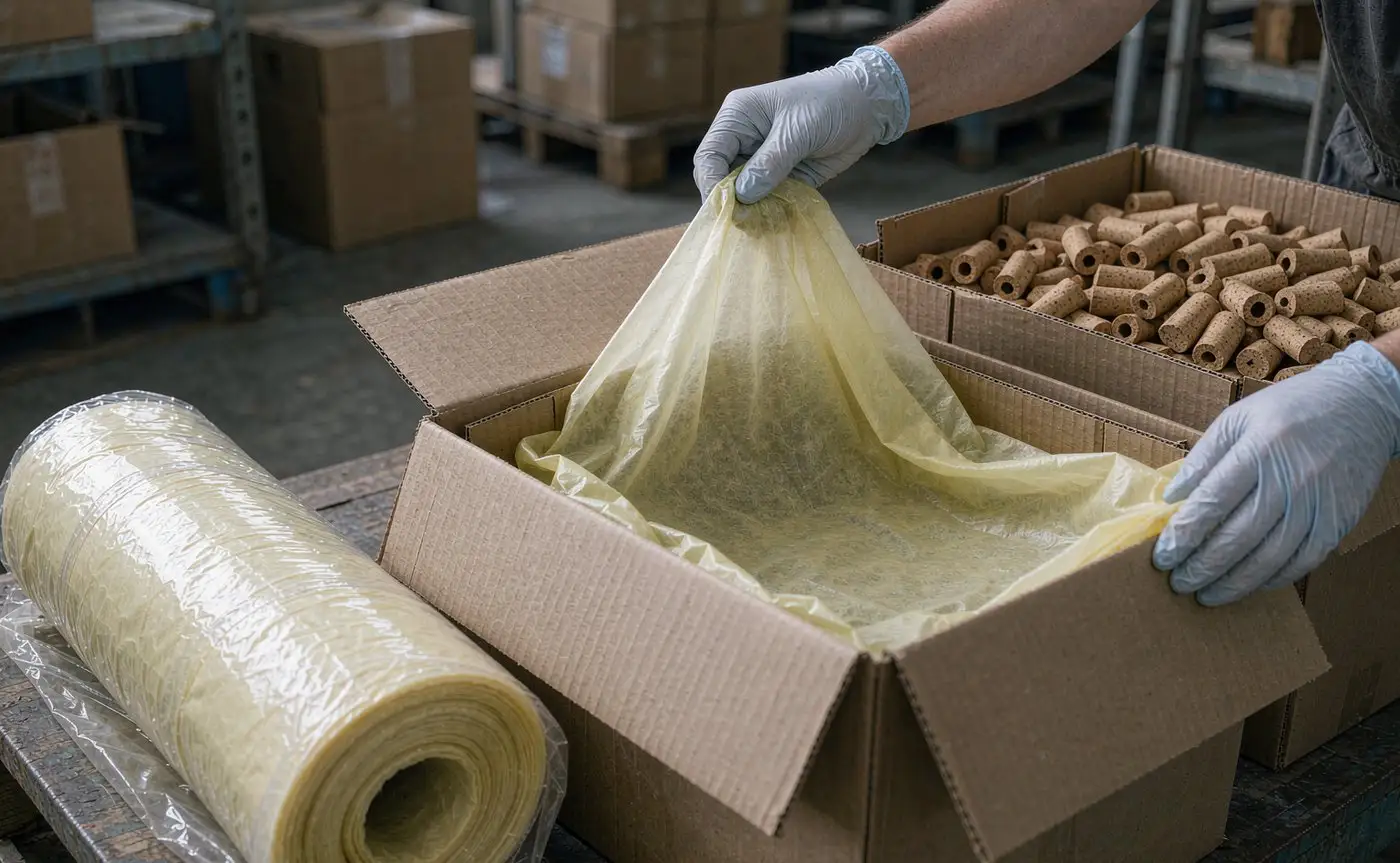
The cubic metre inside the carton is what a container stick cannot reach. iHeir-D is a yellow liquid at 70%±5 solids with particles below 5 microns, a mould-inhibiting ink made into paper; the vapour reaches the stoppers and the dead corners. The level is 0.1-0.2g per sheet.
Three rules for placement. First, position: against the liner and around the stoppers, never pressed onto them, because a covered face gets no vapour and the paper can leave a mark. Second, quantity: one or two sheets in a standard export carton, moving to the top of the range for large cartons, thick liners or sea freight. Third, timing: put it in as the carton is packed, not stuffed in before sealing, where it bunches in a corner and coverage becomes uneven.
Two cautions: in damp conditions D can corrode poor-quality metal fittings, so run a triple-dose trial with the carton catches; and keep the drum closed, dry and out of light, use it promptly, and seal the paper into the pack quickly.
5. Shipment: 8-10 sticks in a 20ft container, hung high
The risk at sea is not constant humidity but condensation: the container roof heats to fifty or sixty degrees by day, the temperature drops at night, moisture condenses on the roof and walls and drips, and a damp carton wall wicks inwards. T-1000 container desiccant sticks cover that leg: 8-10 sticks in a 20ft container and 10-12 in a 40ft, hung high and spaced along the walls, clear of the cartons and away from the doors.
The absorbent is SAP, a cross-linked sodium polyacrylate rather than a chloride salt; it is pH neutral and contains no chloride, a point export orders ask about often, because a salt desiccant can release liquid as it takes up water, corroding metal parts and staining cartons, which T-1000 does not do.
Check three things on arrival: water marks on the roof and walls when the doors open, softened carton walls, and two cartons opened for smell. Clean on all three and the container has passed; if one fails, isolate that lot rather than feeding it into the next process.
6. Questions: can a mouldy lot still be used, and is a desiccant enough
Can cork that has already moulded still be used? It depends. With a few isolated spots that wipe off leaving no discolouration and no musty note, the lot can be sorted, cleaned, dried and downgraded to a non-critical use, but it should be isolated and recorded. With patches, a soft body or a dark tone, scrap the lot: the hyphae are inside the pores and a clean surface is only a clean surface.
Is a desiccant in the carton enough, without the paper? A desiccant handles water vapour, the paper handles spores already sitting on the surface and at the pore mouths; they are not the same job. Porous material arrives carrying spores, so drying alone does not stop growth once humidity moves. Paper alone is not enough either, because its capacity is finite. Both together is what closes the stage.
Does the paper affect the smell of the cork? Not at the normal level, but do not overdose or press it onto the stoppers. Seal paper and stoppers in a bag for seven days and smell it on opening.
Closing figures: separate damp from mould first, and isolate any moulded lot instead of mixing it into the stack; in storage, pallets off the floor, a gap to the wall, a humidity logger, and part-used cartons rebagged; in the carton, iHeir-D paper at 0.1-0.2g per sheet and one or two sheets against the liner, with a triple-dose trial before using metal catches; for shipment, 8-10 T-1000 sticks in a 20ft container, and a check for wall marks and soft cartons at destination.


