




 View Count:92
 Date:2026-09-28
Where does plywood mould start, and how do you dose for it? Veneer draws moisture the night it is stacked, the glue line carries its own carbon load, and a patch on the face means a downgrade while a rejected container means freight paid twice. Soak the veneer with iHeir-JP at 1:15 to a 10-20% pickup, and dose iHeir-JS at 1-2% on the glue weight. This article covers the figures for both points and the mistakes that show up on the line.
1. Why the veneer goes first and the glue line second
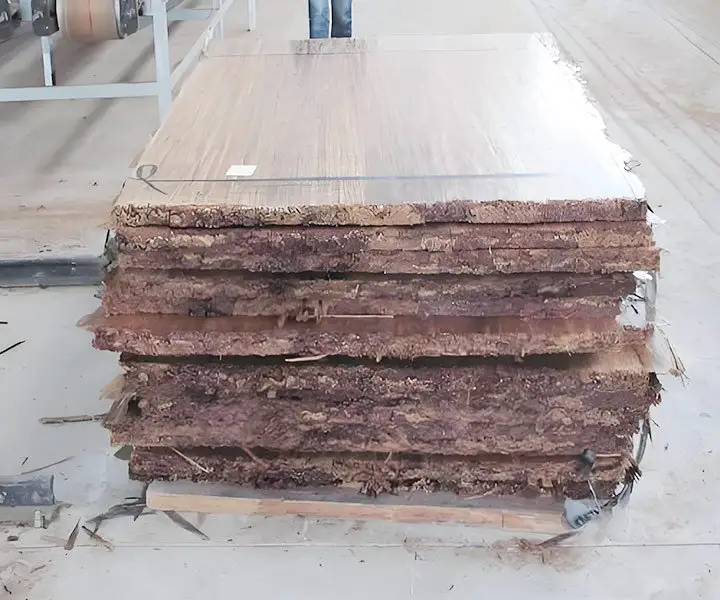
The build of plywood decides the order in which it fails. Veneer is thin, with a large surface area, so one damp night in the yard is enough to pull water in. The glue line brings its own carbon load through the urea resin and the starch filler, and the press seals that moisture into the core; once the panel leaves the press and the core cools, the vapour migrates to the cold face. Across one batch, the face of the outer veneer is normally first to go, and the glue line to core interface follows.
China still held just over 5,010 plywood producers at the end of 2025, on total capacity of about 246 million cubic metres a year, up 11.3%. Linyi alone accounts for 54.6 million cubic metres, 83.1% of Shandong province and still the largest plywood base in the country (China National Forest Products Industry Association, 2025 capacity survey). The more concentrated the cluster, the more stock sits through the same wet season.
2. Veneer soak and glue dosing: the two points side by side
The table sets out the stage, what is treated, the product, the figures and the points to watch, so process and purchasing can work down an existing order against it.
| Point | Treated part | Product | Figures | Points to watch |
|---|---|---|---|---|
| Veneer soak (main line one) | Veneer, thin wood, core sheets | iHeir-JP bamboo and wood agent | Soak liquor 1:15, pickup 10-20% | Fully submerged, never above the liquor; moisture under 25% after drying |
| Veneer soak (fast tier) | Thin veneer, high-volume lines | iHeir-M5 immersion type | Soak liquor 1:40, pickup 15-20% (about 5-10 minutes) | Acidic; keep it off metal and away from alkalis |
| Glue dosing (main line two) | The glue in the mixer | iHeir-JS glue mildew inhibitor | 1-2% on the weight of the glue | Add at the end of mixing, never together with the hardener |
| Face and edge sealing | Panel face, edge cuts | iHeir-PT brush-on type | Brush on neat | pH compatibility up to 9.5; do not miss the edge |
| Coating film and the store | Topcoat and the warehouse | iHeir-YQ paint inhibitor plus dehumidifiers | 1-1.5% in the paint; hold the store humidity down | The core of the stack and anything against a wall goes damp first |
Two main points and one finishing pass: the soak decides whether the fibre carries protection, the glue dose whether the sandwich between two sheets fails first, and the sealed edge whether the cut ends stay open to water.
3. The veneer soak: choosing and mixing JP or M5
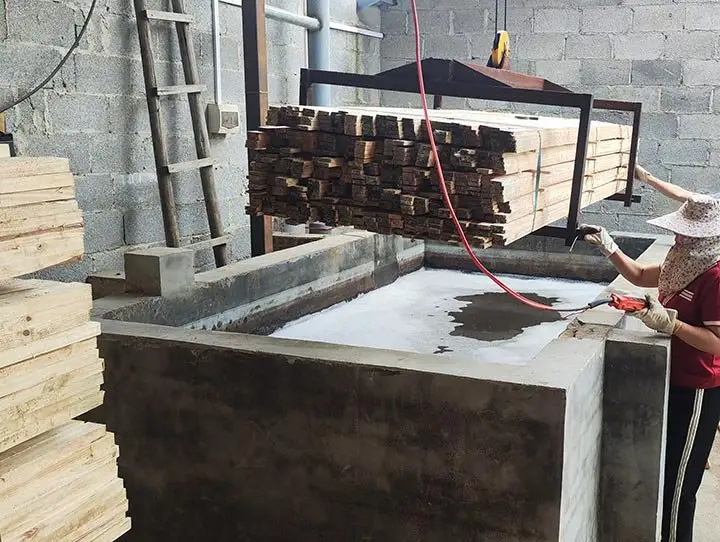
The veneer soak is the first and the most effective line. Both iHeir-JP and iHeir-M5 will do the job, and they differ in dilution and penetration: JP is mixed at 1:15 (one kilogram of agent to fifteen kilograms of water) and the sheet picks up 10-20% in weight; M5 is mixed at 1:40 (five kilograms to a hundred kilograms of water) and the pickup is 15-20% in about five to ten minutes. M5 runs lean and fast for thin veneer; JP is richer and suits thicker sheets.
Three rules belong on the card. First, full immersion: the sheet has to sit below the liquor line, because anything above it is the first place to grow mould. Second, draining and moisture: once the pickup target is reached, lift the sheet, let it drain, and air or sun dry it before it goes to the store; hold the finished moisture below 25% and the protection holds for more than a year. Third, the chemistry of M5: it is acidic, so it must not touch metal or be mixed with alkaline products, and the tank, racks and trolleys have to be acid-resistant.
Spraying can replace the soak for panels already pressed: mix JP at 1:10-20 with water or alcohol, stir, then spray or brush it on across the whole face. The two routes do not conflict, and one order can run both, split by sheet thickness.
4. Glue dosing: JS into the mix, rate and order
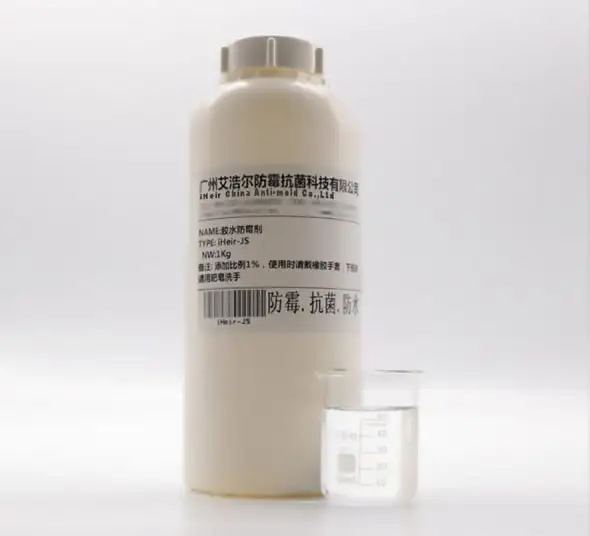
The glue line is the second main point. Pressing seals the moisture of the glue into the core, and if the glue carries spores or the recipe leans on organic filler, that core becomes a closed greenhouse. The fix is to dose iHeir-JS glue mildew inhibitor at the mixing stage, at 1-2% on the total weight of the glue, within a working pH range of 3-10.
The order of addition causes more trouble than the rate. Add JS at the end of mixing, after the fillers, stirring slowly until it is uniform, and never drop it in with the hardener; adding both at once lets the agent complex in a local high-concentration zone, the glue throws grit or the viscosity jumps, and the press then delivers delamination and blisters. Keep the spread rate and assembly time on the original settings and run one shift as a comparison.
5. Face, edges and the finished store
The face and the edges are the closing points. Where a panel is overlaid or takes a topcoat, brush iHeir-PT on neat; it also works in mildly alkaline systems (pH compatibility up to 9.5), carries 5-9% active content, and gives mould inhibition of 98% or more with insect protection of 85% or more. The cut edges take up water faster than the face, so do not leave them uncoated.
Where the panel takes paint or topcoat, add iHeir-YQ at 1-1.5% of the formula weight; the active content is 79.5% and the pH range is 4-7, covering both in-can preservation and the film itself. The pattern at many plants is that the panel body is treated and the coating is left as the single weak point, so the film spots first in the wet season.
The finished store is the blind spot. Plywood takes up moisture quickly and stacks tightly, so vapour cannot leave the middle of the stack, and piles against a wall go first. Keep the warehouse ventilated and the racking off the floor, run dehumidifiers through the wet season, confirm moisture before loading, and use desiccant sticks inside the container with the roof air path left clear.
6. Common questions
Q: Do we really need both the soak and the glue dose? Yes, because the two mould routes are separate. Soak only, and the glue to core interface stays the weak point; dose only the glue, and the outer veneer still takes up moisture in the yard and in transit. Where the budget is tight, split by end use.
Q: Can the soak liquor be reused? JP keeps well, so the bath can be topped up and reused rather than dumped, but it should be finished within a month; M5 is best mixed for the shift. Concentration falls as liquor is carried out on the sheets, so top up by shift rather than simply adding water.
Q: Can a panel that has already gone mouldy be saved? Grade it first. Where the spots sit on the surface and sanding removes them, a cleaning pass and a fresh treatment can work; where the growth has reached the glue line, or the panel has started to delaminate or lose strength, it is a downgrade. For the wider context see treating mouldy boards and mould in the glue itself.
Closing note: the soak puts protection into the fibre with iHeir-JP or iHeir-M5, the glue carries iHeir-JS at 1-2%, and the face and edges are closed with iHeir-PT or a topcoat dosed with iHeir-YQ. Samples and minimum order details for all of these are available on request.


