




 View Count:29
 Date:2026-09-18
Mouldy filter bags and mesh: which standard applies, and how do you dose the finish? Filter media that sit through a rainy season either lose permeability or go to full replacement and line-down cleaning, and export inspections can stall on an anti-mould clause. Test the antibacterial rate to GB/T 20944.3 and the mould rating to AATCC 30; finish with iHeir-PG at 20-40 g/L padded or 2-4% owf exhausted, backed by iHeir-BJ at 2-3% owf. This article covers the standards, the dosing and the filtration performance you must not trade away.
1. Standards first: antibacterial rate and mould rating are two tests
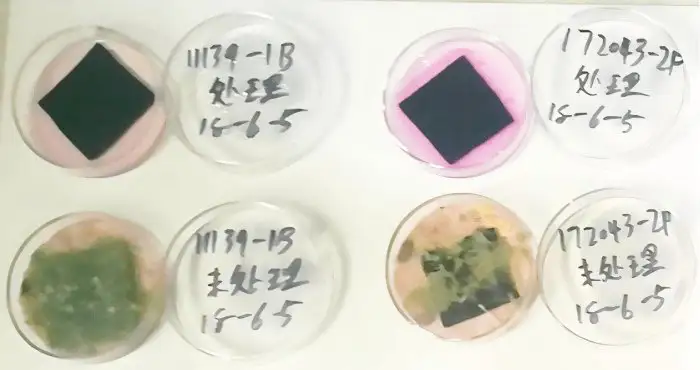
What buyers call an anti-mould grade is really two different measurements, and they do not belong on one report. The antibacterial rate is tested to GB/T 20944.3 (Textiles, Evaluation of antibacterial activity, Part 3: oscillation method): samples shake in a bacterial suspension, colonies are counted, and the reduction rate is calculated; export orders are often closed against ISO 20743 or AATCC 100 instead. Mould resistance is tested to AATCC 30, inoculating with Aspergillus niger and related fungi, incubating for 28 days, and rating growth from 0 (best) upward.
Procurement checks two things against suppliers: whether the report matches the batch number, and whether the method matches the purchase order. A great-looking number under the wrong method is worth nothing, so lock the method before you book the lab.
Pick the method by what the order actually says: where the clause reads antibacterial rate or reduction rate, test to GB/T 20944.3 or ISO 20743; where it reads anti-mould grade or growth rating, test to AATCC 30 or the GB/T 4768 series. Domestic filter tenders often ask for both, the rate to prove the agent works and the rating to prove it survives humid service. Prepare two separate sample sets with the method and batch number on the label, and never leave the lab guessing which test a sample belongs to.
2. Padding and exhaustion: iHeir-PG’s two finishing lines
iHeir-PG composite nonwoven antimicrobial agent bonds covalently to the fibre, wash-fast and non-migrating, which matches how filter media live through repeated wetting. Two process lines, chosen by what your line already runs:
| Process | Dosage | Operation |
|---|---|---|
| Padding | 20-40 g/L | Room-temperature pad, about 70% pick-up, dry at 100-170 C |
| Exhaustion | 2-4% owf | Saturate, extract directly, dry at 100-170 C |
| Spraying | Diluted 25-50x | Spray evenly on the nonwoven surface, adjusted for thickness and line speed |
Both lines share one convenience: no heat setting is needed for fixation, simple drying is enough up to 170 degrees C, so thermal-bonding and needle-punch schedules stay untouched. Shake the dispersion before use, wear rubber gloves, goggles and a mask, and keep the working environment above 0 degrees C.
Set the level by working backwards through pick-up: at 70% pick-up, a 20 g/L bath carries roughly 14 grams of liquor solids per kilo of dry fabric, and 40 g/L carries about 28. Start the first bath at 30 g/L, cut samples off the outgoing web for the agar comparison, and close the range within two baths, topping up if growth shows and trimming if the dose overshoots. Exhaust lines start at 3% owf the same way, calibrating against the weight gain after extraction rather than trusting the make-up concentration.
3. The anti-mould backstop: iHeir-BJ bath recipe and the one taboo
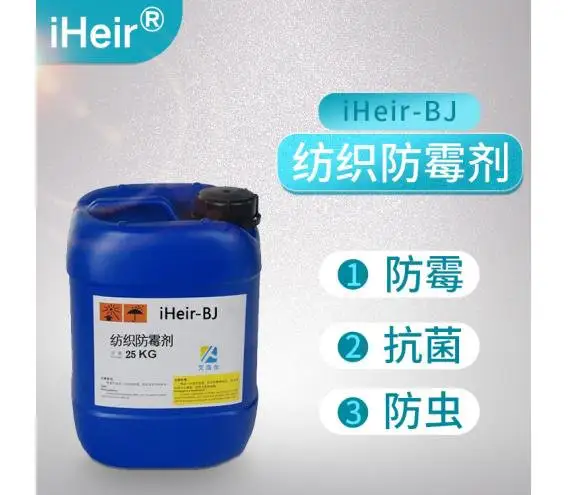
Passing the antibacterial rate does not guarantee the mould grade, and media in humid service need a second pass. iHeir-BJ textile anti-mould agent runs by pad-mangle exhaustion: 2-3% owf on dry-fabric weight, bath at 21-50 degrees C (ideally below 48), pH 4.5-8.5 (ideally about 6), softened water only. Pre-mix the concentrate with 9 to 13 times its weight of water before adding it to the bath in stages, and hold pick-up near 70%.
One hard taboo: BJ is cationic and must not share a bath with anionic auxiliaries, which would precipitate it out and kill the finish. Where an anionic softener or water-repellent is needed, split into two passes, BJ first and dry, then the anionic bath. Service life follows the dose: 2% holds mould at bay for over a year, 3% for two to three years; match the bath to the number of years the contract promises.
4. Packaging and the retests: vapour-phase paper and two metrics you keep
Between the plant and installation there is still storage and sea freight, and that stretch is covered at packaging. iHeir-D gas-phase antimicrobial agent is coated onto paper as a special ink to make anti-mould packaging paper or sachets, each carrying 0.1-0.2 grams of active ingredient; the active slowly releases inside sealed packaging and reaches roll ends and crevices by vapour, places a contact finish never touches. Run the compatibility test first: three times the normal dose in a box with a little water, samples separated by plain paper, then check for staining and corrosion after several days.
Two metrics must be retested after finishing, and neither trades away: air permeability and filtration efficiency, measured before and after dosing with the comparison recorded by batch. If both drop noticeably, check pick-up and drying temperature first, then retry at a lower dose. The membrane-specific treatment is covered in our filtration membrane anti-mould guide.
5. FAQ
Q: Do we need both the GB/T 20944.3 and AATCC 30 reports?
Follow the purchase order: where it says antibacterial rate, test to GB/T 20944.3 (or ISO 20743 / AATCC 100); where it says anti-mould grade, test to AATCC 30. The two terms get mixed up constantly, so split them before signing and issue reports under the matching method.
Q: How do I pick a point inside the 20-40 g/L padding range?
Start light filter cotton and standard bags at the low end, heavy felts and high-GSM nonwovens at the top; convert with a 70% pick-up, run the first batch as a trial, and scale up once the agar comparison confirms it.
Q: Can PG and BJ share one bath?
Check ionic compatibility with a small sample first: no precipitation and no breaking means they can merge; the safe route is PG first, dry, then BJ, keeping records for each pass. Our textile anti-mould agent buying guide covers the selection logic across agents.
Q: How do trials and ordering work?
PG, BJ and iHeir-D are all available as samples. Send us the fabric weight, the finishing line you run and the target standard, we return a bath recipe and a test plan, and orders start at drum quantity. Welcome to contact us.