




 View Count:28
 Date:2026-09-21
How do you treat outdoor furniture mould on the line? Woven parts and cushions pick up moisture in the warehouse and the container, spots show at seams and folds, and overseas buyers reject the batch on sight. Dose by material: cushion fabric through iHeir-BJ at 2-3% o.w.f. on a pad mangle, tarpaulin through iHeir-666 in one dip and one nip, woven frames in iHeir-MA at 1:20 for 5-10 minutes. This article covers the dosing bands and the compatibility rules for each step.
1. Three materials, three lines
One patio set leaves one gate, but it is made of three very different things: the wicker weave, the polyester cushion fabric, and the canopy or umbrella cloth. Each wants something else from the finishing plant. Cushion fabric sits against skin, so the priority is anti-mould protection that does not stiffen the hand. Canopy cloth sells on water repellency, with mould protection as the baseline. The frame weave is a plastic-and-natural-fibre hybrid that takes the dip-tank route. Fix all three in the semi-finished stage; the line that skips the frame bath is usually the one paying for a container of rework later.
2. Cushion fabric: the iHeir-BJ parameter card
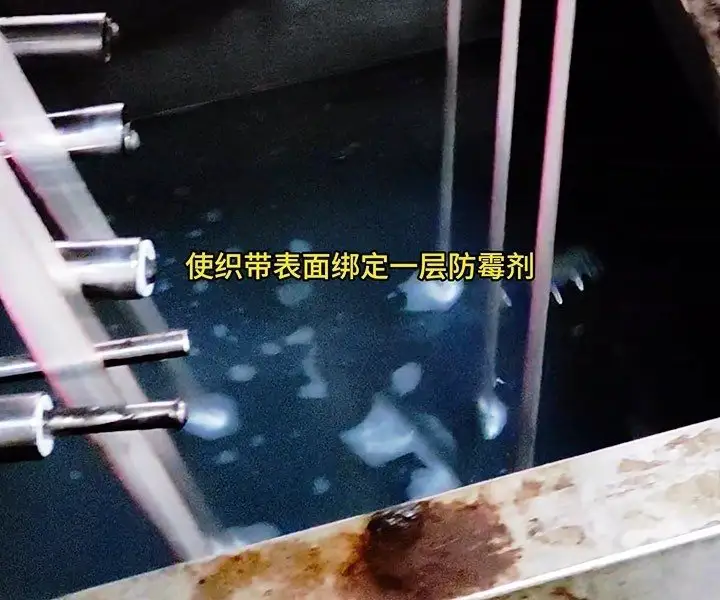
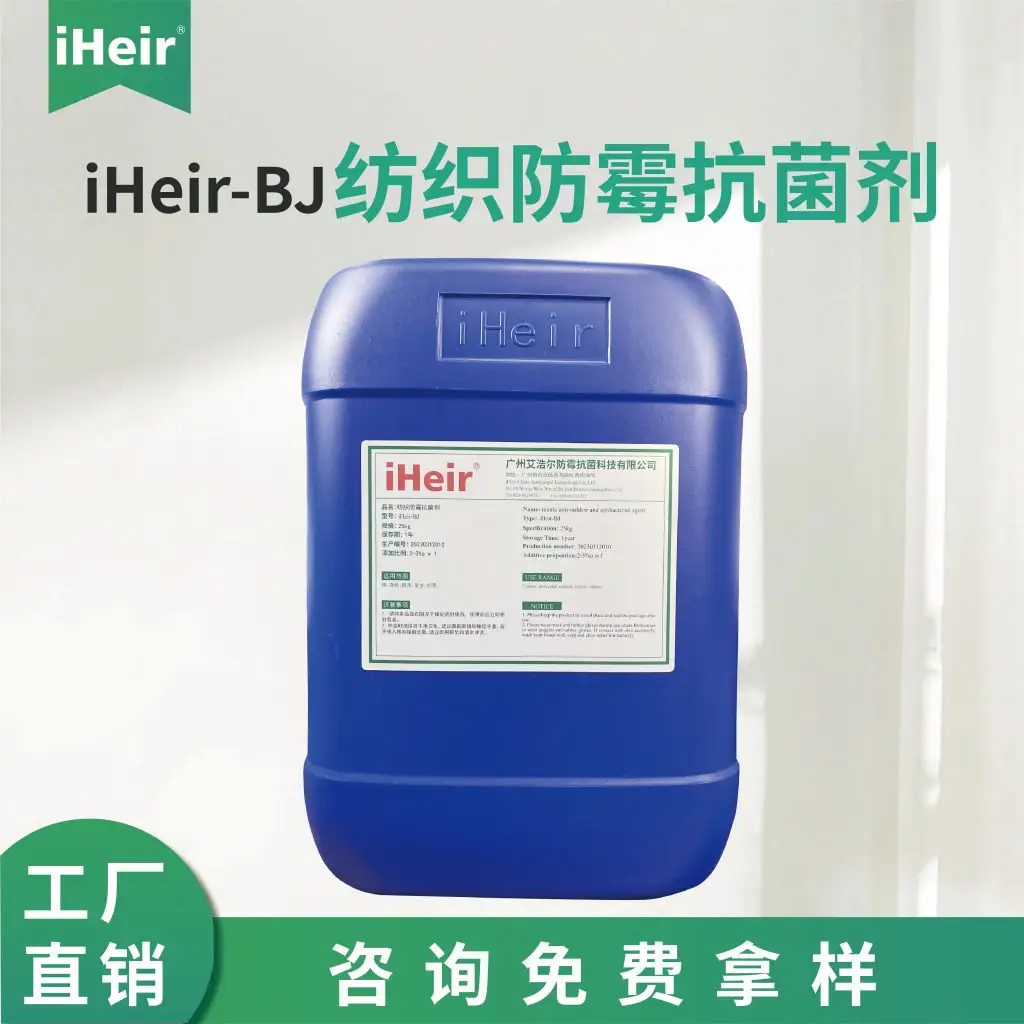
Cushion cloth runs through iHeir-BJ on a pad-mangle. Copy the card: dose 2-3% o.w.f. on dry fabric weight, so 2-3 kg of stock per 100 kg of cloth; pre-mix the stock with 9-13 times its weight of water before it enters the bath; bath temperature 21-50°C, ideally below 48°C; pH 4.5-8.5, ideally about 6, in soft water; squeeze to a 70% pick-up. Log the pick-up per roll; a mangle set wrong on Monday shows up as a soft batch in the buyer’s warehouse, not on your floor. Protection follows the dose: 2% o.w.f. holds mould down for over a year, 3% stretches to two or three, and long-transit retail programmes run at 3%.
Two compatibility rules belong on the process card. BJ is cationic and never shares a bath with anionic auxiliaries, which precipitate the active; where a soft finish is also wanted, run two passes, BJ first, dry, then the anionic softener. And because BJ carries silicone, it can lower moisture regain; fast-dry fabrics add about 0.1% of a cationic hydrophilic agent, and polyester mesh cushion cloth is better with it than without.
3. Canopy and umbrella cloth: the iHeir-666 three-way finish
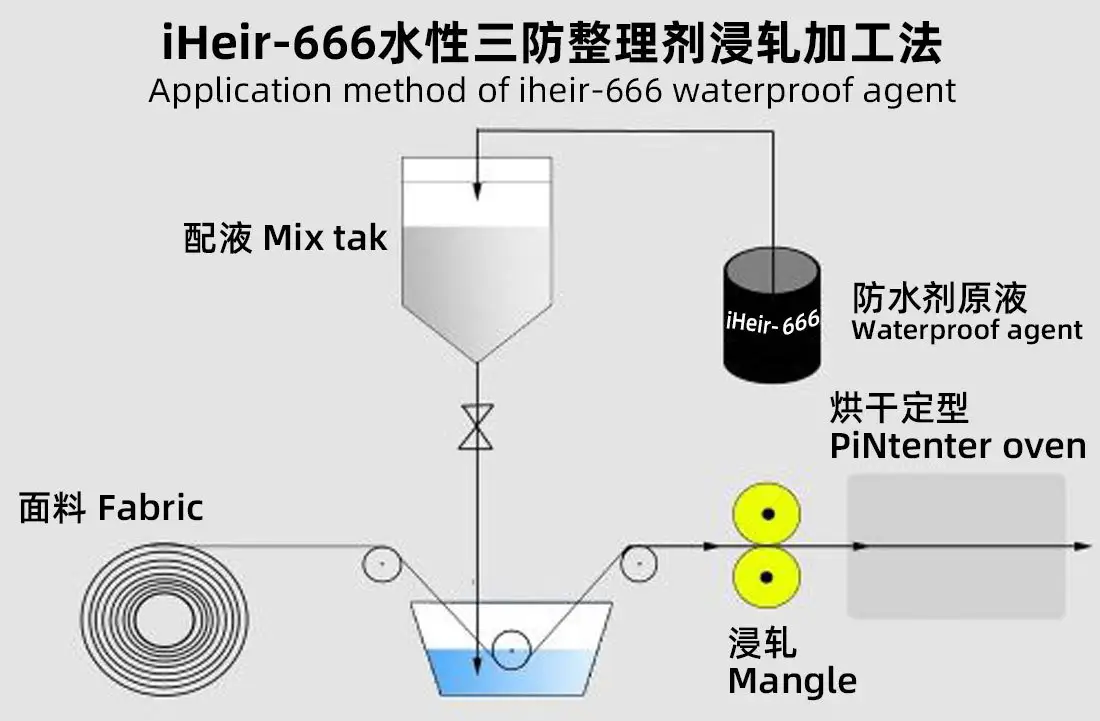
Canopy, umbrella and trim cloth sell on repellency, and the mould protection comes with it: a fabric that will not hold water leaves mould without the moisture it needs. Run iHeir-666 through one dip and one nip: polyester at 8-20 g/L, nylon 5-20 g/L, poly-cotton 20-50 g/L, pure cotton 30-50 g/L; pre-dry at 110-130°C, then cure at 170°C fabric temperature for 60 seconds on the tenter frame. The cure has to be complete or the finish underperforms, and the bath is used within 12 hours of mixing. Five grams per litre already scores full on spray repellency and 30 g/L reaches 6.5 on oil; the emulsion is non-flammable, APEO-free with PFOA below 1 ppm, which answers the compliance questionnaire as-is.
The classic mistake on this line is combining baths. BJ is a cationic antibacterial, 666 a fluoropolymer repellent, and their one-bath compatibility has no validation behind it, so run them as two passes with a drying stage between: BJ first to bond the antibacterial, then 666 to lay the repellent film. Label the 666 bath with its mixing time; a bath past twelve hours looks fine but cures soft. For mould handling on tarpaulins in storage, our tents-and-tarpaulins piece goes deeper; the outdoor-furniture warehouse can follow it directly.
4. The frame weave: five minutes in iHeir-MA
Natural rattan and wooden frame parts go into the tank before weaving: iHeir-MA at one to twenty water, five to ten minutes, until pieces gain 15-20% weight, then drained and air-dried. It is an ammoniacal copper system, resistant to both acid and alkali, and it does not wash out in outdoor rain, which is exactly the service a patio set sees. Three rules: the product is acid, so keep it off metal tanks and alkaline materials, plastic tanks only; spray touch-ups mix 1:10 with water; and parts that will be top-coated can carry iHeir-YQ in the lacquer for film-level protection. PE wicker itself does not feed mould; what you are protecting is the natural-fibre tie cords and the timber core inside the weave.
Final inspection on assembled sets looks at three hiding places: the inside of seam bindings, the folded face of cushions, and the rattan ends. Keep a torch and a white test cloth at the bench; a streak of colour on the cloth stops the piece. Sealed paired samples from each of the three lines settle any buyer question fastest.
5. Dosing at a glance
Three lines on one dosage sheet for the stores to draw against:
| Product | Station | Rate | Rules |
|---|---|---|---|
| iHeir-BJ | Cushion fabric, pad mangle | 2-3% o.w.f., pre-mixed in 9-13x water | Bath 21-50°C, pH 4.5-8.5; never with anionics; 2% holds 1 year+ |
| iHeir-666 | Canopy and umbrella cloth | Polyester 8-20 g/L, poly-cotton 20-50 g/L | Cure 170°C x 60 s; bath within 12 h; PFOA below 1 ppm |
| iHeir-MA | Frame weave dip tank | 1:20 water, 5-10 min, 15-20% gain | Acid, no metal tanks; spray touch-ups 1:10 |
Sequencing stays fixed: frames dipped in the semi-finished stage, cushion cloth and canopy cloth each on their own pass, assembly, then final inspection. One sealed sample per line per shift keeps the evidence chain intact.
6. FAQ
Q: Can the cushion finish and the repellent share one bath?
No validated one-bath data exists for BJ with 666, so do not gamble the batch. Two passes with a dry between them cost one more run through the machine and deliver both finishes at spec.
Q: BJ at 2% or 3%?
Read the protection promise. Standard orders hold over a year at 2%; retail programmes with long transit and storage run 3% for two to three years. Trial the first order at 2%, move to 3% if the buyer wants the longer window.
Q: Does a dipped frame still grow mould?
Not when the weight gain and the drying are honest. The two failures are bundles dipped with ties on, so the core never drinks, and weaving damp rattan, which re-wets in the container. Hold 15-20% gain as the acceptance number.
Q: How do samples and orders connect?
BJ, 666 and MA all ship as samples. Send the fabric weight, canopy material and monthly volume, and we come back with a bath sheet for all three lines; after the trial passes, order by the drum. Welcome to contact us.