




 View Count:8
 Date:2026-09-15
Two or three weeks in the warehouse and spots start appearing on moulded plastic parts. Most workshops call it mould and stop thinking there. In practice three different things produce that look, and mixing them up means scrapping good parts or paying for an additive that cannot possibly work. Spend ten minutes sorting the cause first.
1. Tell mould spots, bloom and colour drift apart
Mould spots spread as dots or threads, run from grey-white to black-green, and have irregular edges. Wipe one with an ethanol swab and the colour comes off; the surface underneath is intact. This is microbial growth, and it shows up most often in compounds carrying plasticisers, wood flour, starch-based fillers or a high regrind ratio, especially when warehouse humidity sits above 75%.
Bloom is white, evenly spread, and tends to concentrate near the gate or on thick sections. Wipe it away and it returns within days, because the source is inside the compound: lubricants, antioxidants and plasticisers migrating to the surface. No antimicrobial or anti-mould additive will touch it, and buying one is a waste of money.
Localised yellowing and colour drift also reads as darkening, but it comes from excessive melt temperature or too much regrind, again with no microbes involved. The test is simple: wipe a sample with ethanol or a cleaner and watch whether the mark lifts and whether the substrate turns rough or tacky. If it lifts and the surface stays sound, it is surface contamination and can be reworked. If it will not lift and the surface is already sticky, the growth has entered the compound and the part should be scrapped or downgraded.
Only the first category is solvable with an antimicrobial additive. When a quality manager opens a complaint investigation, having the sample wiped and classified before any argument starts saves weeks of arguing.
2. Two routes: powder added directly, or masterbatch carried in
Plastic is not a food source for mould on its own, but plasticisers, stabilisers, wood flour, starch-based fillers and mould-release residue all become carbon sources. PP, PE, PVC, ABS and TPE parts sitting at 65% humidity or more and 25-35 degrees provide everything mould needs to colonise the surface. The only cure is to put the active ingredient into the compound at the mixing or pelletising stage. Treating finished parts afterwards only touches the skin.
Which route suits you depends on how you produce. The comparison below is the first decision filter.
| Item | Powder added directly | Antimicrobial masterbatch |
|---|---|---|
| Where it enters | Mixing stage, with resin pellets, colour and additives | Pelletising stage to make masterbatch, then dosed at moulding |
| What does the dispersing | Mixing time and machine shear, typically 10-15 minutes | Twin-screw shear during pelletising, more even |
| Fits which production | Frequent material changes, many colours, small lots | Single grade, high volume, continuous running |
| Batch consistency | Depends on manual dosing and mix time, more scatter | Very stable once the carrier matches the resin |
| Stock and metering | Powder takes up moisture and cakes, needs dry storage | Pellet form, easy to meter, suits automation |
| Minimum order | Low, trials from a few tens of kilos | Needs a masterbatch run, ordered by the tonne |
The active ingredient can be the same product on both routes. The difference is only who performs the dispersing. A plant running many small mixed orders that forces itself onto masterbatch will lose lead time waiting for a pelletising run, while a plant turning out hundreds of tonnes of one grade on powder will hand its quality manager a permanent consistency problem.
3. Selecting by resin, and the dosage to use
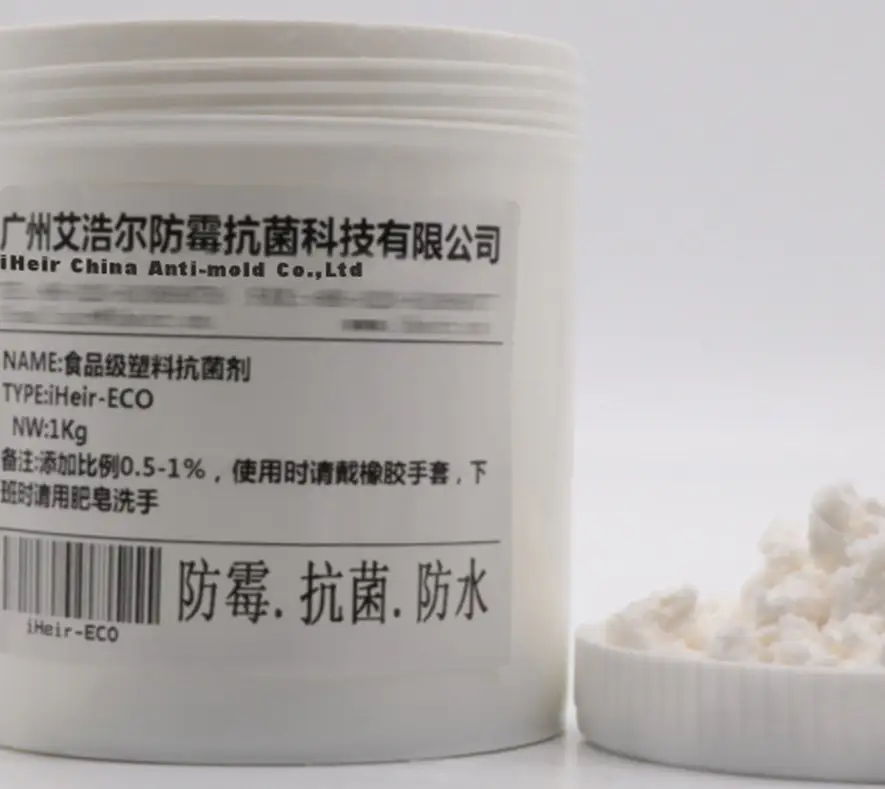
The first hard spec is heat resistance. Injection and extrusion typically run at 200-260 degrees C, softer PVC below that, engineering resins close to 300. TGA testing of iHeir-ECO shows only 35.2% weight loss at 240 degrees C, and the working temperature should stay under 320 degrees C, which covers the overwhelming majority of polyolefin and engineering-plastic jobs.
The second spec is system compatibility. Transparent and light-coloured parts cannot use a grade that yellows or cuts light transmission. Food-contact plastic parts need a food-grade grade, verified against the relevant food-contact standard. Outdoor parts with UV exposure need a UV-stable grade. iHeir-ECO plastic antimicrobial agent is a food-grade option for PP, PE, PU, PMMA and other polymers, with a recommended dosage of 0.3%-1.0% by total part weight, and general polyolefin work usually takes the 0.3%-0.5% band.
Where fungal protection matters rather than only bacteria, use iHeir-JS117 plastic anti-mildew powder, an active content above 97.0% for PVC, PU, silicone resin, polyolefins, polyester, thermoplastic elastomers and rubber, recommended at 0.5%-1.0% by total part weight, blended evenly with the resin before normal forming. Dark parts where colour shift is not visible can take the inorganic route: iHeir-IPI001 inorganic zinc-ion antimicrobial agent carries at least 99% zinc ion and active carrier, controls the release rate so it does not discolour during mixing or long service, and resists UV, recommended at 0.8%-1.0% by total part weight.
Buyers comparing quotes should align three things. First, the active form, because powder, masterbatch and paste cannot be compared on price per tonne. Second, the loading level needed to hit the same antimicrobial rate, since double the loading means double the cost per part. Third, minimum order quantity and lead time. On a polyolefin part dosed at 0.3%-0.5%, the additive cost per piece typically stays in the range of a few cents and sits below 1% of the ex-works price, while a rejected batch costs the full shipment value plus rework and freight. That comparison belongs on the table at the selection meeting.
4. Which stage the additive goes in
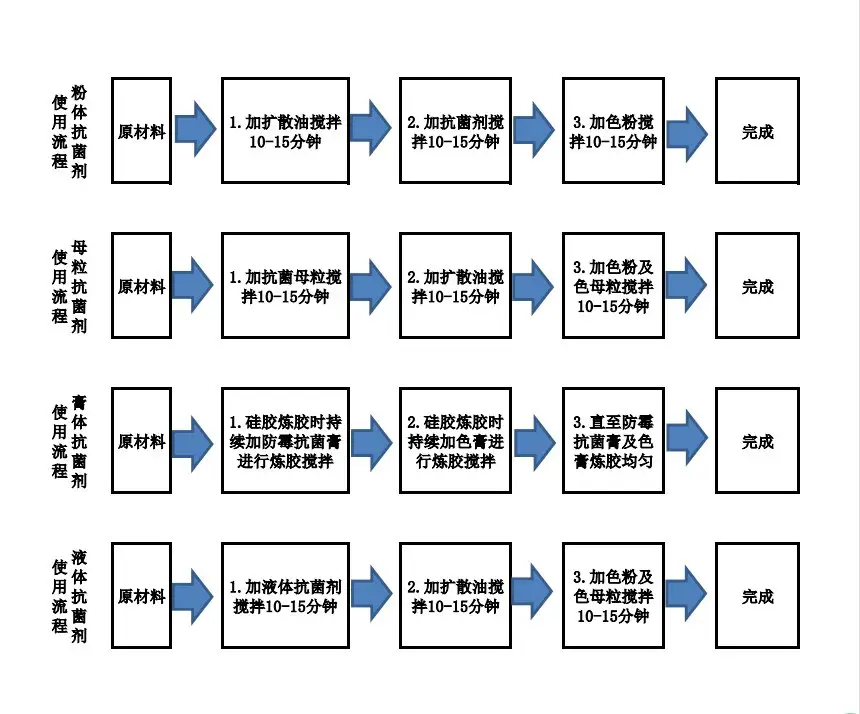
Get the feeding sequence wrong and no dosage will save you. On the powder route the order is resin, antimicrobial, spreading oil, then colour, with 10-15 minutes of mixing at each step. On the masterbatch route it is antimicrobial masterbatch first, then spreading oil, then colour and colour masterbatch. Reversing the order lets the oil coat the powder first and form agglomerates, which show up as white specks on the part and a failed antimicrobial result.
The paste route used for silicone and rubber compounds is added continuously during compounding and dispersed as the batch turns, never tipped in at the end. Liquid grades go in under stirring together with the spreading oil.
For laboratory trials, work in three steps. First run a compatibility test, dosing at the top of the range and watching for separation, discolouration or loss of mechanical properties over 24 hours. Then run accelerated storage at 30 degrees C and 90% relative humidity for 14-28 days. Only then send samples for third-party testing. Reversing the order burns through several rounds of test fees.

5. Proving it: ISO 22196 and ASTM G21
Antibacterial performance is reported against ISO 22196, the measurement of antibacterial activity on plastics and other non-porous surfaces, expressed as a percentage reduction or log reduction, with an in-house requirement usually at 99% or higher. Anti-mould performance is reported against ASTM G21, the standard for determining resistance of synthetic polymeric materials to fungi, or against GB/T 1741 for film and coating mould resistance, where grade 0 or 1 is the common contractual requirement. The two standards cover two different classes of organism and cannot substitute for each other. Test only for bacteria and the mould spots will still arrive.
Export shipments should additionally carry a 28-day accelerated storage record at 30 degrees C and 90% relative humidity, with treated and untreated parts photographed side by side. During a buyer audit or a complaint, that photograph plus a third-party report settles the conversation faster than any explanation.
6. Frequently asked questions
Q: Does antimicrobial masterbatch work better than powder?
With the same active ingredient the performance ceiling is the same. The difference is dispersion. Masterbatch relies on screw shear at pelletising and gives tighter batch consistency; powder relies on mixing time, and works perfectly well when that time is controlled.
Q: If I add an antibacterial, do I still need an anti-mould agent?
It depends on the application. Antibacterials act on bacteria, anti-mould agents on fungi, and warehouse spots are usually fungal. Humid-climate export parts are best covered on both fronts, or by a grade that acts on bacteria and fungi together.
Q: Is a higher loading safer?
No. Exceeding the recommended range raises cost and can bring bloom, discolouration and loss of mechanical properties. Start at the middle of the recommended band for your resin, confirm with an antimicrobial test, and set the level from there.
Q: Can I still use powder that has caked?
Lightly caked powder can be dried and sieved and used again. Heavily caked material should not be forced into the mixer, because uneven dispersion leaves white specks in the part. Keeping the powder store dry and resealing opened containers is the cheapest way to avoid caking. For a wider comparison of plastic antimicrobial options, read our guide to plastic antimicrobial agent types, and for a worked example of choosing an antimicrobial masterbatch, see the EVA slipper case.