




 View Count:40
 Date:2026-10-14
A mouldy plastic hanger can spoil the garment packed with it, and plastic hanger mould does its damage fastest in export, where hangers travel in the same carton and the same container as the clothes. Once the surface of a hanger moulds, spores drop onto the fabric, and at the destination the whole carton is usually rejected. Hangers are PP and PS mouldings, so the body takes iHeir-ECO plastic antimicrobial agent at 0.3%-1.0% on total plastic weight, with pale and clear hangers moving to iHeir-IPL inorganic plastic antimicrobial agent at 0.8%-1%. This article covers the dosing points, the loadings and the packing rules.
1. How a hanger passes mould on to the garment
The hanger itself is cheap; the problem is where it sits. Export garments are often packed on hangers, so hanger and fabric spend weeks in one closed space, and once the hanger surface moulds, spores land directly on the cloth. Fabric is porous and carries finishing residues, which makes it easier to colonise than plastic. By the time the carton is opened at the destination, spots on the garment and spots on the hanger usually appear together, and both the question of liability and the cost of rework are hard to settle.
Why do hangers go wrong more readily than other plastic parts? First the surface: a hanger is a thin-walled part with a hook and recesses, and the recesses and shoulder corners are hard to clean, so dust settles there and gives mould a foothold. Second the storage: hangers are bulky and light, so they sit in open crates where they take up moisture quickly. Third the route: a hanger travels the whole export chain alongside the garment, under garment-grade storage and sea-freight conditions.
So protection has two stages: one built into the hanger body, to stop the hanger moulding on its own, and one at packing, to stop hanger and garment cross-contaminating each other.
2. Masterbatch and packing at a glance
The table lines up the stage, what it controls, the main measures, the figure or criterion and the points to watch, as a first draft of a work instruction.
| Stage | What it controls | Main measures | Figure or criterion | Points to watch |
|---|---|---|---|---|
| Moulded body | General-colour PP / PS hangers | iHeir-ECO through the masterbatch | 0.3%-1.0% on total plastic weight | Heat stable to 240 degrees, processing below 320 degrees; dry-blend masterbatch and resin first |
| Moulded body, pale and clear | Pale or translucent PS / PMMA parts | iHeir-IPL through the masterbatch | 0.8%-1% | Whiteness above 90 and 1-2 micron particles, heat resistance 300 degrees; does not shift the shade |
| Off the line and in transfer | Crates and transfer boxes | Humidity control, off-wall and off-floor, no open storage | Relative humidity below 60% | No crate against an outer wall or on the floor; regrind blended at a fixed ratio and logged |
| Packing and export | Cross-contamination between hanger and garment | Interleaf between the two, humidity control in the carton, batch records | Relative humidity below 60%, interleaf in place | Where hangers and garments are bagged apart, the carton still has to be resealed after inspection |
The four rows divide cleanly: the first two build protection into the hanger itself, the last two look after the weeks when hanger and garment share one carton. Masterbatch alone leaves the moisture a garment brings; packing control alone leaves the hanger body exposed.
3. The hanger body: masterbatch on total plastic weight
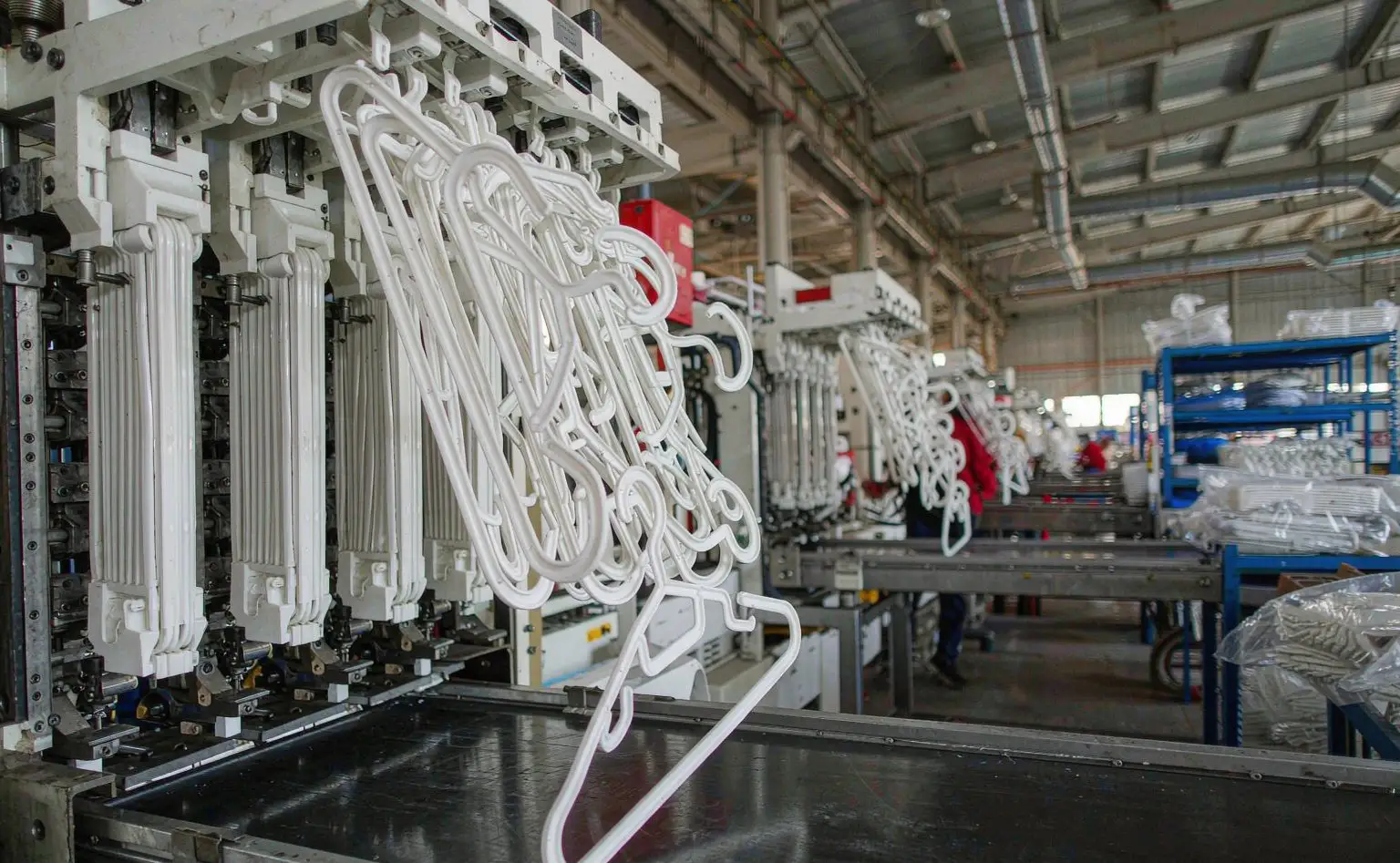
The body is most easily handled through the masterbatch. Antimicrobial masterbatch and PP or PS resin are dry-blended and fed together to the barrel, so the agent ends up distributed through the plastic rather than sitting on the surface, and neither assembly nor transport rubbing takes it off. General-colour hangers take iHeir-ECO plastic antimicrobial agent at 0.3%-1.0% on total plastic weight. Its heat stability reaches 240 degrees, processing should avoid going above 320 degrees, the melting range is 56 to 58 degrees, and it stores sealed, dry and away from light with a shelf life of one year.
Four habits matter in production: dry-blend masterbatch and resin before feeding; purge thoroughly on colour and material changes, because dark residue from the previous batch stands out on pale parts; check the first few shots after a mould change, since a thin-walled part has a short cycle; and keep a sample per batch.
4. Pale and clear hangers: the IPL route
Pale and translucent hangers are the most sensitive to colour, and that position takes iHeir-IPL inorganic plastic antimicrobial agent: a white powder with whiteness above 90, an average particle size of 1-2 microns, a particle density of 3.0 g/cm3 and heat resistance of 300 degrees, recommended at 0.8%-1%. Small, evenly distributed particles are what keep a white or pale part free of scattering points and shade variation, and 300 degrees of heat resistance means it suits higher processing temperatures without the barrel being cooled for the additive. It ships in 25 kg fibre drums, stores sealed, dry and away from light, with a shelf life of 12 months.
Two mistakes are common on this route: carrying the general-colour loading over to a pale part, when pale parts tolerate far less in appearance, so the whiteness and particle size are worth checking rather than trimming the loading; and blending dark-part regrind into a pale part, since regrind already carries the agent and on this route it is better left out.
5. Packing and export: hanger and garment travel together, so protect them together
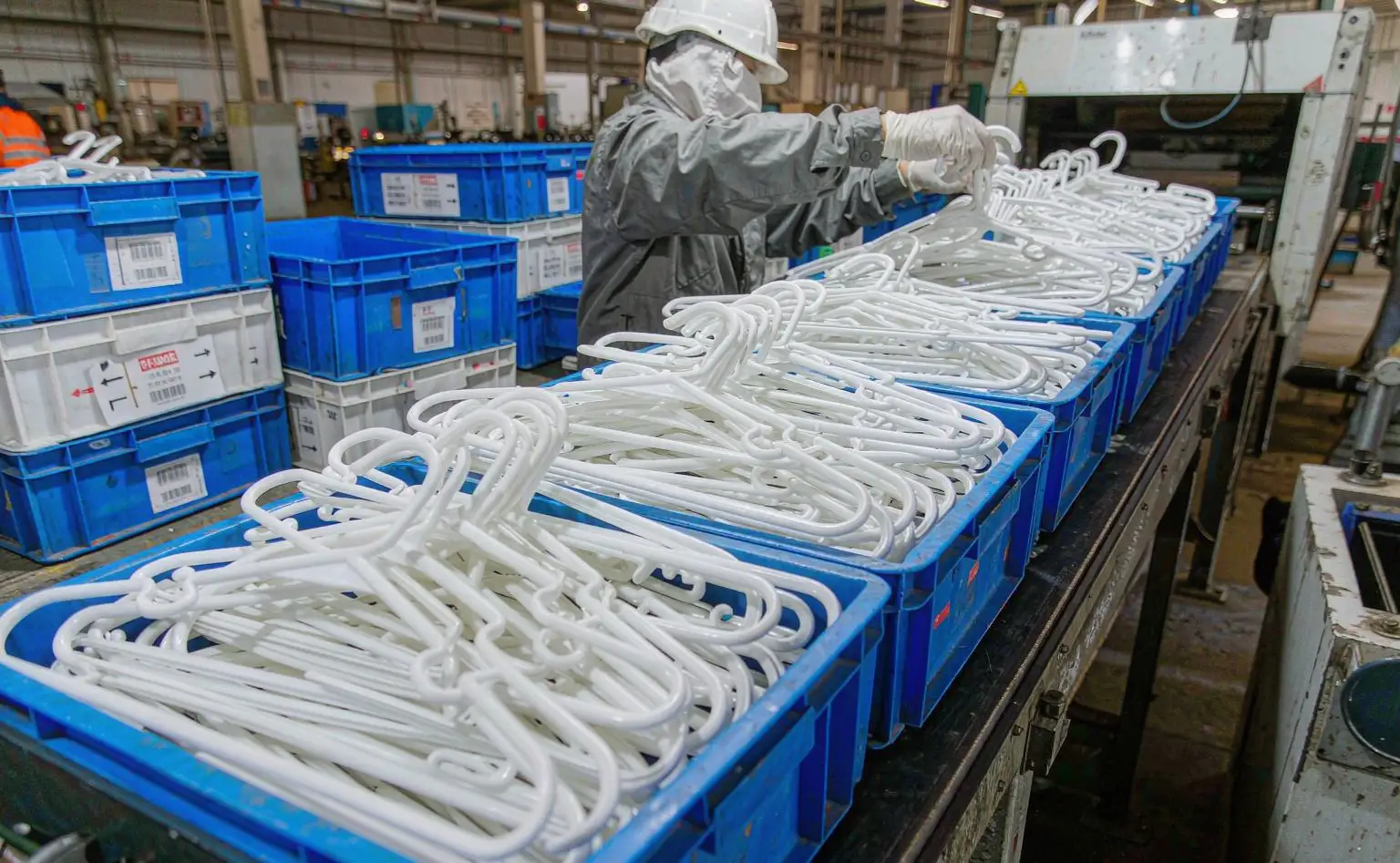
The packing stage controls cross-contamination. The practical measure is an interleaf between hanger and garment: a sheet of thin paper or lightweight nonwoven keeps the surfaces apart and puts one more barrier in the way of spores. That interleaf can be a treated paper, so the barrier and the protection are one and the same.
Moisture in the carton has to be handled as well. Cartons and liners absorb moisture and hold it against the contents, so relative humidity at the packing stage is best held below 60% and cartons kept off the wall and off the floor. For export lots the container is treated separately, with desiccants sized to the container type, since condensation during the sea passage is the main source of damp. The workshop side is set out in the note on plastic parts going mouldy in stock before export.
A carton opened for inspection has to be resealed: opening it disperses the microclimate that had built up inside, so close it again at once with the contents restored and the in-carton provision sized to the inspection frequency. A half-open carton should not be left overnight in the warehouse.

6. Questions that come up: wiping the surface, and whether the garments need rechecking
Is a wipe-on treatment after moulding enough? Not as the main route. A hanger is a thin-walled part with a large surface area, so a surface treatment has to be applied evenly and without changing the appearance, which is hard in practice, and hangers rubbing against garments in the same carton strip that layer off first. Protection belongs in the plastic, with packing interleaf and humidity control carrying the surface side.
A hanger has moulded. Do the garments in the same carton need rechecking? Yes. The hanger and the garment have shared a closed space, so spores have already settled on the fabric and the garments have to be rechecked by batch: sample the appearance, looking at the faces that touched the hanger, the folds and the collar and cuffs, and send any batch with visible spots through the garment rework route rather than treating the hangers alone. The packing material is isolated along with the hangers.
Two points carry the work. The hanger body takes iHeir-ECO plastic antimicrobial agent at 0.3%-1.0% on total plastic weight, with pale and clear parts moving to iHeir-IPL inorganic plastic antimicrobial agent at 0.8%-1%, dry-blended before feeding. Packing puts an interleaf between hanger and garment and holds relative humidity in the carton below 60%, with the box resealed after inspection. Samples and TDS are available to check the configuration.


