




 View Count:28
 Date:2026-11-06
How is sandal mould handled? The upper is webbing, mesh or microfibre and the midsole is EVA foam, two materials off two production lines, so the treatment splits in two: the upper goes through a finishing bath, the midsole takes the agent in the foaming compound. A shipment that moulds at opening has usually done one stage and skipped the other. This article covers the bath recipe, the point at which the compound is dosed, and humidity control in the shoe box.
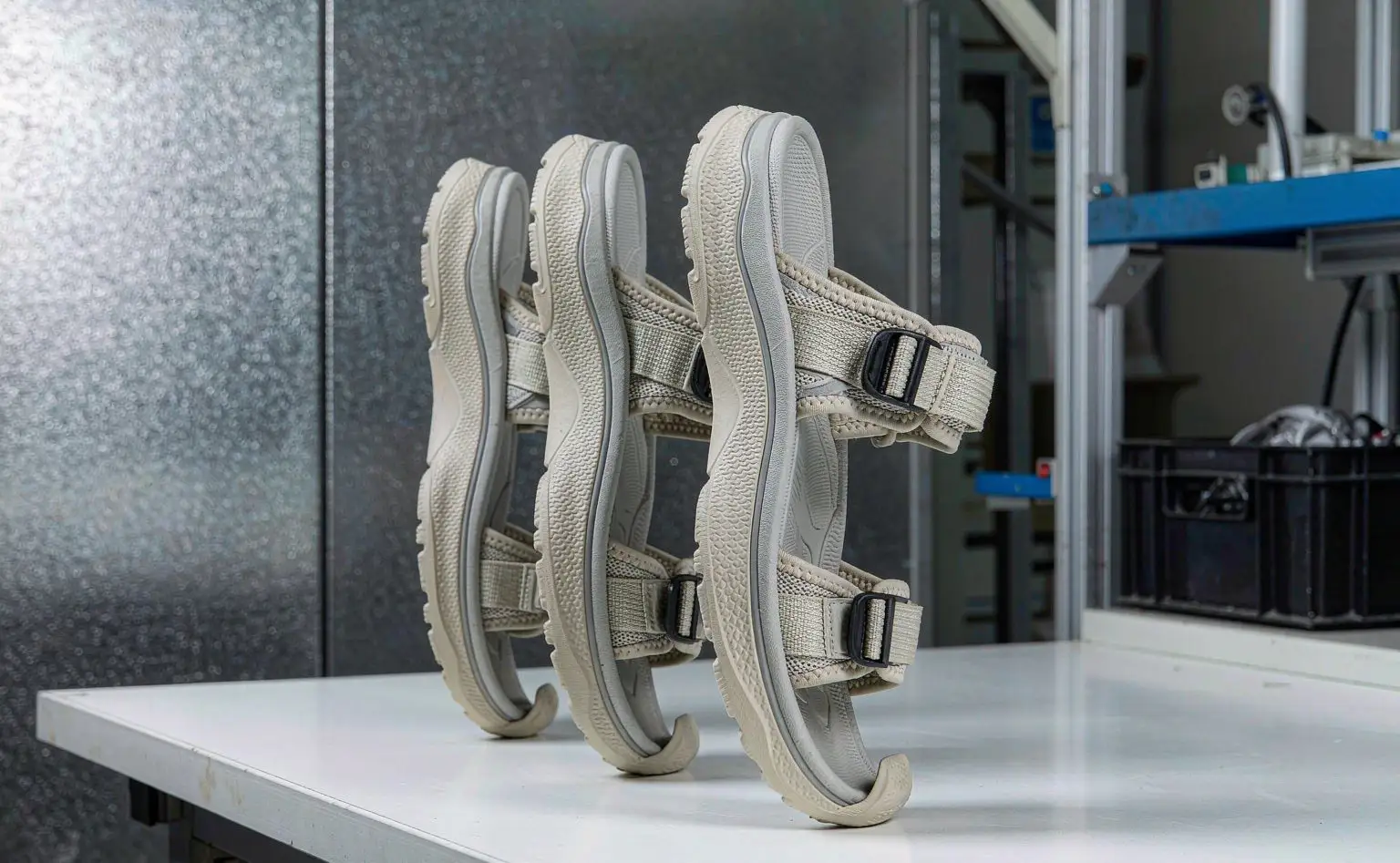
1. Upper fabric and EVA midsole are two processes
Take a flat sandal apart: webbing or mesh upper, microfibre lining, EVA midsole, rubber or TPR outsole, adhesive, buckles, shoe box and tissue paper. Metal buckles and outsole rubber do not mould, so the exposure is the upper fabric and lining and the EVA midsole, with the box and tissue as a third source.
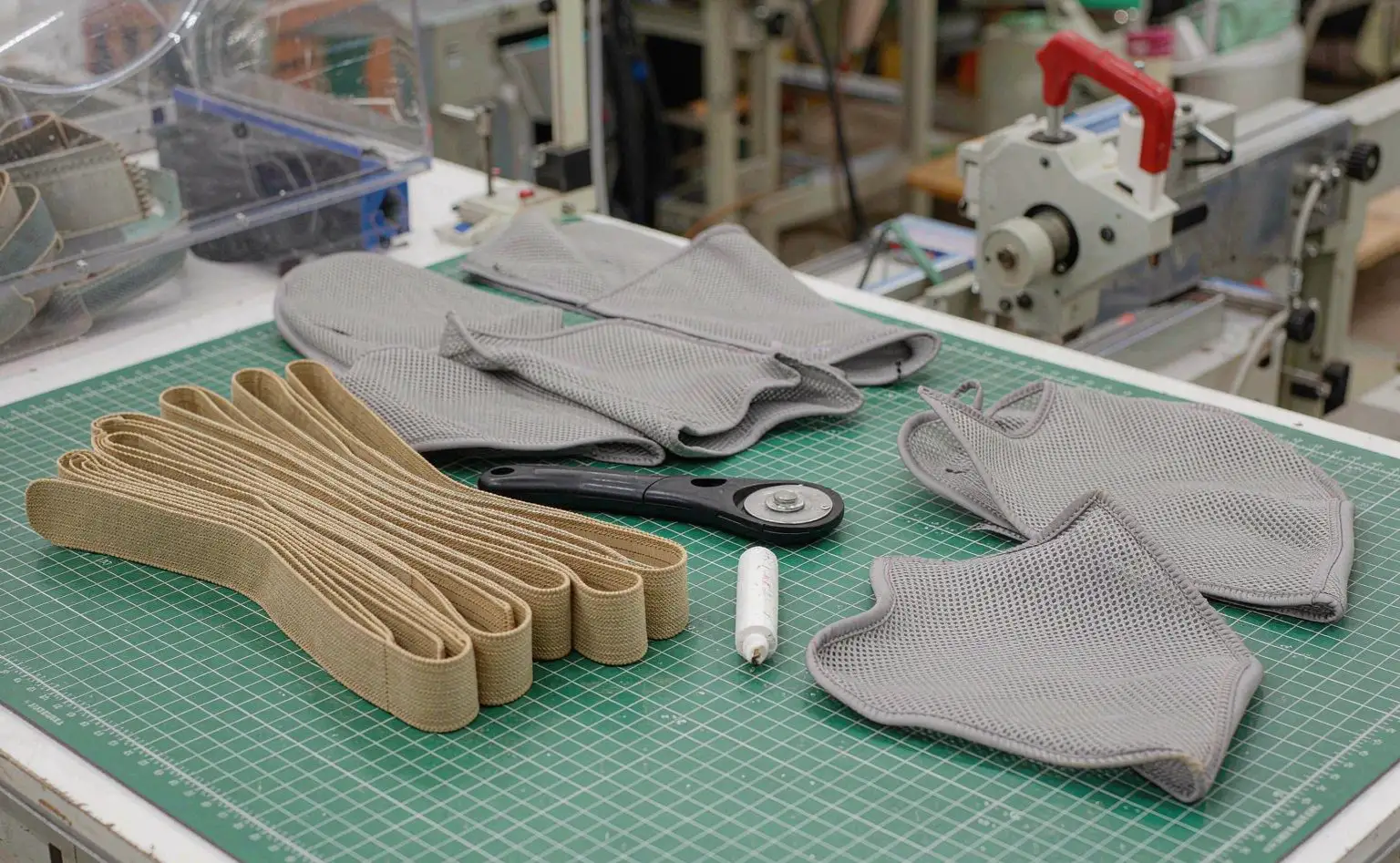
The upper is handled in finishing. Webbing and mesh are polyester, nylon or cotton blends that take water and hold it, and the stitching and lamination points are double-layer structures that dry slowly after washing. Treatment has to happen in the dyeing or finishing bath, inside the fibre; a surface spray does not survive one sea leg.
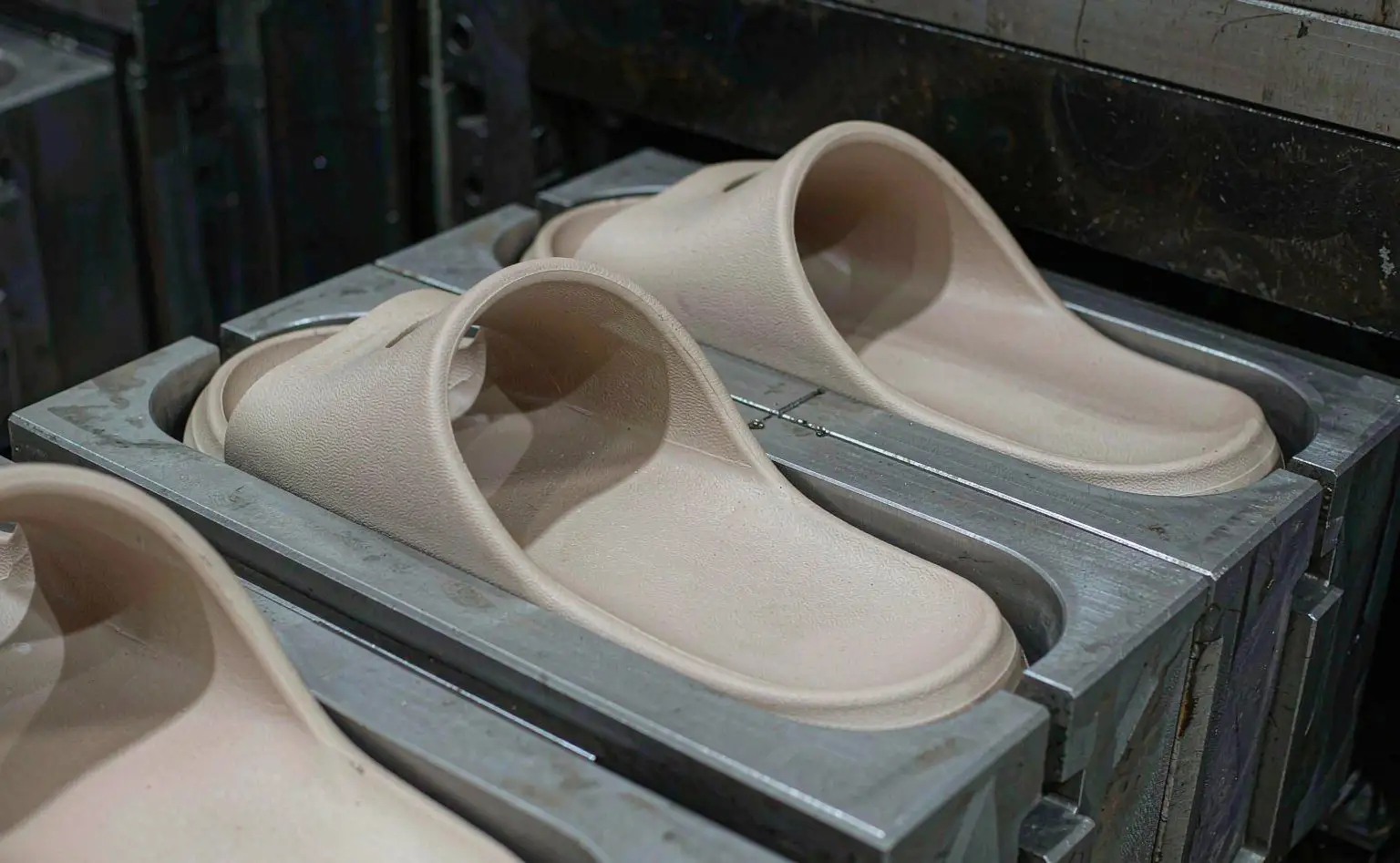
The midsole is handled in the compound. EVA foam carries filler, blowing agent, cross-linker and colour masterbatch, and the closed-cell structure does not breathe, so moisture inside cannot get out. Once mould settles in the skin pores of the foam the surface still looks clean while the cut section has already gone black. The agent has to go into the compound and foam with it.
Watch the adhesive too. Upper and midsole are bonded, and water-based adhesives contain starch or casein, which are nutrients. Bond a wet adhesive line and the water is sealed in the joint, so mould works outward from the bond line.
2. Upper and midsole take different units
The table lines up the upper, the lining, the EVA midsole and the shoe box. Fabric is dosed on weight of goods, foam compound on total weight, and paper items are handled by process control.
| Part | Material | Product and level | Stage | Control point |
|---|---|---|---|---|
| Webbing, mesh upper | Polyester, nylon blend | iHeir-BJ 2%-3% o.w.f. | Finishing bath | 21-50℃, pH 4.5-8.5 |
| Microfibre lining, interlining | Microfibre, non-woven | iHeir-BJ 2%-3% o.w.f. | Same bath as the upper | Wet pickup held at 70% |
| EVA midsole | EVA foam compound | iHeir-FP 0.5%-1.5% of foam compound | Foam make-up | Added apart from the blowing agent |
| Box and tissue | Corrugated, tissue | Process control | Packing | Low-absorbency paper, barrier film |
One boundary. iHeir-BJ in the fabric protects the upper and lining, iHeir-FP in the compound protects the midsole body. Upper only leaves a black cut section in the foam, foam only leaves the spots along the stitching. Both stages, and the box opens clean.
3. Running the upper through the finishing bath
The upper takes iHeir-BJ textile mildew inhibitor at 2%-3% o.w.f. on weight of goods. Choose by the protection period: 2% gives roughly a year and more, 3% reaches two to three years, so fast domestic turnover runs at 2% and an export lot that sits in a container for 30 days or more runs at 3%.
Bath conditions. Hold the bath at 21-50℃ and pH 4.5-8.5, ideally 6, and use softened water, because calcium and magnesium in hard water react with the agent and waste active matter. Webbing is a heavy fabric that carries more liquor than a light cloth, so hold wet pickup at 70% with steady mangle pressure and line speed.
How to add it. Dilute with 9-13 times its volume of water first and add slowly to the bath, never the concentrate straight in. Dyes, softeners and fixing agents are often anionic and cancel the agent, so confirm the ionic type before finishing and run the anionic products in a separate bath.
Drying and setting. Dry on the normal curve without pushing the temperature. On bright webbing an over-hot dryer migrates the agent and the dye together and leaves a patchy shade. Measure regain before cutting, and re-dry webbing that comes off high.
4. Dosing the antimicrobial into the EVA foam
The midsole takes iHeir-FP foam antimicrobial agent at 0.5%-1.5% of the foam compound weight. It is a clear, odourless liquid that is stable from pH 1 to 11 and reaches 99.99% antimicrobial rate, added at the make-up stage so it foams with the compound.
Which step. Add it at the internal mixer or the high-speed mixing stage with the EVA pellets and filler, blend, then feed the foaming machine. Never dose it in the same minute as the blowing agent and cross-linker: those react fast, and an agent that has not dispersed before cross-linking leaves patches of midsole that were never treated.
How much. Pale and white midsoles take 0.5%-0.8%, dark and thick soles 1.0%-1.5%; at a high expansion ratio the agent is diluted through the foam volume, so go to the upper figure. Keep colour and hardness consistent within a batch and never mix batches of different dose.
Re-test after dosing. Run tensile and tear to the usual GB/T 528 items and watch hardness and rebound for drift, then test antimicrobial performance to the matching method, ISO 22196 or GB/T 20944.3, keeping figures before and after. Distribution in foam is uneven, so sample from the centre and the edge of the midsole.
5. Shoe box liner and packing
The box stage works by paper choice and humidity control rather than an additive. Swap the liner and tissue for a low-basis-weight, low-absorbency paper, or add a PE barrier film inside the box; and do not wrap tissue too tightly, because trapped moisture is worse than none.
Water before boxing. Let the adhesive dry before boxing: a water-based bond that is still wet adds water to the box and feeds the mould. Hang finished shoes at a ventilated station to cool, and replace the shaping paper in the cavity rather than reusing recovered paper.
Finished goods store. Hold below 60% RH, keep cartons 10cm off the floor and the wall, and run dehumidifiers through the wet season. Isolate any carton whose outer wall has taken water instead of stacking it with good stock, and reseal a carton after a sampling check, because an open box exchanges its air in half a day.
6. Questions on midsole, softener and dose
Q: The upper is treated, so can the midsole be left?
Not on an export order. A closed-cell foam takes water in and cannot let it out, and a black cut section is invisible from outside until the customer opens the shoe, by which time the lot is lost.
Q: Can iHeir-BJ share the bath with a softener?
It depends on the ionic type. Non-ionic and cationic systems share the bath, anionic softener needs its own, and where the supplier is unsure ask for the ionic type in writing rather than working from experience.
Q: Does too much iHeir-FP affect foaming?
Within 0.5%-1.5% the expansion ratio and hardness normally hold; an overdose coarsens the cells and drops rebound, so test hardness and rebound on a small batch before scaling up.
Q: 2% or 3% on the fabric?
By protection period and stock turn. Domestic stock and end-of-season clearance run at 2%; export lots that sit in a container for 30 days or cross a wet season in store run at 3%, which costs cents a pair against one rejected shipment.
Four points to take away: run the webbing upper and lining in the finishing bath at 2%-3% o.w.f. of iHeir-BJ, with the bath at 21-50℃, pH 4.5-8.5, softened water and a 9-13 fold dilution first, holding pickup at 70% and splitting anionic auxiliaries into their own bath; dose iHeir-FP at 0.5%-1.5% of the foam compound at make-up, apart from the blowing agent, blended before foaming; let the adhesive dry before boxing and swap the liner for low-absorbency paper or a barrier film; grade to GB/T 24346-2009 and ISO 22196. A 1kg sample of each product goes out for a trial, with MOQ and lead time on the iHeir-BJ product page.


