




 View Count:26
 Date:2026-11-04
Can foam roller mould be prevented? Made in a wet season and held two months in a store, the skin and the print grow a grey haze that no wiping or washing removes, and the batch drops a grade. Dose iHeir-FP foam antimicrobial into the EVA compound at 0.5%-1.5% of weight, and slip an iHeir-D vapour sheet inside the OPP bag at 0.1-0.2g of active matter. This article covers the dosing point, the skin and printing, and the packing.
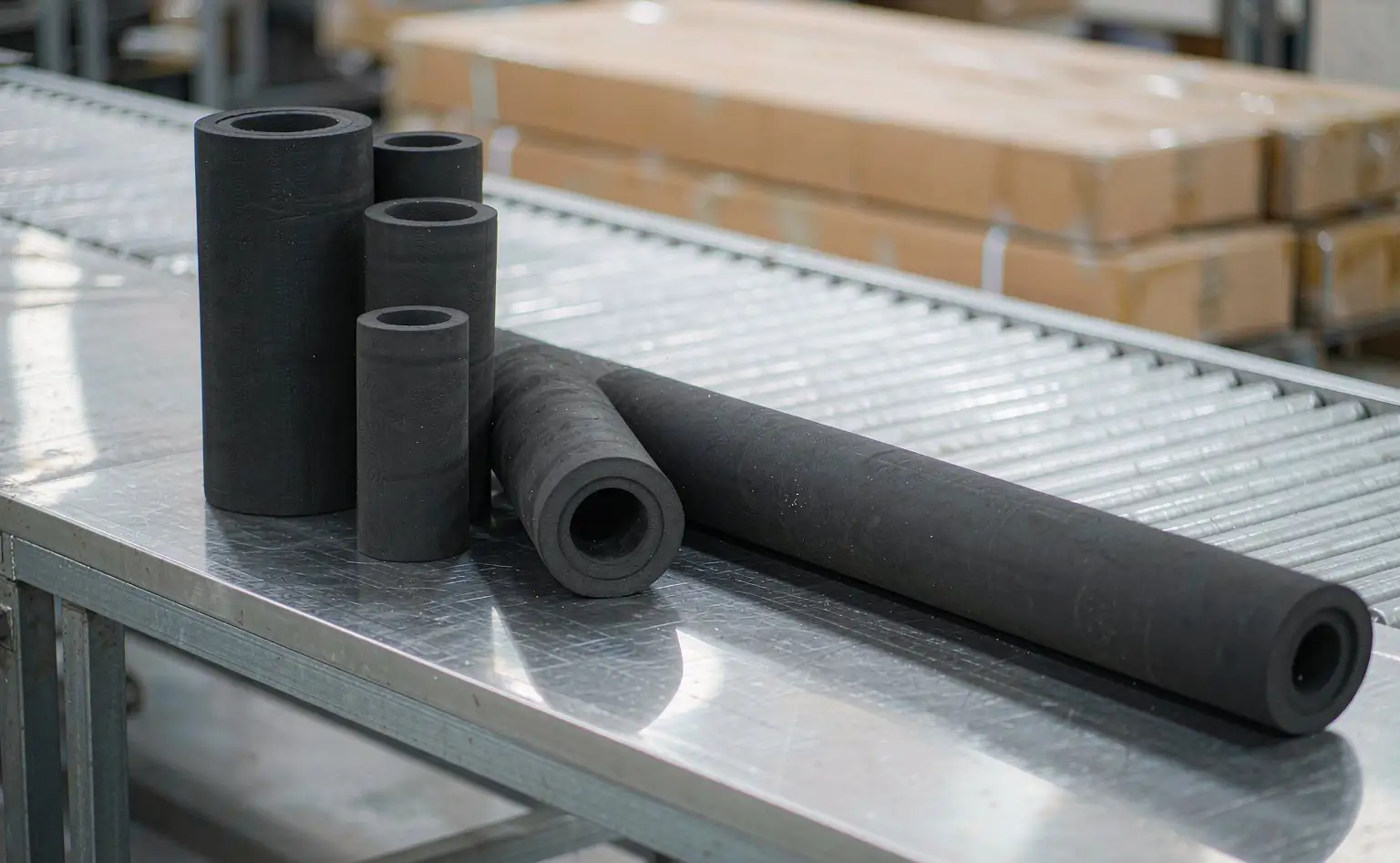
1. Mould sits between the skin and the print
Take a foam roller apart: EVA foam body, embossed skin, pad-printed or silk-screened mark, sealed ends, outer bag. The foam is closed-cell, so what fails is the skin, the layer under the print and the moisture inside the bag.
The skin spots first. The mould face runs hot, so the skin is denser than the core, and release agent, hand sweat and oil stay on it. Once the skin takes water, spots sit in the outermost layer; a thumb wipes the bloom off and leaves the growth in the grain.
The print is the hardest place to fix. Ink sits on the skin, and the interface between the two holds water. Mould travels inwards from the edge of the mark, so the graphic blooms and the edge darkens, which is an automatic fail at inspection.
The bag is the third place. A roller in an OPP bag inside a carton sits in a sealed volume. The foam leaves the mould warm and still carrying moisture, so bagging it hot seals that moisture in; a container then condenses it onto the bag wall and spots start where bag meets foam.
2. Antimicrobial in the foam, a sheet in the bag
The table lines up the foam compound, the skin and print, and the bag. Foam is dosed on weight, paper on active matter per sheet, and the two are not convertible.
| Part | Material | Product and level | Stage | Control point |
|---|---|---|---|---|
| Foam body | EVA compound | iHeir-FP 0.5%-1.5% of compound | Mixing, before foaming | Added apart from the blowing agent |
| Skin and print | EVA skin, ink | Treated with the compound | Foaming, printing | Dry before and after printing |
| OPP bag | Film bag | iHeir-D 0.1-0.2g per sheet | Bagging, cartoning | Trial at three times the dose |
| Carton | Corrugated board | Sheet per carton, humidity control | Cartoning | Store below 60% RH |
One boundary. Antimicrobial in the compound travels with the foam and never reaches the air in the bag; a sheet in the bag never enters the skin.
3. Foaming: FP at 0.5%-1.5%, in before the blowing agent
This stage takes iHeir-FP foam antimicrobial at 0.5%-1.5% of total foam weight. It is a clear, colourless to pale yellow liquid with no odour, stable from pH 1 to 11 and stable to light and heat, with an antimicrobial rate up to 99.99%, an oral LD50 above 5000 mg/kg in mice and a sensitisation rate of zero.
Where. Into the mixing stage with the EVA resin, filler and crosslinker, blended before the blowing agent goes in. Do not add it after the blowing agent: once that decomposes the compound starts to expand, and a liquid added at that point cannot be distributed, so cell walls come out uneven and the roller is hard at one end and soft at the other.
How much. Run one set of billets at 0.5% and one at 1.5%, measure apparent density to GB/T 6343 and compression set to GB/T 6669, and hold them 28 days at 30℃/85% RH to watch the skin. Overdosing slows the crosslink, leaves the foam tacky and costs resilience, which is a dearer fault than a spot.
Cells and water uptake. A high closed-cell content takes less water, and at the same formula a denser roller resists damp better, so low-density, large-cell models take the upper figure. Cut edges, punched holes and branded marks open the cells and become the way in, so those models run and test as their own batches.
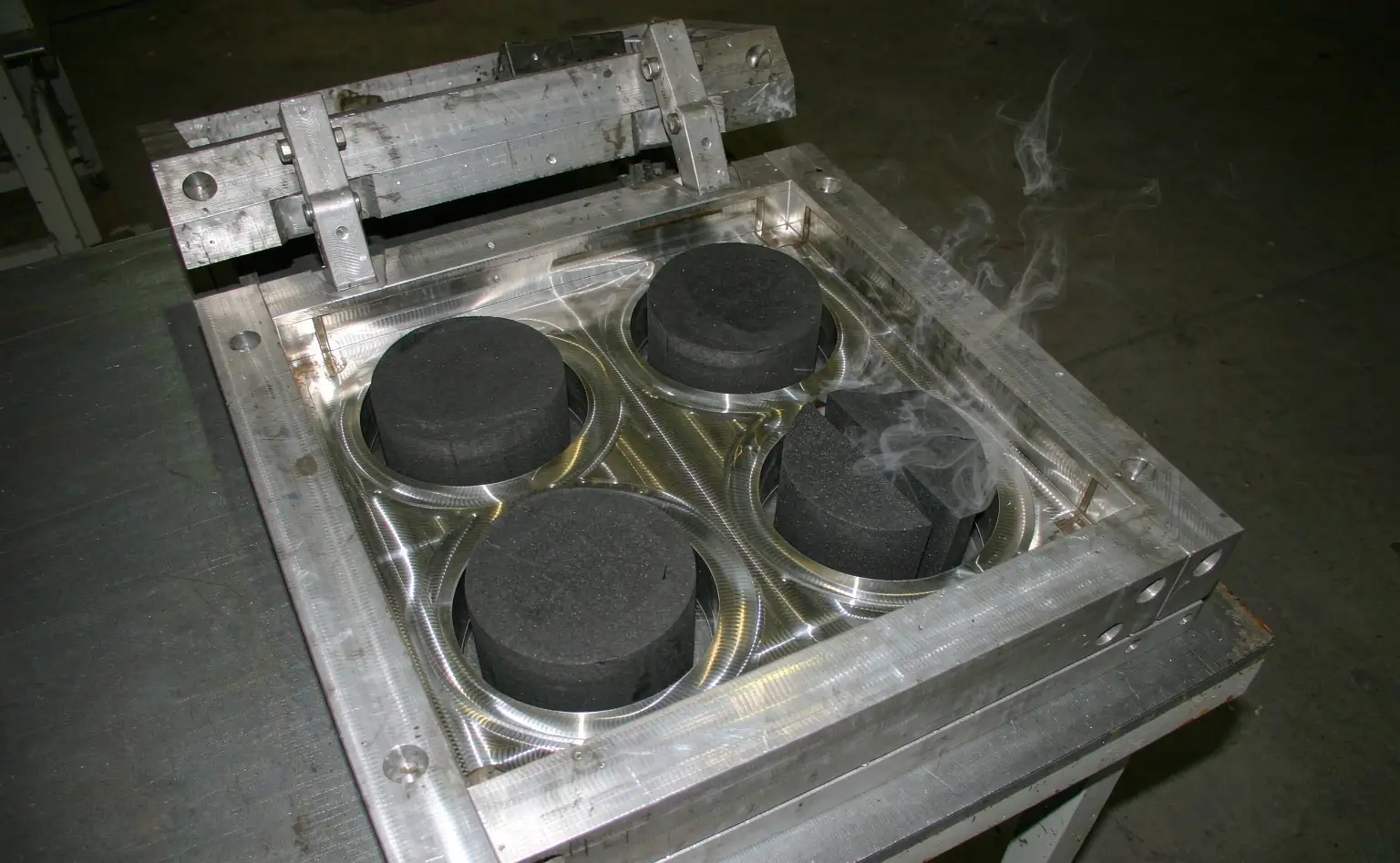
4. Skin, printing and the finishing steps
Printing is where a cosmetic part most often fails. The skin must be dry before screening, since a damp surface pinholes the ink, and it must be dried afterwards, because solvent and water left under the graphic become the starting point for mould. Follow the ink supplier’s oven curve instead of raising line speed to catch a deadline.
Cut edges and holes. Cutting opens the closed cells and exposes the open structure underneath, and that ring takes water first. Bag cut rollers within the shift rather than leaving them out overnight, and blow punchings clean, because swarf and water in a hole start the growth.
Demould temperature. Let the foam cool to near shop temperature before bagging; a warm roller in a bag is a steamer. Fit fans in the cooling area, hold the shop below 60% RH and run dehumidifiers through the wet season.
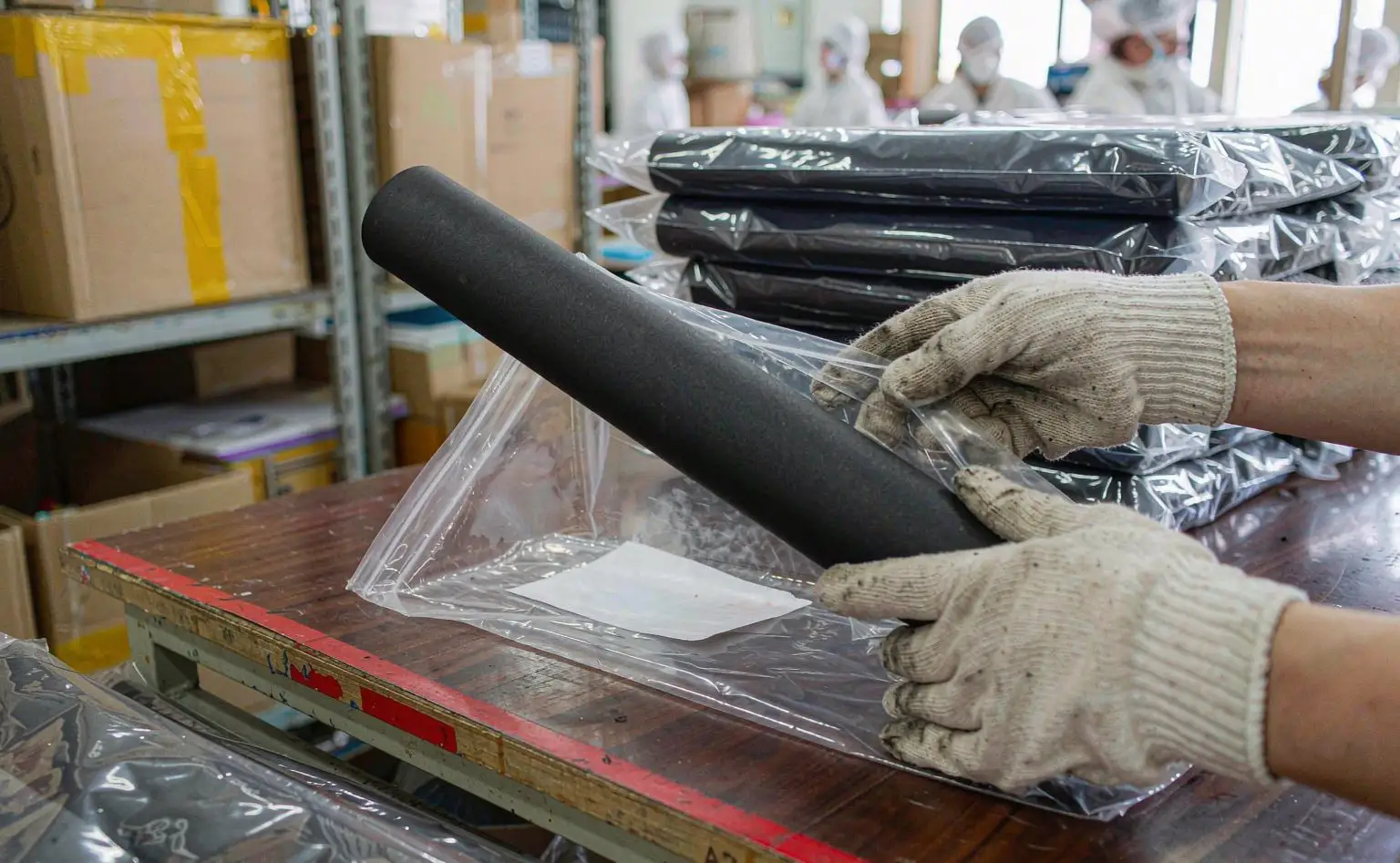
5. Packing, storage and export
The bag stage uses iHeir-D gas-phase anti-mould paper at 0.1-0.2g of active matter per sheet. Put one sheet in a single-unit bag against the film rather than flat on the print, and for multi-unit cartons one against the wall plus sheets between layers.
Compatibility trial. Roller skins are usually pale and the print is a spot colour. Seal three times the normal dose with a finished roller, mist a little water, separate the sheet from the skin with paper, and inspect after a few days for yellowing and faded print. iHeir-D carries 70%±5 solids and pale parts show fading first, so trial a small batch before a run.
Storage and loading: cartons on pallets 10cm off the floor and off the wall, store below 60% RH, and at sea leave an air path with cartons clear of the container wall, since container condensation is harsher than any warehouse. The wider picture on foam and elastomers is in antimicrobials for EVA, EPS and TPU foam.
Release at three levels: foam to ISO 22196 or ASTM G21, sampling the skin and a cut edge; packing to GB/T 24346-2009, sampling the sheet in the bag; finished rollers for 30 days at 30℃/85% RH, opening to check skin, print and cut edges. Put all three on one shipping inspection sheet.
6. Questions on bags, spraying and resilience
Q: With antimicrobial in the foam, does the bag still need a sheet?
Yes. The antimicrobial sits in the foam, and the air in the bag is a separate volume; leave that moisture alone and the skin and print spot as before.
Q: Can we just spray the finished roller?
Not advisable. A sprayed layer does not enter a closed-cell skin, wipes off in two passes and leaves water marks; the additive only works from inside the compound.
Q: Does the antimicrobial hurt resilience?
Inside the 0.5%-1.5% range, measure compression set before fixing the level; an overdose slows the crosslink and leaves the foam tacky and slow to recover.
Q: Will the sheet yellow a pale skin?
There is a risk, since pale parts react to the vapour; run the trial at three times the dose with paper between the sheet and the skin before sealing.
Four points to take away: dose iHeir-FP into the EVA compound at 0.5%-1.5% of weight before the blowing agent, comparing density to GB/T 6343 and compression set to GB/T 6669; dry the skin before printing and after, and bag cut or punched rollers within the shift; slip an iHeir-D vapour sheet into the OPP bag at 0.1-0.2g of active matter after a trial at three times the dose; cool before bagging, hold the store below 60% RH and leave an air path in the container. A 1kg antimicrobial sample and a pack of sheets go out for a trial first, with MOQ and lead time on the iHeir-FP product page.


