




 View Count:3
 Date:2026-11-11
How should swim goggle mould be treated? The lens is rarely the problem; the growth sits on the strap, the nose bridge and the case lining, and a pair put away wet shows black spots within a week. The routine is iHeir-IPL inorganic plastic antimicrobial at 0.8%-1.0% of compound weight in the strap and bridge silicone during milling, no treatment liquor anywhere near the anti-fog lens, and one iHeir-D vapour sheet at 0.1-0.2 g of active in the case. This article covers the dosing, the moulding and the packing.
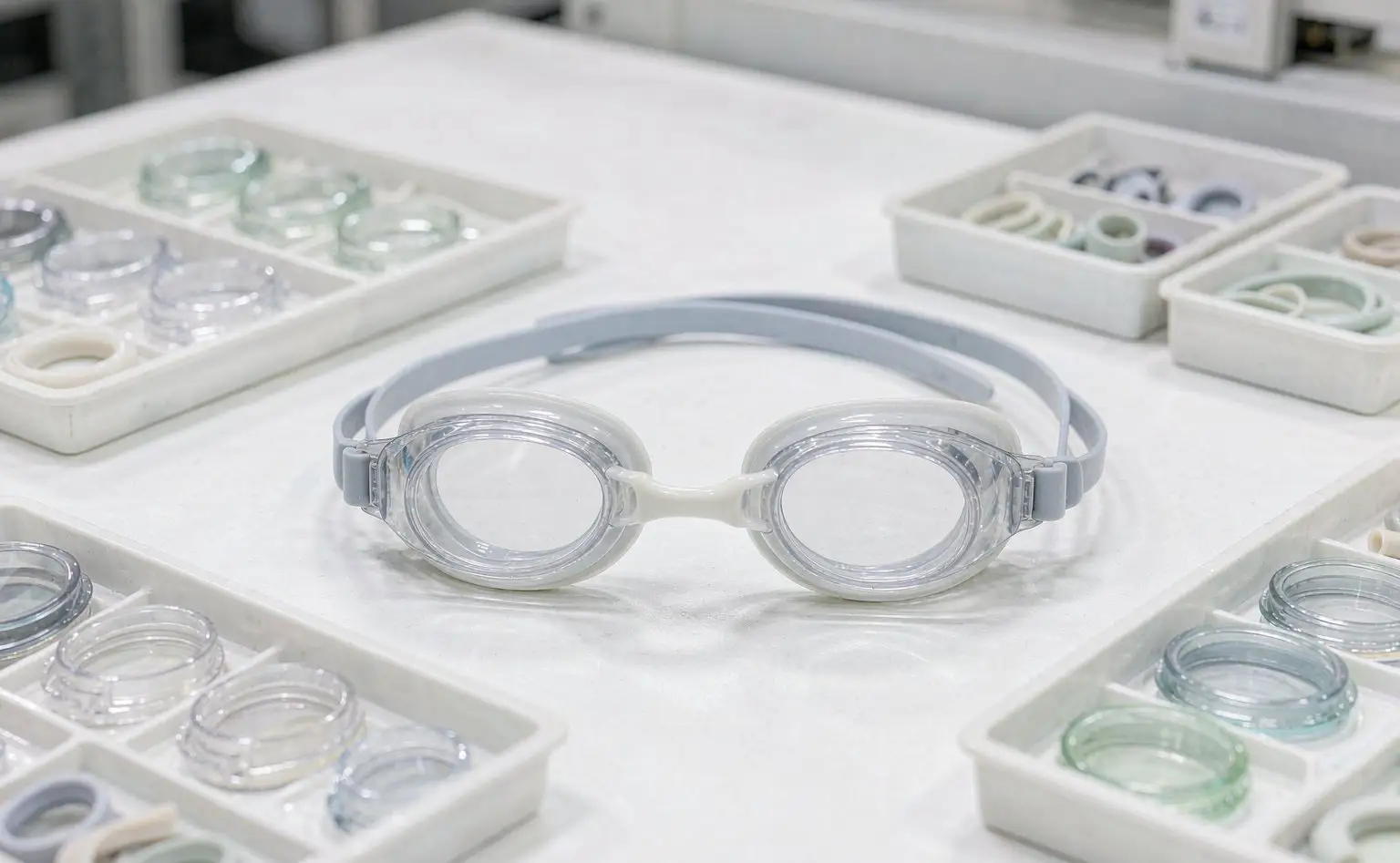
1. Mould grows on the strap, the nose bridge and the case lining, not the lens
Take a pair of goggles apart: PC lens with an anti-fog coating, frame in TPU or silicone, strap in silicone or TPR, nose bridge, case. What moulds is the silicone parts and the case lining; the lens is hard PC with a glossy surface and does not support growth.
The strap sits against skin. Silicone picks up sweat and pool water, and the pair goes into the case before it dries. The strap looks dry while water is still sitting in the slot where it joins the frame, and a slot is a gap that does not drain.
The bridge is small and ignored. The nose bridge clips onto the frame; after a wash it is put down and water collects between bridge and frame. In a production batch nobody checks that one small part, and the customer finds it black at the joint after a week.
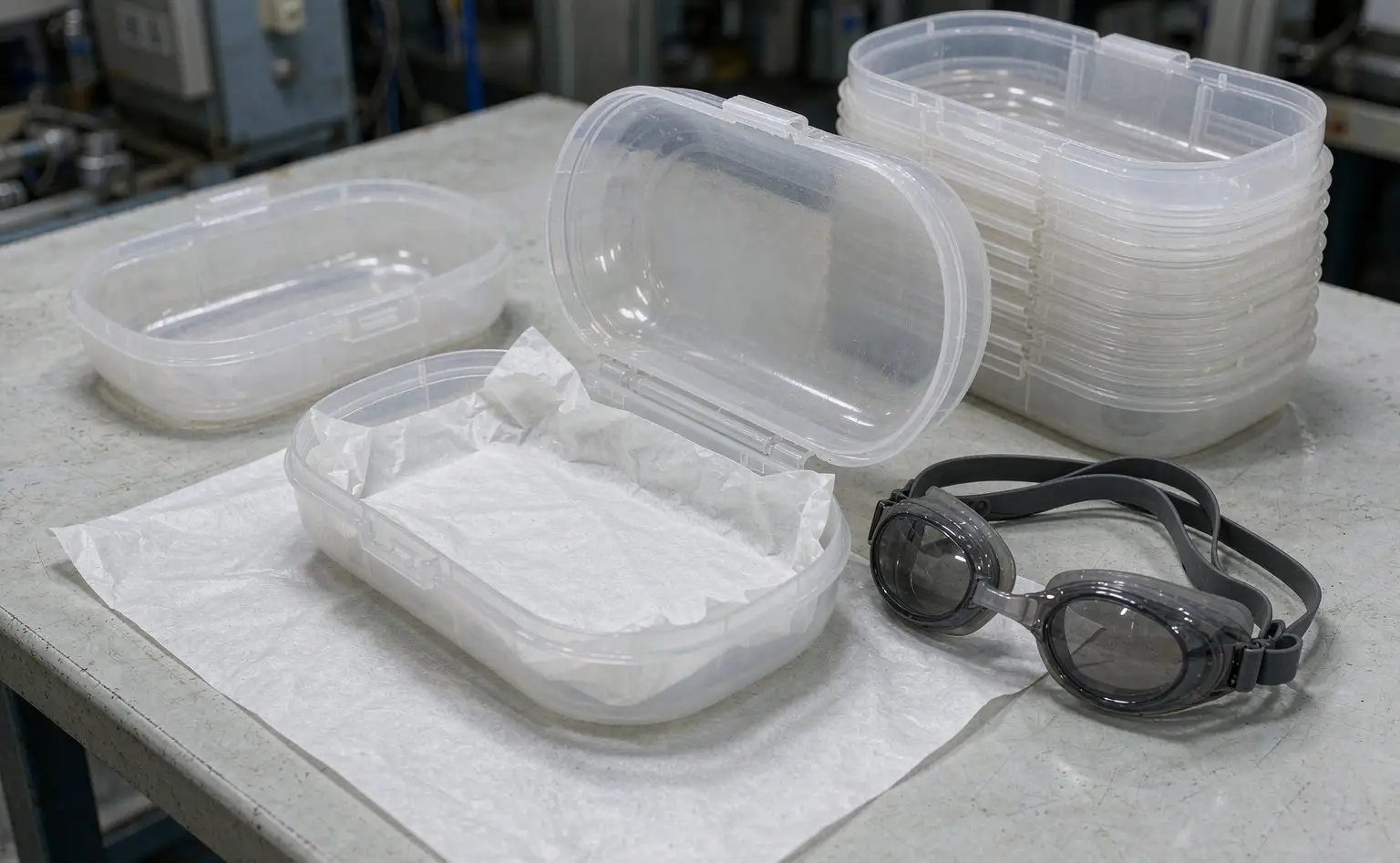
The case is a sealed box. A hard case with a lining does not breathe once the lid is closed. Water carried in stays for days, the lining takes it up first and moulds, and the spots then transfer to the lens.
2. Silicone, lens and case are counted on two different bases
The table lines up the strap, the bridge and frame, the lens and the case. Silicone is counted as a percentage of compound weight, vapour paper in sheets, and the two are not convertible.
| Part | Material | Product and level | Stage | Control point |
|---|---|---|---|---|
| Strap | Silicone, TPR | iHeir-IPL 0.8%-1.0% | Milling | Of compound weight, mixed evenly |
| Nose bridge and frame | Silicone, TPU | iHeir-IPL with the same lot | Milling, moulding | Check clarity on clear parts |
| Lens | PC with anti-fog coat | No treatment liquor | Assembly | Dry cleaning only |
| Carry case | Hard case, lining | iHeir-D 1 sheet 0.1-0.2 g | Packing | Lid closed tight |
One boundary. iHeir-IPL works inside the silicone so the strap and bridge stop being a source; the lens stage has nothing but cleaning and drying, no additive at all; the vapour sheet covers the air in the case. The silicone stage lasts for the life of the product, the other two only cover the trip from plant to first opening.
3. Compounding the silicone at 0.8%-1.0% during milling
The level is 0.8%-1.0% of compound weight. Dark straps take the low end; clear and pale straps, and orders with an antimicrobial test, take the high end. iHeir-IPL is a white powder with whiteness above 90 and a mean particle size of 1-2 µm, so clarity has to be checked before it goes into a clear compound.
How it goes in. Add it during milling with the compound and mix until even before sheeting off and moulding. iHeir-IPL withstands 300-320C, well above silicone mixing and vulcanising temperatures, so there is no decomposition risk in the process. Its specific gravity is high, and short mixing leaves it clustered in patches, so one length of strap ends up active and the next does not.
Trial three things. Clarity and shade, most sensitive on clear and pale straps, checked on a pressed plaque; mechanicals, tensile strength and elongation to GB/T 528 and hardness to GB/T 531.1, looking for a drop at 1.0%; and ageing, hot air ageing to GB/T 3512 with retention of tensile checked afterwards.
It is not a desiccant. iHeir-IPL deals with what grows on the silicone; it does not absorb water or dry the part. Water in the strap slot still has to be wiped and aired out. Dosing and drying are two separate jobs.
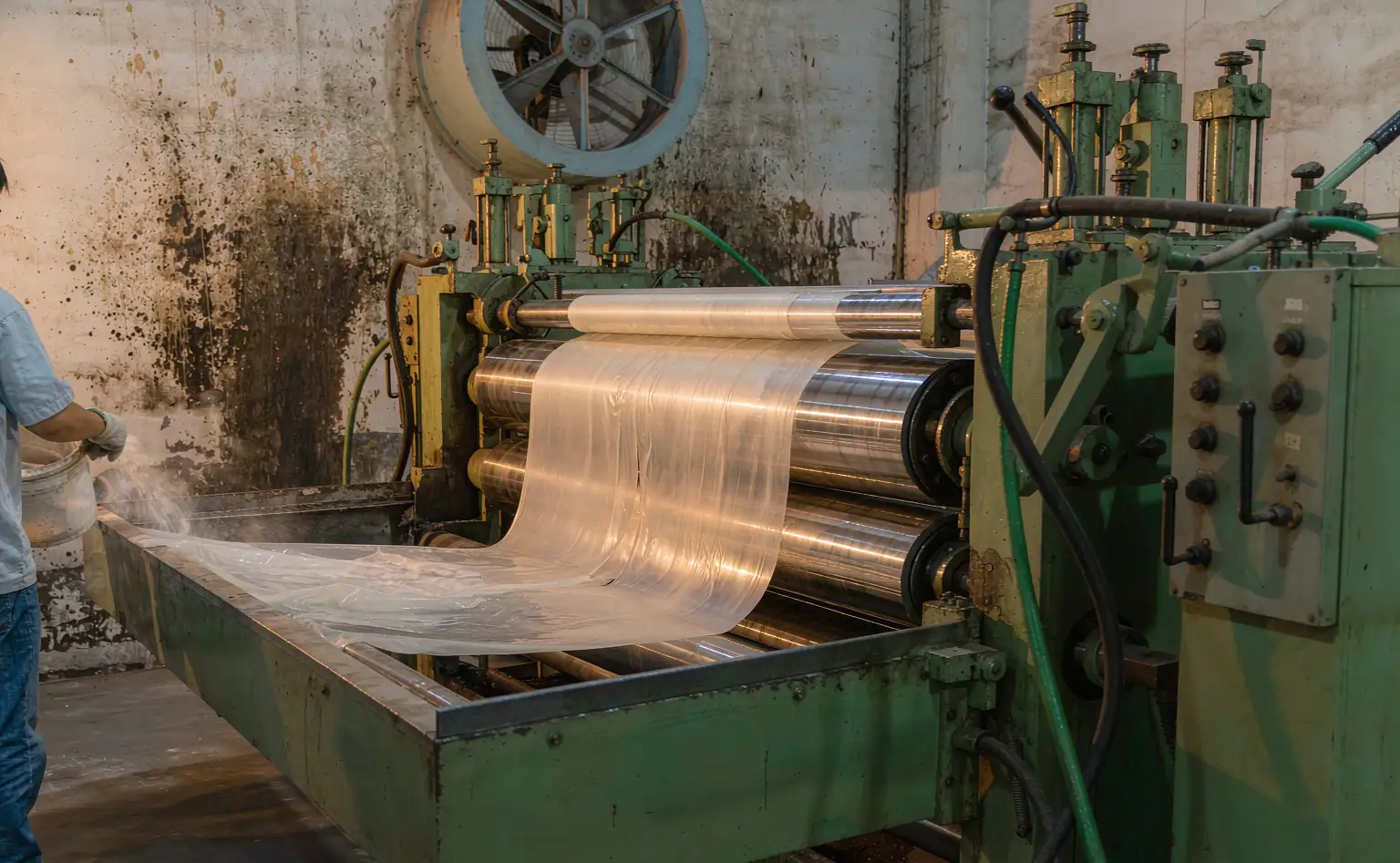
4. The anti-fog lens takes no treatment liquor, only dry cleaning
Half the parts on a pair of goggles cannot take water, and the anti-fog coating is the most fragile of them. Write that boundary onto the line.
Lens and coating. The anti-fog layer on a PC lens is a hydrophilic film. Any liquid carrying an additive leaves a mark when it dries, and wiping takes the film with it, so fog resistance fails outright. The lens stage is dry only: dust removal, inspection, static control.
No spray bottles at the assembly bench. Hands stay clean while the lens is pressed into the frame, and no spray belongs on that bench. Plants have sprayed a “cleaner” onto lenses before framing to save time, lost the anti-fog performance on the whole batch and had to strip and rebuild.
Case lining. Linings are flocked fabric or EVA, and once damp they hold mould that transfers onto the lens. Store linings dry and check for damp or stiff patches before packing.
Shop humidity. Hold moulding, assembly and packing at 45%-60% RH and run dehumidifiers in the humid season. Do not leave moulded silicone open to a draught: condensation landing on it undoes the work.
5. One vapour sheet in the case, plus the warehouse and the container
At packing, put one iHeir-D vapour sheet in the case at 0.1-0.2 g of active, stuck inside the lid or laid under the goggles, never against the lens. Close the lid and seal the outer carton, or the concentration will not hold.
Run the compatibility test. Seal a sheet at three times the normal level with a finished pair, add a little water, keep paper between sheet and product, and leave it closed for a few days. Check the lens for haze, the anti-fog layer for bloom, the silicone for hardening and the case for distortion. iHeir-D has 70%±5 solids and can attack poor-quality metal under damp conditions, so cases with metal clasps need the test first.
Warehouse. Keep finished goods below 60% RH, cartons on pallets 10 cm off the floor and 10 cm off the wall, and walk the stock before the humid season, opening cases to check the lining and the strap slot.
Export. Line containers with barrier film and hang desiccant sticks, and check every carton for soft corners before loading. Optical goods follow the same logic in eyewear frame compound and case lining.
6. Questions on clarity, levels and black straps
Q: With the antimicrobial in, will the strap stop going black?
Only partly. The agent holds back microbial growth; some of the darkening is sweat and pool water deposit, which needs rinsing and airing after use. Dosing covers the product, habits cover the poolside, and both matter.
Q: Will iHeir-IPL haze a clear strap?
A little. It is a white powder, and at 1.0% in a clear compound some haze can show. Press a plaque first; if the haze is visible, drop to 0.8% or move to a clear-grade antimicrobial route.
Q: 0.8% or 1.0%, does it matter much?
It is a 25% difference in active content, which is the difference between passing and failing an antimicrobial acceptance test. Fix it by colour and customer requirement and put it on the batch sheet.
Q: Will the buyer smell the sheet when the case is opened?
At 0.1-0.2 g of active there is no noticeable smell. Overdosing is what smells, so count sheets rather than adding by eye.
Four points: compound iHeir-IPL at 0.8%-1.0% of compound weight into the strap and bridge silicone during milling, mix evenly before sheeting, check clarity and shade on clear parts first, and re-test tensile, elongation and hardness at 1.0%; keep every treatment liquor away from the lens and anti-fog coating, keep spray bottles off the assembly bench and handle the lens dry; put one iHeir-D sheet at 0.1-0.2 g of active inside each case lid after a three-times compatibility test; keep the warehouse below 60% RH on pallets off the floor and line and dry containers for export. A kilo of antimicrobial and a pack of sheets go out for a trial, with MOQ on the iHeir-IPL product page.


