




 View Count:9
 Date:2026-11-10
Can tea tray mould be prevented? A tea tray meets water every day, and mould usually starts in the glue lines and on the underside rather than on a polished face. The routine is a 1:40 iHeir-M5 immersion-type bamboo and wood fungicide soak to 15%-20% weight gain for the body, plus iHeir-JS glue mildew inhibitor at 1%-2% of adhesive weight, and a brush-over of every joint after pressing. This article gives the soak, the glue dose and the drying figures.
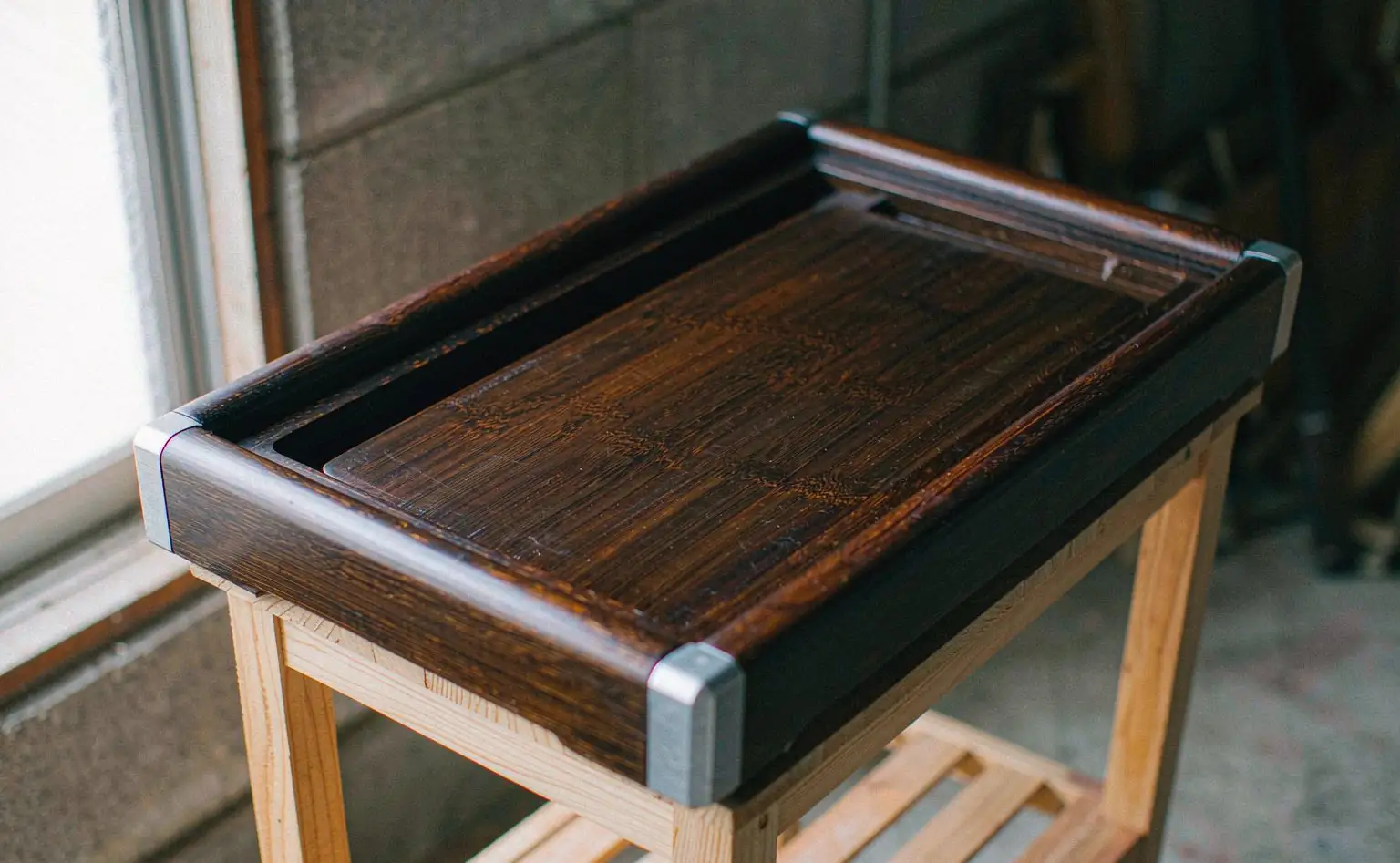
1. Mould starts in the joints and the underside, not on the face
Take a solid-wood tea tray apart: top panel, side panels, base, laminating adhesive, corner edging. Of these, the glue lines and the underside fail first, and both fail from the inside out.
The joint is the water door. The panel is built up from strips, and the adhesive sits in every joint. The glue line itself takes water, and the end grain of the timber is exposed inside that line; end grain absorbs five to ten times faster than a face. Water goes into the joint, darkens both sides of the glue line first and then travels into the board.
The underside sits against the bench. No air moves under a tray, and water from a washed tray or a spilled brew creeps underneath and stays there. Turn it over and the spots are concentrated on the base and the four corners, with nothing visible on top.
Why wiping the face achieves nothing. Once mould is in the joints and the base, a clean surface only lasts until the next wash. That kind of failure is a strip-down, sand and re-glue, which is close to building the tray again.
2. Body, glue line and packing are counted separately
The table lines up the body, the adhesive, the joint touch-up and the packing. The soak is counted as a weight gain, the adhesive as a percentage of adhesive weight; the two are not convertible.
| Part | Material | Product and level | Stage | Control point |
|---|---|---|---|---|
| Body and sides | Solid-wood blanks, finger joint | iHeir-M5 at 1:40 | After cutting, before gluing | 15%-20% gain, about 5-10 min |
| Laminating adhesive | PVAc, assembly glue | iHeir-JS 1%-2% | Mixing the glue | Of adhesive weight, stirred in |
| Joints and end grain | Pressed panel | Same liquor, brushed on | After pressing, before sanding | Line fully wetted, no dry edge |
| Finished packing | Carton, EPE | Moisture control, sheet optional | Cartoning | Pack only at the target regain |
One boundary. The soak works on the timber itself, the adhesive dose works on the glue line. Soak without dosing and the glue line takes water and moulds on its own; dose without soaking and every colony inside the board is untouched. Do both and the tray survives washing.
3. Soaking the body: 1:40, and 15%-20% gain is the real target
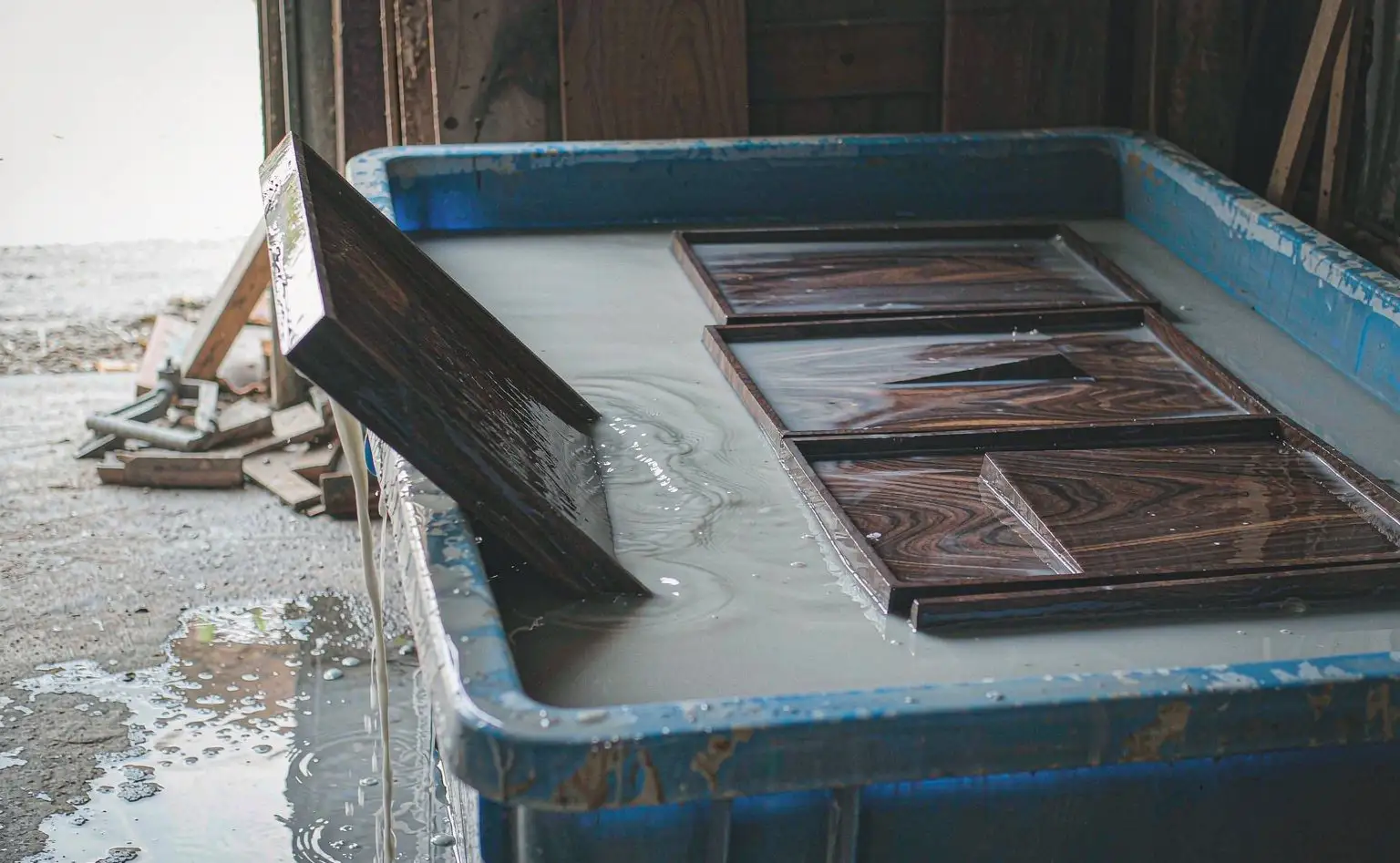
Mix one part agent to forty parts water (1:40), for example 5kg of agent into 200kg of water. Stronger is not better: at higher concentrations the face darkens and the following coats take stain unevenly.
How to soak. Submerge the blank completely with nothing above the surface, hold 5-10 minutes and pull it at 15%-20% weight gain. Gain is the only reliable criterion, because time alone misleads: thin boards and finger-jointed stock take water fast, thick boards slowly, and a factor of two inside one batch is normal. Weigh samples and set the time band by thickness.
Drain before stacking. Drain the blank, then air-dry or sun-dry before the next step. Stacked wet, water migrates to the core, the outside dries and the inside stays wet, and the problem is built into the panel before it is even glued.
Keep metal away. iHeir-M5 is acidic and must not contact or be mixed with metal or alkaline materials. A tray with a brass drain, a metal handle or stainless corner caps keeps those parts out of the tank and off the bench where liquor runs; the tank itself should be plastic or plastic-lined.
Shake before use. Some surface float is normal after standing, so shake the drum before mixing. It ships in 25kg drums, stores dry and dark, and keeps for a year.
4. Dosing the laminating adhesive at 1%-2%
The level is 1%-2% of adhesive weight. Domestic orders in dry regions take 1%; export orders, sea freight and buyers in humid regions take 2%. Count on the glue, not on the weight of the board.
How to add it. Stir iHeir-JS into the glue at mixing time, mechanically, until even, then spread. Two turns by hand leaves pockets of high and low concentration, and after cure some glue lines protect while others do not. iHeir-JS mixes with water in any ratio, runs at pH 6-7 and is compatible with ordinary PVAc and assembly glue systems, but a trial is still needed whenever the glue type changes.
Three things to check in the trial. At 2%, watch whether open time shortens noticeably, whether the glue line darkens, and whether shear strength after cure drops. If any one fails, step back to 1%-1.5% and recover the protection with the brush-over.
Do not skimp on glue. The joint needs a full bead that squeezes out as an even line; a starved joint cannot be rescued by more agent in the mix. Follow the adhesive maker’s press pressure and closed time.
5. Joint touch-up, sanding and moisture content
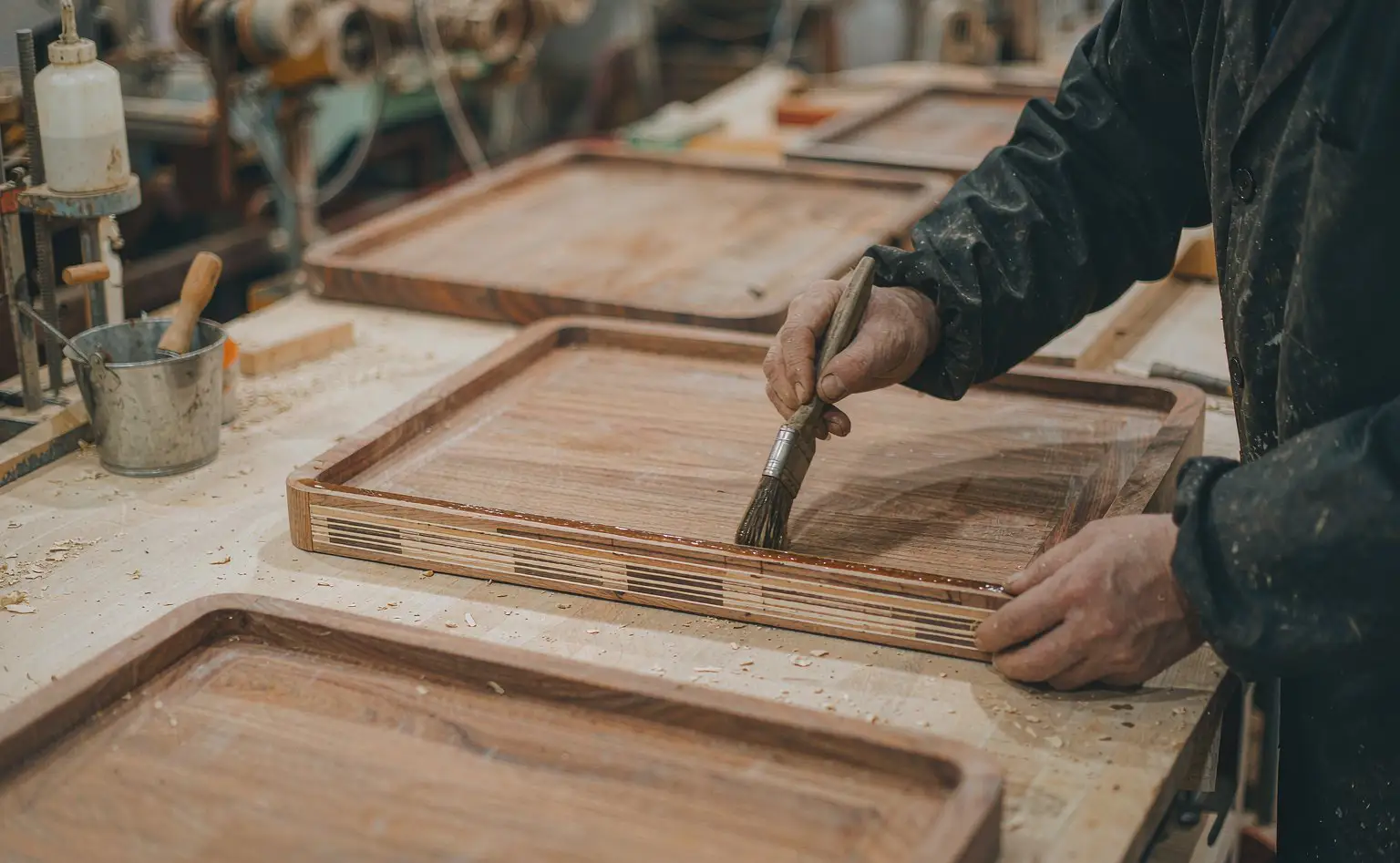
Pressing is not the end of the job: the joint is compressed during assembly, the fibres at the edge are bruised and take water even more readily.
Brush early. After the press is released and before sanding, brush each joint with the same liquor until the line darkens and stops absorbing. End grain, finger joints and corner edging get the most attention.
Regain is the hard gate. A tea tray is an indoor product, so set final moisture to the equilibrium of the market: 12%-14% for southern China, 8%-10% for the north. Ship a wet tray to a dry market and it cracks; ship it to a humid one and it moulds.
Do not sand the treatment off. After the brush-over, sand only to remove raised grain and avoid working the joint line. A well-sealed finish holds the protection; wax only, with no sealing coat, lets water back into the joint.
Packing. Check regain before cartoning, protect the corners with EPE and seal the carton; export orders can take a vapour sheet inside. For full containers, hang desiccant sticks, with a comparable routine in bamboo chopping board packing and the storage side in bamboo cup drying.
6. Questions on soaking, glue and spotted trays
Q: Can we soak the body and skip the adhesive dose?
No. The glue line takes water on its own and dries slowest, so mould starts either side of it. The soak covers the timber, the dose covers the joint.
Q: Can the soak be a flat ten minutes for every batch?
No. Thickness, species and the share of finger-jointed stock all change uptake, and a flat time leaves half the batch either under-soaked or over-soaked. Work to 15%-20% gain and treat time as a guide only.
Q: Does 2% in the adhesive hurt the bond?
Trial for shear strength and open time first. Most PVAc and assembly glue systems are fine up to 2%; if the bond suffers, drop to 1%-1.5% and recover protection through the joint brush-over.
Q: Can a mouldy tray be saved?
It depends on depth. Marks on the face and at the joint mouth can be sanded out, brushed and refinished; once mould has gone into the board and the base has darkened and softened, scrap it rather than mixing it into good stock.
Four points: soak blanks in iHeir-M5 at 1:40, fully submerged, to 15%-20% gain (about 5-10 minutes), drain, and keep metal and alkaline materials out of an acidic system; dose iHeir-JS at 1%-2% of adhesive weight, stirred mechanically, after a trial on open time, line colour and shear strength; brush every joint after pressing and sand only to remove raised grain; hold final regain at 12%-14% for southern markets or 8%-10% for the north, and grade mould resistance to GB/T 24346-2009. A kilogram of agent goes out for a trial, with MOQ on the iHeir-M5 product page.


