




 View Count:19
 Date:2026-10-28
Where does bamboo chopping board mould actually start? Brush a fungicide over the face and leave the water in the blank core, and the boards are spotted two months after they reach port. These boards go through a dip: the blank takes iHeir-M5 at 1:40 to a 15%-20% weight gain, and the carton carries iHeir-D paper at 0.1-0.2 g of active content per sheet. This article covers the dip, the sanding-to-packing window and export storage.
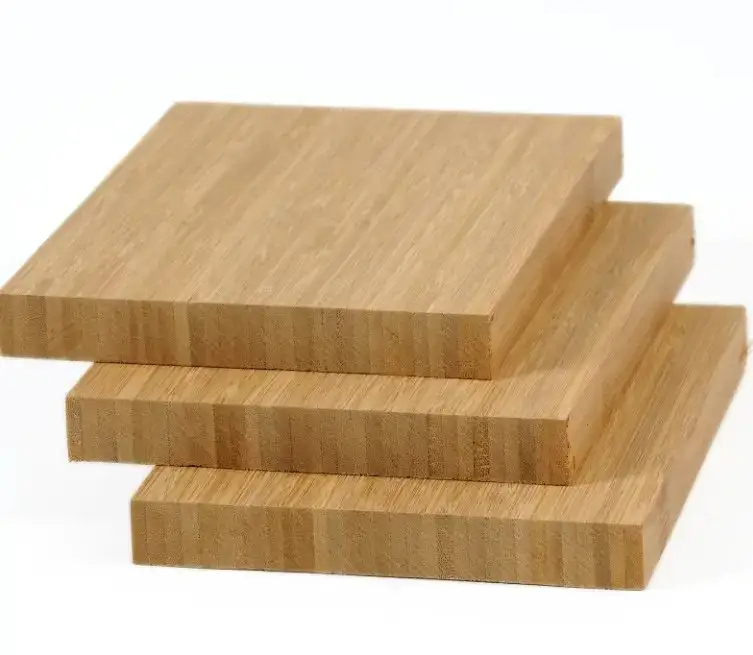
1. The mould comes out of the blank core
A chopping board is a laminated stack: bamboo strips or wood staves glued under side pressure, then edge-milled and sanded. The glue lines, the gaps between strips and the cut end grain are all water paths. If moisture has not come down to the process limit before gluing, water is sealed inside the stack, and no amount of sanding afterwards reaches it.
Failure has a sequence: grey-black specks at the end grain first, then a spread along the glue lines, then a dark board that smells musty. Once mould is in the glue line it cannot be washed out — the knife carries fragments through every cut.
The second location is the open time between sanding and packing. A freshly sanded face is new wood and takes up water fastest; a day on an open bench in a humid shop puts the moisture straight back. Many plants run a good dip and lose the batch here.
The third is the micro-climate inside the carton. Boards stand in a small, poorly ventilated space; over a sea leg the day-night swing condenses water on the carton wall, and it lands on the outer board. That is what the gas-phase paper in the carton is for.
2. Blank and carton are counted separately
The table sets out the dip, the open time, packing and export. The dip is measured as weight gain, the paper as sheets and active content, and the two are not interchangeable.
| Stage | What is done | Product and level | Control point | Basis |
|---|---|---|---|---|
| Blank dip | Fully submerged, never breaking the surface | iHeir-M5 at 1:40 | 15%-20% gain, about 5-10 minutes | Weigh before and after |
| Draining and drying | Lift, drain, air or sun dry | No additive | Below 12% moisture | Meter reading |
| Sanding to packing | Sanding, edge milling, inspection | No additive | Open time under 4 hours | Station cycle |
| Packing | Paper lining the carton | iHeir-D 0.1-0.2 g per sheet | Sheets matched to carton and piece count | Sheets per carton |
| Export and storage | Container loading, warehouse humidity | Desiccant plus humidity control | No carton against the wall | Container type and store volume |
Two boundaries. First, the dip does not replace drying: an additive suppresses organisms, it does not remove water, and a wet blank fails whatever the dose. Second, the paper is not just a liner: it releases active content into a closed carton, so it must face the board with the carton sealed — loose in an open box it is spent.
3. Blank dip: twenty percent gain means saturated
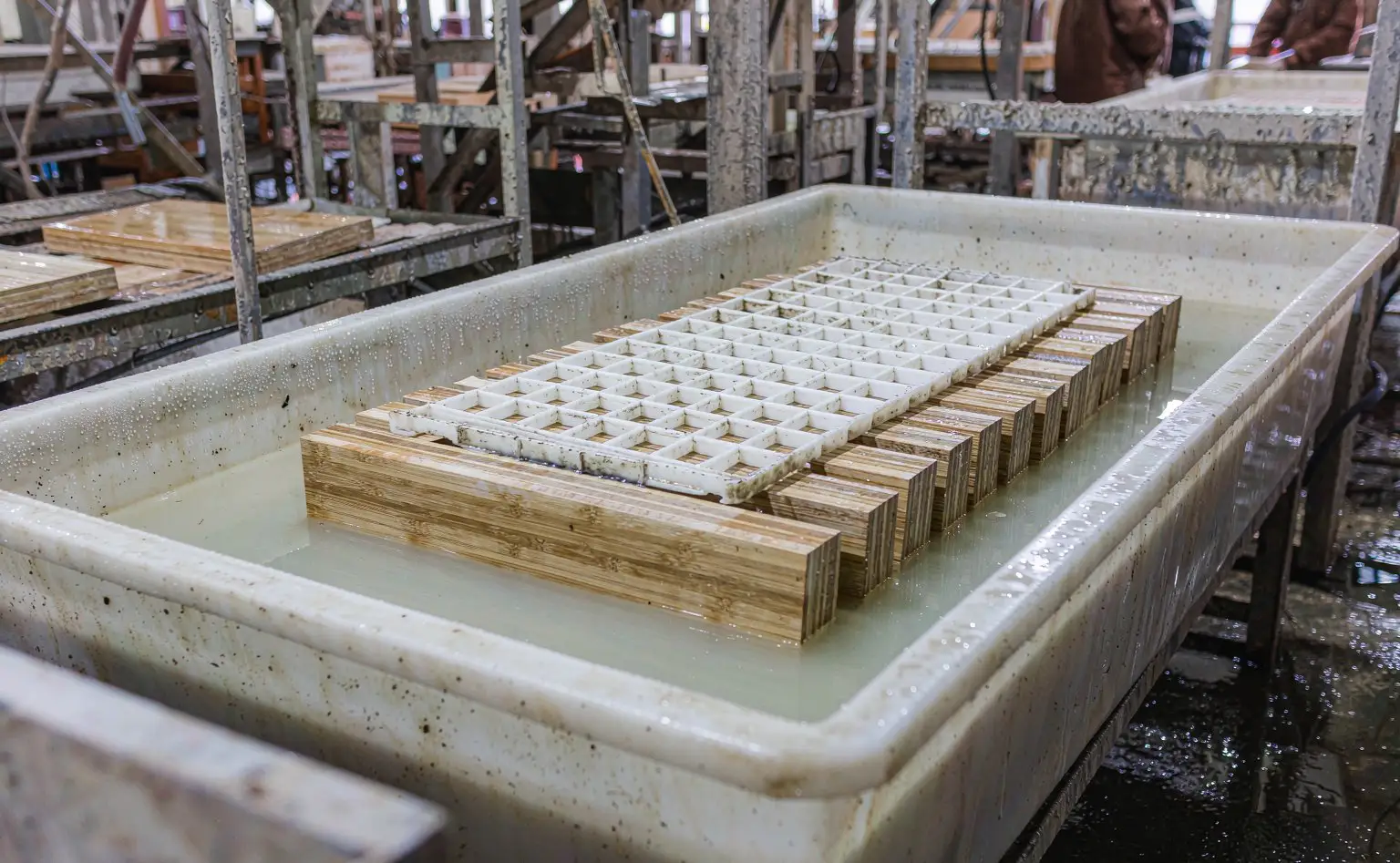
The blank takes iHeir-M5 immersion-type bamboo and wood fungicide. Mix the bath at 1:40, that is 5kg of product to 100kg of water; submerge the blank completely without letting it break the surface, soak to a 15%-20% weight gain — about 5-10 minutes — then lift, drain and air or sun dry before sanding.
Weight is the only firm criterion. In five minutes a thick blank and a thin one take up very different amounts. Weigh each batch before and after and pull it at 15%-20%. Below 15% the core is still dry; above 25% the board holds too much water and cups or opens at the glue line.
Three operating points. Tank material: M5 is acidic and must not touch metal or be mixed with alkaline material, so use plastic or FRP — an iron tank corrodes and neutralises the bath. Shake before use: a floating layer is normal, and pouring unshaken leaves the active content at the bottom. Top up in proportion: liquor carried out on the boards is replaced at 1:40, because water alone dilutes the bath run by run.
Do not stack the blanks straight out of the tank. Stand them on racks in a single layer; stacked, the contact faces never dry and grow mould first. In the wet season use a drying room and raise the temperature in stages — pulling it straight above 60℃ dries the skin while the core is wet, and the board cracks.
4. Sanding to packing: the four-hour window and the paper count
A freshly sanded face is new end grain and takes up water fastest. Keep the open time under four hours: sand, then straight to the packing station with no stacking on the floor in between, and hold the shop at 60% RH or below with dehumidifiers in the wet season. A board left open overnight is back above 15% moisture, and the dip is wasted.
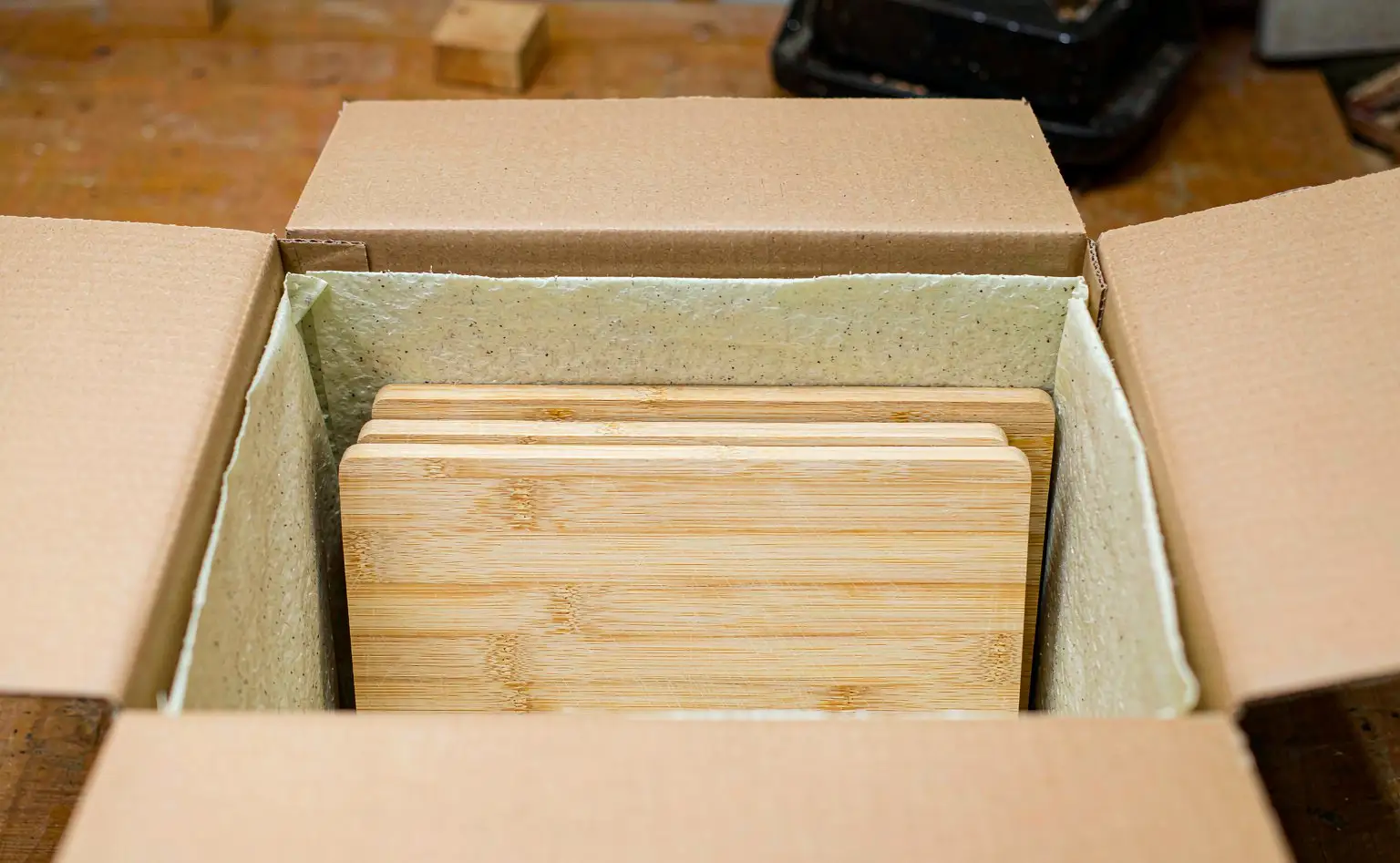
Packing uses iHeir-D gas-phase anti-mould paper, 0.1-0.2 g of active content per sheet, solids 70%±5, 25kg per drum, one year shelf life. It goes in as a carton liner: paper facing the board, carton sealed, so the active content builds a gas-phase atmosphere inside the box.
The sheet count follows carton volume and piece count: boards per carton and air space left decide how many sheets. The usual pattern is one against the carton wall plus one between boards where needed, set by a packing trial — 30 days at 30℃/85% RH, then open the carton and check the outer face and end grain. No mould means the count is right; mould means add a sheet and retest. More is not better: an overdose leaves a stronger smell.
Two details: do not lay paper on a wet board — let the moisture come down first; and seal the carton, because the gas phase only works in a closed space.
5. Export and storage
Leave an air path in the container: no carton against the wall or under the ceiling. The day-night swing condenses water on the ceiling and the cartons at the wall come back damp first; a thick board hides it until the carton is opened and the end grain is black. The mechanism is the one described in condensation in sea freight containers.
In the warehouse three things matter: pallets under the stock, 10cm clearance from the wall, and 60% RH or below. Coastal stores need dehumidifiers rather than ventilation, because venting on a rainy day brings wet air in. Ship first in, first out — six-month stock is where problems surface.
Verify at three levels: blanks on a mould resistance test to GB/T 18261, sampling face and end grain; moisture by meter on every batch, after the dip and before packing; finished cartons for 30 days at 30℃/85% RH.
6. Questions on cracking, smell and boards that already have mould
Q: Why do blanks crack or cup after the dip? Check the weight gain first — above 25% is too much water. Then check the drying curve: pulling straight above 60℃ dries the skin while the core is wet, and the stress opens the board. Staged heating with a longer low-temperature stage does more than cutting the dose.
Q: There is a smell in the carton — too much paper? The paper has an odour of its own; match the count to carton volume and seal the box. A strong smell usually means an overdose or boards stacked in an unventilated carton. If it is sharp and the faces feel tacky, check whether the boards were packed damp.
Q: Can a board that already has mould still ship? Surface bloom can be sanded off and the board dipped and dried again. Where mould has gone into the glue line and a black line remains after sanding, the board is a downgrade or scrap. Any reworked batch needs the dip and the packing step again; sanding alone and the mould returns within a month.
Four points to take away: blanks with iHeir-M5 at 1:40, fully submerged, pulled at a 15%-20% gain in about 5-10 minutes, in a non-metallic tank; dry on racks in a single layer below 12% moisture before sanding; pack within four hours of sanding with iHeir-D paper at 0.1-0.2 g per sheet, the count set by a packing trial; leave an air path in the container and release after 30 days at 30℃/85% RH.


