




 View Count:55
 Date:2026-10-05
How do you stop pet pad mould from coming back after a rework? A pet pad is bulky and barely breathes once stacked, so needle-punched and fleece fabrics draw moisture and spots appear within days, and a downgraded export batch takes the delivery date with it. Pad needle-punched and fleece pads with iHeir-BJ textile anti-mould agent at 2%-3% o.w.f., and pad or dip the nonwoven liner with iHeir-PG nonwoven antimicrobial agent at 20-40 g/L. This article covers the two finishing stages and how to hold the store dry.
1. Where pet pad mould comes from: fabric that holds moisture, stacks that hold air
A pet pad is normally a needle-punched or fleece face, a nonwoven liner and a non-slip base, laminated into a bulky item. Stack it or pack it and the middle barely sees any airflow. Needle-punched and fleece fabrics are both fibre assemblies, so moisture sits in the spaces between the fibres; the adhesive residue in the liner adds a second source of nutrient. A few sealed days are enough for the spots to spread.
Two stages cause most of the trouble. The first is finishing: the face never gets an anti-mould step, or a softener and the anti-mould agent go into the same bath and neutralise each other so both are lost. The second is the finished-goods store and export packing: the pads are stacked high, the middle and the bottom draw damp first, and the packs nearest the wall and at the bottom of the stack are the first to spot.
The read is not hard. Spots that sit on the face and lift off when rubbed point to storage. Spots that run into the fibre and show on a torn cross-section mean the finishing stage never put the protection in. A spray holds on the surface only; needle-punched and fleece fabrics have to go through padding or dipping so the agent reaches the fibre.
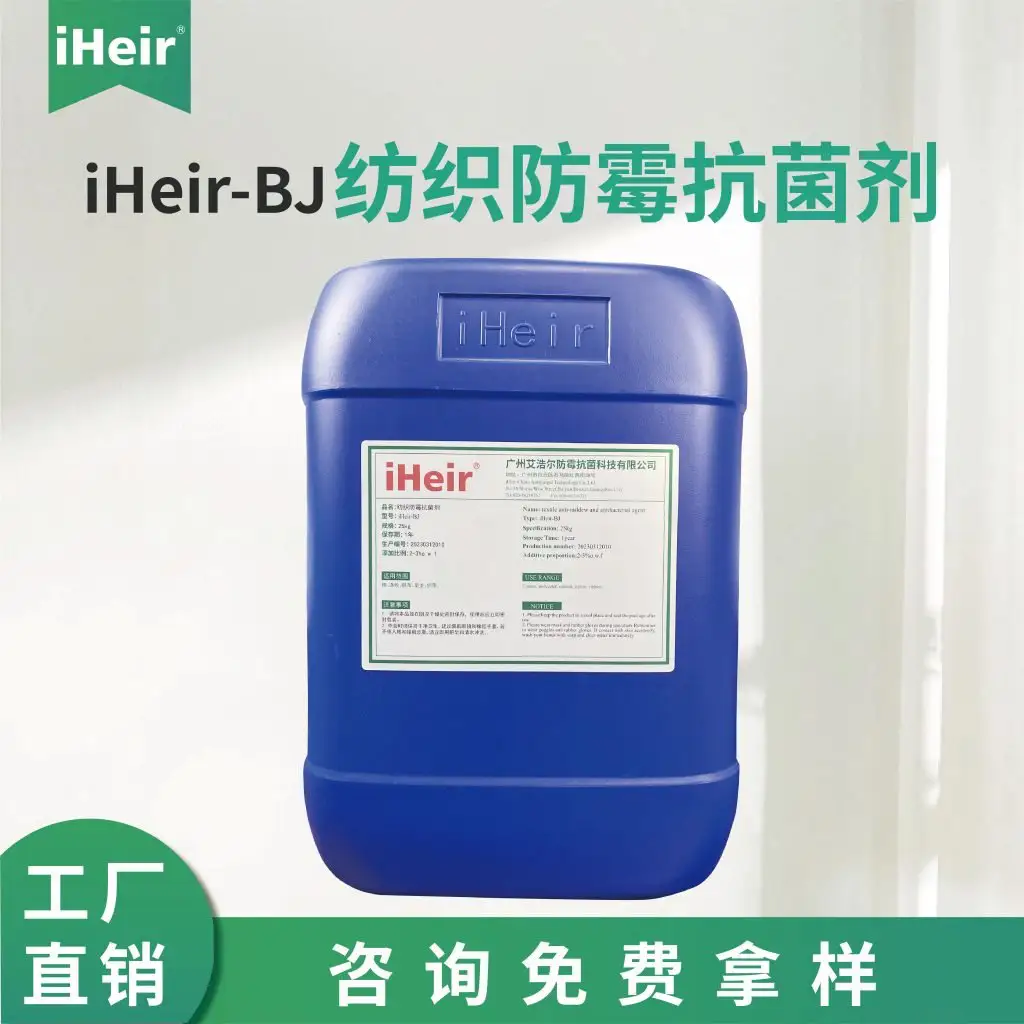
2. The two stages at a glance: the finishing line and the store
The table lines up the part, the stage, what is treated, the product, the figures and the points to watch. It is written to serve as the first draft of a process card.
| Part | Stage | Treated item | Product | Figures | Points to watch |
|---|---|---|---|---|---|
| Needle-punched or fleece pad | Padding and pressing in the finishing bath | Face fabric | iHeir-BJ textile anti-mould agent | 2%-3% o.w.f. | Bath 21-50 degrees, pH 4.5-8.5, pre-mix with 9-13 parts water; cationic, so never in the same bath as an anionic auxiliary |
| Nonwoven liner (with a mangle) | Padding | Nonwoven | iHeir-PG nonwoven antimicrobial agent | 20-40 g/L | pH 6-8, room temperature, 70% pick-up, dry at 100-170 degrees |
| Nonwoven liner (no mangle) | Dipping | Nonwoven | iHeir-PG nonwoven antimicrobial agent | 2%-4% o.w.f. | pH 6-8, 50 degrees for 20-30 minutes, dewater directly then dry |
| Plastic parts (feed bowls, litter trays) | Injection moulding | Resin | Control only (select separately) | On total resin weight | The figure moves with the resin and the contact type, so the selection is confirmed case by case and never mixed with the textile line |
| Finished-goods store | Stacking | Finished pads | Humidity control only | Keep the store below 60% relative humidity | Off the floor, away from the wall, air gaps between stacks, first in first out |
| Export packing | Full container | In-container climate | Humidity control only | Set by box type and voyage | Pads take up moisture fast; skip in-container control and the first two stages are wasted |
Six rows, one conclusion: the finishing stage decides whether the fibre carries any protection, and the store and the packing hold what the finishing built.
3. The finishing line: how the agent goes onto a needle-punched pad
The face gets its protection in the finishing bath, once. Pad and press with iHeir-BJ textile anti-mould agent at 2%-3% o.w.f. on dry fabric weight, with the bath at 21-50 degrees and pH 4.5-8.5 (6 is the target), in soft water. Pre-mix the agent with 9-13 parts water and add it to the bath in stages; work on a 70% pick-up.
Three pitfalls are worth clearing before the line starts. First, iHeir-BJ is cationic and must not share a bath with an anionic auxiliary: softeners and wetting agents have to be checked for their charge, because the two will precipitate each other and both jobs are lost. Second, the figure is on dry fabric weight, not finished weight, so a change in fabric weight means recalculating. Third, the loading sets the service life: about 2% is good for a year or more and 3% covers two to three years, so an export order belongs at the top of the range.
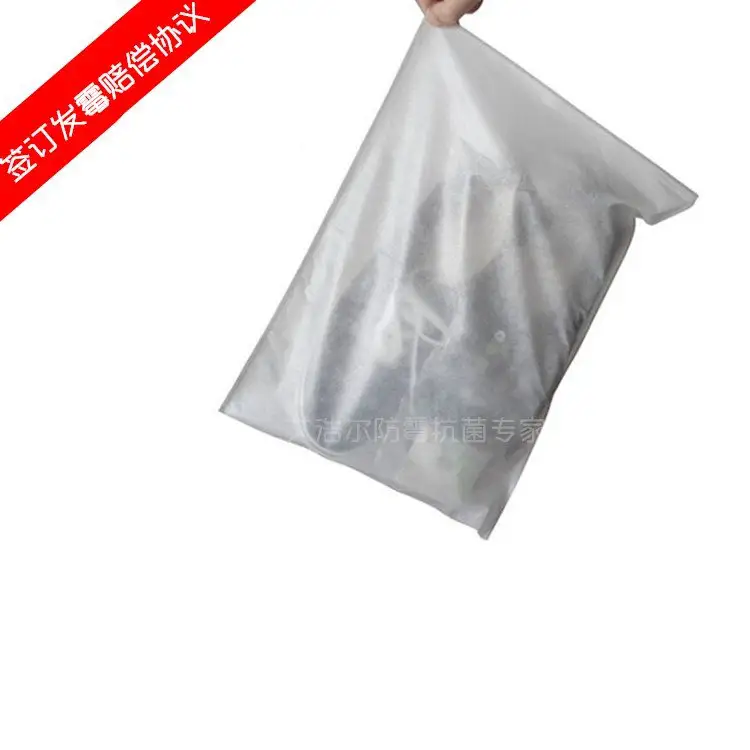
4. The nonwoven liner: pad it or dip it
The liner runs on a second product. iHeir-PG nonwoven antimicrobial agent has two routes. Where a mangle is available, pad at 20-40 g/L, pH 6-8, room temperature, 70% pick-up, and dry at 100-170 degrees. Where there is no mangle, dip at 2%-4% o.w.f., pH 6-8, 50 degrees for 20-30 minutes, dewater directly and then dry.
PG fixes without a heat-setting step and has little effect on whiteness, shade, strength, hand and air permeability, which is what a liner needs: antibacterial without going stiff. The route is decided by the equipment, not by preference. With a mangle, padding gives a low, even add-on. Without one, dipping makes up in time and temperature. Neither should be replaced by a spray: coverage on a liner is uneven, so parts of it end up untreated.
5. Choosing between the two, then holding the store
The two products divide cleanly. iHeir-BJ textile anti-mould agent looks after the needle-punched and fleece face, by padding at 2%-3% o.w.f., bath 21-50 degrees, pH 4.5-8.5. iHeir-PG nonwoven antimicrobial agent looks after the nonwoven liner, at 20-40 g/L by padding or 2%-4% by dipping. One covers the outer face, the other the inner liner, and they are done separately rather than with a single product.
Once finishing is right, the store still has to be held. Keep the store below 60% relative humidity, load pads off the floor and clear of the wall, leave air gaps between stacks, run first in first out, and never stage a pending batch against an outside wall. A full container needs humidity control sized to the box type and the voyage. On acceptance: a fresh sample passing does not mean the stacked goods will. Hold one sample per batch at 28 degrees and 85% humidity for 7 days and read the face and the cross-section. For the storage side, see preventing mould on pet supplies before it starts.
6. Questions that come up
Can a needle-punched pad simply be sprayed? Not as the main route. A spray stays on the face, it cannot reach the pores inside the pad, and rubbing and washing take the surface layer off. Do it in the finishing bath, by padding or dipping.
Can the anti-mould agent share a bath with a softener? Check the charge first. iHeir-BJ is cationic, and an anionic softener will precipitate it, losing both jobs. Confirm the auxiliary is cationic or non-ionic, or move the softener to a later, separate step.
Will treating the liner make it stiff? Not on the PG route. The effect on whiteness, shade, strength, hand and air permeability is small: pad at 20-40 g/L where a mangle exists, dip at 2%-4% where it does not, and take a small sample through a hand and thickness check before the full run.
The work sits in two places: the needle-punched and fleece face takes iHeir-BJ by padding and pressing at 2%-3% o.w.f., the nonwoven liner takes iHeir-PG at 20-40 g/L by padding or 2%-4% by dipping, and the store and the container hold the result with humidity control. Samples and TDS sheets are available, and we are glad to run a trial on your own line.


