




 View Count:6
 Date:2026-09-27
How should export warehouse mould be controlled across a whole shipment? Mould rarely starts in the factory; it starts when a container cools at night at sea, water condenses on the cartons, and colonies appear within 48 hours. Keep the finished-goods store below 60% RH, add one iHeir-D sheet per carton at 0.1-0.2 g of active ingredient, and hang iHeir T-1000 desiccant sticks at 8-10 per 20 ft container. This article covers the three layers, the dosage for each and the loading steps.
1. Why export cargo only grows mould after it lands
The conditions mould needs are simple: moisture, nutrients and a workable temperature. Export cargo already has the last two. Cartons, wooden pallets and textiles are all organic, and workshop and store temperatures sit above 20 degrees Celsius for most of the year. What actually decides whether mould appears is when the moisture arrives.
A shipping container is a sealed steel box. During the day the deck is in full sun and the air inside warms up; at night the sea cools the steel first, so the water vapour condenses on the walls and on the cargo. A crossing produces a dozen of these day-night cycles, yet the total amount of water inside never increases. It simply condenses, evaporates and condenses again on the goods. The distribution is uneven too: cartons near the doors meet warm humid air first, while cargo at the far end takes the brunt of wall condensation, which is why one shipment can arrive with clean cartons at the door and mould at the back. When that happens the cause is the humidity profile inside the container, not the grade of the goods, so raising the anti-mould specification of the product alone will not fix it. Protection therefore has to be arranged in spatial layers: the store, the carton and the container each deal with a different source of moisture, and a gap in any one of them makes the other two pointless.
2. The three layers and their control points
The table below lists where each layer sits, which product it uses, at what rate, and what it is trying to achieve. It can be used directly as a packing work sheet.
| Layer | Location | Product | Rate | Target |
|---|---|---|---|---|
| Layer 1 | Finished-goods store | iHeir CH-10 drying and deodorizing pack | Absorbs over 200% of its own weight; holds 270-300 days | Keep store RH below 60% |
| Layer 2 | Inside the carton | iHeir-D vapour-phase paper | 0.1-0.2 g of active ingredient per sheet | Vapour-phase mould suppression, no contact with the goods |
| Layer 2 | Inside the carton (odour-sensitive goods) | Power Pak anti-mildew deodorizing tablets | Active within 72 hours of sealing; replace after 15 days if reopened | Mould suppression plus odour control |
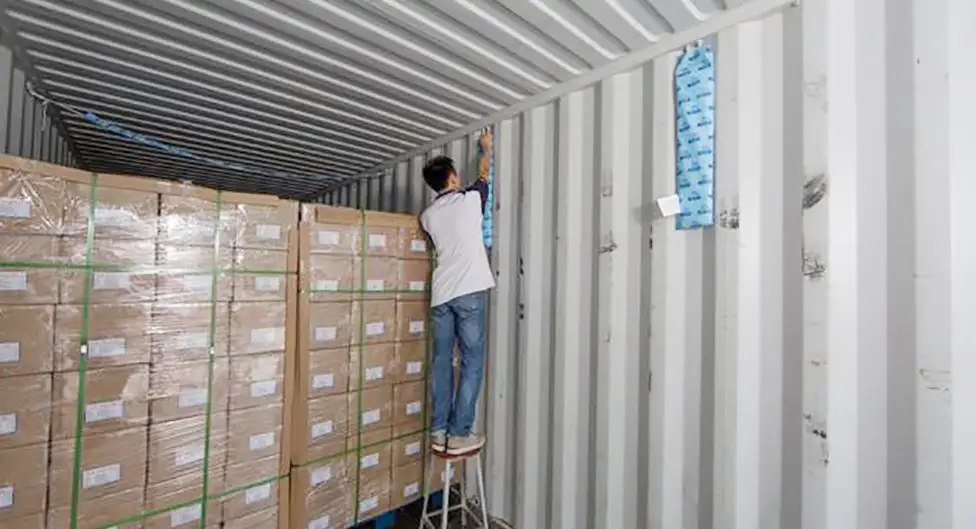
| Layer 3 | Shipping container | iHeir T-1000 container desiccant sticks | 8-10 per 20 ft / 10-12 per 40 ft | Absorb condensation inside the container |
Read down the table and one logic emerges. Layer 1 handles everyday moisture pickup after the goods leave the line, layer 2 the sealed space between sealing and opening, and layer 3 the water that keeps condensing at sea. The further down the chain you go, the harder it is for moisture to escape, so protection has to be pushed forward along the chain instead of being patched at the end.
3. Dosage by layer: store, carton, container
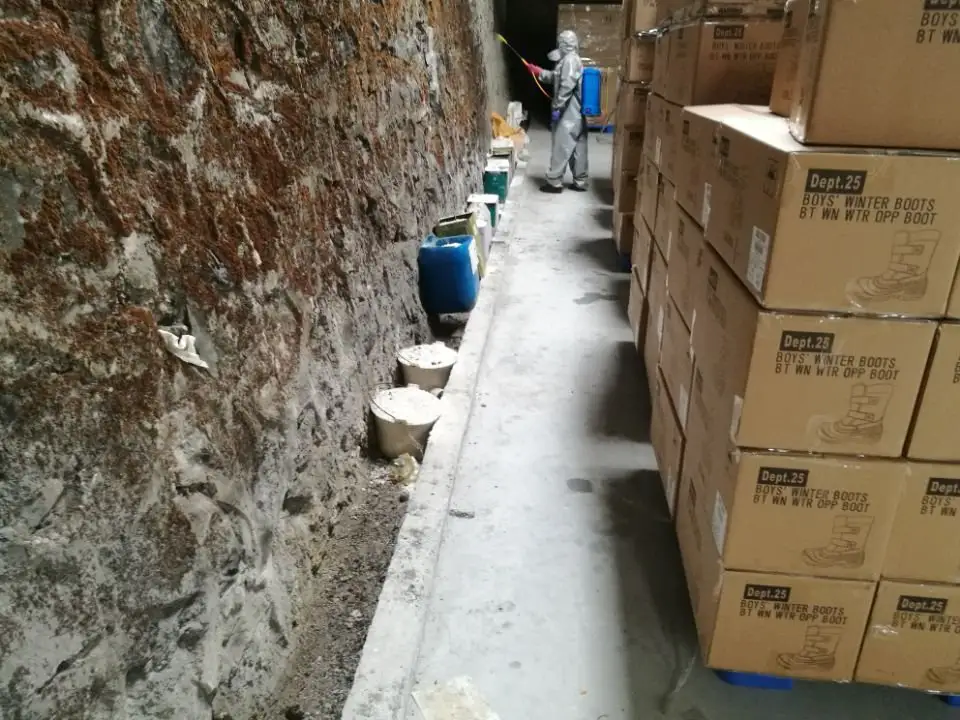
Layer 1, the finished-goods store. Bring relative humidity below 60% first, keep stock at least 10 cm off the walls and floor, and rely on dehumidifiers or drying packs in the humid season rather than opening windows. For enclosed spaces such as a store, a sample room or a bag warehouse, use iHeir CH-10: it absorbs over 200% of its own weight and holds 270-300 days, covering a whole humid season from a single placement.
Layer 2, inside the carton. Add a vapour-phase product at packing. iHeir-D paper carries 0.1-0.2 g of active ingredient per sheet and works by diffusing through the air in the carton, so it never has to touch the goods and is safe for hardware, appliances and garments that must stay dry. For odour-sensitive goods such as footwear, leather goods and textiles, use Power Pak tablets instead: they release their active ingredient within 72 hours of sealing and control odour at the same time.
Layer 3, the container. Match the desiccant to the container size with iHeir T-1000: 8-10 sticks for a 20 ft unit and 10-12 for a 40 ft unit, hung from the rails or hooks along the top and kept clear of the cargo. The absorbent core of T-1000 is a superabsorbent polymer, not a chloride-based salt, so it turns into a gel as it takes on water and cannot leak a corrosive brine onto metal parts or packaging.

4. Loading and hanging in practice
- Dry the wooden packaging first. Kiln-dry pallets and crates to a moisture content below 12% before loading. Wet timber is a sponge that travels with the shipment.
- Hang the sticks before loading. Fit them before the first pallet goes in rather than climbing over cargo halfway through, and fix them to the upper rails, never on top of the goods. Keep a gap between the cargo and the walls and never load to the roof, or condensing vapour has nowhere to go but onto the goods.
- Keep carton products off the bottom. Vapour-phase protection depends on diffusion, so a sheet crushed under the heaviest boxes performs worse; place it above or beside the goods.
- Re-seal with a fresh sheet. Any mid-journey inspection releases the vapour inside the carton; add a new sheet when re-sealing instead of reusing the old one.
5. Checking results and fixing responsibility
Each layer is checked a different way. Layer 1 is judged on humidity records: log temperature and humidity continuously and confirm during the humid season that readings stay below 60%. Layer 2 is judged on grading at opening: sample to the mould resistance standard and look at the inner liner, folds and seams where moisture lingers. Layer 3 is judged on the condition inside the container at destination: whether water is still standing on the walls and whether the sticks have hardened. When a claim comes in, identify which layer failed first: dry walls with mould only inside the carton points to layer 2, while standing water and soft cartons mean the chain between layers 1 and 3 has broken.
6. Common questions
Q: Can a desiccant replace a mould inhibitor, or the other way round? No. In a container the two work as a pair. The desiccant removes water vapour and pulls humidity down; the vapour-phase product suppresses spores that have already landed on the goods. With only a desiccant, a long voyage exhausts the absorbent and mould returns; with only a mould inhibitor, continuous condensation still softens the cartons.
Q: Where can I read more on condensation and desiccant quantities? The mechanism and how it varies with route is covered in our article on container rain and sea freight condensation. Container size is only the first input to the stick count; voyage length, moisture content of the goods and packaging breathability all move it, as set out in how much desiccant a container needs. The day-to-day side of store management is in warehouse mould prevention.
The point of export warehouse mould control is not picking the single strongest product, but closing the moisture source at each of the three layers: humidity control in the store, vapour-phase suppression in the carton and absorption inside the container. Run your current packing flow against the table above, find the layer that is missing, and fix that one first instead of adding more desiccant. Samples and minimum order details for iHeir T-1000, CH-10 and iHeir-D are available on request.