




 View Count:71
 Date:2026-09-28
How do you treat sanitary ware mould when the substrate may be ceramic, stone or plastic? The three fail in different ways, so one agent at one rate will always leave one of them short, and a rejected container takes the sea freight and the customs cost with it. Add iHeir-AM04 at 6-8% of glaze solids for ceramic, protect stone with iHeir-M300, and dose iHeir-ECO at 0.3-1.0% of part weight for plastic parts. This article covers the dosing point, rate and acceptance basis for each substrate.
1. Decide first whether the problem is the product or the installation
Humidity in a bathroom sits above 80% most of the year, and soap residue supplies nutrients, so mould will grow somewhere almost regardless. Where it grows decides who has to fix it. If the growth spreads evenly across the glaze, or shows at the interface between body and glaze, the cause is in the product and has to be solved at the glazing stage. If the growth sits only in joints, along the edge of the sealant, or in the internal corner between floor and wall, the cause is usually installation: sealant was closed over before it had cured, so moisture was trapped inside, and no antimicrobial glaze can compensate.
The second test is the substrate. Ceramic is a porous sintered body, so only the glaze layer can carry the function and nothing can be added inside the body. Stone, sintered stone and porcelain tile are dense blocks with low water uptake but open capillaries at the surface, so the work is surface protection and sealing the cut edges. Plastic parts are polymers, and the agent has to be compounded before moulding. The three routes cannot be substituted for one another.
2. Dosing point by substrate
The table sets out the substrate, the part, the product, the rate and the process stage, so it can be used as the first draft of a process card and a testing plan.
| Substrate / part | Carrier | Product | Rate | Added at |
|---|---|---|---|---|
| Basins, toilets, baths (top glaze layer) | Glaze slip | iHeir-AM04 nano antimicrobial agent | 6% of glaze solids gives 90% or better; 8% gives 95% or better | Glaze ball milling; added one hour before the end, or mid-cycle |
| Stone, sintered stone and tile faces and cut edges | Surface and cut edge | iHeir-M300 waterproofing agent | Active content 14-16%; for in-system use, 1 part agent to 4 parts solvent | Applied to machined faces and cut edges to block rising damp |
| Seats, tank internals, cabinet panels | Polymer matrix | iHeir-ECO plastic antimicrobial agent | 0.3-1.0% of part weight | Mixing or plastifying stage; wet-service parts to the upper end |
| Finished goods: joints and around hardware | Surface | iHeir-QF anti-mildew cream | Reacts at room temperature; pH compatibility up to 9.5 | Local treatment before assembly and packing |
| Carton packing and full-container export | Packaging layer | iHeir-D vapour-phase product / T-1000 desiccant sticks | 0.1-0.2 g active content per sheet; 8-10 sticks for 20 ft, 10-12 for 40 ft | Placed before sealing; sticks hung from the roof rails |
Five rows, one conclusion: sanitary ware is handled on four levels — glaze, surface, matrix and packaging. Decide which level the growth is on before choosing a product; get the order wrong and the dosing is wasted.
3. Ceramics: the agent goes into the glaze, measured on solids
On ceramics the nano agent is added straight into the glaze slip. At 6% of glaze solids, the finished ceramic reaches 90% antimicrobial efficiency or better; at 8% it reaches 95% or better. For a first trial, a new customer is advised to start 10% above the chosen figure. AM04 is a white inorganic powder with an average particle size below 30 nm, and the relationship between the rate and the result is reasonably stable.
One detail is easy to get wrong: when the powder goes in. The normal route is to ball mill the base materials as usual, raise the water addition by 5-10%, and add the agent one hour before milling ends so the two finish together. Where conditions allow, mid-cycle or late addition is better still: mill for half the time, add the agent, then mill for the other half, which disperses it more evenly. The nano material takes up water strongly, so if flow falls off, add a little dispersant rather than water. Two formulation points are worth flagging: AM04 is a fairly strong flux, so after an 8% external addition you need extra calcined kaolin or alumina to hold the firing temperature, or reduce low-temperature fluxes such as zinc oxide in the base recipe; and it promotes colour development, so check the effect before running a coloured glaze.
4. Stone and sintered stone: protection at machined faces and cut edges
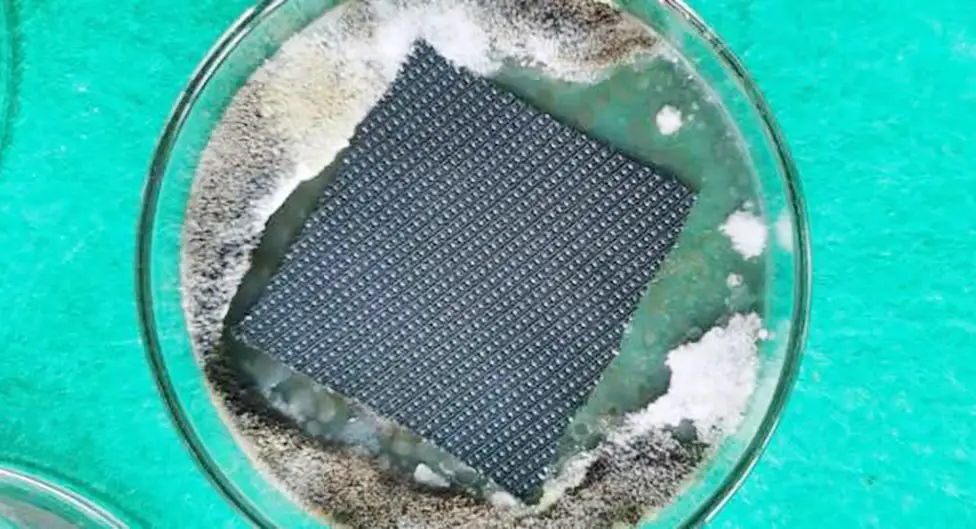
The problem on stone, sintered stone and tile is not growth in the material itself; it is water coming up from the back and in through cut edges, carrying alkali and impurities to the surface as efflorescence and mould staining. Two places matter: machined faces and cut edges. Use iHeir-M300 for surface protection; the active content is 14-16%, and for in-system use it is diluted at 1 part agent to 4 parts petroleum-based solvent and processed with the substrate. Site work needs the same step, especially at worktop joints and floor seams: once the moisture content comes down, the efflorescence and staining fall together.
One boundary has to be clear: M300 blocks the moisture path. It does not kill growth that is already there. Clean the growth off, let the stone dry, and protect it afterwards; reversing the order seals the growth inside.
5. Plastic parts and the packing stage
Seats, tank internals and cabinet panels are dosed internally: add iHeir-ECO at 0.3-1.0% of part weight at the mixing stage. Parts in constant contact with water and detergent go to the upper end; dry-zone trim can sit at the lower end. If growth is already visible in a joint at assembly, treat locally with iHeir-QF, which reacts at room temperature and needs no heating equipment.
Packing is where export orders are most often lost. Separate ceramic pieces with anti-mould paper as they are cased; iHeir-D carries 0.1-0.2 g of active content per sheet, so work out the number of sheets from the carton volume. For full-container export, match the desiccant to the container: 8-10 sticks for a 20 ft unit and 10-12 for a 40 ft unit, hung from the roof rails rather than laid on the top cartons. Ceramic itself does not take up water, but cartons, EPE foam and timber pallets do, and the growth appears on the packaging first.
6. Common questions
Q: How do you verify an antimicrobial glaze after firing? The test piece has to mimic the real process. Use a sample about 5 by 5 cm with roughly 3 g of glaze, applied by the same spray or dip route used in production, ideally with some glaze run at the edge, then grade the antimicrobial result. A small pressed disc fired outside the real glazing route gives data of no value.
Q: What is the difference between doing the whole glaze layer and only the top layer? Treating the whole layer performs well but takes more than 200 g of agent per piece, so it costs more. The usual route is to add the agent to the top glaze layer only, balancing performance against cost. Both routes are in use, so fix the product position first and then set the rate.
Q: Should growth in joints and sealant be treated? That is an installation issue: sealant closed before it cures, or a corner that holds water, will grow mould regardless. The finished-goods side can make sure local surface treatment and packaging protection are solid; the related basis is in antimicrobial control for toilets and bathroom fittings.
Sanitary ware mould control comes down to splitting the substrates: ceramics by glaze solids, stone by surface protection, plastic parts by mixing-stage dosing, with packaging and container humidity as the final layer. For the neighbouring case see efflorescence and mould on stone and tile. Samples and minimum order details for iHeir-AM04, iHeir-ECO, iHeir-QF and iHeir-M300 are available on request.


