




 View Count:12
 Date:2026-11-09
How do you keep a wooden door free of mould? Most plants put the effort into the lacquer and the packing, while the mould actually starts at the core board’s end grain and the lock holes. The routine is a 1:40 bath, the core board fully submerged to 15%-20% weight gain (about 5-10 minutes), cutting after the soak, and a touch-up of the end grain and lock holes with the same liquor using iHeir-M5 immersion type bamboo and wood fungicide. This article covers mixing, touch-up and stacking.
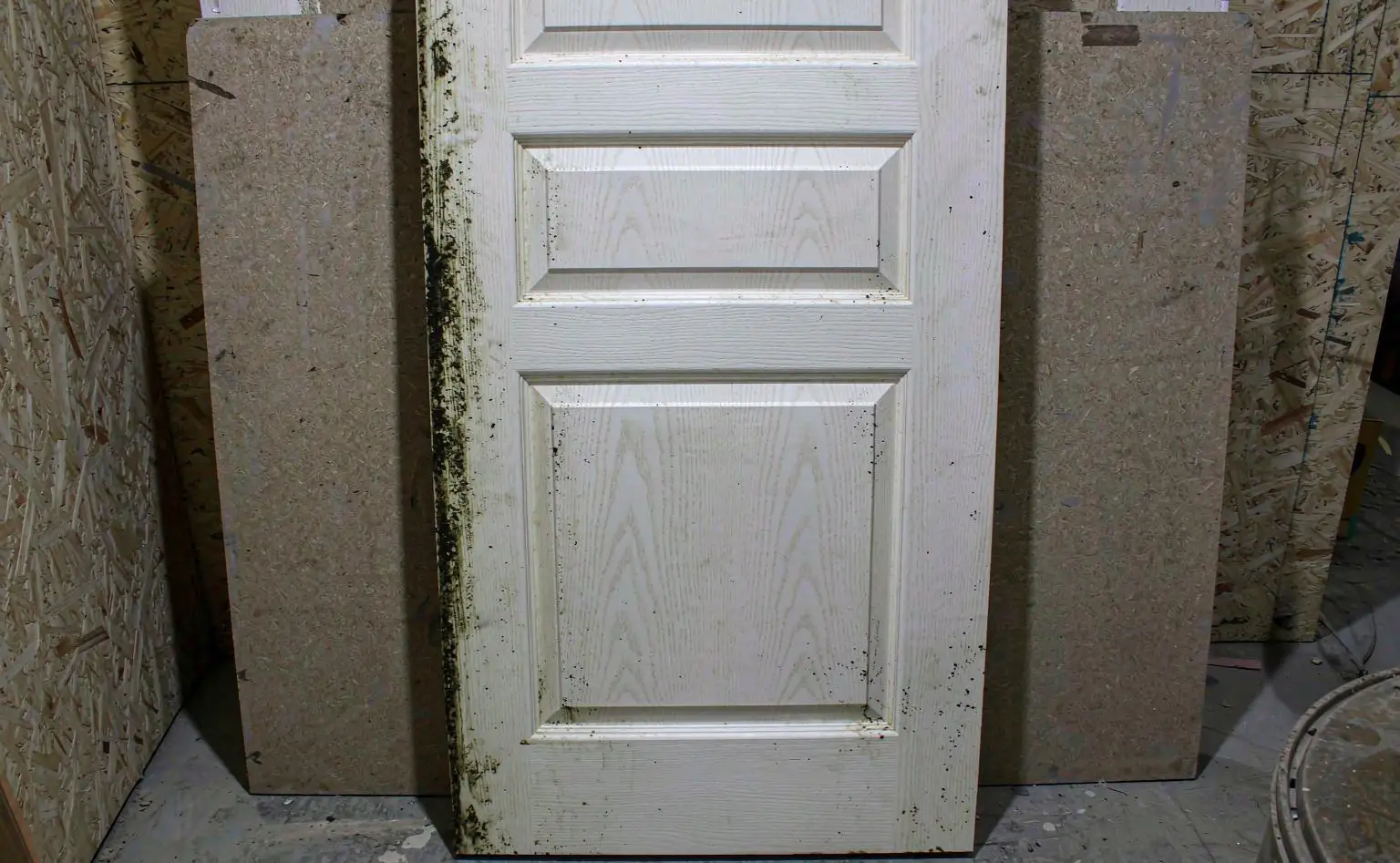
1. Mould enters at the end grain and the lock holes, not the lacquer
Take a door apart: core board, stiles, architrave, face panel and hardware. Lacquer does not feed mould; what takes water is the end grain, the lock holes, the hinge slots and the grooves.
End grain is the open end of the timber. The top and bottom edges of a core board are cross sections with every fibre end open, so they take water fastest. Once the door is hung, those ends are closed off, so moisture goes in and cannot come out and the mould starts on the inside face.
Lock holes and hinge slots get cut on site. Doors usually leave the plant with pilot holes only, and the lock is bored out at installation; hinge slots are often cut on site too. Everything newly cut is bare timber with no lacquer and no treatment, which is an open door for mould.
Why the lacquer alone does not work. A film stops surface water but not water drawn in at the end grain. In a humid season the ends swell, the lacquer blisters, then mould comes out of the seam.
2. Core board, frame and hardware each take a different step
The table lines up the core board, the frame and mouldings, the lock holes and the packing. Timber parts are controlled by soak weight gain, fresh cuts by touch-up, and one does not replace the other.
| Part | Material | Treatment | Stage | Control point |
|---|---|---|---|---|
| Core board | Plywood, solid-wood strips, honeycomb | iHeir-M5 1:40 soak, 15%-20% gain | Whole board before cutting | Fully under the surface, 5-10 minutes |
| Stiles and architrave | Solid wood, finger jointed | Same bath or brush with the same liquor | Before cutting | End grain and mortises covered |
| Lock holes, hinge slots | Freshly cut timber | Same liquor, two brush coats | After boring, before hardware | Walls and bottom of the hole |
| Hardware | Lock body, hinges, bolts | No contact with the liquor | Fitted after drying | M5 is acidic, keep it off metal |
One boundary. The soak handles the inside of the timber, the touch-up handles the surfaces opened by machining. Soak without touch-up and the lock holes and ends still spot; touch up without soaking and the moisture inside the board is untouched, so the door swells again after one wet season. Do both.
3. Mixing 1:40 and holding the 15%-20% weight gain
Mix the bath at 1:40: 5kg of concentrate to 100kg of water, stirred before use. The dose is not set by counting doors, it is set by weight gain: soak to 15%-20%, usually 5-10 minutes, longer for dense timber.
How to tell it is done. Weighing is the direct method: weigh a few boards before the soak, drip-dry and weigh again. Without a scale, judge by cut face and feel, since treated timber darkens and feels heavier, but acceptance should still be by weight.
Everything has to go under. Hold the load down with a weight bar or grille, and do not pack the tank so full that boards touch and the liquor cannot reach every face.
Not an iron tank. iHeir-M5 is acidic and must not contact metal or be mixed with alkaline materials. Use a plastic tank and plastic or rubber-covered bars rather than bare steel, and never run an alkaline auxiliary into the same bath.
Shake the drum first. A drum that has stood will show floating matter on top, which is normal; shake it before use. The concentrate is high in solids and sensitises some skin, so wear rubber gloves and do not fish boards out by hand.
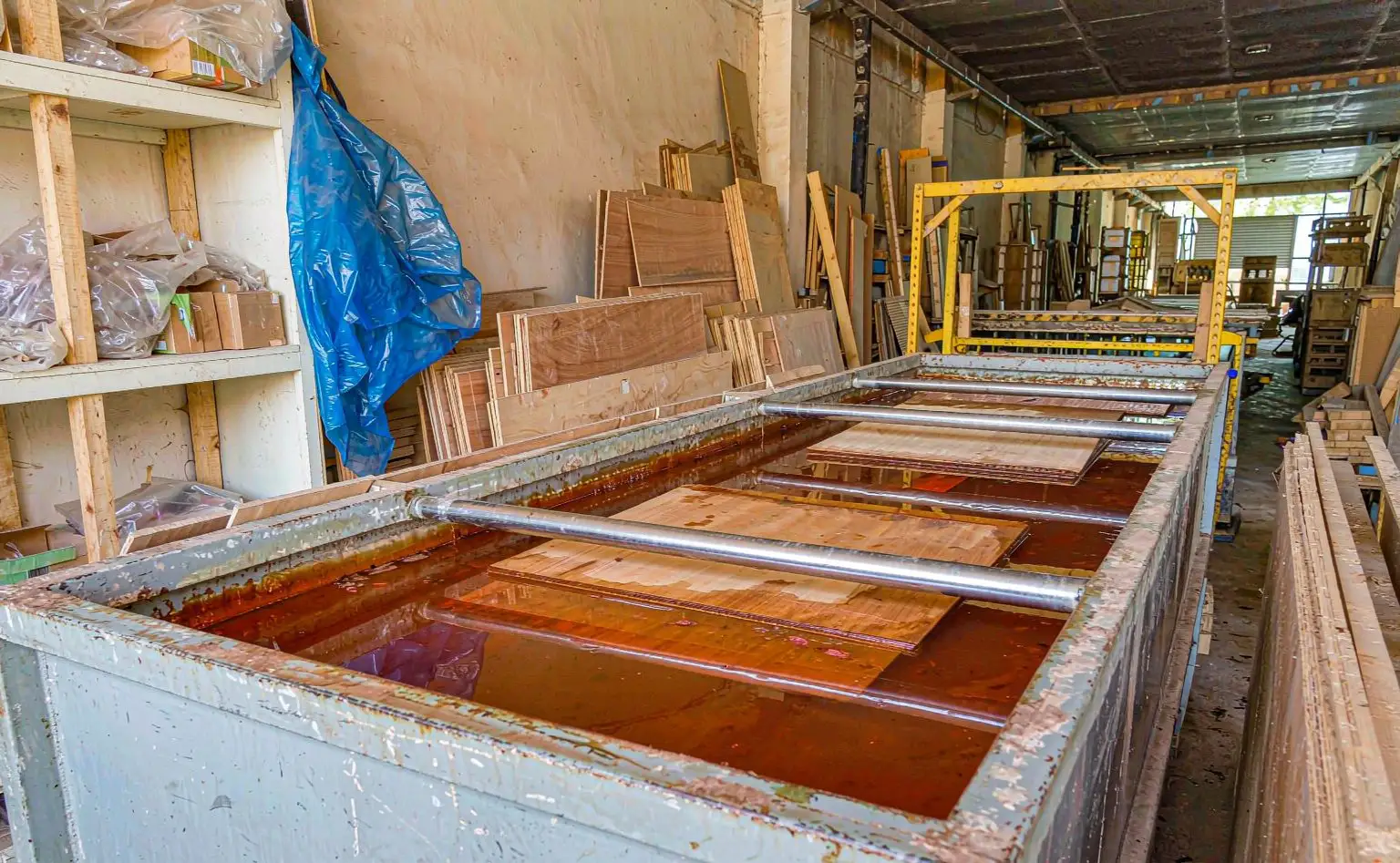
4. Cut after the soak, then touch up every fresh face
Sequence matters: soak the whole board, then cut. Reverse it and every cut edge is untreated, which throws the soak away.
Why soak first. A whole board soaks through and the timber inside is continuous; after cutting only the new perimeter is bare and one coat covers it. Cut first and thin boards distort in the bath while thick ones never soak through.
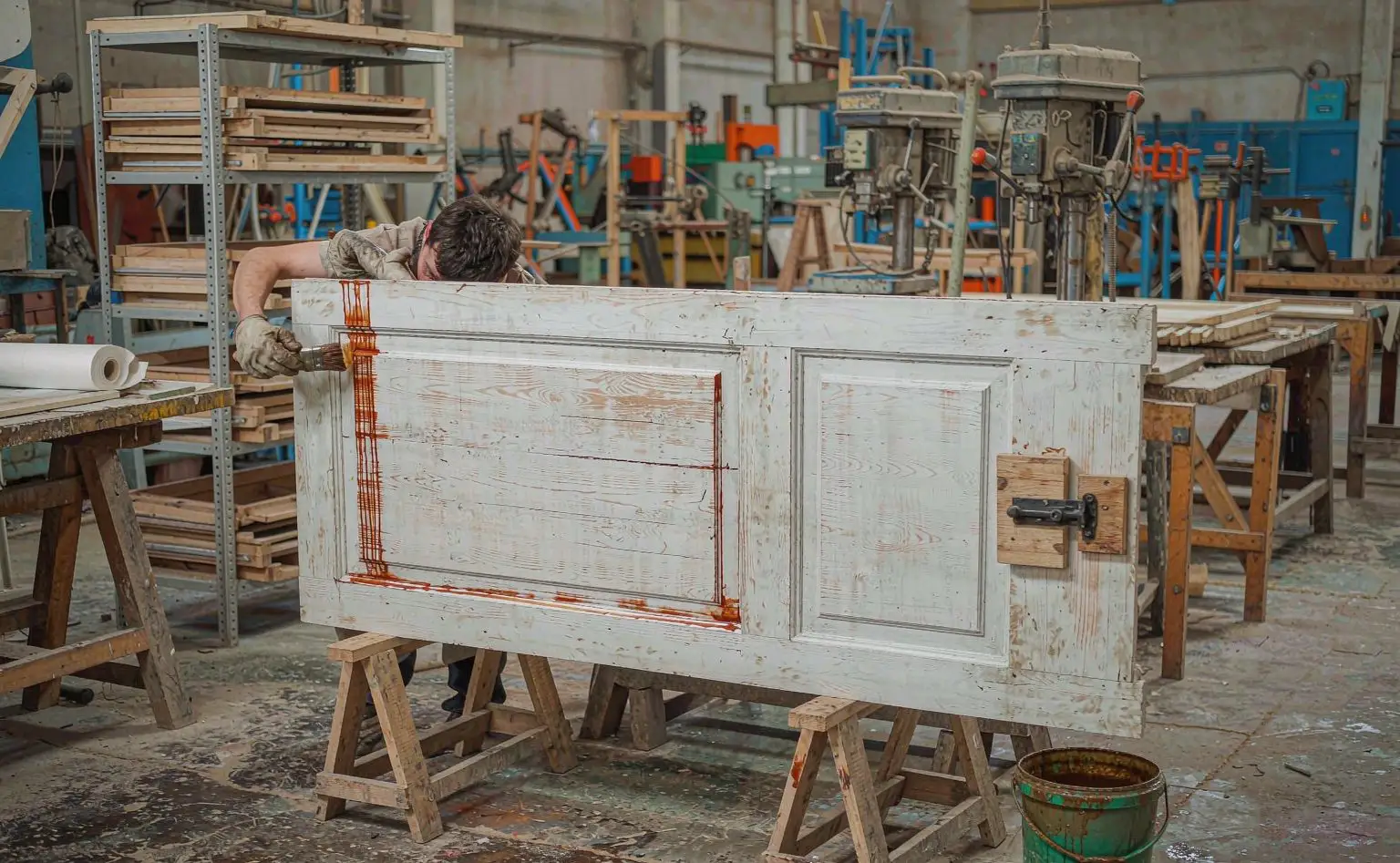
How to touch up. Brush with the same liquor, two coats on end grain with the first dry before the second, and use a brush or small roller to reach the walls and the bottom of lock holes. Let it dry before fitting hardware.
Dry before the next step. Drip-dry, then air-dry or sun-dry, and hold the moisture content to the equilibrium value for the market the door ships to, which differs between north and south. Laminating a face onto a board that is still wet seals the water in and invites the mould inside.
Facing and edge banding. The face has to be dry and flat before laminating, and the edge banding adhesive must be a full bead with no void. A void holds water and the mould starts in the banding seam. For the broader comparison of soaking and spraying see wood anti-mould agents in practice.
5. Drying, stacking and container loading
Once the boards and leaves are soaked, drying and stacking decide the outcome. Stack them tight in a damp yard and the best soak is wasted.
Leave air channels. Put stickers between boards in vertical lines, keep the stack 10cm off the floor on bearers and 10cm off the wall so air moves.
Control store humidity. Hold the store below 60% RH, run dehumidifiers in the wet season and curtain the doorway. On a floor that sweats, add a barrier under the stack.
Check before loading. Inspect every leaf at the end grain, the lock holes and the bottom rail before it goes into the container, and pull anything darkened or whitened. Line the container, hang desiccant sticks and close the doors properly. For the anti-theft door version of the same job see panel furniture that went mouldy and for the board side see treating mouldy boards.
6. Questions on cores, mix strength and touch-up
Q: Can an MDF core be soaked too?
No, MDF swells when it takes water. On that core, brush the end grain and hole positions after cutting, or spray the perimeter. Plywood and solid-wood strips can be soaked, because they hold their shape.
Q: Can the bath be mixed stronger than 1:40?
Keep to 1:40. A stronger bath leaves the face tacky, slows drying and blisters the laminate; extra protection comes from hitting the weight gain, not from concentration.
Q: The soaked boards have distorted. What now?
Check soak time and moisture content first, because over-soaking and uneven drip-drying both distort. Dry thin boards flat under a grille and stand thick ones on edge with airflow. Do not force a distorted board back, because the stress comes out again in the finished door.
Q: The lock is bored on site, so is the earlier work wasted?
No. Only the ring of timber around the hole is broken. Brush those walls with the same liquor before fitting the lock.
Four points to take away: mix the bath at 1:40, five kilos of concentrate to a hundred kilos of water, submerge the core board fully to 15%-20% weight gain in about 5-10 minutes in a plastic tank away from metal and alkaline auxiliaries; soak the whole board before cutting, then brush end grain twice and take the same liquor to the bottom of every lock hole and hinge slot; drip-dry and air-dry to the equilibrium moisture content of the destination market, sticker the stack 10cm off floor and wall and hold the store below 60% RH; grade mould resistance to GB/T 24346-2009 and check the finished door to GB/T 29498 at the ends and holes. A kilogram of concentrate goes out for a trial, with MOQ on the iHeir-M5 product page.


