




 View Count:50
 Date:2026-09-07
“Why are my cartons getting moldy?” and “How do I deal with mold spots on printed boxes?” are the two most common questions we hear from packaging plants, printing houses, gift-box factories and export traders during the rainy season and the long sea-freight window. Corrugated cartons are made from recycled pulp, so they absorb moisture much faster than plastic; printed gift boxes are coated with ink and varnish on the outside, and once moisture gets in, the ink film wrinkles and mildew bleeds through. The customer opens the box and sees mold — the whole batch is rejected or has to be reworked. This article is written for carton plants, printing houses, gift-box makers and export traders: how to identify carton mold, what humidity level to control, how printing and varnishing affect anti-mold, and how to roll out an export packaging anti-mold plan. We only do physical moisture control at the warehouse and outer-packaging level — no spraying, no fumigating on the carton or box itself.
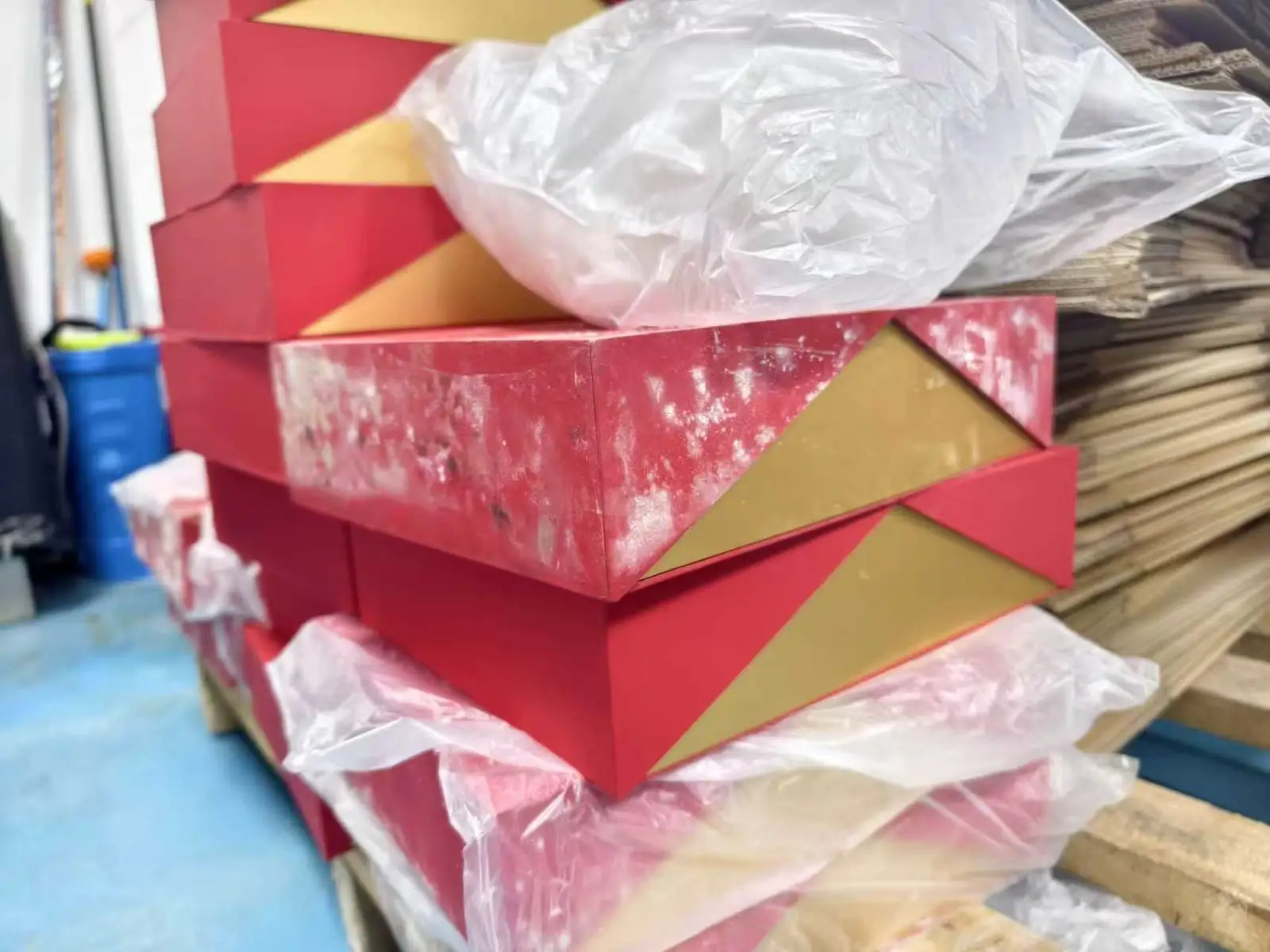
1 Why do cartons and printed boxes mold? Three moisture paths
Carton and box mold needs three conditions at the same time: water (high humidity), nutrition (pulp fiber), and temperature (20–35°C is the most active range). Cardboard itself is a great food source for mold — once moisture arrives, airborne spores land and grow fast. There are three main moisture paths:
- Warehouse damp + carton absorption: during the South China rainy season or the spring humid spell, the floor and walls sweat. Cartons placed directly on the floor or stacked against the wall pick up moisture first. The corrugated flute absorbs water faster than the liner, so box moisture can climb from 8% to 14%+ in just a few days.
- Printing & varnishing reduce the moisture barrier: the ink and water-based / UV varnish on a gift box are supposed to “waterproof” it, but uneven varnish, pinholes, or thin ink at corners become hidden moisture inlets. Once water gets in, it sits between liner and flute — invisible from outside, mold already growing inside.
- Sea-freight container rain: the day-night temperature swing inside a 20ft or 40ft container can hit 15–25°C. At night, water condenses on the inner wall and drips onto the cartons. The outer liner wets first, then moisture slowly migrates inward. Across a 20–40 day ocean voyage, humidity swings repeatedly between the origin and destination ports, so the cartons are essentially “breathing” the whole trip.
A simple way to judge: if a corrugated carton feels soft and no longer gives a crisp “crack” sound when squeezed, or the liner is wrinkled and the corners are dented, it has already absorbed moisture. If you see ink blistering, white haze, or grey-green spots on a gift box, that is active mold. One warning: in the early stage, mold on a carton may not be visible from the outside, but the moment the customer opens the box the musty smell hits and the paper turns black — the whole batch is scrap.
2 How to identify carton mold? Return-cause breakdown
There are four most common return reasons for moldy cartons, and you can match them back to your own line:
- White / green mold spots: white fluffy, green or grey-black patches on the box surface that cannot be wiped off and turn to powder when rubbed — that is active mold, not “water stain” or “varnish haze”.
- Ink blistering / wrinkling: tiny blisters and wrinkles on the printed surface mean moisture has already penetrated under the ink and is “pushing” it off the paper.
- Musty odor: a “damp basement” or “earthy” smell the moment the box is opened is mold VOC — the goods inside pick up the same smell, which is fatal for food, cosmetics and gift packaging.
- Paper turns black and soft: the corrugated flute turns black, loses stiffness and crushes. The carton loses all protective function, and the return trip itself causes further damage.
For return-cause analysis, group mold by stage: ① in-plant inventory mold (warehouse humidity); ② customer warehouse mold (their problem); ③ in-transit ocean mold (container humidity); ④ end-user mold after opening. Each stage has a different root cause and a different fix — do not blame everything on “carton quality”. The principles in Warehouse Mold Prevention apply to cartons and gift boxes equally.
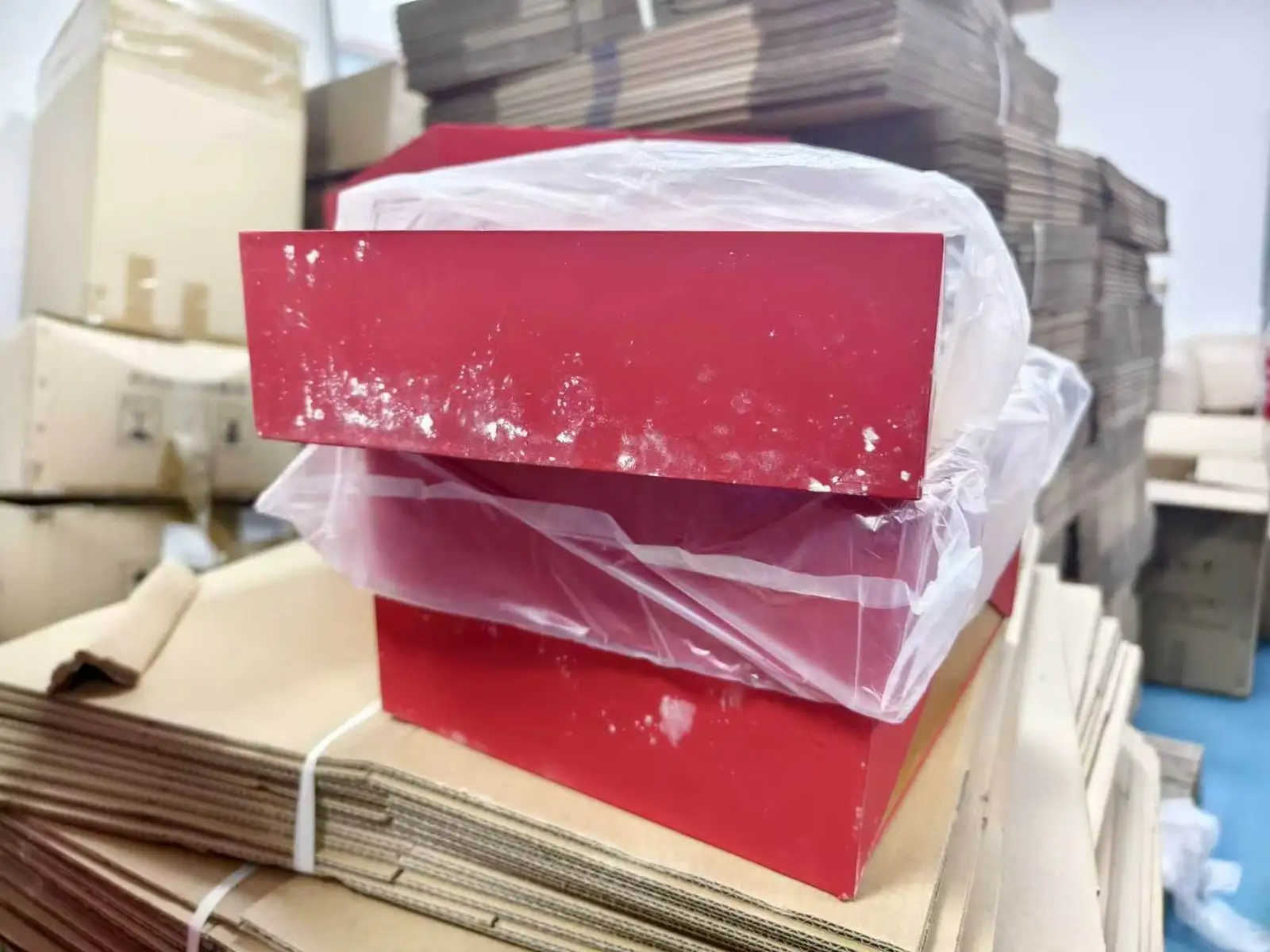
3 What humidity should a paper warehouse hold? Stacking & spacing
The single most important metric is relative humidity. The working number is: keep the corrugated warehouse below 65% RH; for printed gift boxes, festival gift packaging and any paper product where appearance matters, hold it at 55–60% RH. Temperature should be ≤25°C and kept stable — a sudden temperature drop makes water condense on the box surface, which is local wetting in disguise.
Three zones to monitor: ① doors, windows and corners — these are the first to sweat; ② stacking layout — cartons must be on pallets, 15–20 cm off the floor and 20–30 cm off the wall, with airflow gaps between stacks; ③ spot-check — never judge by outer look alone, open a few boxes and check the inside board strength and smell; outer-dry / inner-damp is invisible from the outside.
On stacking: the bearing direction and stacking layers of a corrugated carton are tied to its edge crush strength, never stack above the labeled load. If the bottom layer gets damp and the board softens, the whole stack collapses and the whole batch is scrap. Printed gift boxes and lightweight gift packs should be stored separately and spot-checked separately — do not mix-stack with raw corrugated cartons. Gift boxes crush easily and pick up odor easily, and a single damp bottom carton can take down a whole stack.
4 How do printing and varnishing affect anti-mold? Process points
Printing and varnishing on a gift box have a big impact on anti-mold performance. Three things to lock down:
- Ink selection: water-based ink absorbs more moisture than solvent-based ink, prioritize UV ink or water-resistant ink for export boxes. If you must use water-based ink, make sure the varnish layer fully covers it. If water-based ink is not fully dry before varnish is applied, the trapped moisture becomes a perfect mold bed.
- Varnish coverage: for water-based or UV varnish, make sure corners, score lines and die-cut edges are fully covered — those are the spots most often missed. A flashlight held at a low angle is the fastest QC tool to find missed varnish.
- Water-based glue: the water-based white latex or starch glue used for laminating gift boxes is a classic mold hotspot if not fully dried. After lamination, dry for 8–12 hours before the next process; otherwise the moisture in the glue is sealed inside the board and mold goes wild the moment spores land.
One more often-overlooked step: die-cut paper dust — fine pulp dust on die-cut edges is ready-made food for mold. Before packing, blow the boxes with an air gun or roll them with a sticky roller; then put them in the outer carton.
5 Export packaging anti-mold plan: the 4-piece kit
Export anti-mold is not one product but a combination. From real customer experience, here is the 4-piece kit we recommend, ready for carton plants and export traders to deploy:
- ① Anti-mold packaging paper (inner wrap of the gift box): a layer of anti-mold paper between the gift box and the outer corrugated carton physically separates the printed box from potential mold sources — see How to Choose Anti-Mold Packaging Paper.
- ② CH-10 anti-mildew drying and deodorizing pack (carton space moisture absorber): placed inside the outer corrugated carton, absorbs the extra moisture picked up in warehouse and sea transit, only contacts the outer carton air space, not the contents. See CH-10 Anti-Mildew Drying & Deodorizing Pack.
- ③ Power Pak anti-mold tablets (mold-spore suppression): placed in the gift box inner space or near the box liner, continuously releases anti-mold factor to suppress spore germination, ideal for long ocean transit. See Power Pak Powerful Anti-Mildew & Deodorizing Tablets.
- ④ Carton tape + stretch wrap (secondary sealing): seal the outer corrugated carton with carton tape, then wrap 1–2 layers of stretch film around the whole box, to reduce moisture ingress through carton seams. The cheapest and most under-rated step.
In one customer case, a Gift Box Exporter from Guangdong shipping mid-autumn gift boxes to the US used no anti-mold paper in June 2024 during the rainy season, 30% of an 8,000-piece batch arrived at the Port of LA with visible mold, the whole batch was written off plus an emergency air-freight return — losses above RMB 600,000. In 2025 the same product line switched to the “anti-mold paper + CH-10 + Power Pak + stretch wrap” kit, 12 batches across the year landed with under 0.5% mold rate (the industry-accepted target for a 30-day ocean voyage is ≤1%). Gift-box mold control also benefits from the gift-pack-specific experience in Mooncake Box Mold Prevention.
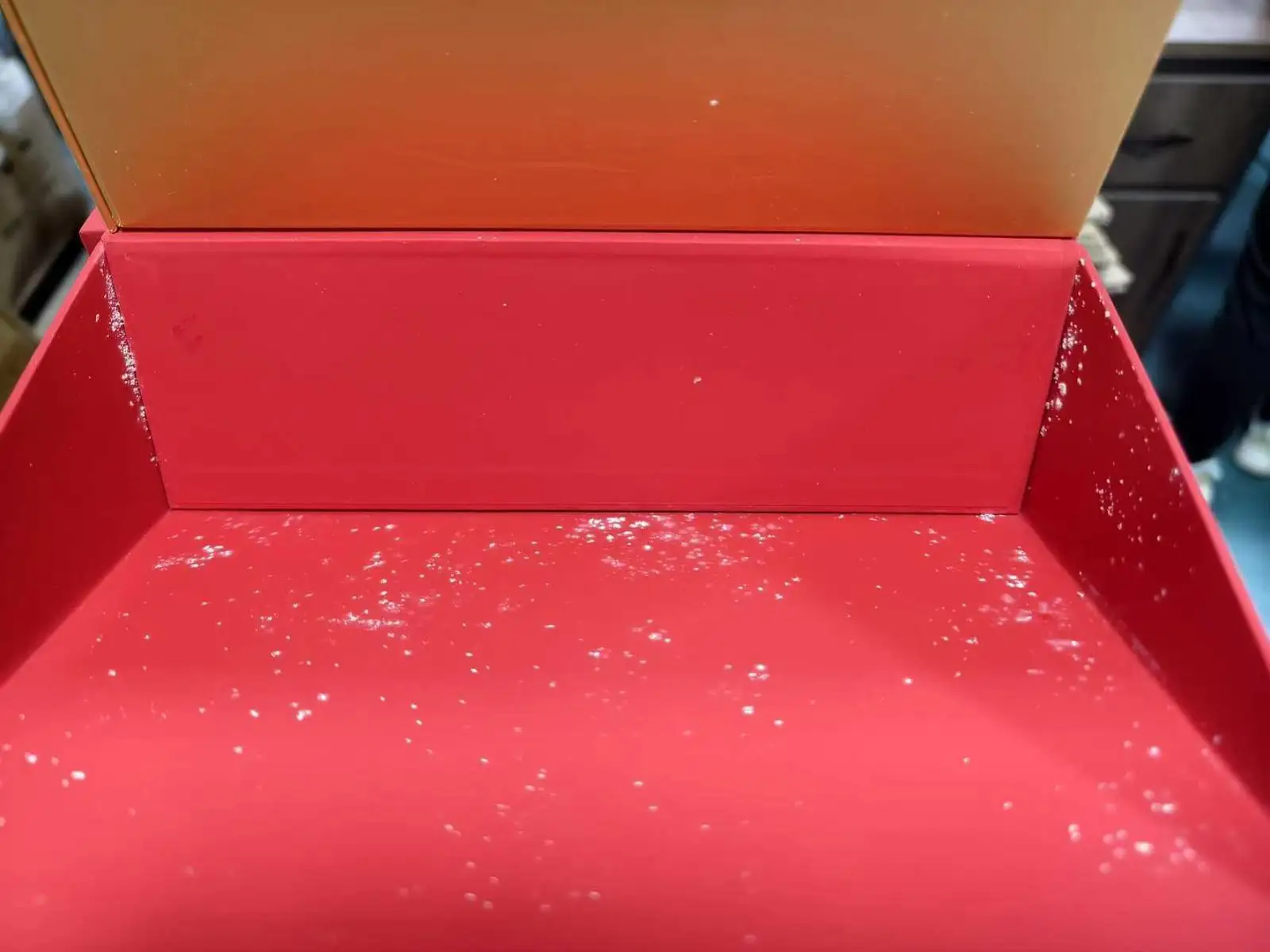
6 How to control moisture in ocean containers? Stacking & isolation
Container moisture control is the “last mile” of export packaging — if the container humidity goes wrong, all the work before is wasted. Three things to lock down:
- Container inspection: before loading, check that the inner wall is dry, no seepage, no odor, no residue from the previous shipment. Refuse any container with water beads or mold on the inner wall — container-side moisture will ruin the whole load. Container moisture control principles are covered in Container Moisture & Mold During Shipping.
- In-container desiccation: based on container size and voyage length, hang 4–6 T-1000 desiccant sticks + 8–10 CH-10 packs in a 20ft container, hung on the container’s wall rings, not in direct contact with the cartons; double the dose for a 40ft high-cube. For ocean voyages over 30 days, add Power Pak inside the cartons as well.
- Stacking and isolation: place a wooden pallet + a layer of plastic moisture barrier film under the bottom row of cartons; keep 10–15 cm between cartons and the container wall for airflow; do not stack to the ceiling, the top of the container is where condensation is worst, leave 20–30 cm of headroom for safety.
Board-based packaging is even more moisture-sensitive, and the humidity control logic in How to Treat Moldy Boards applies to cartons too — the core idea is the same: keep water out of the box, and pull water out of the box. After loading, cover the whole container door with PVC moisture-barrier film and seal it with tape to further reduce “container rain” ingress through the door.
7 FAQ
Q1: Can a moldy carton still be used?
For light mold (surface white spots, board strength not yet compromised) you can clean and re-pack; for moderate to heavy mold (ink blistering, black board, musty smell), scrap it — mold VOCs on a moldy carton cannot be fully removed, and the second-use risk is too high.
Q2: Can the anti-mold tablet / paper touch the contents directly?
No. Anti-mold tablets and desiccants are placed in the outer carton air space or the gift-box outer wrap only, not in direct contact with food, cosmetics, electronics or any inner product. The only layer that touches contents directly is food-grade barrier packaging (e.g. aluminum foil pouches).
Q3: Which is more important — anti-mold paper or desiccant?
They are not in conflict. Anti-mold paper physically isolates the mold source; desiccant absorbs extra moisture. Use them together for best results. If budget is tight, prioritize the paper; if budget allows, run the full 4-piece kit.
Q4: What EU standards do export cartons need to meet?
The carton itself must meet EU Packaging Directive 94/62/EC (heavy metals and recyclability); if the end customer is food packaging, it must also meet EU Regulation 1935/2004 for food contact materials; anti-mold tablets need a REACH declaration. Ask the additive supplier for the relevant reports before shipment.