




 View Count:3
 Date:2026-11-11
Can cycling jersey mould be prevented? The spots turn up at the underarm, along the back panel seam and around the hangtag, the fabric itself looks fine, and the bag opens to a musty smell. The routine is iHeir-BJ textile mildew inhibitor at 2%-3% o.w.f. on dry fabric weight in a 21-50C low-temperature bath, the finished jersey dried through before bagging, and one iHeir-D vapour sheet at 0.1-0.2 g of active in each bag. This article gives the bath, the drying and the bagging.
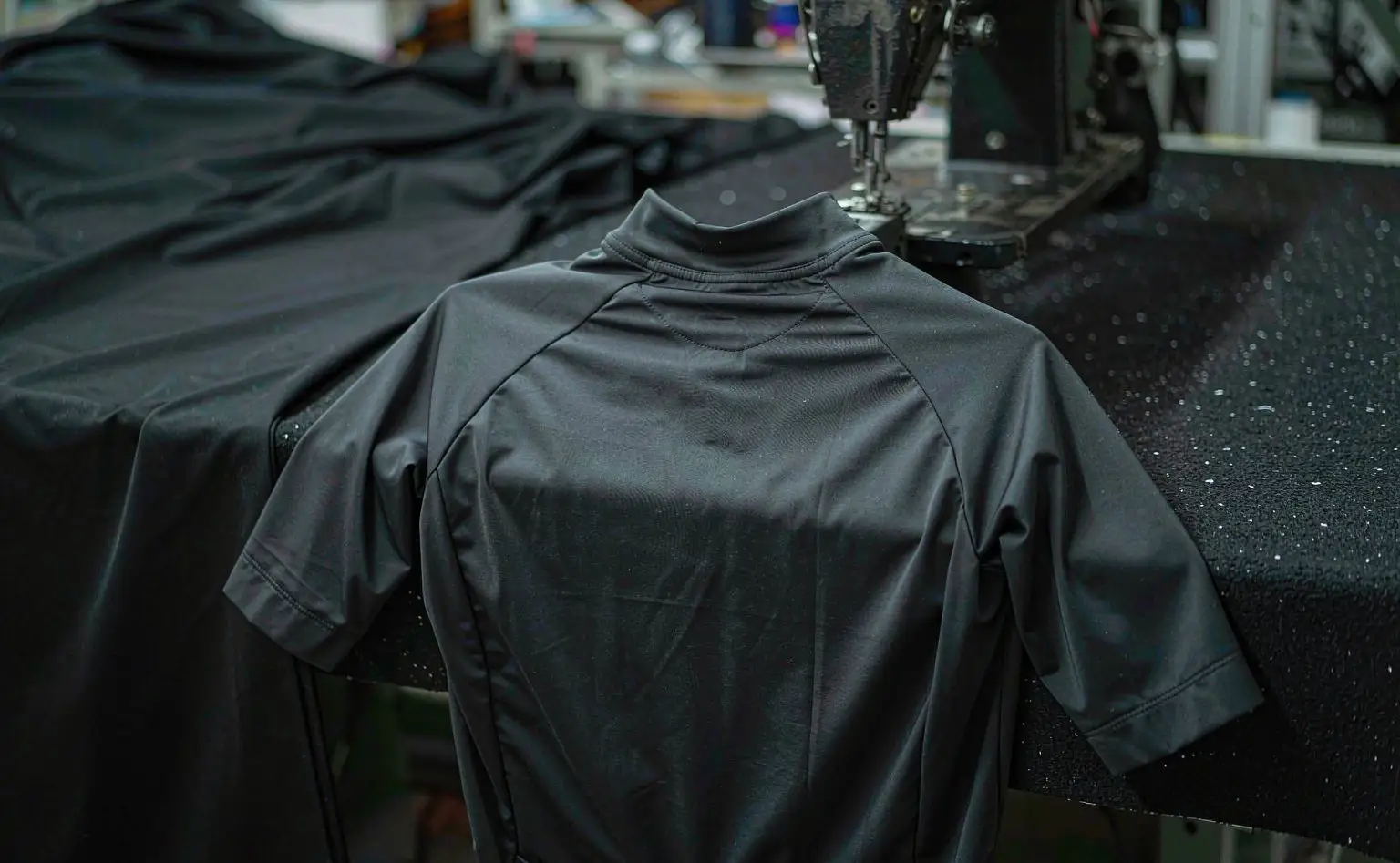
1. The spots appear at the underarm, the back seam and the tag, not on the front panel
Take a jersey apart: stretch polyester body, mesh panels at the underarm and back, bonded tape at the cuff and placket, hangtag and care label, poly bag. What moulds is the fabric and the paper tag; bonded tape and its adhesive film are usually the last to go.
The underarm goes first. It is a seam, and the stitch line holds sewing oil and sweat; mesh is open enough to take water in and hold it. A cut panel left overnight on a bench shows grey-white spots at the seam by the next shift.
The back panel is two layers. Double-layer back construction traps a layer of air between the two plies. Moisture goes in and does not come out, so the front looks clean and the reverse is a sheet of spots.
The tag takes water hardest. Paper hangtags and care labels absorb first, pulling water out of the bag air and releasing it slowly into the fabric.
2. Fabric, garment and bag are counted on two different bases
The table lines up the fabric, the finished garment, the tag and the bag. Fabric is counted as o.w.f. on dry weight, vapour paper in sheets, and the two do not convert.
| Part | Material | Product and level | Stage | Control point |
|---|---|---|---|---|
| Body and panel fabric | Stretch polyester, mesh | iHeir-BJ 2%-3% o.w.f. | Dye or stenter bath | 21-50C, pH 4.5-8.5 |
| Finished garment | Sewn piece | Dried to moisture target | Before bagging | Seams and plies dry |
| Hangtag and care label | Coated paper, nonwoven | Stored dry | Tagging | No damp, no yellowing |
| Poly bag | PE / OPP | iHeir-D 1 sheet 0.1-0.2 g | Bagging | Seal the bag mouth |
One boundary. iHeir-BJ sits in the fibre and keeps working after the garment leaves the plant; drying deals with the water carried in by sewing and pressing; the vapour sheet covers the air in the bag and finishes when the bag is opened. Skip the fabric and ten sheets will not hold back what is already in the yarn.
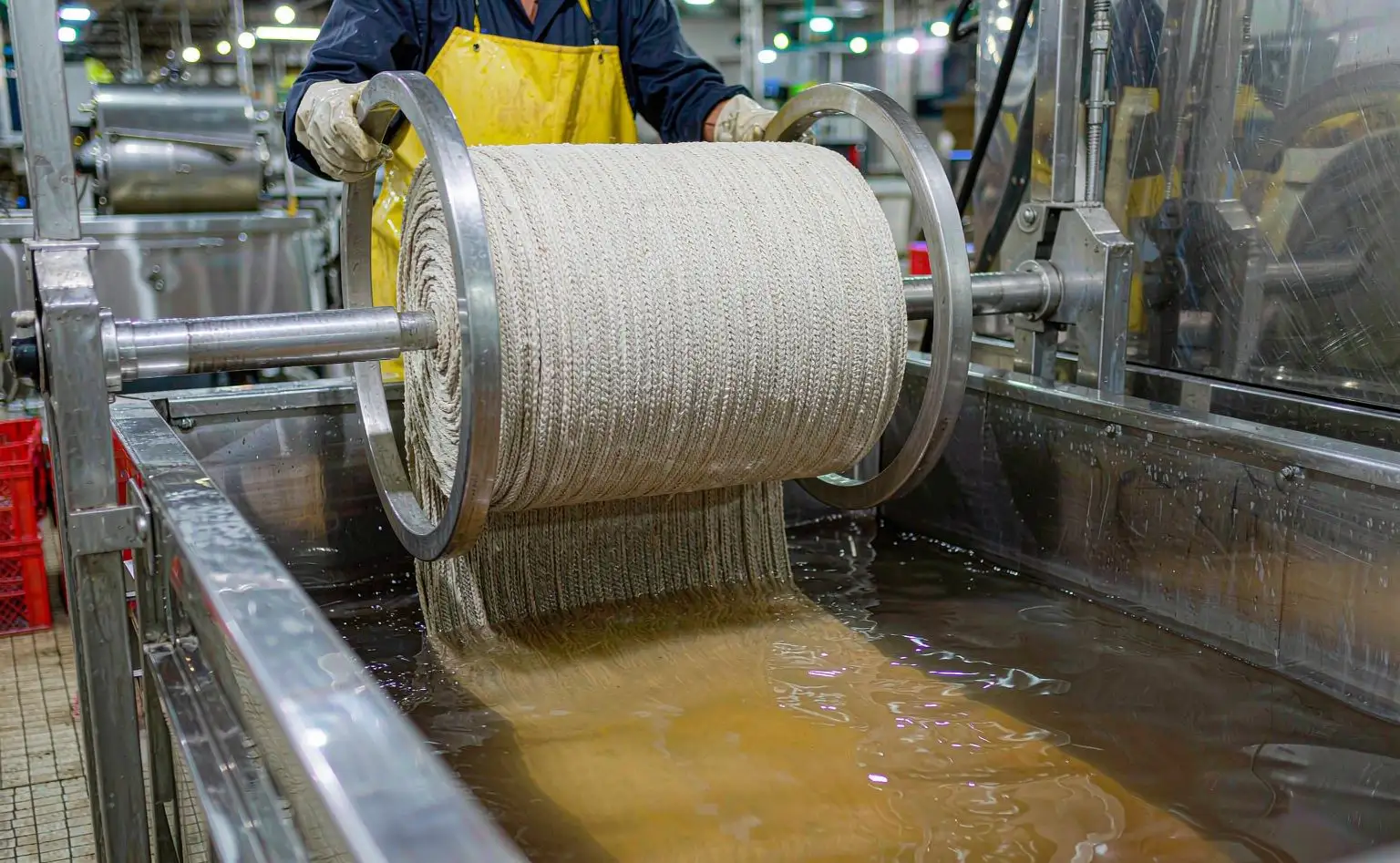
3. One pass through the low-temperature bath at 2%-3% o.w.f.
The level is 2%-3% of dry fabric weight. Domestic orders and pale colourways take the low end; export, dark high-stretch styles and buyers with a mould test take the high end. Three kilos of inhibitor treats a hundred kilos of fabric at 70% pick-up, and that is how a batch is planned.
Why it has to be low temperature. Stretch polyester cannot take high heat: the elastane loses recovery and the edges curl. iHeir-BJ works at 21-50C and pH 4.5-8.5, so it exhausts without a temperature rise and without cooking the elastane.
Which stage. Either the dye bath or the stenter bath, depending on scheduling. In the dye bath there is a wash-off afterwards and part of the agent goes with it; in the stenter bath the fabric goes straight to the dryer and more of the agent stays on the fibre, which is the safer route for export orders.
Do not skip the pre-mix. Pre-mix with 9-13 times its weight in water and charge in portions; a whole drum at once leaves high local concentration, which shows as shade variation on dark shades and yellowing on pale ones. Bring the make-up water to pH 4-6, add 0.1% cationic hydrophilic agent (70 g in 67 kg of water), then the inhibitor.
Keep anionic auxiliaries out of the bath. iHeir-BJ is cationic and an anionic softener or anionic moisture-management agent will complex it into a scum that marks the fabric and will not wash out. Schedule softening and moisture management separately or switch to non-ionic products. Grading is set out in sweater wool yarn and poly bag.
4. Dry the garment through before bagging, seams and plies hold the water
This stage has no product, only sequence, and it is the step jersey plants skip most often.
Dry to a moisture target. After pressing, garments go into a drying room at 50-60C with circulating air, timed to the fabric weight and the number of layers. Coming out, feel the collar, the cuff and the underarm seam: dry and slightly rough, not tacky. Measured on blends, hold below 8% moisture content.
Check the plies separately. The double-layer back and the pocket lining feel dry on the surface while the inner ply is still damp. In sampling, turn the bag area inside out and feel for a cool, damp patch.
Pressing adds water. Steam pressing raises moisture, and many plants bag straight off the press. Run the garment through drying or hang it in a dehumidified area instead.
Shop humidity. Hold sewing and packing at 45%-60% RH, run dehumidifiers in the humid season, and cover cut panels and part-finished work with PE film overnight.
5. One vapour sheet in the bag, plus the warehouse and the container
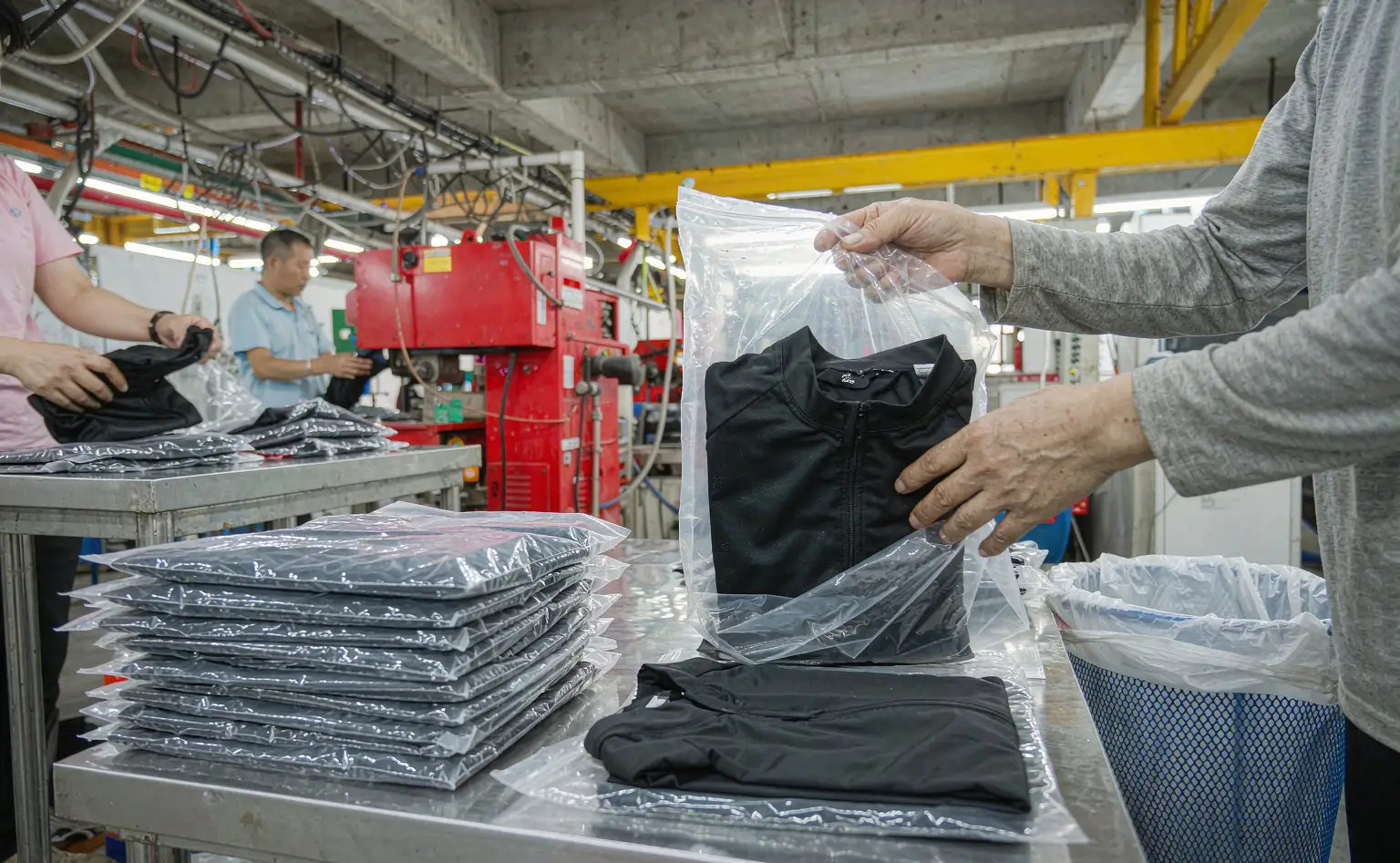
At bagging, put one iHeir-D vapour sheet inside, at 0.1-0.2 g of active, against the bag wall or between the folds, never pressed onto a printed label. Seal the bag mouth or the concentration will not hold.
Run the compatibility test. Seal a sheet at three times the normal level with a finished jersey, add a little water, keep paper between sheet and garment, and leave it closed for a few days. Check the fabric for shade change, the print for bleeding and the bonded tape for tackiness. iHeir-D has 70%±5 solids and can attack poor-quality metal under damp conditions, so styles with metal zip pulls need the test first.
Warehouse. Keep finished goods below 60% RH, pallets 10 cm off the floor and 10 cm off the wall, and walk the stock before the humid season, opening bags to check the tag and the back plies.
Export. Line containers with barrier film and hang desiccant sticks, and check every carton for soft corners before loading. Knitwear packing follows the same logic in cap crown and stuffing.
6. Questions on finishes, levels and mouldy stock
Q: The fabric already has a moisture-management finish. Can the inhibitor still go in the same bath?
Yes, but as separate passes. Most moisture-management agents are anionic or weakly anionic and will complex with the cationic iHeir-BJ, so wash off between the two, or switch the finish to a non-ionic product.
Q: 2% or 3%, a factor of one and a half?
Follow the style and the market. Pale lightweight styles for domestic orders take 2%; dark high-stretch styles, export and buyers with a mould test take 3%. Both are on dry fabric weight, not bath volume.
Q: Will the buyer smell the sheet when the bag is opened?
At 0.1-0.2 g of active there is no noticeable smell. Overdosing is what smells, so count sheets rather than adding by eye.
Q: A jersey has already spotted. Can it be washed and shipped?
Washing does not reach the roots. Spots on stretch polyester fade, the organisms stay in the fibre and the spots are back within a week of bagging. Downgrade the batch or replace the panels and keep it out of first-quality stock.
Four points: run the fabric at 2%-3% o.w.f. with iHeir-BJ in a 21-50C bath at pH 4.5-8.5, pre-mixed in 9-13 times water with 0.1% cationic hydrophilic agent, and for export use the stenter with no anionic auxiliaries; dry pressed garments at 50-60C with circulating air to the moisture target and feel the collar, cuff, underarm seam and back plies; put one iHeir-D sheet at 0.1-0.2 g of active in each bag after a three-times compatibility test and seal the mouth; keep the warehouse below 60% RH on pallets off the floor and line and dry containers for export. A kilo of inhibitor and a pack of sheets go out for a trial, with MOQ on the iHeir-BJ product page.


