




 View Count:33
 Date:2026-09-19
Damp plant floors growing mould: how do you remediate it without the spots coming back in two weeks? Mopping is not the answer while the water source keeps feeding the floor; the coating blisters right behind the regrowth. The order matters: trace the water, clean the mould, then build the inhibitor into the repair materials, iHeir-TQ at 2-3% in the waterborne recoat and iHeir-BCA at 0.5-0.75% in the levelling putty and mortar. This article covers how to tell the three water sources apart, the cleaning step and the dosing.
1. Trace the water: rising damp, condensation or a leak
The three sources need three different fixes, and misreading them wastes the whole job. Rising damp: a missing or broken damp-proof course lets ground water climb the concrete capillaries; it worsens in the rainy season, the floor darkens over large areas, and the mould band runs continuously up the wall skirt. The plastic-sheet test is definitive: tape a square of sheet to the floor and check after 24 hours, water under the sheet means rising damp. Condensation: the floor sits below dew point in poorly ventilated warehouses, pallets stacked on the slab, basement ceilings; smooth floors and metal parts sweat first, and spots cluster in dead-air corners. Leaks: point ingress through pipework, expansion joints or wall cracks; spots stay in one place with a spreading water ring and worsen after rain.
If in doubt, run both checks: the sheet test for capillary water, before-and-after photos on a rainy day for the leak. The verdict decides whether the answer is a damp-proof layer, better ventilation or pipe repair first; inhibitors suppress mould, they do not stop water.
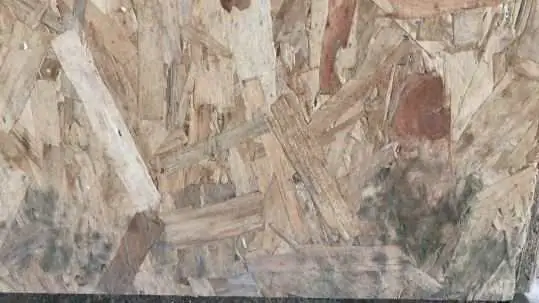
2. Clean before you rebuild: CM spray, dry, then repair
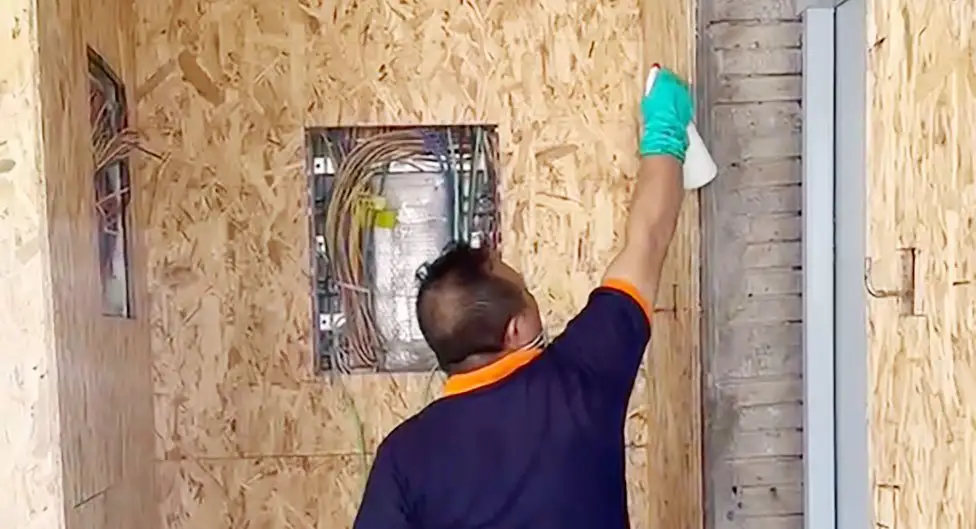
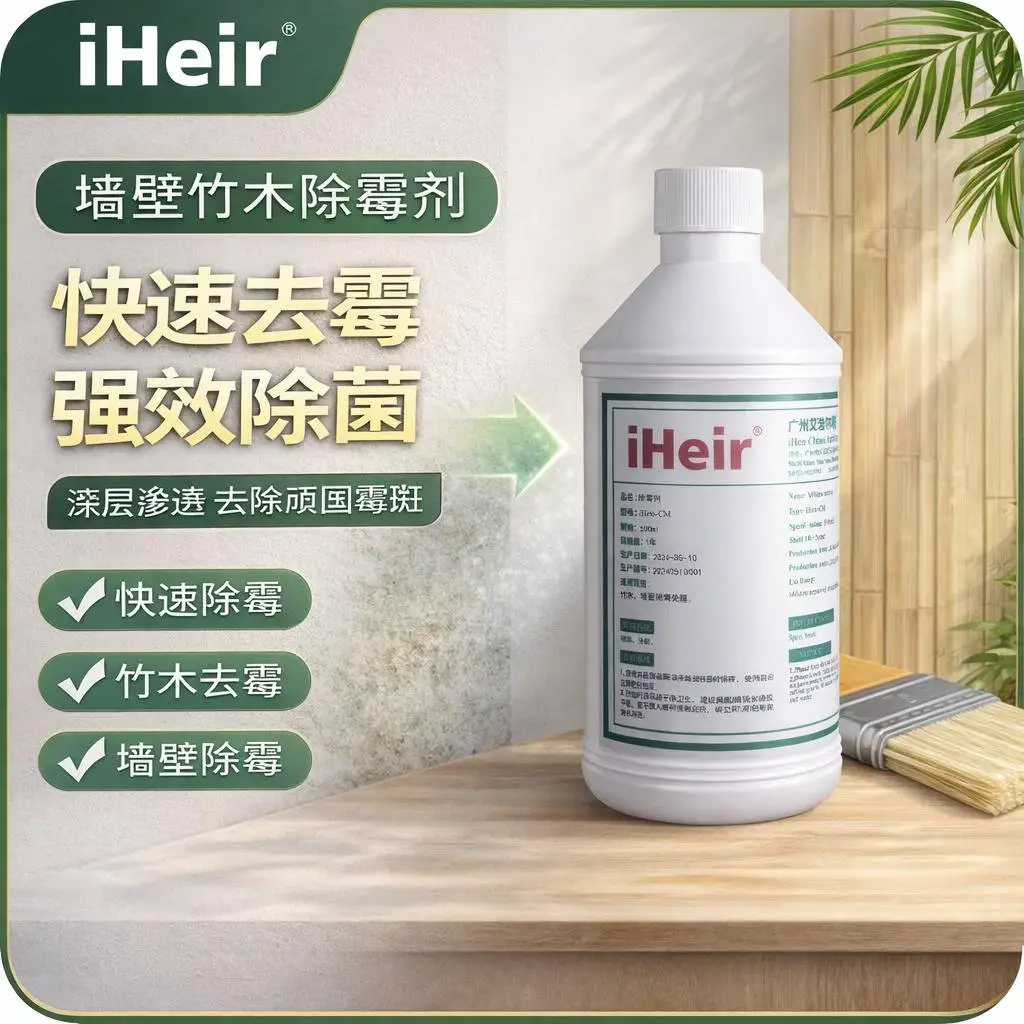
Coating over live mould just farms it under the new film. Spray the affected areas with iHeir-CM mould remover, which is broad-spectrum against Mucor, Penicillium, Aspergillus, Alternaria and other fungi; leave it until the spots fade, wipe stubborn patches with a soft cloth, then dry the surface and sand off loose paint and blisters before any filler goes on. Ventilate the work area and wear gloves and goggles. One-kilogram and five-kilogram packs suit spot jobs; a full-floor refurbishment takes the 25 kg drum.
Two common mistakes: wiping the surface without soaking it, leaving hyphae in the pores to regrow within weeks; and filling over a damp base, which seals moisture into the new coating and hands mould an incubator. Dry to a normal base moisture reading, not to a clock.
3. Build the inhibitor into the repair: TQ for films, BCA for dry powders
Cleaning clears the stock of mould; the inhibitor in the repair materials provides the lasting hold. The split follows the material form:
| Product | Where it goes | Dosing | Key window |
|---|---|---|---|
| iHeir-TQ coating mould inhibitor | Waterborne topcoats, emulsion paints | 2-3% of system weight | Add at the grinding or paint-mixing stage, mix well; no unlined metal containers |
| iHeir-BCA paint mould-proof powder | Levelling putty and repair mortars (dry powders) | 0.5-0.75% of powder mass | Blend at the mixing stage; works at pH 5.0-10.0, alkali-tolerant |
| iHeir-CM mould remover | Base treatment before repair | Spray until spots fade | Surface must be dry before filling |
iHeir-TQ is a 45% CMIT/MIT blend approved for in-can preservation of waterborne paints; its cationic component bonds firmly to the wall, and at the recommended rate the protection lasts five to ten years. It is formaldehyde-free, ships in 25 L or 160 L, and keeps at least a year. iHeir-BCA is built for high-pH dry-powder systems like putty, with slow-release and light-stabilised technology and a 4-30 micron particle size that disperses cleanly; in humid regions dose at the 0.75% top of the range. Pre-blend the powder with a small batch before it enters the main mixer to avoid specks.
In damp regions, dose both layers: a treated topcoat over an untreated levelling layer still blisters as moisture carries growth up from below; treated on both, the rainy-season pressure finally stays down.
4. Acceptance and records
Keep three things after the job. A moisture curve: base readings before treatment, after filling and after the topcoat; the line must flatten before the job counts as dry. An inhibitor log: BCA dosing per mixer batch and TQ ratio per paint batch, mapped to the work zones, ready for any customer or tenant audit. Follow-up points: check the wall skirt and pallet bases in each rainy season; two seasons without regrowth validates the scheme.
The mould-resistance grading system is covered in our wall mould treatment guide, and system selection across paint families in our paint anti-mold agents comparison; for wooden wall panels and pallets in adjacent storage see the mouldy boards guide.
Two sequencing traps to flag: do not leave the base exposed across a rainy season between the damp-proof layer and the topcoat, a gap that catches plenty of plants that finish the layer in spring and paint after the rains, by which time the base has soaked again; and let the dosed putty dry surface-tough before the sealing primer, because sealing too early traps moisture underneath while too late lets rising damp push back up. Set the interval by the day’s temperature and humidity, or send us the site conditions to confirm.
4bis. FAQ
Q: Does the floor coating itself need an inhibitor?
Depends on the system. Waterborne floor paints and emulsions take TQ at 2-3% in the mixing stage; solvent and PU systems take iHeir-YQ at 1-1.5%, covering both in-can and film protection. Epoxy cured systems need case-by-case review; contact us with the formula.
Q: Does 3% TQ affect the film?
2-3% is the product-page range, mixed in well with no obvious effect on appearance or application; for a dedicated formula our technical centre can pin the exact rate by testing rather than pushing past the range.
Q: With a damp-proof layer installed, is the inhibitor still needed?
Yes. The layer handles water, the inhibitor handles organisms; condensation still wets the surface every rainy season, and a treated film does not stain under that load.
Q: How do samples and orders work?
TQ, BCA and CM are all available as samples; send the floor area, damp type and repair material list, and we return dosing ratios and a work sequence, then quote per drum. Contact us.