




 View Count:76
 Date:2026-09-28
How do you treat cashmere mould on sweaters that are already packed for export? Cashmere fibre is fine and takes up moisture readily, so mould and insect damage usually arrive together, and because most sweaters are high-value light shades a single patch writes the piece off. Pad iHeir-BJ at 2-3% o.w.f. on the finishing line, then manage the store and the carton with iHeir-D vapour-phase sheets (0.1-0.2 g of active content per sheet) and T-1000 desiccant sticks. This article covers where the two lines divide and how to hold the store dry.
1. Why cashmere goes wrong as soon as the wet season starts
Qinghe in Hebei is the largest cashmere raw-material and spinning cluster in China: it processes and trades roughly 8,000 tonnes of goat cashmere and over 50,000 tonnes of sheep cashmere a year, which is 50-60% and 90% of the national total respectively, and it knits more than 30 million garments a year, with RMB 52 billion in sector revenue in 2025 (Qinghe county government, Hebei Daily). The more concentrated the cluster, the more stock sits in the warehouses over the same weeks.
The problem starts with the fibre. Goat cashmere has a fineness of only about ten-odd microns, with dense scales and a large surface area, so it absorbs moisture far more readily than ordinary wool or synthetics; the trade figure for the official moisture regain of wool is around 15%, and cashmere stock in a southern warehouse regularly sits above 20%. That same property is why the hand feel is good, and it also means water does not leave easily once it is in. Mould needs moisture, warmth and a carbon source, and cashmere is a protein fibre, with the oils and sizes carried in from spinning and finishing on top, so the carbon source is never in short supply. Worse, insect damage and mould arrive together: carpet beetles breed quickly in warm damp conditions, and the hole they leave becomes the entry point for mould.

2. Three lines of defence, side by side
The table lists the stage, what is treated, the product, the dosage figures and the points to watch, so purchasing and production can work down an existing order against it.
| Line | Treated part | Product | Figures | Points to watch |
|---|---|---|---|---|
| Finishing (the mould line) | Sweaters, cashmere yarn, scarves | iHeir-BJ textile mildew inhibitor | Padding at 2-3% o.w.f. | Bath 21-50 degrees, pH 4.5-8.5, soft water, pre-mix with 9-13 parts water |
| Finished-goods store | Garments and inner packing before casing | iHeir-D vapour-phase sheet | 0.1-0.2 g of active content per sheet | Placed by carton volume, packed with the garment |
| Export container | The full container load | T-1000 container desiccant sticks | 8-10 sticks for 20 ft, 10-12 for 40 ft | Hung from the roof rails, clear of the cartons |
| Warehouse climate | Store and hanging area | Dehumidifier plus off-floor racking | Relative humidity held below 60% | Run through the wet season and log the humidity curve |
| Acceptance | Finished goods and batch file | Testing as agreed in the contract | Retained sample and report per batch | European buyers check the file; samples must be traceable |
Finishing decides whether the fibre carries protection at all, while the store and the container decide whether that protection survives the climate. Do the first and skip the second and the result is handed to the weather.
3. Finishing: how to run the padding pass
The mould line on cashmere runs at finishing. Use iHeir-BJ at 2-3% o.w.f. by padding, with the bath at 21-50 degrees Celsius, the working liquor at pH 4.5-8.5 (ideally near 6), soft water throughout, and pre-mixing with 9-13 parts water before the bath. The rate sets the service life: 2% corresponds to roughly a year or more of protection and 3% to two to three years, so pick the tier by the humidity of the destination.
Cashmere has a narrower process window than cotton or linen, and three prohibitions belong on the process card. The first is water quality: soft water is compulsory, because calcium and magnesium in hard water react with the agent and floc forms in the bath, which wastes the whole pass. The second is the bath itself: BJ is cationic and must not be run in the same bath as an anionic auxiliary, nor share a stage with anionic softeners or fixing agents, or the agent complexes in the bath and marks can be left on the surface — on a high-value light shade a mark costs more than the mould would have.
Run the sequence as dyeing, rinse, mould finish, dewater and dry, then softening, so the mould finish sits ahead of the softener. Hanks and made-up garments differ in immersion time and dewatering rate, so the first bath of each should be checked for shrinkage and hand feel before scaling up.
4. Store and container: keep the moisture outside the fibre
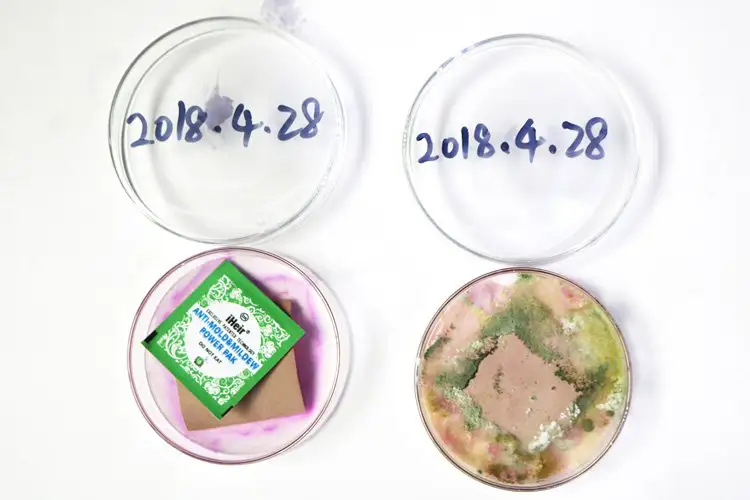
Once finishing is done the second front is storage. Confirm the moisture content has come back to specification before the sweaters are cased, and do not leave garments in the hanging area longer than needed. Hold the store below 60% relative humidity, run dehumidifiers through the wet season, keep racking off the floor and away from the wall, and do not stack garments against an external wall. Place iHeir-D sheets at 0.1-0.2 g of active content each, scaled to the carton volume, inside the bag with the garment rather than outside the carton.
The container is the layer most often forgotten. In a sea container the cargo is heated by day and cooled at night, so water condenses again and again and drips from the ceiling onto the cartons, wetting the top layer of cashmere first. Hang T-1000 desiccant sticks to match the unit: 8-10 for 20 ft and 10-12 for 40 ft, from the roof rails rather than laid on the cartons, so condensation forms on the sticks first. Leave the air path at the container roof clear.
5. What the batch file has to contain
European buyers are strict about storage conditions and the batch file, and the cost of a problem is not just the claim but the next order. Three sets of records are worth keeping: the finishing record (product, rate, bath temperature, pH, time), the storage record (temperature and humidity curve with dehumidifier run hours), and the test report agreed in the contract, with samples traceable back to a batch and dye lot.
One wording rule applies to that file: cite only reports commissioned by us. A report commissioned by a customer on their own finished product is not quoted by number or conclusion, and customer names are always anonymised, so no real brand or factory name appears in the document set.
6. Common questions
Q: Can a sweater that already has spots still ship? Grade it first. If the spots sit on the surface, the fibre has not discoloured and the smell clears, a cleaning pass plus a fresh finish can work; if the growth has gone into the fibre, with a drop in strength or a colour difference that will not wash out, it is effectively a downgrade. On high-value light shades it is not worth the risk.
Q: Is insect protection still needed once the mould finish is on? Yes. Mould and insects are two separate lines: the finish handles mould, while carpet beetles need their own measure. Do both at the casing stage, and control the climate at the storage end — below 60% relative humidity the breeding rate falls away sharply.
Q: Can yarn and made-up garments share one set of parameters? The product can be the same, but the process figures have to be set separately. Hanks differ from garments in liquor ratio and pickup, and garments bring shrinkage and hand feel into play, so run a first bath of each before scaling. For the selection side see mould prevention for seasonal garments, and for container humidity see moisture and mould in sea containers.
Export cashmere comes down to holding both lines: build the protection into the fibre with iHeir-BJ at finishing, then keep the moisture outside with vapour-phase sheets and desiccant sticks in the store and the container. Samples and minimum order details for iHeir-BJ, iHeir-D and T-1000 are available on request.


