




 View Count:11
 Date:2026-10-22
How is mould on a wooden-handled knife handled? Soak the handle, then fit the blade, then pack. The mould is only in the timber; the blade will not take acid or damp, so the wrong order rusts it first. Before assembly the handle is soaked in iHeir-M5 immersion-type bamboo and wood fungicide at 1:40 to a 15%-20% weight gain; once fitted, the only option is a spray of iHeir-M8 bamboo and wood fungicide at 1:20, on the handle only. This article gives the checks for both stages and the packing rules.
1. The mould is in the handle, and the blade fears acid and water
Mould on a wooden-handled knife almost always starts in the timber, in a predictable place: the ring where the handle meets the blade goes first, because that ring traps water at assembly and picks up oil from hands; the end grain at the butt comes second, since end grain is cut across the fibres and takes water fastest. Handles are usually dense hardwoods such as rosewood, beech or ebony, whose fibres carry sugars and starches, so once moisture content rises the timber is a culture medium.
The blade behaves differently. A stainless blade does not grow mould, but it fails in two situations: prolonged contact with an acidic liquid breaks the passive layer and leaves rust spots, and damp packing traps water in the joint between blade and handle, from which rust works outward. Carbon steel is more sensitive still and shows rust within hours of contact with water.
2. Soaking and spraying: the two stages side by side
The table sets out the pre-assembly soak and the post-assembly spray. Different products, different dilution, different checks, and neither transfers to the other.
| Timing | Object | Method and level | Check | Points to watch |
|---|---|---|---|---|
| Before assembly | Bare handle | iHeir-M5 at 1:40, fully immersed | 15%-20% gain, about 5-10 minutes | Acidic; no contact with metal or alkalis |
| Drying | Soaked handle | Lift, drain, air-dry or sun-dry | No water on the end grain | Stand to drain, never lay flat |
| Touch-up after assembly | Handle with blade fitted | iHeir-M8 at 1:20, sprayed | Full coverage, air-dried | Mask the blade, wipe the steel |
| Packing | Blade and liner | Dry liner, moisture-absorbing material | No rust on opening | Do not press the blade against a solid liner |
The dividing line is whether the blade is fitted. Once it is, the knife cannot be dipped, because M5 is acidic and will attack the steel; break the passive layer and no amount of wiping removes the mark.
3. Before assembly: soak the bare handle in iHeir-M5 at 1:40, to a 15%-20% gain
iHeir-M5 immersion-type bamboo and wood fungicide is a red-brown liquid for bamboo ware and for wood, rattan, vine, palm and grass articles. The bath is made up at 1:40, 5kg of product to 100kg of water; the handles go in fully immersed with none breaking the surface and stay until they show a 15%-20% weight gain, roughly 5-10 minutes, after which they are lifted, drained and dried before assembly. It comes in 25kg drums, stores dry and dark, and has a one-year shelf life.
Three operating points. First, go by weight gain, not by the clock: 5-10 minutes is a guide and dense hardwoods take water more slowly, so weigh three handles as a baseline. Second, turn them to release air: a handle dropped into the bath traps air, so press it under and turn it twice to get liquor into the end grain. Third, plastic tanks only: M5 is acidic and must not touch metal or alkalis, and the alkaline wash upstream has to be rinsed off first.
Drying is the stage that gets shortened when a delivery is tight. Lift the handles and stand them to drain with the end grain down; laid flat on a bench, the face in contact never dries. Fit the blade only when the moisture content has settled, because water sealed into the joint grows mould and rust together.
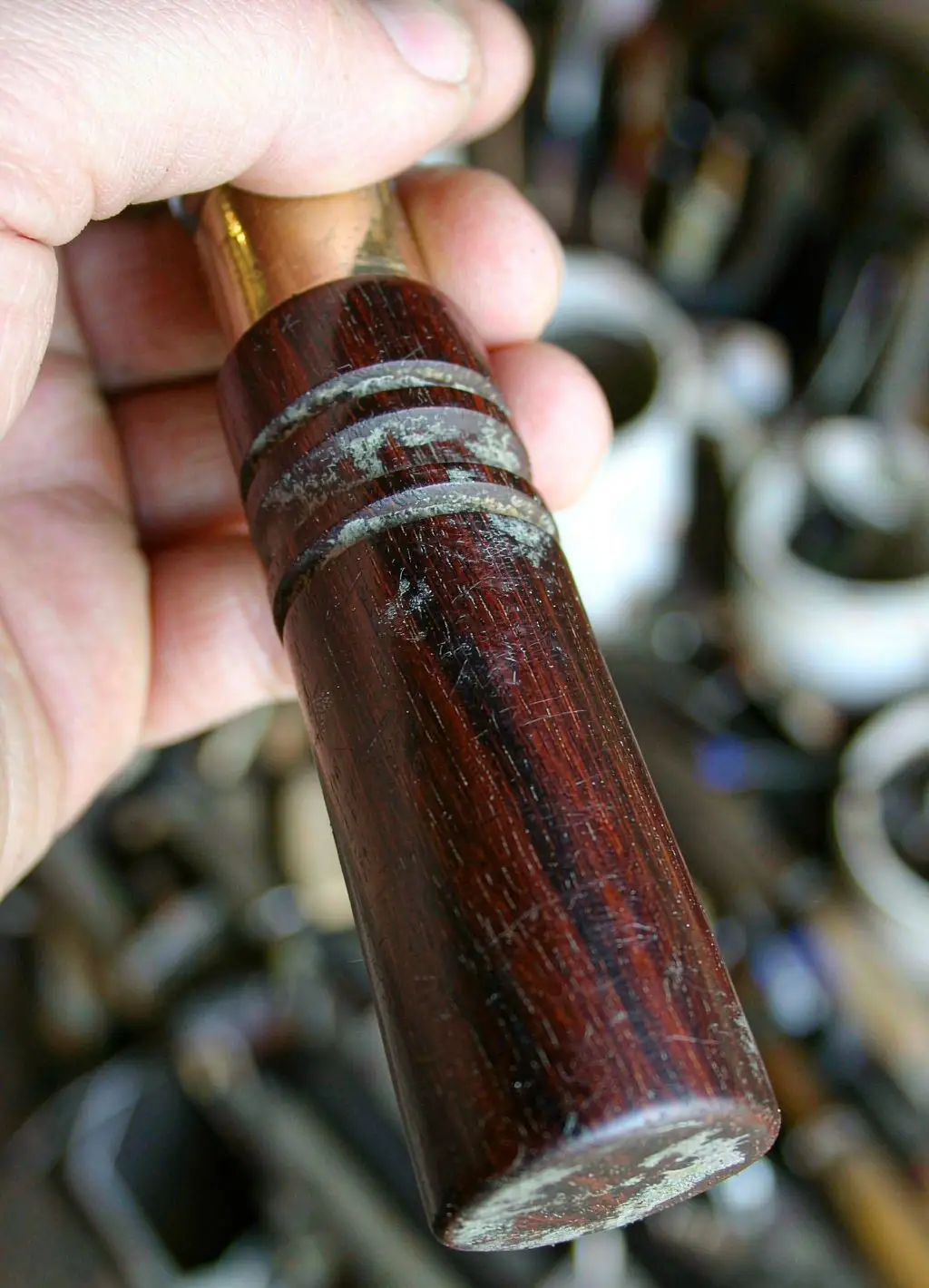
4. After assembly: spray iHeir-M8 at 1:20 on the handle only
A knife with the blade already fitted cannot be dipped again. The touch-up is a spray: iHeir-M8 bamboo and wood fungicide is a clear amber liquid with an acetic note, an active solubility of 5-7ppm in water, dispersed in the aqueous phase, for bamboo ware and for wood, rattan, vine, palm and grass articles. It is made up at 1:20, one kilogram to twenty of water, stirred and sprayed or brushed on, with the liquor covering the surface completely, then air-dried. It comes in 25kg drums and stores dry and dark.
Four rules. First, mask the blade: tape or a jig over the steel, and wipe overspray off at once. Second, look after the joint: the line between blade and handle is where mould and rust both begin, so wet the handle side without running liquor into the gap. Third, full coverage: the end grain at the butt and the grip grooves all have to be wetted. Fourth, dry before packing, until the surface is not tacky.
There is also an upper bound: the maximum use level for M8 is 15ppm of active substance, so dosing at 1:20 sits well inside it; a stronger liquor only leaves an acetic note and raises the rework rate.
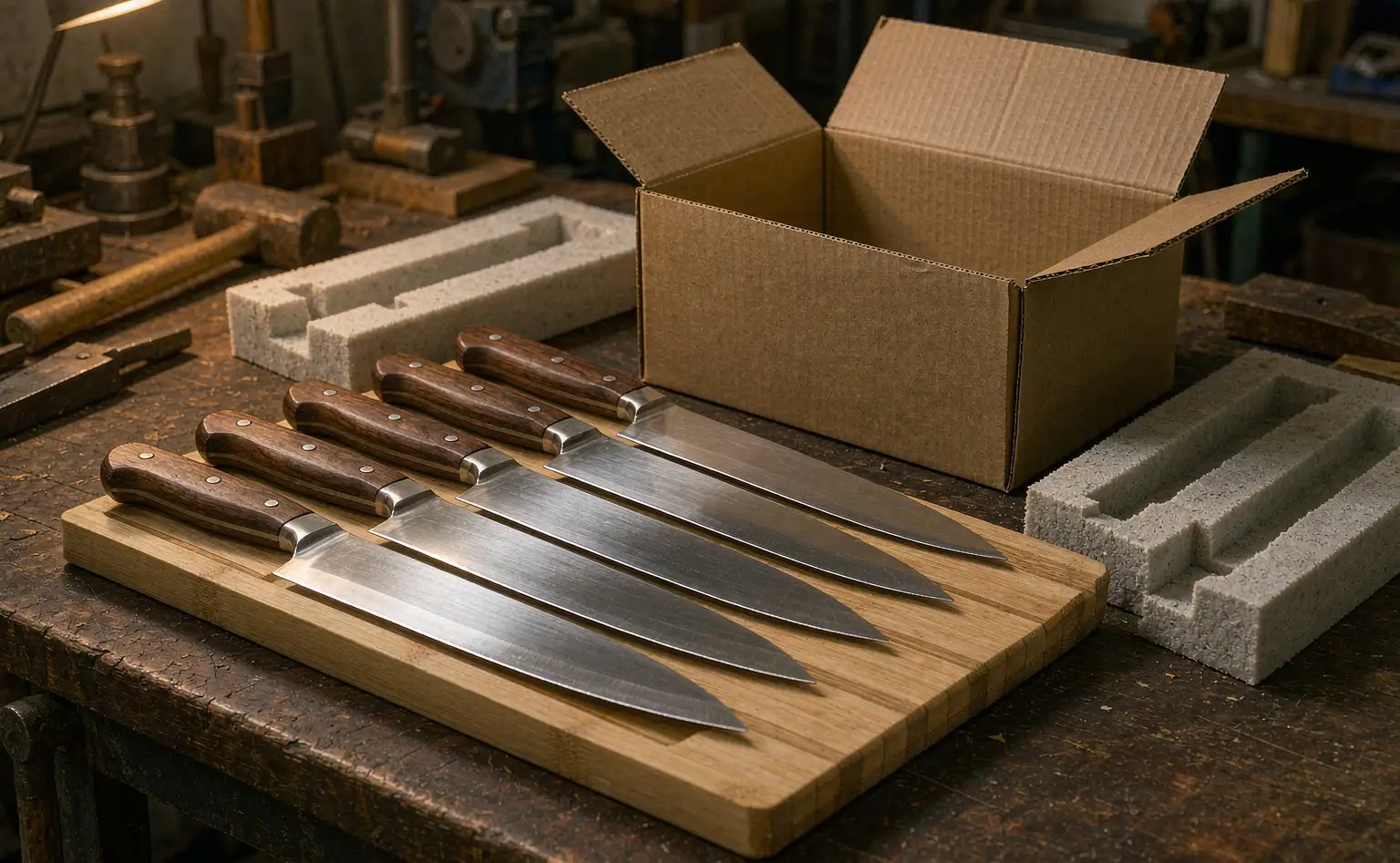
5. Drying, packing and the store: the blade stage is about damp only
The blade is metal, so treating it for mould is wasted effort and tends to leave marks. The packing stage has one job: keep moisture out. Use a dry paper or foam liner rather than damp corrugated board, and leave a little clearance so the blade is not pressed against a solid liner, because a contact face with moisture behind it leaves a water mark. The stainless side of the same argument is set out in why stainless steel knives still go mouldy.
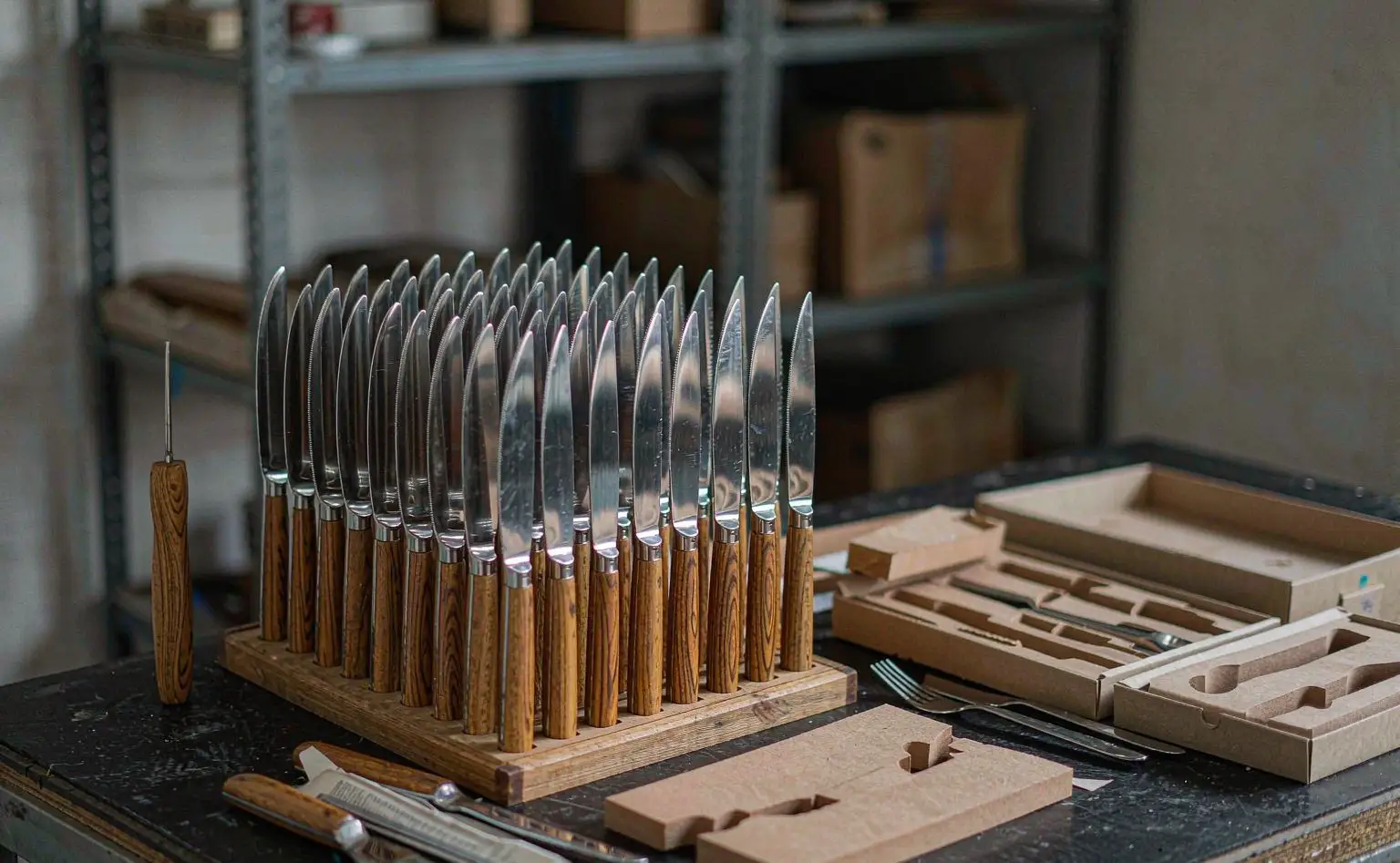
A moisture-absorbing pack in the box is standard, provided it is not pressed onto the blade. For sets with a wooden block or box, the timber parts go through the same treatment as the handle before assembly. Check every knife before closing the box: spots on the end grain, rust at the joint, water marks on the grip.
In the store: pallets off the floor, a gap to the wall, humidity held down; for sea freight, absorbent material in the container and a gap between cartons and the wall. Moisture content of the timber is the number to watch, because it warns earlier than appearance does.
6. Questions: can the whole knife be dipped, and what if the handle cracks
Is it not simpler to dip the whole knife? No. M5 is acidic and the data sheet states it must not contact metal or be mixed with alkalis; dip a whole knife and the passive layer on the blade is attacked, rust appears within hours of leaving the bath, and the polished face is left pitted. The order is handle first, blade second.
The handle cracked after soaking. What now? Check three things: whether the soak ran past the weight gain, because over-absorbed fibre shrinks hard as it dries; whether the handles were laid flat to drain; and whether drying was too fast in sun. Cracked handles are graded by depth, shallow ones sanded and downgraded, deep ones scrapped.
How is the effect verified? Mould resistance runs to ISO 846 or ASTM G21 for a growth rating on treated handles, not on untreated timber; the packing stage is checked by the smell on opening and by damp marks on the liner. Samples and TDS are available for both products.
Closing figures: bare handles soaked in iHeir-M5 at 1:40 to a 15%-20% gain, about 5-10 minutes, in plastic tanks; stood to drain and fitted only once the moisture content has settled; after assembly a spray of iHeir-M8 at 1:20 on the handle only; and a dry liner checked on every knife before sealing.


