




 View Count:41
 Date:2026-09-04
Yiwu’s market-purchase consolidated containers are the hardest case in export mold control: a single 40ft box may carry plastic storage bins, bamboo-wood kitchenware, textile tablecloths, paper photo frames, ceramic mugs and small metal hardware — five or six materials sharing one voyage, each able to “infect” the others. In the mold-rework cases we handled in recent years, consolidated mixed-cargo containers show a clearly higher mold rate than single-category containers, concentrated in the peak export season (May-September). This plan is written for Yiwu trading companies, sourcing agents, forwarders and general-merchandise factories — every step is actionable, from before loading to arrival.
1 Why Do Yiwu Consolidated Containers Mold So Easily? Three Special Risks
It is not that Yiwu goods are low quality — the consolidated model itself amplifies mold risk:
- Risk 1 — mixed materials: moisture sources “drag down” the whole container. Wood, bamboo and paper goods often carry 12%-15% moisture and act as mobile humidifiers inside the box; the water they release is absorbed by textiles, leather and foam, creating local high-humidity pockets. The classic problem mix is “bamboo-wood kitchenware + tablecloths + paper boxes” in one container.
- Risk 2 — long consolidation time: goods “wait for the container” in the warehouse. Yiwu means goods from many factories arriving at a warehouse to fill one 40ft box, often taking 3-7 days. In plum-rain or typhoon weather, cargo absorbs moisture in the warehouse and carries the problem into the container.
- Risk 3 — chaotic loading with no traceability. With cargo from a dozen suppliers, nobody can prove whose goods had excessive moisture or which carton got rained on. When problems appear, the whole container shares the blame.
So the first principle of consolidated-container mold control is: stop the risk before loading, not after arrival.
2 Pre-Loading Checks: Three Filters for Problem Cargo
Most Yiwu trading companies have no full-time QC, but these three checks take half a day and remove most risk sources:
- Check 1 — sample the high-moisture categories. Use a moisture meter on bamboo, wood and paper goods and cartons; reject batches above 12% and ask suppliers to re-dry or hold. No meter? Hefting the goods and feeling for softened cartons also filters obviously damp cargo.
- Check 2 — packaging integrity. Inspect every carton for rain stains, water marks, damage, and check that inner PE bags are sealed. Rain-stained cartons must be opened and inspected whatever they look like — the stain is proof the cargo got wet before.
- Check 3 — cargo freshness. Old stock over 3 months and display samples carry higher moisture and mold-spore risk; prioritize freshly produced batches. For large orders, ask suppliers to add an anti-mold chip at packing to lower the risk from the source.
For how to choose single-item packaging materials, the packaging-selection guide for anti-mold packaging paper applies equally to mixed cargo.
3 Loading Order: Stowage Is Mold Prevention
Do not load a consolidated container on a “first come, first in” basis — sequence cargo by moisture characteristics:
- Moisture sources (wood, bamboo, paper) go mid-container and ventilated, never against the walls and never on the floor — container walls swing in temperature and cargo touching them condenses moisture first.
- Moisture-sensitive goods (textiles, leather, electronics) go upper-inner, away from the doors and walls; the door area has the biggest temperature swings and is the condensation hotspot.
- Heavy goods (ceramic, glass, hardware) at the bottom, light on top, so cartons are not crushed open to moisture.
- Separate wet from dry: physically isolate high-moisture wood and paper from skin-contact textiles with large plastic sheeting or waterproof cloth.
- Leave an air channel: do not pack to the ceiling; keep about 10 cm clearance at the top for airflow and desiccant action.
4 In-Container Moisture Control: Sticks + Chips, with Numbers
Configuration is calculated from both container space and cargo hygroscopicity:
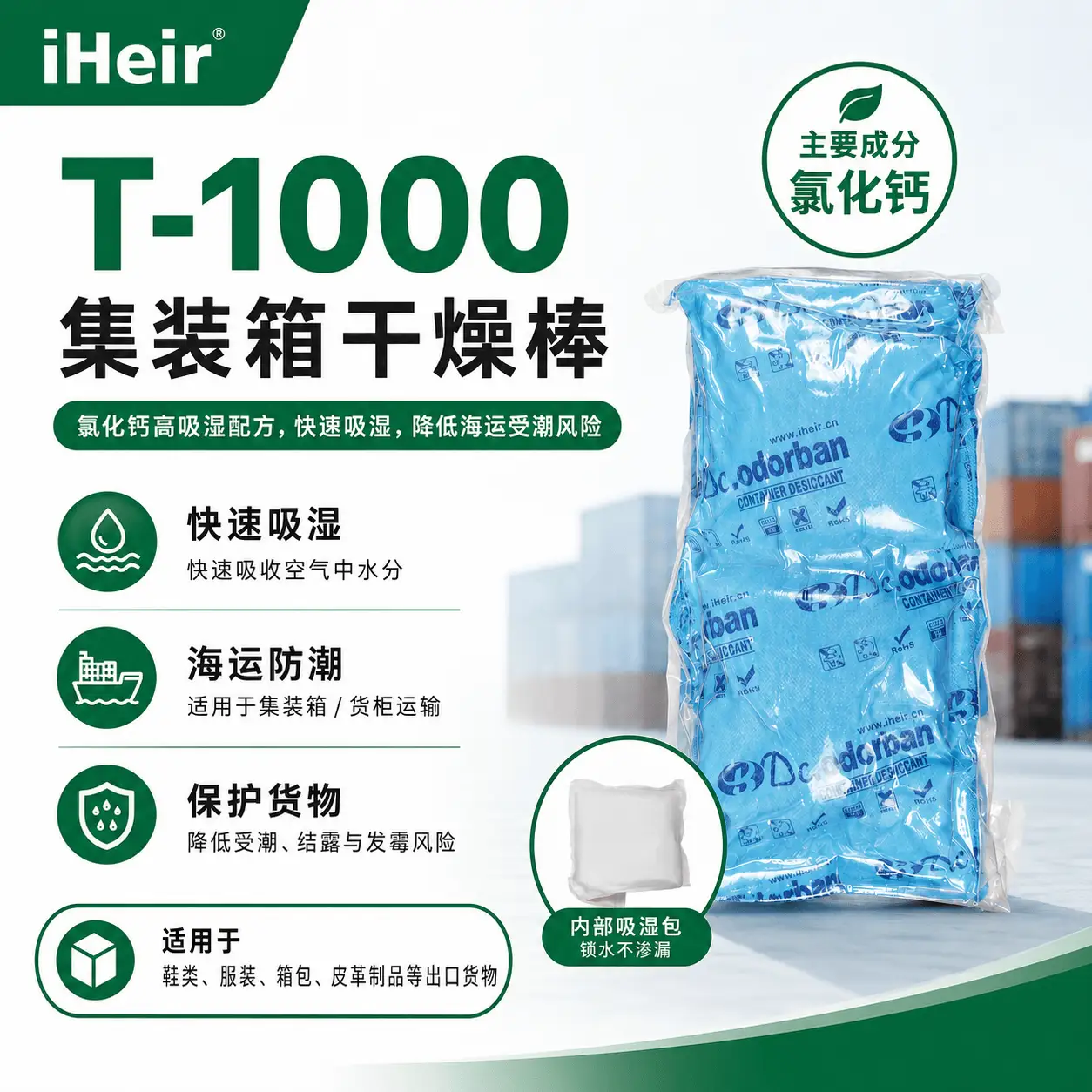
- T-1000 container desiccant sticks: 6-8 sticks per 20ft, 10-12 per 40ft; take the upper limit when moisture-absorbing cargo (wood, bamboo, paper) dominates. Hang sticks in the wall corrugations at least 5 cm from cargo so condensed water never drips onto goods.
- Anti-mold chips per carton: 1-2 chips per carton, placed against sensitive items. Chips create a gas-phase anti-mold environment inside the box, covering what desiccants cannot (they absorb water but do not kill spores). For dosage details see how much desiccant goes in a container.
- Odor-eliminating sachets: if the box mixes fresh plastics or strong-glue goods, add sachets such as the CW microcapsule odor-eliminating bag so package odor is not mistaken for “bad goods”.
Two small things before loading: inspect the container itself — check for roof rust spots and wet floor marks (leakage signs) and clean/sanitize it before loading; and place a temperature-humidity data logger inside (a few dozen yuan). The logged curve is the strongest evidence you will have with suppliers or the shipping line later. For the general mechanism and misconceptions of container moisture, see container moisture and mold during shipping.
5 Arrival, Claims and Prevention: Say It Up Front
When a consolidated container arrives moldy, the worst outcome is unprovable liability. Do three things in advance:
- Keep samples: retain 1-2 representative pieces of each category (sealed) before shipment so “as-shipped condition” can be compared in a dispute.
- Log temperature and humidity: the logger curve decides responsibility — if cargo molded but the log shows normal humidity, the goods themselves left with excess moisture; if the log shows prolonged high humidity, the container or the route is the cause. This data is your claim evidence.
- Photograph at opening: on arrival, take photos and videos (container number, carton marks) before touching anything, notify the forwarder and insurer, and arrange rework only after documentation. See our full mold rework process for what a rework entails.
Real case: A Yiwu home-goods trading company shipped a 40ft mixed container (bamboo-wood kitchenware + textiles + paper boxes) to the US in June 2024; about 25% arrived moldy and the buyer claimed USD 42,000. The audit found: six days of consolidation during heavy rain, no dehumidifier in the warehouse, and bamboo-wood kitchenware at over 14% moisture at loading. After the fix — the three checks above, 10 T-1000 sticks, chips in every carton and an in-container logger — the company shipped 47 mixed containers in the second half of 2024 with only one partial spot issue (caused by the buyer’s flooded warehouse), and the logger data settled responsibility cleanly. Configuration must be adjusted to your cargo mix, route and season — contact us for a container-specific loading plan.
6 FAQ: Yiwu Mixed-Cargo Mold Prevention
Q1: Do consolidated and full containers need the same moisture configuration? No. A single-category container can be calculated precisely; a mixed container should be configured to protect its most sensitive category, with stronger wet-dry separation and per-carton protection.
Q2: Do I need both anti-mold chips and desiccants? They do different jobs: desiccants absorb moisture and lower RH; chips release gas-phase inhibitor that suppresses spores. Desiccants alone still allow mold when humidity spikes temporarily; chips alone exhaust early in prolonged high humidity. Use both when budget allows, plus moisture barrier bags for the most sensitive goods.
Q3: A buyer demands “zero mold” — how do we phrase the contract safely? Define responsibility clearly: the seller warrants that goods were packed per the agreed moisture plan and documented; the buyer must raise claims within X days of opening with photos or logger data. “Zero mold” is only safe with samples, a logger and photographs — otherwise a dispute is just words against words.
Q4: Whose fault is it when a mixed container arrives moldy? Follow the evidence: excessive moisture at loading (supplier/seller), abnormal in-container humidity (loading plan or container problem), or extreme weather in transit (insurable, rarely recoverable from the line). Without a logger and samples, the seller usually bears it.
Q5: Extra care for rainy-season shipments? Dehumidify the consolidation warehouse (below 60% RH), cover cargo with waterproof sheeting when loading in rain, avoid loading during downpours, and use the upper desiccant limits in these seasons.
Q6: Cargo arrived moldy — what can still be done? Assess the rate first: light spots can be cleaned by a local partner; serious cases need local rework or return for treatment. Decide fast — the longer mold sits, the deeper it penetrates. Related export plans: bag and luggage export mold prevention and export toy mold and EN71 compliance.