




 View Count:17
 Date:2026-09-14
PP and PE are the most widely used commodity plastics on earth. Turn-around boxes, pipes, drums, appliance housings, pallets – walk through any factory and most of what you see is polyolefin. Over the past two years one thing has changed quietly but decisively: brand owners and export buyers now list “antimicrobial surface” as a pass/fail item in factory audits. Without an antibacterial treatment and a test report, shelf and marketplace approvals get harder every year. For plastic processors and masterbatch compounders, an antibacterial masterbatch is the least invasive answer – but only if you get four things right: active chemistry, dosage, processing window and testing. This guide walks through all four in order.
1. Why Polyolefin Products Need Antimicrobial Protection
First, correct the misconception: pure PP and PE are hydrocarbon polymers, and mold cannot digest them. “Plastic itself gets moldy” is technically wrong. The real problem is the surface. A freshly molded or extruded part carries at least four kinds of contamination: release-agent residue (stearates and silicone oils – excellent carbon sources for fungi), fingerprints and skin oil from assembly, warehouse dust with organic deposits, and blooming layers from talc or slip agents. Once relative humidity reaches 75%, mold spores colonize these films within 24 to 48 hours, producing visible spots, tackiness and odor.
Three product families carry the highest risk. Circulation crates and pallets touch damp goods repeatedly in food and pharma logistics, accumulate a heavy bio-burden and become cross-contamination nodes. Plastic pipes develop biofilm in stagnant sections of potable and drainage lines, growing slime that affects flow. Appliance and sanitary housings are high-touch surfaces where brand owners set explicit bacterial count limits. We covered the basic taxonomy of plastic antimicrobials in an earlier overview of plastic antimicrobial agent types; this article goes straight into engineering practice.
2. Silver Ion, Zinc Ion or Organic: Choosing the Active Chemistry
Commercial plastic antimicrobials fall into three chemistry families, and the differences are large enough that a wrong choice wastes the whole project.
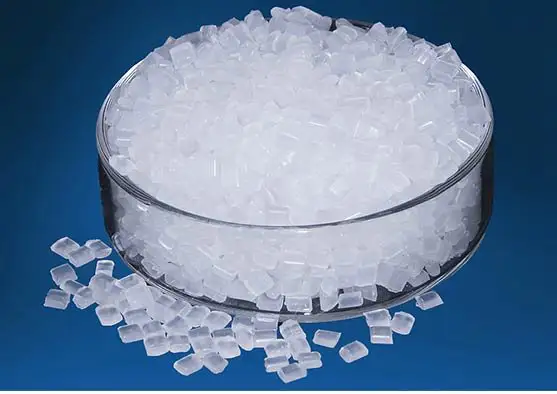
Silver-ion inorganic agents offer the broadest spectrum and highest efficacy against E. coli, Staphylococcus aureus and mold. Their heat resistance is outstanding – decomposition temperatures sit above 500 degrees C – so injection and extrusion windows pose no threat. The trade-offs are cost and a slight gray cast possible at high loadings in highly transparent resins. iHeir-ECO plastic antimicrobial agent belongs to this family and is dosed at 0.5-1% as the default choice for commodity resins. Zinc-ion inorganic agents act more mildly but durably, show excellent thermal stability, stay colorless and cost roughly half of silver systems, which makes them ideal for high-volume price-sensitive goods; they are also widely paired with silver for synergy. iHeir-IPI001 inorganic ion compound antimicrobial follows this silver-zinc hybrid route, balancing efficacy and cost. Organic agents (quaternary ammonium and phenolic types) act fast and cost little, but carry two hard constraints: limited heat stability (many begin to decompose below 260 degrees C – always verify decomposition temperature with a 30 degree C margin above your melt temperature before using them in PC, PA or other engineering resins) and weaker durability, with antibacterial rates dropping after repeated washing.
One-line selection rule: high processing temperature, long-term claim, export orders – go inorganic silver or silver-zinc; bulk low-margin goods, short-term claim – zinc or organic systems control cost.
3. Setting the Dosage and Choosing the Carrier
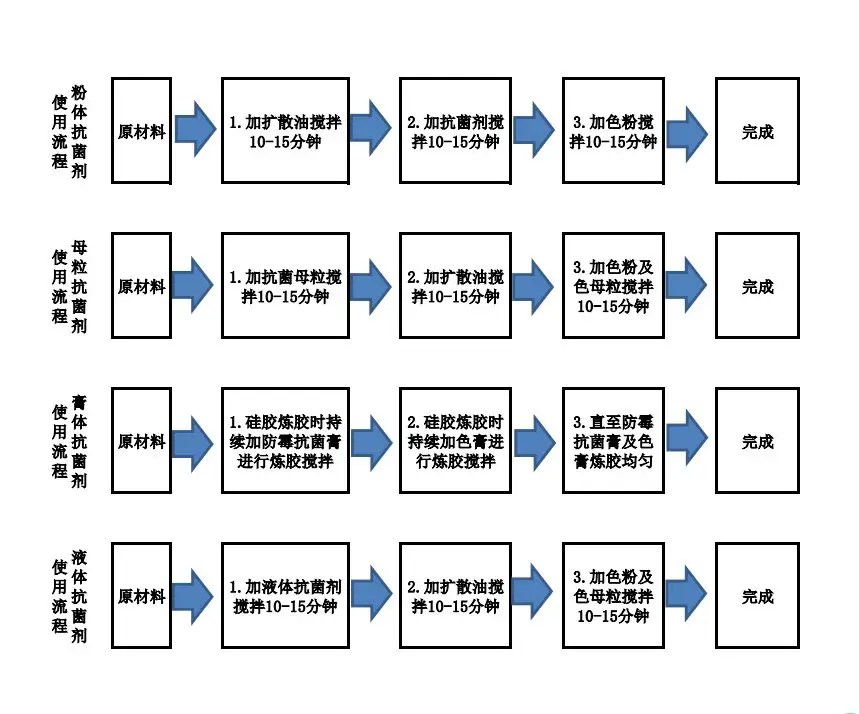
An antibacterial masterbatch is a concentrate of active agent, carrier resin and dispersing aids. Dosage must always be calculated on active content, not masterbatch ratio. The industry window is 0.5-1% active in the finished part; with a 10% active masterbatch that translates to 5-10 parts per hundred resin (5-10 kg per 100 kg of raw material). Below 0.5%, efficacy decays too fast over the product life; above 1.5%, you pay for nothing and risk color shift and mechanical loss.
Carrier matching comes down to three checks. Check the base resin: PP parts take a PP-carrier masterbatch, PE parts a PE carrier – mismatched carriers cause poor dispersion and interfacial defects. Check the melt flow index: the carrier MFI should match or slightly exceed the base resin; a large gap desynchronizes plasticization and shows up as color specks. Check the filler level: in highly filled or regrind-rich blends, add 0.05-0.1% of processing oil (white oil) to aid wetting and dispersion. Before committing to production, always run a gradient trial – 0.3%, 0.5%, 0.8% and 1.2% – mold a set of parts at each level and let quantitative data pick the recipe. That modest cost is nothing next to a rejected shipment.
4. Processing Windows for Injection, Extrusion and Blow Molding
Polyolefin processing is gentle overall: PP injection runs at 180-240 degrees C, HDPE pipe extrusion at 160-200, and hollow blow molding at 170-210. Inorganic silver and zinc agents, stable above 500 degrees C, pass through these windows without any decomposition risk. Organic actives must be checked item by item: the decomposition temperature should exceed your actual melt temperature by at least 30 degrees C – for a 220 degree PP molding operation, that means an organic agent rated at 250 or higher.
Three process notes matter. First, blending order: when antibacterial masterbatch and color masterbatch run together, dry-blend them for 2-3 minutes before feeding to prevent electrostatic separation that shows up as color drift. Second, residence time: after a stoppage, purge material that has sat in the barrel over 30 minutes – any additive risks blooming after long thermal exposure. Third, screw shear: inorganic powders are shear-stable, and a high-shear mixing screw actually helps dispersion, so mid-to-high screw speeds are recommended. The fastest visual check for dispersion is the part surface itself: regular specks or streaks mean unmelted masterbatch.
5. Impact on Mechanical Properties and Appearance
Plant managers often worry that antibacterial agents embrittle the resin. Practical data: at loadings up to 1%, inorganic agents typically shift PP and PE tensile and impact strength by less than 5%, well inside normal part tolerances. Above roughly 3%, the inorganic powder starts behaving like a rigid filler – impact strength drops visibly and surface blooming can appear. Stay inside the 0.5-1% window and you will never meet the problem.
For appearance, transparent and light-colored parts are the sensitive zone: ordinary silver chemistry can impart a faint gray cast in high-clarity PP. Such orders should switch to a grade designed for light and transparent resins such as iHeir-IPL inorganic plastic antimicrobial, with the dosage confirmed by trial in the 0.8-1.2% range. On color matching, antibacterial masterbatch slightly dilutes color strength, so reserve 1-2% extra pigment in the shade match. For high-gloss parts, raise mold temperature 5-10 degrees C to reduce sink and dull spots and to help the active disperse evenly.
6. Testing Protocols and Batch Acceptance + FAQ
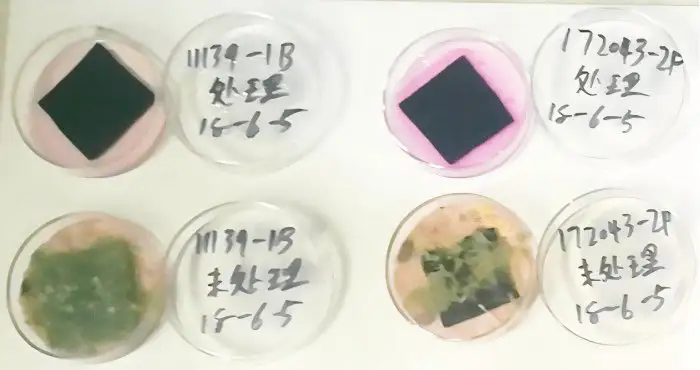
Three standards cover antibacterial plastics; ignore the exotic names. ISO 22196 is the quantitative surface-antibacterial method recognized by international buyers – the report states antibacterial rates, with 90% as the passing line and 99%+ as what major brands actually demand. GB/T 31402 is the Chinese national method for plastic surface antibacterial performance, used by domestic retail systems. GB/T 2423 mold test runs 28 days and grades fungal growth on a 0-4 scale, with grades 0-1 passing for anti-mold claims. For submission: label samples with recipe number and production batch, resubmit whenever the recipe changes, use a CNAS/CMA-accredited laboratory, and keep reports for at least one order cycle so factory audits can be answered on the spot.
FAQ
Q1: What dosage suits a high-regrind blend?
A: Regrind carries more contaminants and a heavier bio-burden. Raise the active level 0.3-0.5 percentage points over the virgin-resin recipe and prefer inorganic chemistry, which tolerates heat and impurities. Ironically, antimicrobial treatment shows its clearest benefit on regrind-rich parts.
Q2: Is inner-wall antibacterial treatment necessary for pipes?
A: For potable-water and industrial fluid lines, yes – biofilm in stagnant sections degrades water quality and flow. Dose 0.5-0.8%. For exterior rainwater pipes with wet-dry cycling, the value is modest; decide by budget.
Q3: Do antimicrobials conflict with flame retardants?
A: Inorganic agents generally do not react with brominated or phosphorus flame-retardant systems. Organic agents should be screened for compatibility with halogenated retardants in a small trial; if blooming or discoloration appears, switch to inorganic.
Q4: How long does testing take?
A: A quantitative ISO 22196 report usually takes 7-10 working days; a 28-day mold test needs 5-6 weeks. Build the testing window into export schedules – never send samples after the delivery date is fixed.
Summing up: pick the chemistry by processing temperature and durability claim, dose at 0.5-1% active with a gradient trial, and test to ISO 22196 or GB/T 31402 depending on the buyer’s market. Get these three right and antimicrobial moves from a selling point to a pass-without-inspection item. iHeir-IPI inorganic plastic antimicrobial agent, built on a silver-ion compound stable above 500 degrees C, suits high-temperature injection and extrusion. For a full factory case on housewares, see our Taizhou plastic housewares anti-mold program; appliance-specific guidance is in Cixi small-appliance export anti-mold, antibacterial agents in home appliances and toilet and bathroom antimicrobial solutions. For samples or a recipe review, contact us – we will match a workable plan to your resin and export market.