




 View Count:61
 Date:2026-09-29
Umbrella fabric mould and leakage usually arrive together, and the fix is the order of the passes rather than a single product: repellency first, then the mould finish, then the frame. Pad iHeir-666 at 8-20 g/L on polyester, 5-20 g/L on nylon, 20-50 g/L on poly-cotton and 30-50 g/L on cotton, and run iHeir-BJ at 2-3% o.w.f. as a separate pass. This article covers the dosage tiers, the bath rule, and the packing and container side.
1. Why umbrella cloth meets mould and leakage at the same time
Two sources feed the problem and they are linked. The first is the fibre: canopies are mostly polyester, nylon and poly-cotton, they pass through water repeatedly during dyeing and coating, and the weaving size, the spin finish and the emulsifiers in the coating are all organic matter that feeds mould. The second is the construction: the cloth is coated or laminated, so the two faces never breathe, moisture between the layers cannot escape once the roll is packed, and a sea passage condenses water on the container roof that drips onto the top cartons.
The result is cloth that has not leaked yet but is already mouldy, or cloth whose growth has opened a path for water. Order matters too: run the two finishes in the wrong sequence and the agents interfere, so both underperform. A plant has to decide which pass comes first, how much each takes, and which agents cannot share a bath.
2. The four dosing points at a glance
The table lists the stage, what is treated, the product, the figures and the points to watch, so it can serve as the first draft of a process card.
| Stage | Treated part | Product | Figures | Points to watch |
|---|---|---|---|---|
| Repellent finishing (the waterproof line) | Polyester, nylon, poly-cotton, cotton canopy | iHeir-666 water-based repellent | 8-20 g/L on polyester, 5-20 g/L on nylon, 20-50 g/L on poly-cotton, 30-50 g/L on cotton | Pad once, pre-dry at 110-130 degrees, cure at 170 degrees for 60 seconds; PFOA below 1 ppm |
| Mould finishing (the anti-mould line) | Canopy fabric and sleeve | iHeir-BJ textile mildew inhibitor | Padding at 2-3% o.w.f. | Bath 21-50 degrees, pH 4.5-8.5, soft water; cationic, never with an anionic auxiliary |
| Heavy cloth and oil-repellent work | Heavy cotton canopy, coated cloth | iHeir-600 oil-based waterproofing agent | Two cross sprays, 10-12 grams per square foot | Air dry or low-temperature dry afterwards; store between 0 and 50 degrees |
| Frame and shaft | Metal ribs, shaft, springs | Rust inhibitor to the process card | Mixed to the specified bath strength, used within 12 hours | Keep it after the cloth pass so the bath cannot contaminate finished fabric |
| Assembly and casing | Finished umbrellas and inner packing | iHeir-D vapour-phase sheet | 0.1-0.2 grams of active content per sheet | Confirm the article is dry before casing; place sheets by bag volume |
| Export container | The full container load | T-1000 container desiccant sticks | 8-10 sticks for 20 ft, 10-12 for 40 ft | Hang from the roof rails and leave the air path clear |
Six rows, one conclusion: umbrella protection has four lines, repellency, mould, rust and humidity control. Skip any one and the other three have to carry it, at a higher cost.
3. The repellent pass: pick the rate by substrate
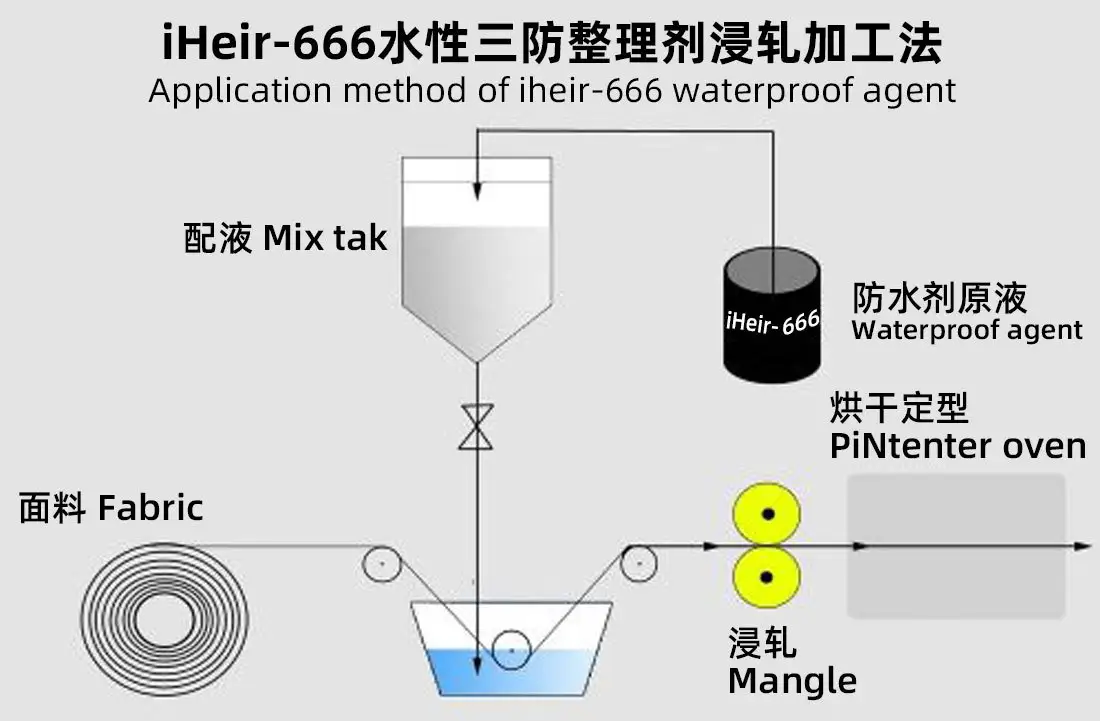
Repellent finishing is the main waterproof line and the easiest place to get caught by one setting. iHeir-666 runs in four tiers by substrate: 8-20 g/L on polyester, 5-20 g/L on nylon, 20-50 g/L on poly-cotton and 30-50 g/L on cotton. Synthetic fibres take up little liquor and hold the agent poorly, so the lower end will do; cotton and poly-cotton are strongly hydrophilic and carry far more liquor, so the rate has to move up or the spray rating will not hold. The route is a single pad, pre-drying at 110-130 degrees to remove free water, then curing at 170 degrees for 60 seconds so the finish cross-links into a film.
Three variables decide which end to use: fabric weight, whether the cloth is coated, and the destination. Light polyester canopy sits low; heavy cotton and any product that also has to repel oil sit high. For the EU, the water-based fluorine-free route is the safer default, and this product is below 1 ppm PFOA with no APEO or PFOS. Test them separately: repellency comes from the spray rating (start at 5 g/L) and oil repellency from its own rating, which reaches 6.5 at 30 g/L.
4. One bath rule: never mix the mould finish with an anionic auxiliary
The mould pass follows iHeir-BJ at 2-3% o.w.f. by padding, with the bath at 21-50 degrees Celsius, the working liquor at pH 4.5-8.5 (ideally near 6), soft water throughout, and pre-mixing with 9-13 parts water before the bath. Pickup is held at 70%. The rate sets the service life: 2% corresponds to about a year or more and 3% to two to three years, so choose the tier by the humidity of the destination.
The rule that matters sits here: BJ is cationic and must not run in the same bath as an anionic auxiliary. Repellents, softeners and fixing agents all come in anionic grades, and the two complex in the bath, the agent is lost, marks can appear on the face, and both passes are wasted. Run them as separate passes: mould first, dry thoroughly, then repellency; or the reverse with a separate mould immersion afterwards. Rinse in between. That line belongs on the process card, because shift and bath changes are where it breaks.
5. Frame, assembly and casing
The frame treatment is a small material cost that decides the life of the umbrella. Run the rust pass after the cloth finishing is complete so the bath only touches metal. Some plants save a step and put ribs and cloth through one bath; the metal ions react with the finishing agent and leave spotted discolouration on the face, and the rework costs far more. Mix the bath to the process card and use it within 12 hours, because both strength and performance drift after that.
At assembly and casing, watch dryness and sealing. Hold the assembly area below 65% relative humidity and confirm cloth and frame are dry before the umbrella is bagged. Where several pieces share a bag, place iHeir-D vapour-phase sheets at 0.1-0.2 grams of active content each, inside the bag with the goods rather than outside it. For full-container export, hang T-1000 sticks to match the unit: 8-10 for 20 ft and 10-12 for 40 ft. Umbrellas ship in long packs, so stacked cargo has almost no air path between layers and roof condensation runs down onto the top cartons first.
6. Common questions
Q: Can repellent finishing replace the mould finish? No. Repellency deals with water penetration, the mould finish deals with growth in the fibre and the coating. Good repellency only reduces the water that reaches the fibre; it does not deal with spores already sitting on the size and the finish. A passing spray rating says nothing about mould resistance.
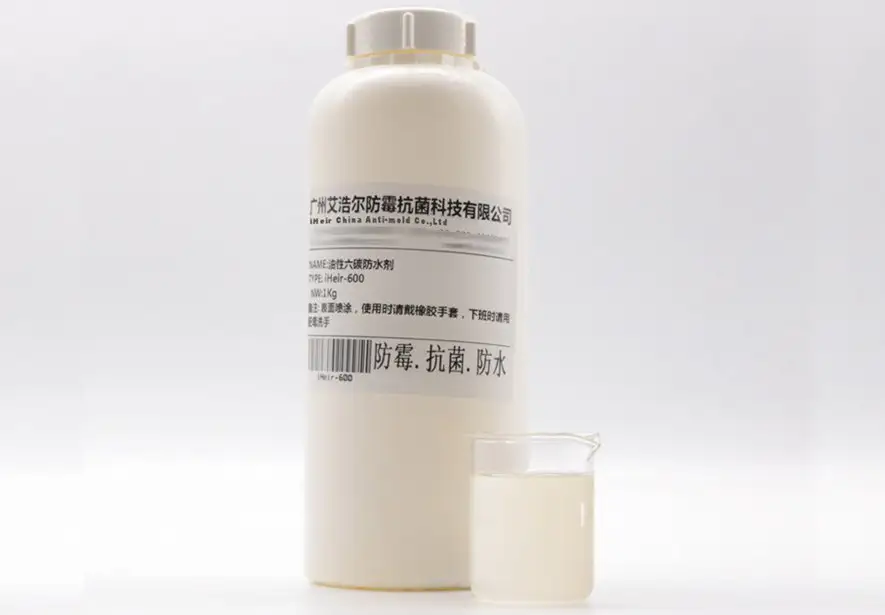
Q: Why switch heavy and coated cloth to spraying? Those fabrics are heavy and the coating blocks penetration, so a single dip leaves liquor on the surface only. iHeir-600 applied in two cross sprays at 10-12 grams per square foot covers the surface in perpendicular directions, which reaches folds and seams that a dip misses.
Q: Which stages decide mould on finished umbrellas? Three: the mould finish on the finishing line, the iHeir-D sheet at packing, and humidity control in the container. Rework on umbrellas is close to impossible, so a spotted canopy is a write-off. The fibre side is set out in mould and repellent finishing on outdoor fabric, and the container side in moisture and mould in sea containers.
Umbrella fabric mould control comes down to order: the repellent pass by substrate tier, the mould finish as its own pass and never with an anionic auxiliary, the rust bath after the cloth pass, and vapour-phase sheets plus container humidity control to close. Samples and minimum order details are available on request.


