




 View Count:19
 Date:2026-11-19
How is carbon brush mould handled? Not by dosing graphite: the body is dense and rarely supports growth, while the cotton shunt braid and the plated spring seam go first. Bath the braid at 2%-3% o.w.f. in iHeir-BJ at 21-50℃ and pH 4.5-8.5, blow the spring ends dry before assembly, and put iHeir-D sheets at 0.1-0.2 g into each box. This article covers the three stages and how to judge them.
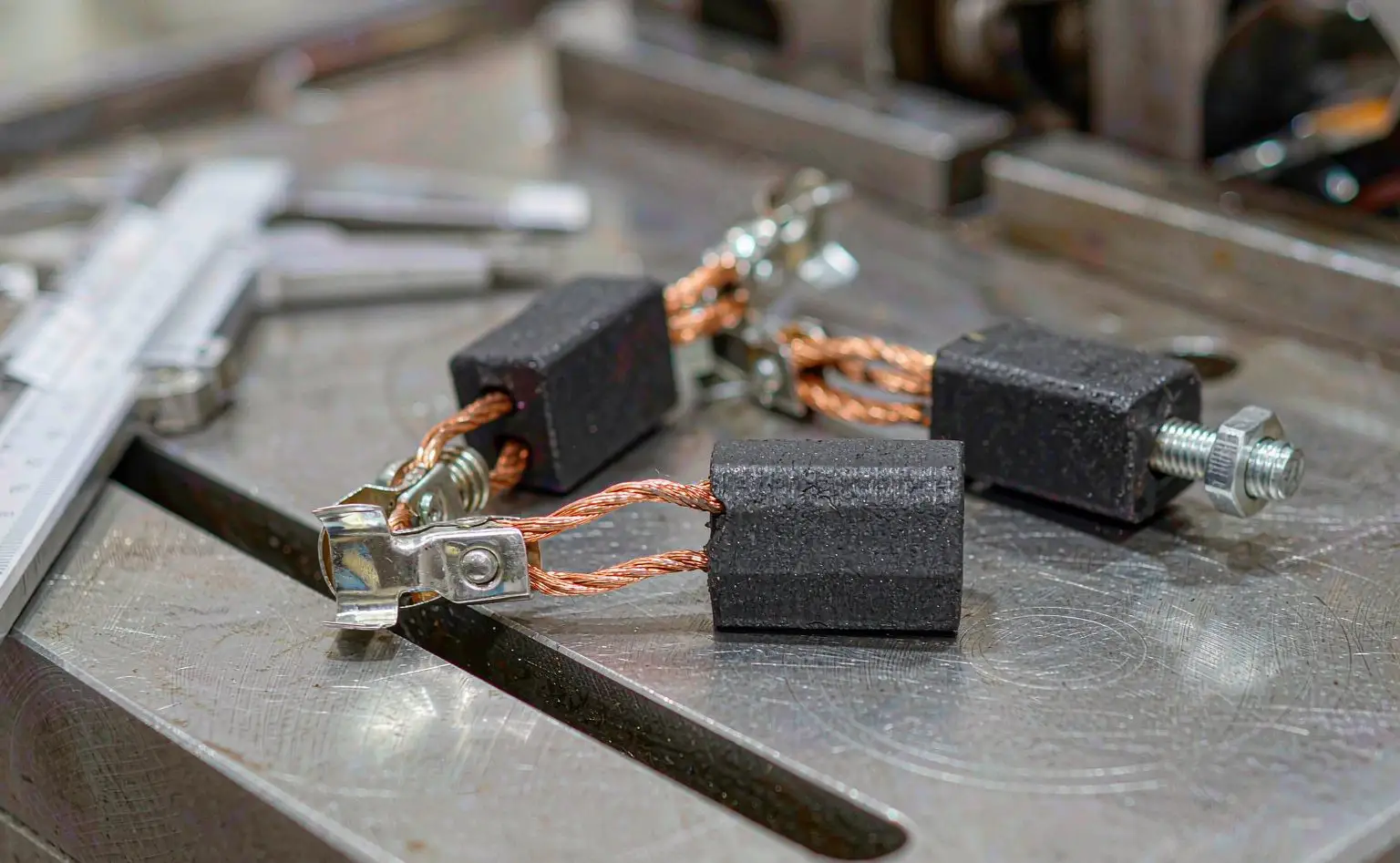
1. Where the mould comes from: body, braid, spring seam
The graphite body comes last. Graphite powder pressed and baked with a binder is dense and high in carbon, so mould finds little to feed on at the surface; when a body does fail it is water carried in at mixing, not growth on the graphite.
The cotton braid comes first. A shunt is a copper strand braided or wrapped in cotton, and cotton is pure cellulose that takes up both moisture and oil. Hand sweat at assembly plus a little machine oil plus store humidity puts grey-green spots on the braid within days.
The plated spring seam comes second. Between the plating and the wire there is a micro gap that holds rinse liquor after pickling and plating; water in the gap plus the organics in the coating give a ring of spots around the coils.
So the work runs on two lines: bath the cotton with a textile anti-mould agent, and get the water out of the metal; then add gas-phase control inside the box.
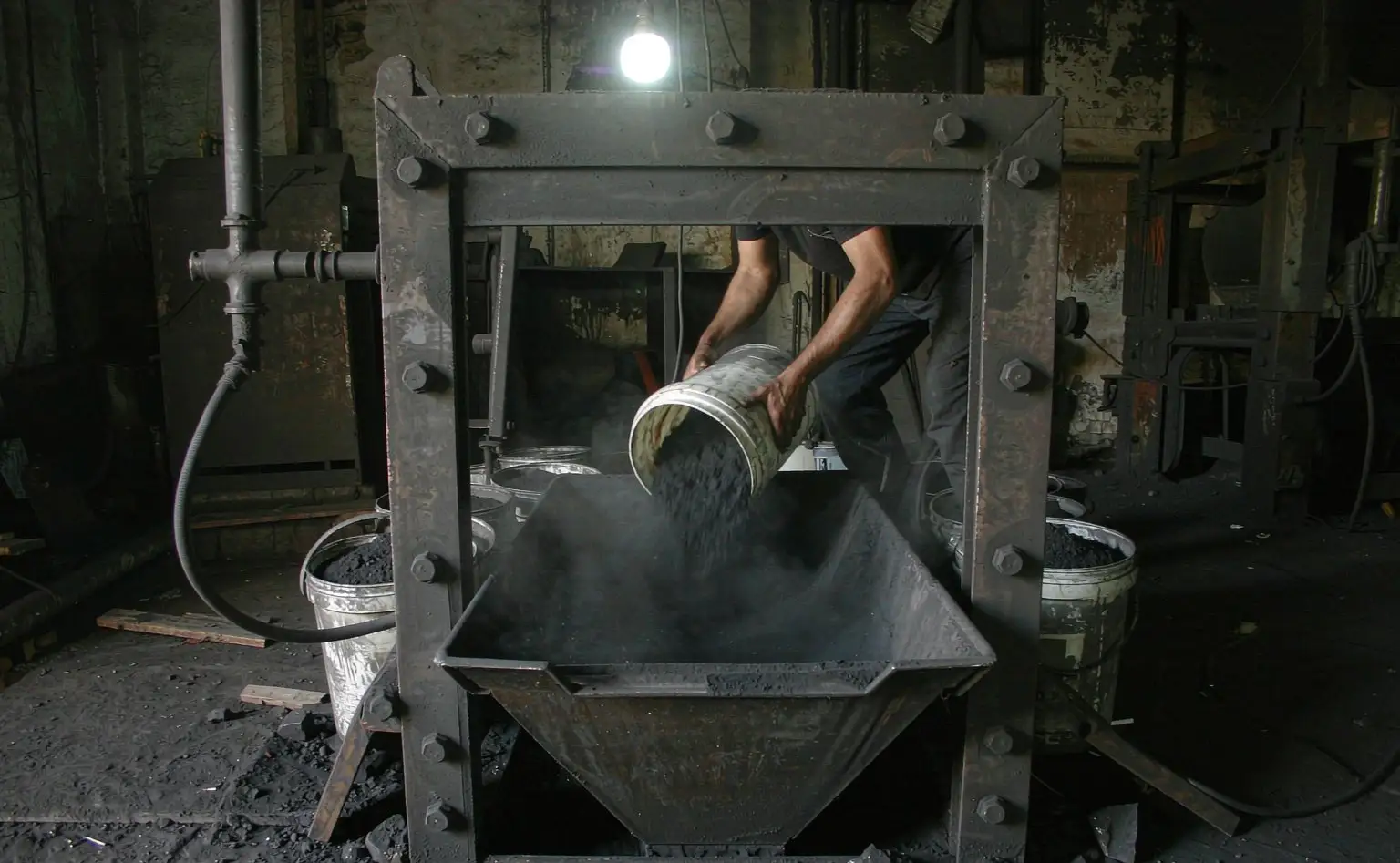
2. Mixing and pressing: hold the water at the mixer
Test the graphite powder first. Once a bag is opened it takes up moisture quickly, and in the rainy season incoming powder can pass 1%. Test before mixing and dry anything above spec; pressing will not squeeze the water back out.
Weigh the binder, do not top up with water. Phenolic or pitch binders carry their own solvent, and mixing too hot drives it off early. The mix then feels dry and someone adds a splash of water for hand feel, which is exactly where the moisture comes from.
Bake the body right through. Bodies straight out of the press go to the oven to route; a body that is under-baked keeps releasing vapour inside the box, and it lands on the braid and the spring. Log weight loss per batch.
Do not stack hot bodies. Rack baked bodies in the air; pressed into a pile overnight, the middle layers keep their water and those are the brushes that fail after assembly.
3. The cotton braid: 2%-3% o.w.f. at 21-50℃
This stage needs a textile agent applied in a bath; a spray only covers the outside and the core stays dry.
Dose on dry weight. iHeir-BJ goes in at 2%-3% o.w.f. on the dry weight of the braid. Three kilograms treats 100 kg of material, and at 70% pick-up the agent is pre-mixed with 9-13 kg of water before it is added in portions.
Bath conditions. Hold 21-50℃ and pH 4.5-8.5, and use soft water; calcium and magnesium in hard water throw the agent out of solution.
No anionic auxiliaries in the same bath. BJ is cationic. Braid that has been through an anionic softener or soaping agent has to be rinsed clean before it goes in, or the bath curdles and the agent never fixes.
Dry by the finishing route. Do not air-dry: cotton held damp for hours loses the agent before it fixes. Dry to route, then check moisture and re-dry anything over spec.
| Part | Material | Product and level | Stage | Control point |
|---|---|---|---|---|
| Graphite body | Graphite powder and binder | No additive | Mixing, pressing, baking | Powder moisture, body baked through |
| Shunt braid | Cotton over copper strand | iHeir-BJ 2%-3% o.w.f. | Bath and padding | 21-50℃, pH 4.5-8.5, soft water |
| Spring | Plated spring wire | No additive | Blow dry, assembly | No liquor left in the coils |
| Box packing | Carton and liner | iHeir-D 0.1-0.2 g per sheet | Sheet in before loading | Sheet off the spring and terminals |
| Export carton | Outer carton | Sheets by box count, barrier film inside | Packing | No undried goods in the carton |
One boundary. BJ handles the organisms in the cotton, the process handles water in the graphite and the plating gap, gas-phase sheets handle the air in the box. Each covers its own stretch.
4. Springs and assembly: blow dry, keep oils apart
Blow into the coils. After plating or blackening, angle the air nozzle at the coils so the rinse liquor comes out of the gap; blown flat across the surface, the water stays where it was.
Do not share lubricant across stations. Brush holders, springs and terminals run on one line, and mixed lubricant and rust oil carried onto the braid becomes food. Separate the cotton parts from the metal stations, or switch to a lubricant free of animal and vegetable oils.
Keep gloves dry. Cotton gloves take up sweat within half a shift. Nitrile gloves, or cotton changed often, remove one of the most common sources of braid mould, and it is the step most plants skip.
Do not seal the box straight away. A few degrees between assembly and packing is enough to condense on a freshly built brush; leave it in the packing area for two hours before closing.
5. Boxes and cartons: where the sheets go
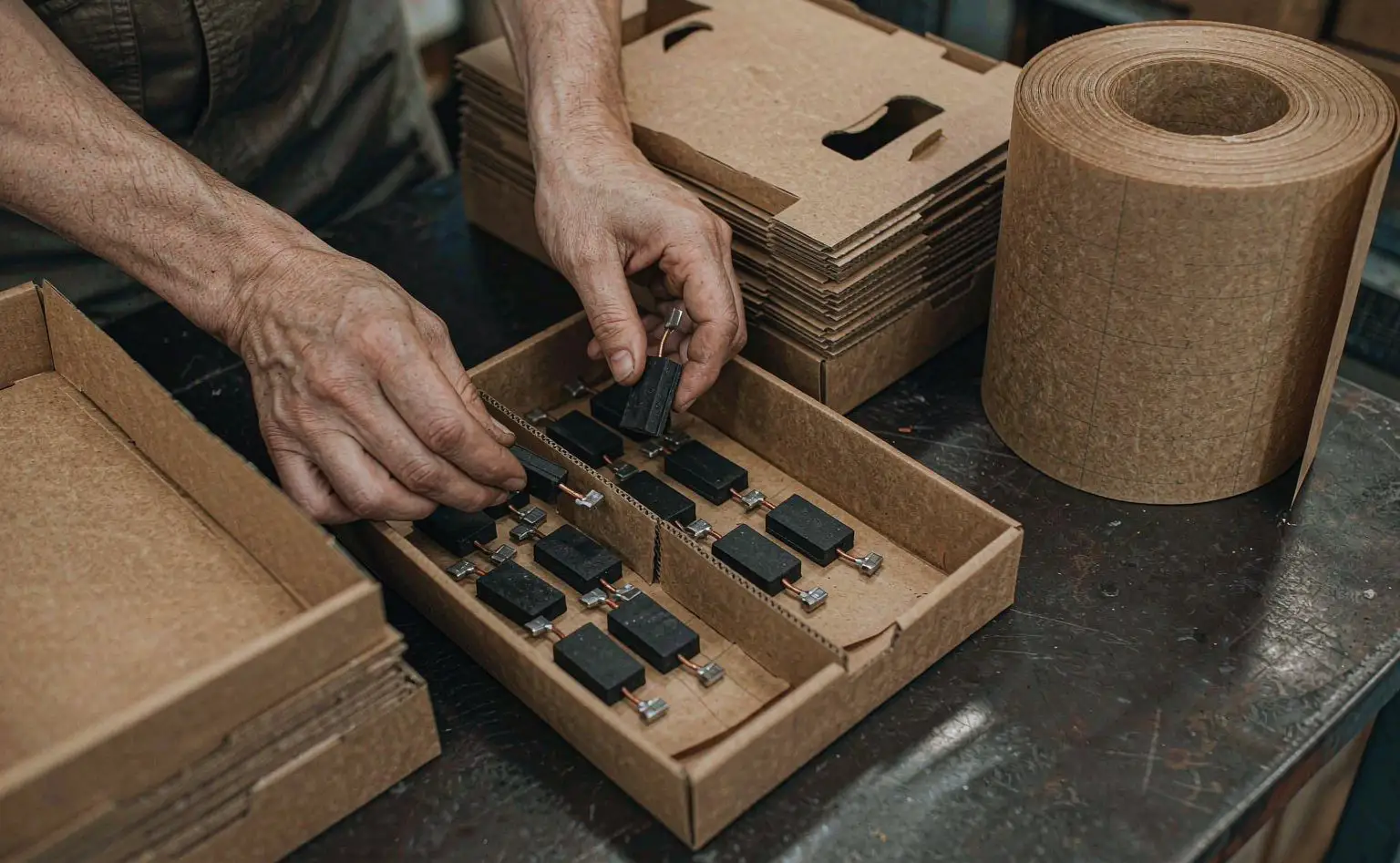
One sheet per box, counted in grams. Each iHeir-D sheet carries 0.1-0.2 g. One box takes one sheet; boxes holding several brushes are dosed per box, not per brush.
Sheet in the base, off the spring. Lay the sheet in the bottom and press the brushes onto it. The product page warns of corrosion on poor-quality metal parts under damp conditions, so a corrugated liner goes between the sheet and the springs and terminals.
Run a compatibility test first. Three times the normal rate, a little water, paper in between, closed for a few days, then check the copper braid for discolouration and the plating for dulling before the batch goes ahead.
Carton and store. Sheets by box count in the outer carton, barrier film inside, store below 60% RH with pallets 10 cm off the floor. For containers, check floor and wall moisture and add board under the bottom layer. Comparable work on motor parts is in motor end caps and foam inserts and hardware tools at the carton stage.
6. Questions from the line
Q: Can we just add an anti-mould agent to the graphite powder?
A: It is unnecessary and risky. The body rarely supports growth, and dosing the powder changes resistance and wear, which means new type testing. Control the water at mixing and baking instead.
Q: Does bathing the braid affect conductivity?
A: At 2%-3% o.w.f. the agent sits on the cotton fibres and does not change the copper cross-section or the crimp. Overdosing stiffens the cotton, which makes the crimp looser, not better.
Q: Why dry the spring if metal does not grow mould?
A: Metal does not, but the liquor trapped in the coils carries plating organics that feed mould. Drying cuts that food and water path.
Q: Is one sheet enough for a small box?
A: Yes. The volume is small and the vapour spreads quickly, so 0.1-0.2 g per box is the working figure; a large box or a multi-brush box takes one more, not a multiple of the brush count.
Control moisture in the powder and binder and bake the bodies through; bath the cotton braid at 2%-3% o.w.f. in iHeir-BJ at 21-50℃ and pH 4.5-8.5 in soft water, with no anionic auxiliaries in the bath; blow the spring coils dry, keep oily lubricant off the assembly stations and the gloves dry; put one iHeir-D sheet at 0.1-0.2 g in each box, in the base and under a liner, after a compatibility test; hold the store below 60% RH. Mould performance can be verified to GB/T 24346 and ASTM G21, and lead times are on the iHeir-BJ product page.


