




 View Count:17
 Date:2026-11-20
How is ball screw mould handled? The steel body does not grow mould. The spots sit in the condensation layer under the oil film, on pallet timber and on paper packing. Dry the screw after grinding before oiling it, touch up the bearing journals with iHeir-D treatment liquid, put gas-phase sheets at 0.1-0.2 g into each crate, and load T-1000 rods at 8-10 per 20ft container and 10-12 per 40ft. One 4 m screw with spots is rejected on appearance and the drive train behind it is reworked. This article covers drying, oiling, touch-up and packing.
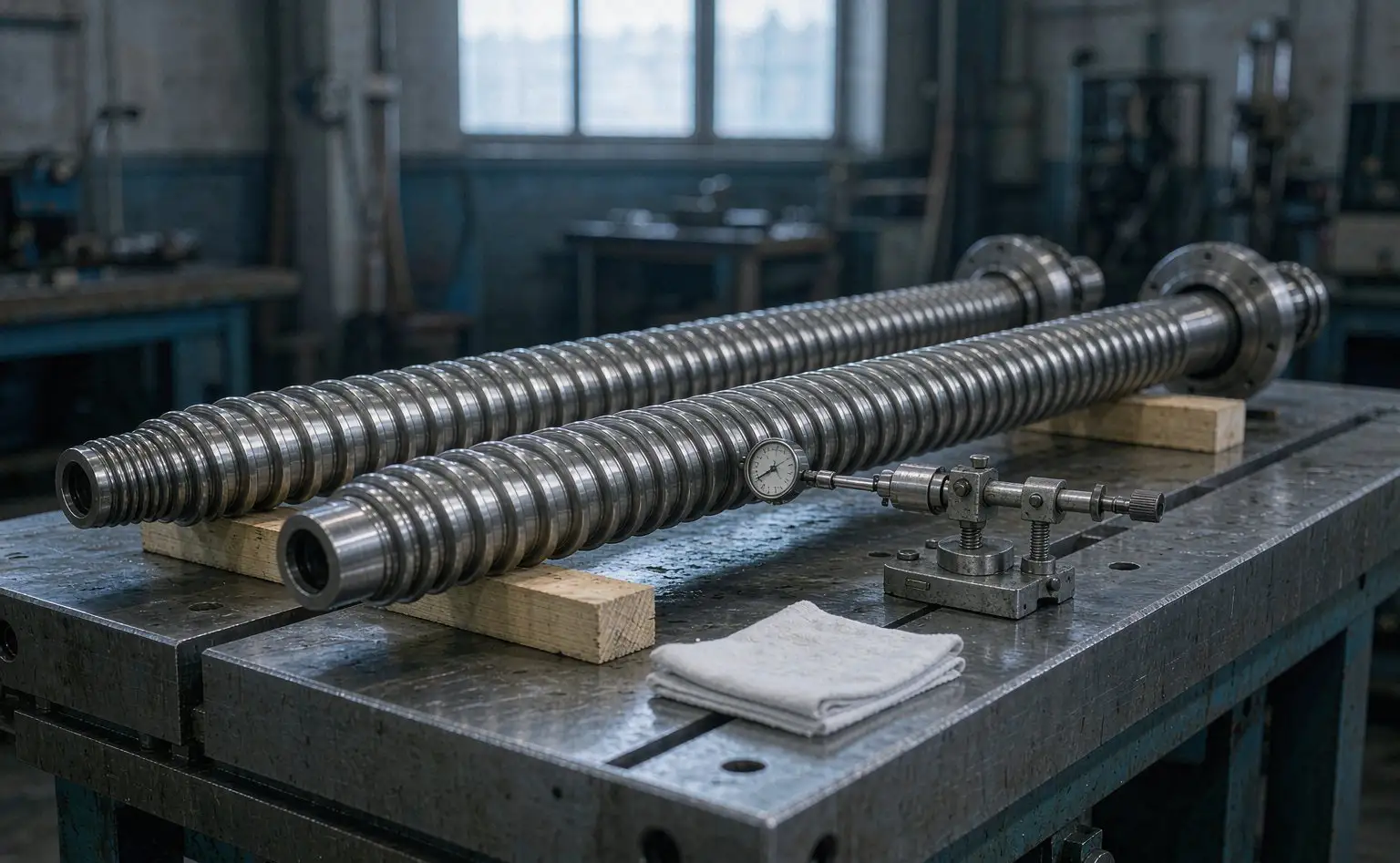
1. Where the spots actually sit
The interface under the oil film. A screw coming off the grinder is cooler than the shop air, so it takes up moisture on the way to packing and carries an invisible water film. Oil brushed over that film seals the water in, and a few days later a wipe with a cloth shows grey-white patches with a musty smell. They are pale and powdery under the finger, not red like rust.
The timber strips. Long slender parts have to lie on timber, and timber above 20% moisture behaves like a damp sponge against the contact face. The oil film is drawn into the wood and moisture comes up from below.
The paper packing. Rust paper, manuals and labels all take up moisture. Once the crate is closed the vapour circulates inside, the paper grows mould first, and the growth then transfers to the steel.
The test is simple: wipe the oil off and look with a loupe. Pale grey, soft edges and a musty smell is mould. Red-brown, sharp edges and a hard crust under the fingernail is rust. The two are treated in a different order, so do not mix them up.
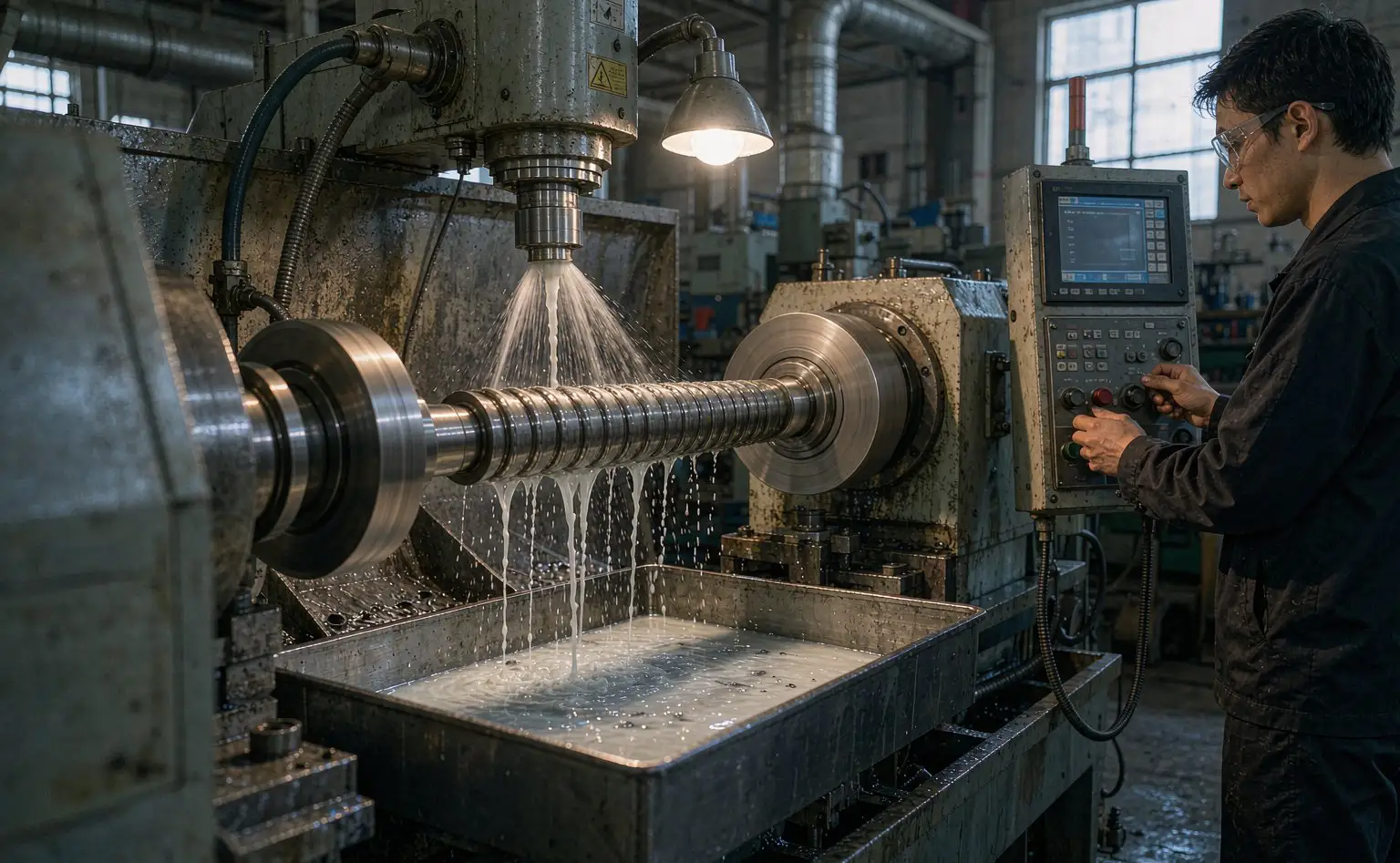
2. Drying after grinding: get the water out of the grooves
Rinse the water-based fluid off before drying. The thread grooves and the oil holes hold liquid, and an air gun blown flat across the surface leaves it there. Angle the hot air along the thread helix, or put the whole screw through an oven at 60-80℃ for 30-60 minutes depending on diameter and length.
Do not oil straight out of the oven. A hot screw condenses moisture the moment it meets cooler packing-area air. Let it come within 3℃ of shop temperature with no visible water film, then oil.
Log the check. Weigh two screws per batch before and after drying, or wipe with white paper and look for a water mark. Keep the record by batch for audits.
Treat the oil holes separately. Blow into the end oil holes with a fine nozzle, then press filter paper against the hole; no damp mark means it passes.
3. Oiling and journal touch-up: thin and continuous
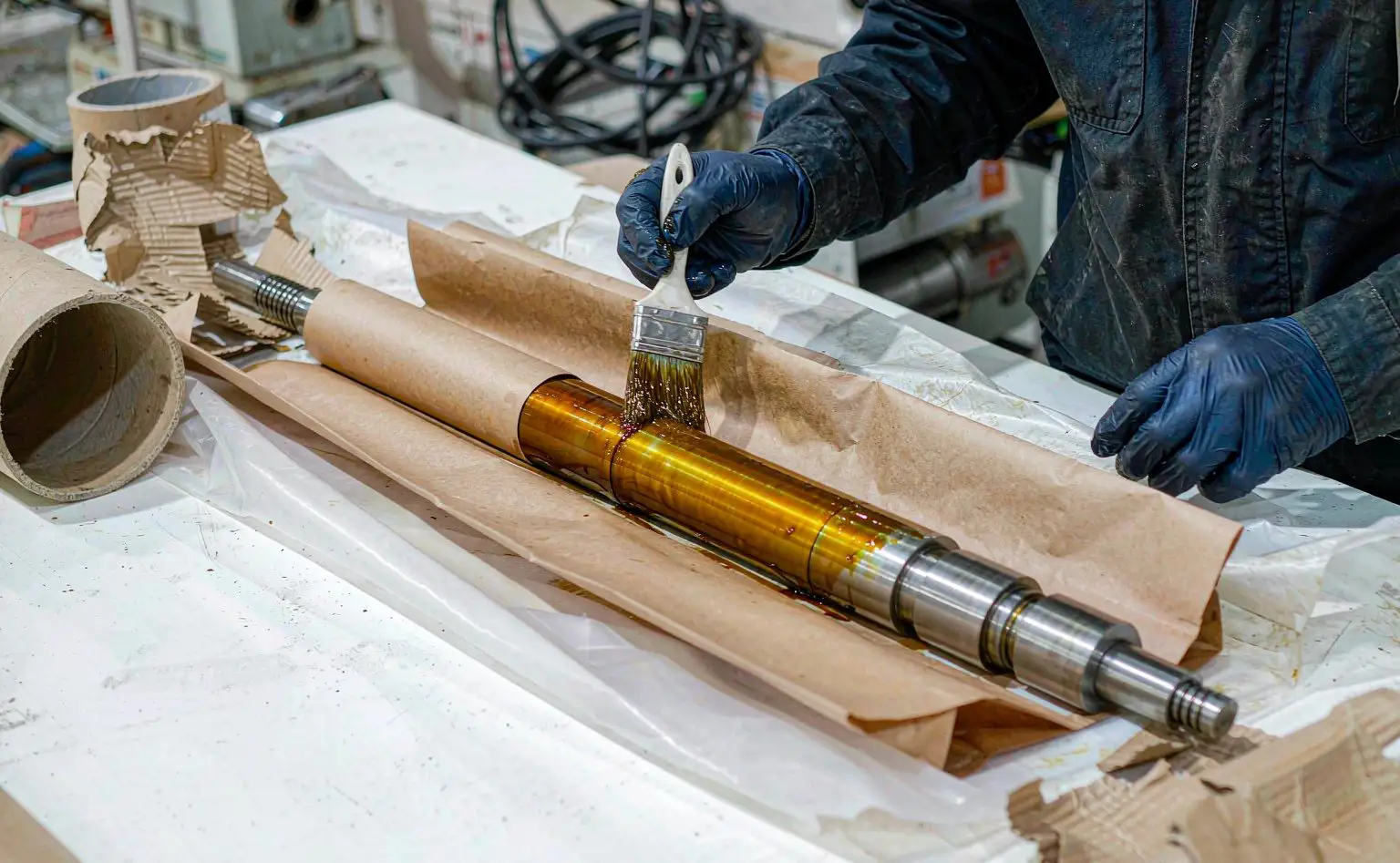
One thin film is enough. A thick coat skins over while the layer underneath still holds solvent, which traps moisture. Brush to 20-30 μm, glossy but not running, and let it drip dry.
The bearing journals and keyways are machining faces. They cannot take a heavy coat or a dip before packing, only a touch-up: brush a thin pass of treatment liquid, and because iHeir-D works as a gas-phase system it flashes off to a film without changing the fit. Wipe the surplus with a non-woven cloth afterwards.
No animal or vegetable oil in the rust preventive. That oil is food for mould, and once water gets into the film the growth spreads along it. Specify a mineral or synthetic rust preventive and ask the supplier for the composition sheet.
Separate the stations. Keep grinding away from the oiling bench so wet air does not travel with the parts, and dehumidify the bench area to below 60% RH.
| Part | Material | Product and level | Stage | Control point |
|---|---|---|---|---|
| Screw outside diameter | Bearing steel | No additive | Grinding, drying, oiling | No fluid in grooves, part within 3℃ of shop air |
| Journals and keyways | Machining faces | iHeir-D treatment liquid, brushed | Before packing | One thin pass, fit unchanged |
| Packing liner | Rust paper, manual | iHeir-D 0.1-0.2 g per sheet | When the crate is lined | Non-woven layer between sheet and steel |
| Timber and pallet | Pine, plywood | Moisture below 20% | Incoming check | Barrier film on the contact face |
| Container export | Container | T-1000 8-10 per 20ft, 10-12 per 40ft | Hanging at loading | Dry floor, liner film inside |
One boundary. Drying and oiling keep water off the steel, gas-phase sheets handle the air inside the crate, and the rods handle humidity in the container. If any one of the three is skipped, the other two cannot make it up.
4. Packing: where the sheets go and what they touch
Count sheets, not volume. Each iHeir-D sheet carries 0.1-0.2 g of active. A single-screw crate takes 2-4 sheets, split between both ends and the middle; a large crate takes one more, and a sheet is never wrapped round the workpiece.
The sheet stays off the steel. The product page warns of corrosion on poor-quality metal parts in damp conditions, so a non-woven or PE layer goes between sheet and screw. The sheet sits against the crate wall and works by diffusion through the air.
Run a compatibility test. Three times the normal rate, a little water, paper in between, closed for 5-7 days. Then check the oil film for dulling and the threads for discolouration before the batch goes ahead. iHeir-D is 70%±5 solids in 25 kg drums with a one-year shelf life, so reseal the drum after use.
Do not mix wet items into the crate. Dry the timber, card and labels before they go in, and replace a crate wall that already has spots.
5. Container loading: how many rods
Count by container size. T-1000 goes in at 8-10 rods for a 20ft container and 10-12 for a 40ft, hung from the top rails and the door frame rather than piled on the cargo. The body is a SAP cross-linked sodium polyacrylate that holds moisture without the liquid bleed that salt-type desiccant bags show, so a rod resting on the load will not corrode steel.
Check the box before loading. Reject a container with damp floors or walls, wipe up standing water and ventilate for half an hour.
Leave air paths. Keep 5-10 cm between crates and do not stack to the roof; crates need cross bracing so the load cannot shift and tear the paper.
Long voyages. Past 30 days at sea, use sheets and rods together; rods alone leave local humidity high inside the packing. Comparable metal work is covered in bearing mould, rust oil and drying rods and hardware tools at the carton stage.
6. Questions from the shop floor
Q: Does steel really grow mould?
A: No. The growth sits in the water film under the oil, in the timber and in the paper, and it looks like mould on steel. Treat the water and the food source rather than brushing a biocide onto the metal.
Q: Can we dip straight into rust oil after grinding?
A: Not advisable. The part still carries grinding fluid mixed with water, and oil seals it in. Dry to no visible water film first, then oil.
Q: Does the journal touch-up affect assembly tolerance?
A: A thin pass flashed to a film is micron thickness and does not change the fit. Wipe the surplus off, and clean with anhydrous ethanol before assembly.
Q: How many sheets are enough?
A: Count by crate: 2-4 sheets for a single-screw crate, split between the ends and the middle. A bigger crate with more liner takes one more. More sheets is not better, because the contact risk with metal goes up, so keep the separating layer.
Rinse the grinding fluid, dry at 60-80℃, oil once the part is within 3℃ of shop air at a 20-30 μm film with no animal or vegetable oil in it; touch up the journals and keyways with a thin pass of iHeir-D treatment liquid; line each crate at a dosage of 2-4 sheets at 0.1-0.2 g with a non-woven layer against the steel, after a three-times compatibility test; hang T-1000 at 8-10 rods per 20ft and 10-12 per 40ft. Mould performance can be verified to GB/T 24346 and ASTM G21, and samples and minimum order are on the iHeir-D product page.


