




 View Count:36
 Date:2026-11-04
Why does circuit breaker mould need two stages, and why does the carton keep moulding after the shell has been wiped? Spots on the shell sit in the parting lines and on the oil film of a printed face, while spots in the carton start in the corrugated board and the divider. Blend iHeir-JS117 plastic anti-mould powder into the flame-retardant shell at 0.5%-1.0% of weight, and stick iHeir-D vapour sheets against the carton wall at 0.1-0.2g of active matter each. This article covers the mixing stage, the UL retest and the packing.

1. Mould in the shell gaps, and in the carton and divider
Take a miniature breaker apart: flame-retardant shell and cover, handle, contacts and arc chute, coil and bimetal, terminals, factory carton and divider. Metal parts and coils do not mould. The plastic shell and the carton board do.
The shell fails at the surface. Flame-retardant ABS or PC parts are usually moulded without paint, so release agent, fingerprints and printing ink stay on the surface, and parting lines, handle slots, terminal openings and window edges collect dust. Once store humidity rises, those points spot, and wiping leaves a haze on the gloss face that ends in a downgrade.
The carton fails because it is closed. A packed breaker in a carton with a divider sits in a nearly airtight volume: the board takes water, the divider holds it in the middle, and the moisture has nowhere to go. Made in a wet season and held three months in a southern warehouse, the carton opens onto spots along the divider while the breaker itself looks clean.
Neither stage replaces the other. Powder in the shell does not evaporate into the carton, and a sheet in the carton never reaches the compound. Treat one stage only and the other still fails, which is the most common reject in low-voltage export.
2. Powder in the shell, sheets in the carton
The table lines up the shell, the cover, the carton and the terminals. Plastic is dosed on weight, paper on active matter per sheet, and the two are not convertible.
| Part | Material | Product and level | Stage | Control point |
|---|---|---|---|---|
| Shell, cover | Flame-retardant ABS, PC | iHeir-JS117 0.5%-1.0% of compound | Premix before moulding | Retest flame and electrical ratings |
| Carton, divider | Corrugated, moulded pulp | iHeir-D 0.1-0.2g per sheet | Before the carton is sealed | Trial at three times the dose |
| Handle, button | POM, flame-retardant ABS | Run with the shell compound | Moulding | Trial-moulded with the shell |
| Terminals, screws | Copper, plated steel | Rust protection only | Assembly | Keep the sheet off metal |
One boundary. A vapour sheet acts only inside a closed space and never reaches work in progress left open on the line; powder in the shell does not migrate into the carton either.
3. Flame-retardant shell: how the powder goes in, and book the retest
Shell and cover take iHeir-JS117 plastic anti-mould powder at 0.5%-1.0% of finished part weight. It is a nitrogen heterocycle phenol-alcohol compound with more than 97% active matter, 380 kg/m³ bulk density, 110μm mean particle size, insoluble in water, leaching-resistant and arsenic-free.
Where. Blend it thoroughly with the compound and mould as usual. Plants compounding in house mix it with pellets, flame retardant and pigment in a high-speed mixer, then pelletise or feed the machine; those buying compound have it blended at the pelletising stage. Do not scoop powder into the hopper: at 110μm the barrel shear is far too brief, and the result is a hazy streak across the shell.
The retest is not optional. Any additive in a flame-retardant part means the flame and electrical validation is done again: vertical burning to UL 94, glow-wire flammability to GB/T 5169.11, glow-wire ignition temperature to GB/T 5169.12, and comparative tracking index to GB/T 4207. A shell is a safety part; if the rating drops, the batch does not ship however good the mould result looks.
Trial before production. ABS and PC sit outside the usual JS117 recommendation list, so run one set at 0.5% and one at 1.0% for compatibility and mechanics: impact strength, shade shift, flow marks at the parting line, then book the retest. Mould thin covers and clear windows as their own batches rather than sharing compound with dark shells.
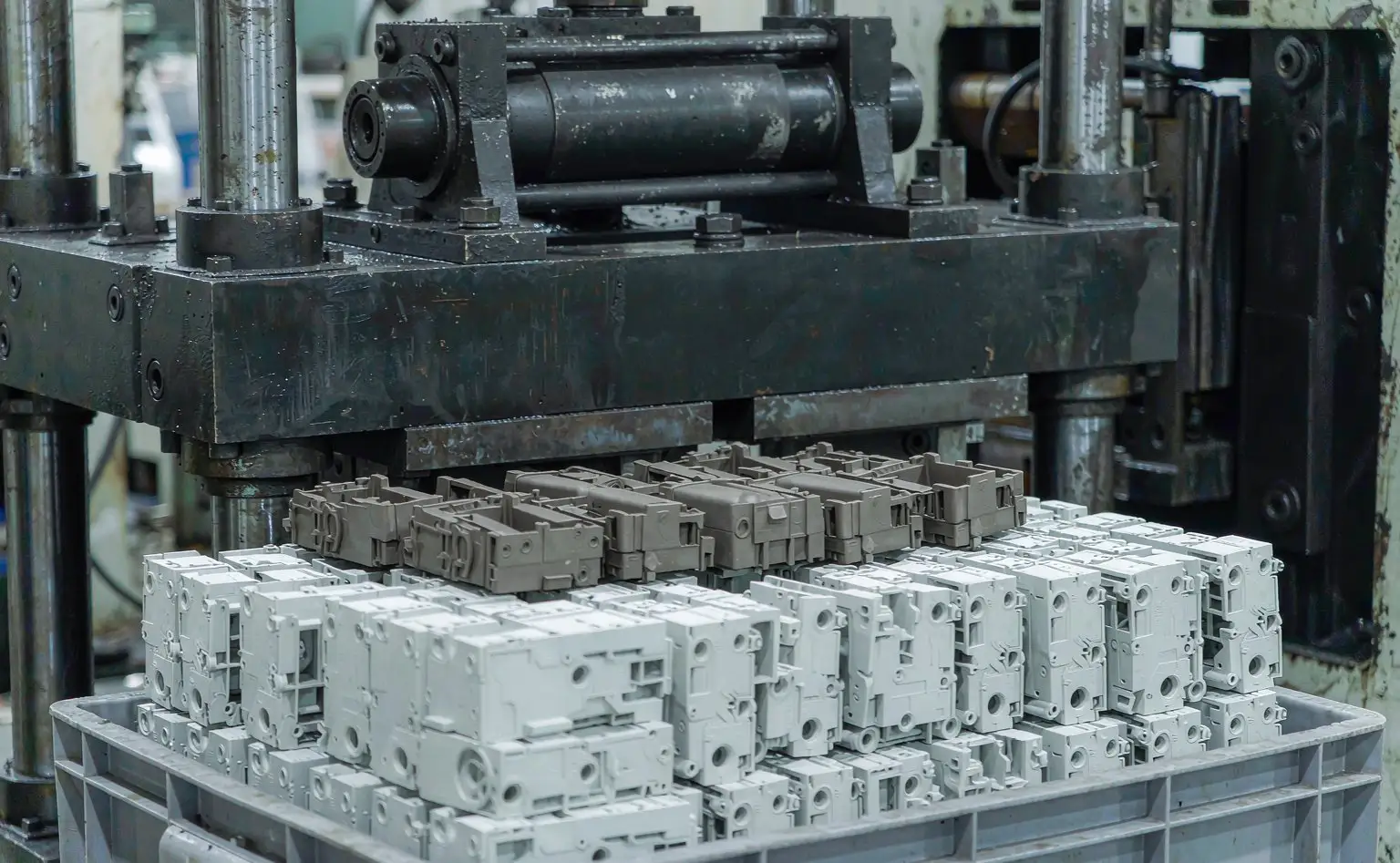
4. Assembly, storage and the factory carton
Risk at assembly is exposed work in progress: moulded shells wait in totes while covers and handles lie loose at the bench. Move shells within the shift, lid the totes, hold the shop below 60% RH, and let assembled units reach room temperature before bagging, since a warm unit in a bag traps its own moisture.
In the store: cartons on pallets 10cm off the floor and 10cm off the wall, humidity below 60% RH, dehumidifiers through the wet season, and no stack pushed up against the ceiling, where the gap to the lights condenses first. Plants supplying panel builders treat the cabinet by volume and the carton separately, because the two are different volumes.
The paper stage uses iHeir-D gas-phase anti-mould paper at 0.1-0.2g of active matter per sheet: one inside a single-unit box, and one against the carton wall plus sheets between layers for multi-unit cartons. Keep the sheet away from terminals and metal parts, using a divider or a sheet of paper in between.
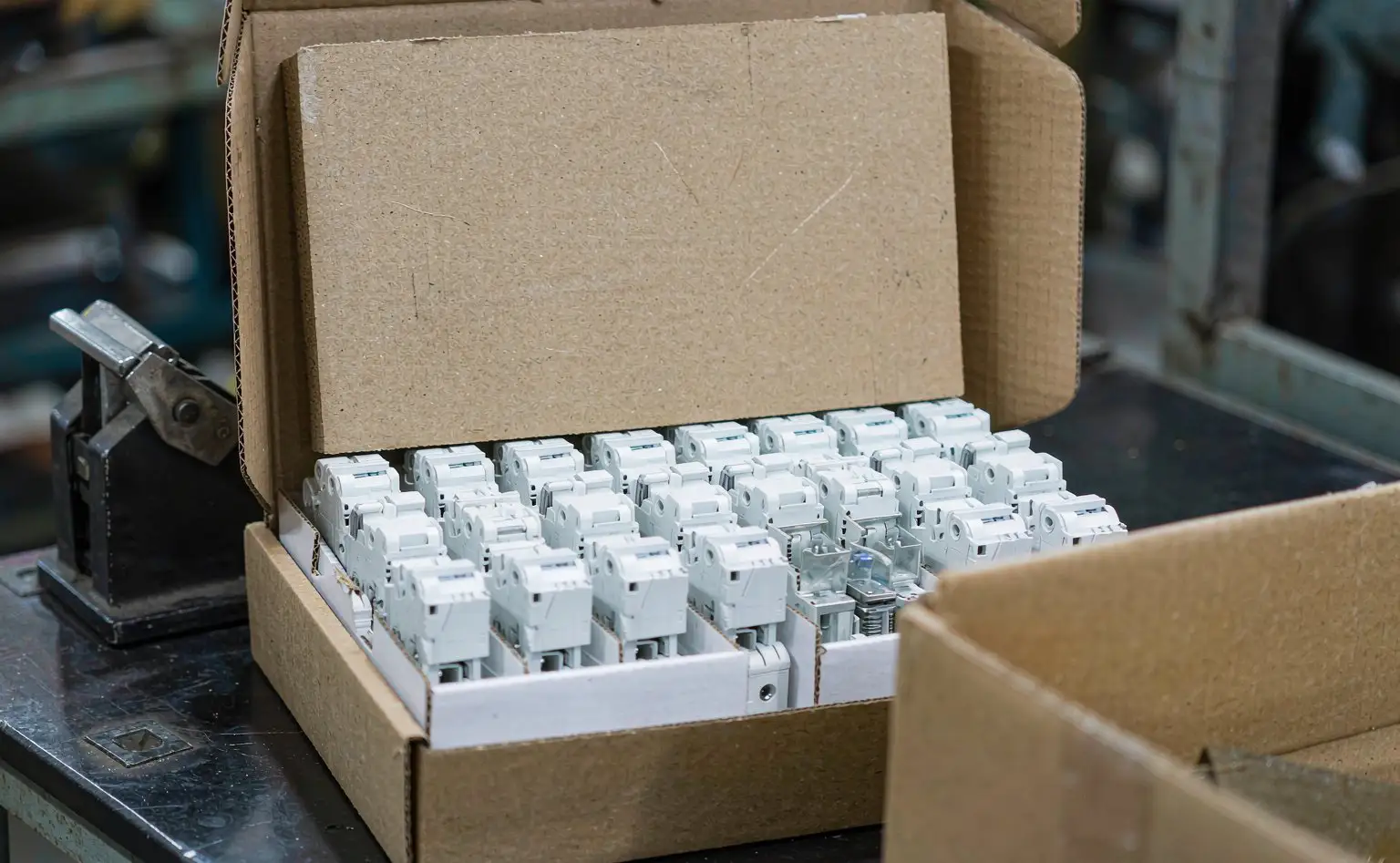
5. Packing, export and release
Trial compatibility first. Breaker shells carry print, windows, plated terminals and labels. Seal three times the normal dose with a complete unit, mist a little water, separate the sheet from the shell with paper, and inspect after a few days for faded print, a hazy window or dulled terminals. iHeir-D carries 70%±5 solids and under damp conditions it can corrode poor-quality metal, so plated parts get the trial first.
Export. Container condensation at sea is harsher than any warehouse, so leave an air path and keep cartons off the container wall; wrapping a whole pallet in film blocks the breathing that the board needs, which is best avoided in a wet season. Selection of a plastic additive is covered in masterbatch or powder, and grading of board in cartons that mould after shipping.
Release at three levels. Shells to ASTM G21 or ISO 846, sampling one parting line and one cover; cartons and dividers to GB/T 24346-2009, sampling the wall and the divider; complete units for 30 days at 30℃/85% RH, opening to check shell gaps, terminals and leaflets. Flame and electrical properties go back through UL 94, GB/T 5169.11 and GB/T 4207, one set before and one after the change, both on file.
6. Questions on carts, retests and fading
Q: With powder in the shell, can the carton skip the sheet?
No. While the unit sits sealed in the carton, mould starts in the board and the divider, and the powder in the shell never reaches that space; sheets alone leave the spots in the parting lines.
Q: Does adding powder really require a new UL retest?
Yes. The shell is a safety part, so any change in formula or additive means the flame and electrical validation is repeated, which is also what most customers and certification bodies ask for. Shipping without it puts the risk on the maker.
Q: Will the sheet fade the printing?
There is a risk, since poor inks react to the vapour; run the trial at three times the dose with paper between the sheet and the shell before sealing.
Q: Is one sheet enough, or are more safer?
Stay inside 0.1-0.2g per sheet, taking the upper figure for large cartons, many layers or long storage. Piling sheets on raises the risk of fading and terminal corrosion without adding protection.
Four points to take away: blend iHeir-JS117 into the flame-retardant shell and cover at 0.5%-1.0% of weight, trial 0.5% and 1.0% for impact, shade and flow marks, then retest to UL 94, GB/T 5169.11 and GB/T 4207; sheet the carton and divider with iHeir-D at 0.1-0.2g of active matter each after a trial at three times the dose; move shells within the shift, cool units before bagging and hold shop and store below 60% RH; leave an air path in the container and keep pallets off the floor. A 1kg powder sample and a pack of sheets go out for a trial first, with MOQ and lead time on the iHeir-JS117 product page.


