




 View Count:28
 Date:2026-11-18
Where does grinding wheel mould start? Inside the bond: dextrin, filler and wetting agent all carry water, and a cure that stops short seals it into the pores, so a pallet that passed a visual check comes back from the customer. Dose 0.8%-1.0% iHeir-IPL on the bond weight, bake the wheels until they stay dry after cooling, and lay 0.1-0.2 g iHeir-D sheets between them as they are packed. This article covers mixing order, the drying criteria and the sheet count.
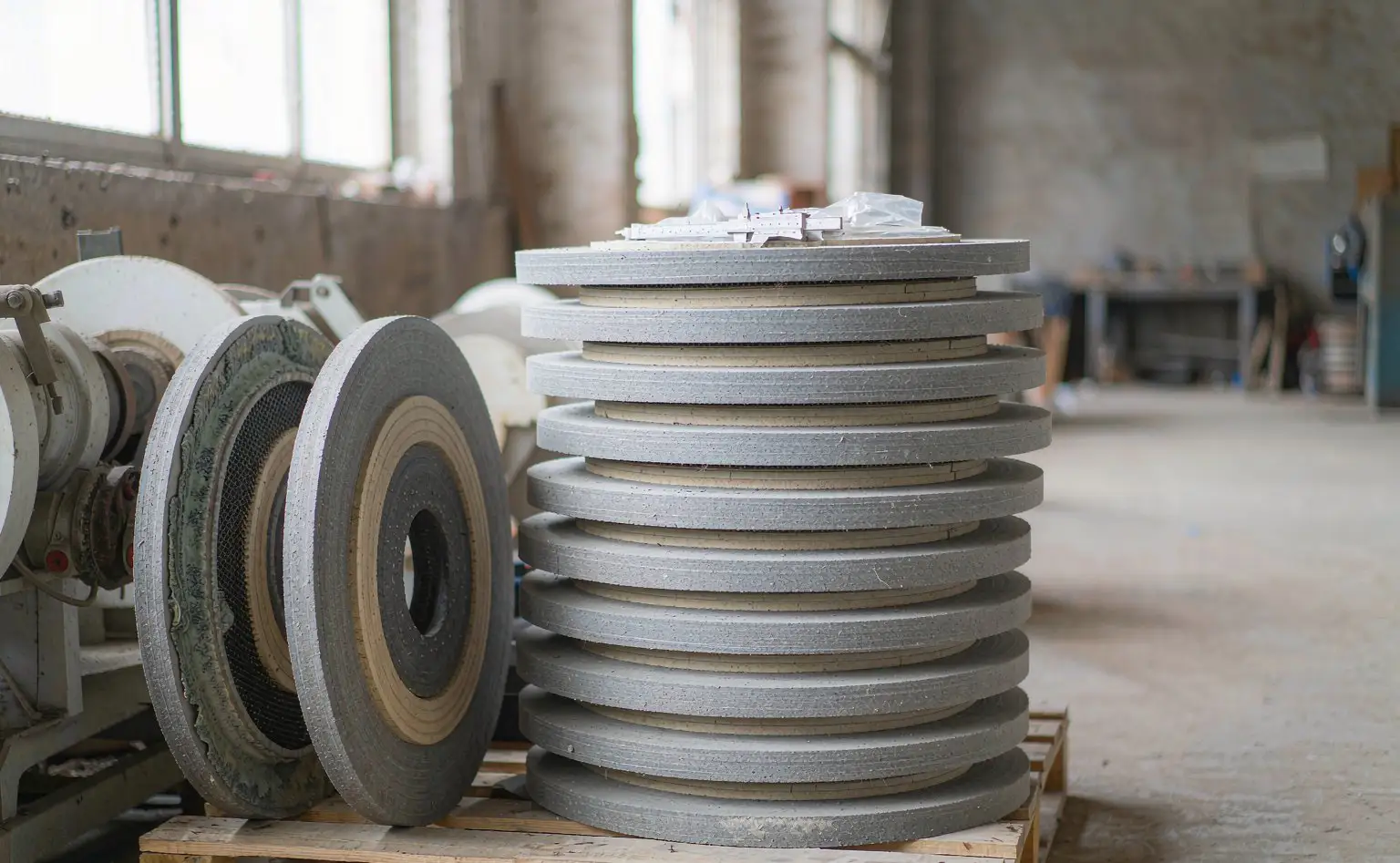
1. Where the mould comes from: bond, pores, packing and store
Brown or white aluminium oxide and silicon carbide do not grow mould; growth sits on the organic matter in the bond that micro-organisms can feed on.
The bond recipe comes first. Phenolic resin powder is the body of it, and to give the pressed body green strength the recipe often carries dextrin, starch or wood flour as a temporary binder and filler. Those are starch and cellulose materials, and at slightly raised moisture they are a ready culture medium.
The pores come second. Porosity runs from thirty to fifty per cent and the pores are connected: damp store air walks in, condenses on the pore walls, and takes a long time to leave. The face looks dry while a broken section is still damp, and that is the body that passes a visual check.
Packing and store come third. Cartons, dividers and pallets take up moisture, and wheels are heavy, so the middle of a stack gets no air. Add thirty to forty days at sea and the wall condensate settles into the bottom of the stack.
Each source needs its own answer: the water in the recipe by dosing and curing, the pores by drying and packing, the stack by the store and the container.
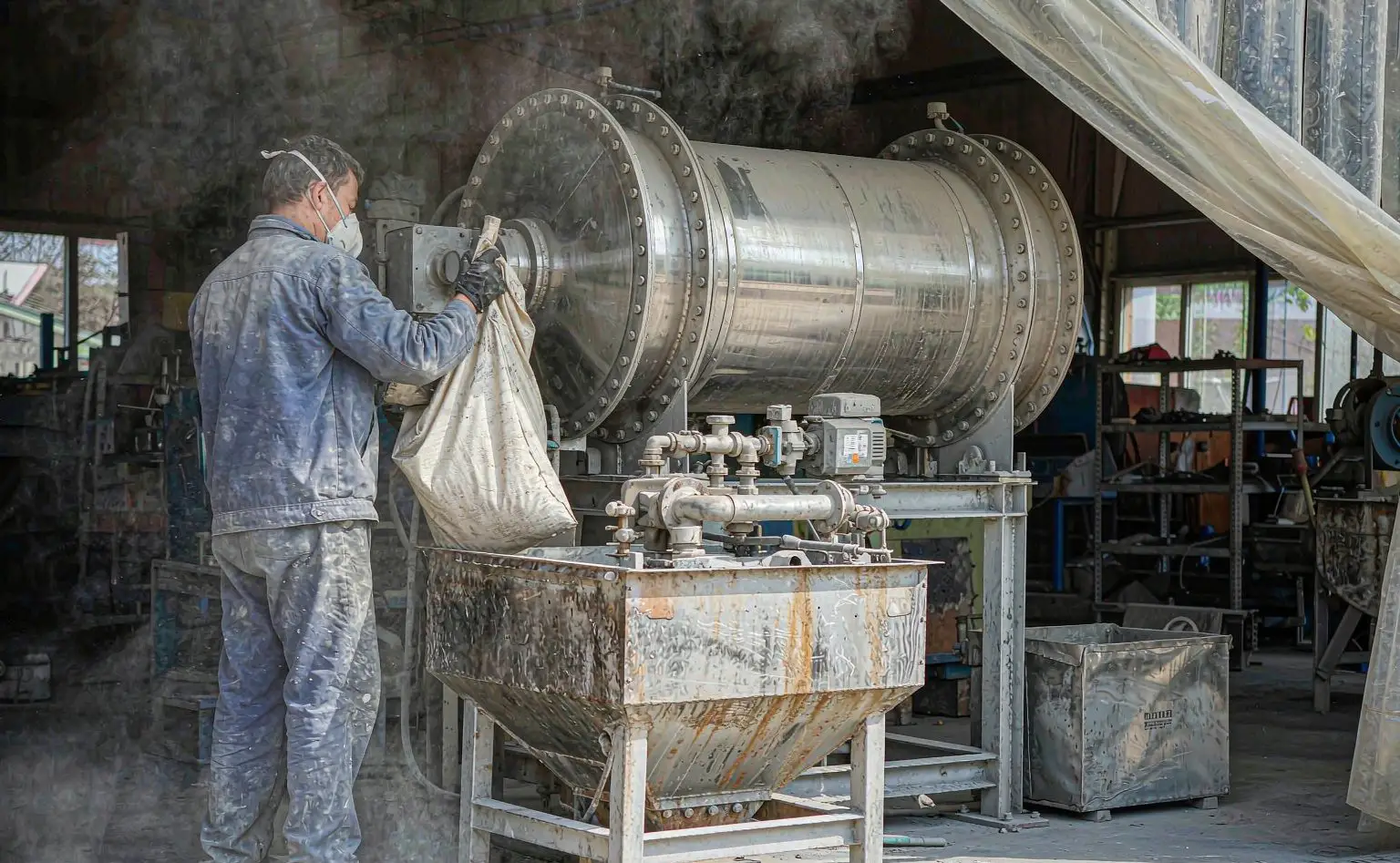
2. How the powder goes in: 0.8%-1.0%, dry-blended first
This stage has one job: get the powder dispersed in the bond instead of sitting in lumps.
Dose on the bond, not the grit. The recommended addition of iHeir-IPL is 0.8%-1.0%, taken on the combined weight of resin powder and filler. Grit is more than seventy per cent of the recipe, so dosing on grit inflates the addition about three times, which costs money and lowers bond strength.
Dry-blend before anything wet. Run the powder with the filler and dextrin for 2-3 minutes so the filler carries it apart, then add resin powder and wetting agent. Tip it into wet mix and it wets out in lumps; the pressed body then shows white specks, and those patches carry no protection at all.
Light-coloured wheels are safe. iHeir-IPL is a white powder with whiteness above 90 and a mean particle size of 1-2μm, so it leaves no colour shift in white aluminium oxide or pale resin systems.
Do not top up on a damp day. Above 1.5% the inorganic powder takes bond area away from the resin and burst strength drops, which is the wrong side of the trade.
3. Pressing and curing: bake until the wheel stays dry
Unit weight follows the grade. The additive does not change the pressing curve, so hold density to the existing grade. Pull out any wheel more than 2% off nominal, because low-density bodies with open pores take moisture first.
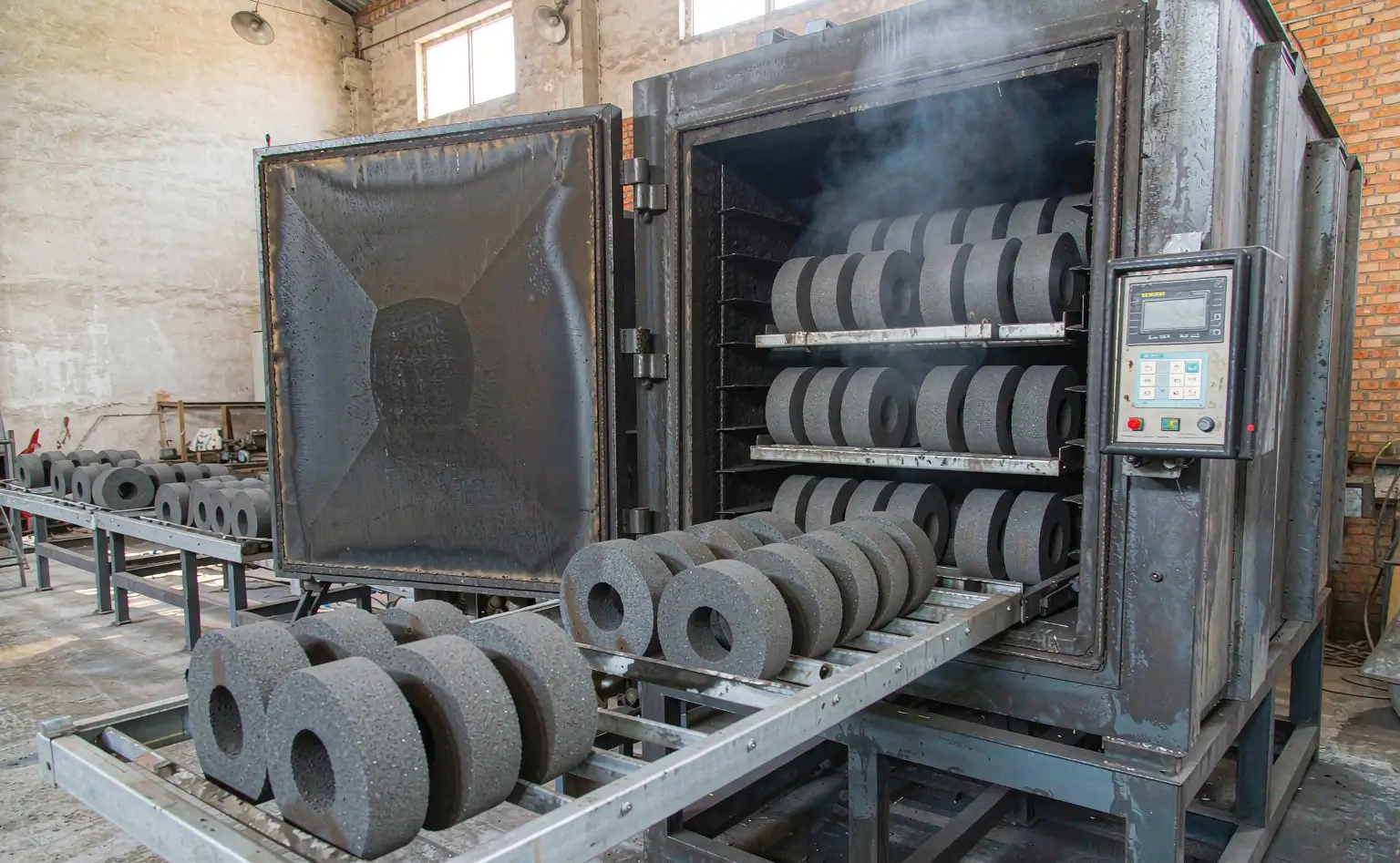
Cure in steps. Start at 60-80℃ and climb 20-30℃ at a time to a hold at 160-180℃, over 20-30 hours, the top of each range for thick and large wheels. Straight into high heat skins the outside while the vapour is still inside, so the wheel looks dry out of the kiln and is damp two days later.
Judge by the bag, not the clock. Cool a wheel to room temperature, seal it in a PE bag for two hours, and read the bag: no mist inside and no tack on the wheel means dry, mist means another pass. A hot wheel feels dry and is not.
4. Packing: a sheet between wheels, count by stack height
Wheels stack face to face, and the faces that touch are where the first spots appear.
One sheet between. Lay an iHeir-D sheet flat between wheel and wheel, each carrying 0.1-0.2 g of active ingredient, face up and unfolded. A sheet pushed into a corner of the box never reaches the contact faces.
Count by stack height. Up to five wheels, one top and one bottom; five to ten, one sheet every three wheels; above ten, keep adding one per three. Sheets stacked together lose evaporating area, so spread them.
Keep it off the printed face. Vapour-phase paper can corrode poor-quality metal in damp, so do not press it on the printed face or the metal ring of some cut-off wheels; put neutral paper in between. On thin wheels with a metal ring, bag-test at three times the dose for seven days before fixing the count.
One layer in the box, one in the case. Add a sheet at the top of each carton, and one or two in a timber case, on the upper inner wall rather than on the wheels.
| Stage | Condition | Product and level | Step | Control point |
|---|---|---|---|---|
| Bond (resin + filler) | Dry powder with dextrin | iHeir-IPL 0.8%-1.0% on bond weight | Mixing | Dry-blend with filler for 2-3 minutes |
| Wet body | Wetting agent present | No addition | Pressing | Unit weight within 2%, density by grade |
| Cured body | Warm, vapour inside | No addition | Curing and cooling | 60-180℃ in steps, 20-30 h |
| Wheel to wheel | Contact faces | iHeir-D 1 sheet per 3 wheels (0.1-0.2 g each) | Stacking | Flat, off printed face and metal ring |
| Carton and case | Board takes moisture | iHeir-D 1-2 sheets | Packing | Upper inner wall, off the wheels |
One boundary. The additive covers the organic load in the bond, the oven covers the water in the pores, the sheet covers the small air space in the packing. Drop one and the other two cannot carry the load.
5. Store and export: humidity, stacking, the container
Hold the store below 60% RH. Run a dehumidifier above 70% and log temperature and humidity at the wall so a bad lot can be traced to a bay.
Stacking and dunnage. Pallets 10 cm off the floor and 20 cm off the wall, gaps between stacks, and no stack above 1.5 m because the middle cartons get no air. Test incoming timber pallets and dry anything above 20% moisture first.
Loading out. Check the container floor and walls for moisture, line the walls with a vapour barrier and put board under the load. Add a sheet under the carton lid where sheets are already between the wheels. The bottom tier takes the wall condensate, so it gets one more sheet.
Reseal after sampling. An open carton spends the sheet early; keep samples in their own bag.
6. Questions from the line
Q: There is white bloom on a wheel, is it mould or efflorescence?
A: Wipe it with a damp cloth: bloom that comes off is efflorescence from an incomplete cure, and another pass can save it. Fuzzy spots that do not wipe off are mould; downgrade that lot.
Q: Would 1.2% iHeir-IPL be safer?
A: Not advised. 0.8%-1.0% is the recommended band, and above it the powder takes bond area from the resin. Put the margin into drying and sheeting instead.
Q: Will pale white-aluminium wheels yellow?
A: iHeir-IPL has whiteness above 90 and a 1-2μm particle size, so there is no visible shift in pale systems. What shifts colour is excess wetting agent and too hot a cure.
Q: The shop is dry in winter, can we skip the sheets?
A: No. The sheet covers the air space in the packing, and the load still crosses a sea freight and a customer warehouse.
Dose 0.8%-1.0% iHeir-IPL on the bond weight and dry-blend it with the filler for 2-3 minutes before the resin; hold unit weight within 2%; cure from 60-80℃ up to a 160-180℃ hold over 20-30 hours and judge dryness with a two-hour bag test after cooling; sheet one iHeir-D per three wheels at 0.1-0.2 g each, bag-testing metal-ring wheels at three times the dose; keep the store below 60% RH. Mould resistance can be verified to GB/T 1741 and ASTM G21, and lead times are on the iHeir-IPL product page. Comparable packing practice is in hardware tool handles and cartons and fastener carton liners and drying rods.


